Haewon Byeon
© 2026 The author. This article is published by IIETA and is licensed under the CC BY 4.0 license (http://creativecommons.org/licenses/by/4.0/).
OPEN ACCESS
This study re-examines employment retention among workers with disabilities by integrating longitudinal panel data, L2-regularized XGBoost, logistic regression, and a neutrosophic interpretation layer that makes uncertainty explicit. Using the second-wave Panel Survey of Employment for the Disabled in Korea from 2016 to 2020, the analysis evaluated 75 candidate predictors spanning demographic, human-capital, and workplace domains. The respondent-level analytic cohort comprised 3,907 individuals observed at the 2020 follow-up, and model splitting was grouped by respondent identifier to avoid longitudinal data leakage. L2-regularized XGBoost identified six variables as the most influential for retention: age, household economic level, subjective health status, degree of disability, type of disability, and education level. Comparative evaluation showed that the explicitly tuned regularized boosting model outperformed CART, GBM, and default XGBoost in accuracy, F1-score, and AUC, indicating better generalization under complex nonlinear conditions. Logistic regression confirmed that higher education, better household economic status, better subjective health, milder disability, and non-physical disability type were positively associated with job retention, whereas increasing age lowered the likelihood of continued employment. The neutrosophic framework clarified how supportive signals, contradictory evidence, and contextual ambiguity coexist in disability-employment data. The findings support policy strategies that combine education, health support, income security, workplace accommodation, and age-sensitive retention interventions to advance sustainable labour-market inclusion.
disability, employment retention, labour-market inclusion, longitudinal data, machine learning, neutrosophic logic, policy modeling, XGBoost
Employment retention among persons with disabilities is not only a labour-market outcome; it is also a sustainability issue that links decent work, reduced inequality, household resilience, social participation, and the long-term effectiveness of welfare systems. Entry into employment is important, but sustainable development requires more than initial placement. It requires the capacity to remain employed under changing health conditions, organisational demands, and family circumstances. When employment is unstable, the consequences extend beyond wages. Job disruption can weaken self-sufficiency, limit social networks, increase dependence on public support, and reinforce social exclusion. For these reasons, employment retention has become an essential dimension of inclusion-oriented policy design [1, 2].
Workers with disabilities continue to encounter multiple barriers across the employment cycle. Studies have described employer concerns, inaccessible work environments, limited accommodation, discriminatory attitudes, and restricted promotion opportunities as recurring obstacles to labour-market participation [3, 4]. These barriers do not end after a worker is hired. In many cases, they become more visible during employment because job retention depends on whether the workplace can adapt to fluctuating health, rehabilitation needs, assistive technology requirements, and changes in role expectations. Retention is therefore shaped by a combination of individual capability, accumulated human capital, and the capacity of institutions and employers to provide flexible support.
Earlier studies on disability employment have shown that demographic factors such as age, education, income, and health status are closely associated with labour-market outcomes [5, 6]. Workplace factors also matter. Wage level, enterprise size, discrimination during recruitment or after hiring, and job satisfaction influence whether employees remain in a job or leave involuntarily [7, 8]. Yet the determinants of retention rarely operate in a simple linear fashion. Education can buffer the effect of disability severity; health can interact with age; and the implications of household economic status can differ according to whether a worker has access to services, transport, or rehabilitation resources. A methodological challenge therefore arises: the most policy-relevant signals may be hidden within nonlinear interactions and uncertain measurement structures.
Traditional regression-based analyses remain valuable, but they can understate interactions in high-dimensional labour datasets. In longitudinal disability research, this becomes especially problematic because employment is affected by dynamic changes in health, household resources, and workplace environments over time [9, 10]. Machine-learning approaches are increasingly used to address this complexity because they can detect nonlinear relationships and rank predictor importance without requiring all interactions to be specified in advance [11, 12]. Among these approaches, XGBoost has shown robust performance in classification tasks involving many candidate predictors and possible overfitting [13, 14]. When combined with regularization, it becomes particularly useful for policy-oriented modelling in which predictive strength must be balanced against stability and interpretability.
At the same time, even strong predictive models leave an important question unresolved: how should uncertainty itself be interpreted? Disability-employment data frequently contain ambiguity arising from subjective self-report, changing work conditions, and heterogeneous disability categories. Neutrosophic logic offers a useful conceptual response because it extends binary and fuzzy reasoning by simultaneously representing truth, falsity, and indeterminacy [15-19]. In the context of employment retention, this means that a factor can support retention for some workers, weaken it for others, and remain ambiguous in still other contexts. A modelling framework that acknowledges this coexistence is especially valuable for social and public-health applications where crisp classification alone may conceal meaningful uncertainty.
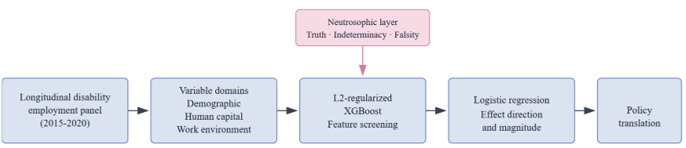
The present study was designed to integrate these two perspectives. Using longitudinal panel data on Korean workers with disabilities, it combines L2-regularized XGBoost for feature screening, logistic regression for interpretable effect estimation, and neutrosophic logic for uncertainty-sensitive interpretation. The analytical workflow is summarized in Figure 1. This design allows the study to answer three linked questions. First, which factors most strongly predict employment retention among workers with disabilities? Second, does L2-regularized XGBoost perform better than other common prediction models in this domain? Third, how can neutrosophic reasoning improve the interpretation of disability-employment dynamics by distinguishing supportive evidence from contradiction and indeterminacy?
Figure 1. Analytical workflow integrating panel data, machine learning, neutrosophic logic, and policy translation
This study makes three contributions. Empirically, it identifies a compact set of six high-value predictors from 75 variables. Methodologically, it demonstrates the complementary value of regularized boosting, conventional regression, and neutrosophic interpretation within one framework. Practically, it translates the results into policy directions for education, health support, income security, workplace accommodation, and age-sensitive retention services.
Compared with earlier Korean disability-employment studies that primarily examined isolated workplace facilities, job satisfaction, or single-equation panel associations, the present study advanced the literature in four specific ways: it focused on the coherent 2016-2020 PSED follow-up window, screened a broader set of 75 predictors, compared multiple classification algorithms under grouped validation, and translated the strongest empirical signals into a neutrosophic truth-indeterminacy-falsity framework for policy interpretation.
Research on disability and employment has consistently shown that retention is shaped by more than medical condition alone. A recurring theme is that disability operates through social and institutional pathways as much as through functional limitation. Labour-market attachment depends on the fit between worker capacity, workplace design, managerial attitudes, transport access, household resources, and public support systems [20, 21]. For this reason, the same disability category may produce very different employment trajectories depending on economic context and employer response. Studies of workers with disabilities have therefore argued that sustainable employment requires coordinated support across recruitment, job matching, accommodation, supervision, and career development [4, 7, 22-27].
Education remains one of the most consistent predictors of favourable employment outcomes. Higher educational attainment usually improves access to less physically demanding occupations, expands job-search networks, and strengthens adaptability when occupational tasks change. In the disability context, education can also reduce employer uncertainty by signalling trainability and competence more strongly than inferences based on disability status. Research on disabled graduates and other vulnerable job seekers has shown that training and qualification are strongly associated with employability and continued labour-force participation [12, 27]. However, the benefit of education is not uniform; it can be moderated by age, health decline, or sector-specific requirements. This suggests that the influence of education should be interpreted alongside other human-capital and workplace variables rather than in isolation.
Health and household economic conditions also play central roles in employment maintenance. A worker with better self-rated health may have more consistent attendance, lower fatigue, and greater capacity to cope with routine demands, but the effect is also partly social. Better health often implies better access to treatment, stronger psychological well-being, and lower exposure to repeated job disruption. Household economic stability can function as both a resource and a constraint. On one hand, it may provide transport, rehabilitation, digital tools, or family support that helps the worker remain employed. On the other hand, economic precarity may intensify the negative consequences of workplace discrimination or unstable contracts [6, 28]. The literature therefore supports a multidimensional approach in which health and economic variables are interpreted as components of broader labour-market resilience.
Age deserves special consideration. As workers with disabilities grow older, they may face a dual disadvantage produced by disability-related barriers and age-related exclusion [4, 29]. Functional changes can accumulate, retraining opportunities may narrow, and employers may have weaker incentives to invest in accommodation or career development for older employees. For some workers, age is also linked to increased mismatch between previously acquired skills and new technological requirements. Thus, even when older workers possess valuable experience, their retention may be threatened if labour markets fail to adapt. This problem is especially important in societies experiencing demographic ageing, because employment instability among older disabled workers can create long-term economic and health burdens at both family and population levels.
Recent studies have explored machine-learning approaches to employment prediction because labour-market data frequently involve numerous correlated predictors and nonlinear effects. Boosting algorithms, including gradient boosting and XGBoost, are particularly attractive because they iteratively improve classification by focusing on residual error while handling mixed variable structures efficiently [11-14]. In studies of employability, turnover, and health-related outcomes, these methods have outperformed simpler decision trees or conventional models when predictor interactions are strong. Regularization is a critical feature in this setting because high-dimensional social data often contain noisy or partially redundant variables. L2 regularization shrinks overly complex solutions, thereby reducing variance and improving generalization when the goal is not only to fit the observed sample but also to produce a stable model for broader policy interpretation.
Nevertheless, predictive accuracy alone is insufficient in disability studies. Social-policy decisions require not only knowledge of which variables matter, but also an account of uncertainty. This is where neutrosophic logic becomes relevant. Unlike conventional binary logic, and even unlike standard fuzzy logic, neutrosophic logic explicitly distinguishes truth, falsity, and indeterminacy as separate components of knowledge [15-19]. In applied settings, this means that evidence can support a proposition while also containing contradictory and ambiguous aspects. In health data, image analysis, and complex classification tasks, this framework has been used to handle incomplete and uncertain information more flexibly than crisp decision rules [20, 21, 24].
The social relevance of neutrosophic logic is especially strong when the data reflect lived circumstances that cannot be perfectly represented by one measured value. By allowing indeterminacy to remain visible rather than forcing it into a single probability score, neutrosophic reasoning can complement machine learning and statistical modelling in social epidemiology, labour analysis, and public-health planning.
Despite these advances, three gaps remain in the literature. First, few studies combine high-performing machine-learning models with an explicit uncertainty framework when analysing disability employment. Second, employment retention has received less methodological attention than employment entry or unemployment status, even though retention is a more direct measure of sustainable inclusion. Third, many analyses focus on either prediction or interpretation, rather than building a workflow in which predictive modelling identifies salient features and interpretable models translate them into actionable policy knowledge. The present study addresses these gaps by integrating regularized boosting, logistic regression, and neutrosophic reasoning within one longitudinal disability-employment framework.
The novelty therefore did not rest only on applying XGBoost to labour-market data. It lay in connecting a Korean disability-employment panel, a leakage-aware model-validation design, an interpretable post-selection regression step, and a neutrosophic uncertainty layer that distinguished stable retention evidence from contextual ambiguity. This clearer positioning was added to separate the contribution from prior studies using similar PSED data.
3.1 Study design and data source
This study used a longitudinal secondary-analysis design to investigate employment retention among working-age persons with disabilities. Longitudinal analysis is well suited to retention research because it allows employment outcomes to be understood as sustained processes rather than one-time events. The analytic workflow is summarized in Figure 1. The process began with a broad candidate feature pool, followed by predictive modelling with L2-regularized XGBoost, comparative evaluation against alternative classifiers, and interpretive modelling with logistic regression. A neutrosophic layer was then applied to translate the findings into an uncertainty-sensitive conceptual framework.
The data source was the second-wave Panel Survey of Employment for the Disabled (PSED), a nationally organised Korean panel administered by the Korea Employment Agency for Persons with Disabilities and the Employment Development Institute [10]. The analysis used the 2016-2020 waves because they provide a coherent longitudinal cohort with harmonised variables for employment status, disability characteristics, health, household resources, and work environment. The source wave counts were 4,577 respondents in 2016, 4,214 in 2017, 4,104 in 2018, 3,995 in 2019, and 3,907 in 2020. After retaining respondents who had follow-up information through the 2020 wave and imputing non-outcome predictor missingness within the training folds, the final respondent-level analytic cohort comprised 3,907 individuals. The analysis was therefore based on one analytic record per respondent and a final binary retention outcome, rather than an ungrouped pooled person-year file.
The inclusion and exclusion process was clarified as follows. First, respondents had to be registered persons with disabilities in the PSED cohort and within the working-age range covered by the survey. Second, respondents had to have usable employment-status information for constructing the retention outcome. Third, observations with missing outcome information at the follow-up endpoint were excluded, whereas missing values in candidate predictors were handled by fold-specific imputation rather than by deleting additional respondents. Fourth, when the machine-learning models were trained and tested, all records associated with the same respondent identifier were assigned to the same data split. This grouped split prevented information from the same individual from appearing simultaneously in training and testing data, thereby reducing longitudinal data leakage.
3.2 Outcome and predictor measurement
The primary outcome was employment retention, operationalised as a respondent-level final binary outcome. Respondents who maintained employment through the follow-up endpoint were coded as retained employment (=1), whereas those who reported resignation, non-retention, or transition out of the observed job during the follow-up window were coded as non-retention (=0). The classification task was therefore closer to a baseline-to-follow-up retention prediction than to a repeated person-year hazard model. This definition matched the objective of identifying workers at elevated risk of not sustaining employment and avoided treating repeated waves from the same individual as independent observations.
A total of 75 candidate predictors were screened. These variables were drawn from three domains: demographic structure, human capital, and the employment environment. Demographic variables included sex, age, household economic level, subjective health status, disability type, and disability severity. Human-capital variables included years of schooling, highest degree obtained, vocational certification status, and recent exposure to employment services. Employment-environment variables included wage level, firm size, job satisfaction, and experiences of discrimination during job search and in the workplace. Continuous variables with marked skewness, such as wage and firm size, were log transformed, categorical predictors were one-hot encoded, and predictor missingness was handled by median imputation for continuous variables and mode imputation for categorical variables within the training data. The same imputation parameters learned from the training set were then applied to the validation and test sets to prevent information leakage. Table 1 summarises the major variable domains and the operational logic used in the analysis.
Table 1. Candidate predictor domains and operational definitions
|
Domain |
Variable |
Operationalization |
Interpretive Relevance |
|
Demographic |
Age |
Years; increasing values indicate older working age |
Captures aging-related retention vulnerability and adaptation need |
|
Demographic |
Household economic level |
Basic living support recipient vs. non-recipient; higher level interpreted as greater economic stability |
Represents material resources that can buffer employment disruption |
|
Demographic |
Subjective health status |
Four-point Likert scale; higher scores denote better perceived health |
Reflects functional stamina, confidence, and health burden at work |
|
Demographic |
Disability type |
Panel classification covering physical and non-physical external disability categories |
Indicates heterogeneity in accommodation needs and labour-market barriers |
|
Demographic |
Degree of disability |
Severe vs. mild according to panel classification |
Represents functional burden and the need for environmental adaptation |
|
Human capital |
Education level |
Years of schooling and highest degree; high-school graduate or above used in the final model |
Signals trainability, job mobility, and access to stable occupations |
|
Human capital |
Certification and employment services |
Vocational certification status and employment-service experience within the last five years |
Reflects formal skill development and institutional support exposure |
|
Employment environment |
Monthly wage and firm size |
Log transformed to reduce skewness |
Capture labour-market position and organisational resource context |
|
Employment environment |
Discrimination and job satisfaction |
Experiences during job search and in the workplace; overall satisfaction scored on a five-point scale |
Reflect workplace climate and the sustainability of continued employment |
3.3 Neutrosophic representation of uncertainty
Neutrosophic logic was introduced as an interpretive framework rather than as a standalone classifier. In this study, the employment-retention state associated with a predictor profile x was represented conceptually as a neutrosophic triplet,
$E(x)=<T(x), I(x), F(x)>$ (1)
where, T(x) denotes the degree to which the available evidence supports retention, I(x) denotes indeterminacy arising from ambiguity, heterogeneity, or measurement uncertainty, and F(x) denotes the degree to which the evidence supports non-retention. The three components were not constrained to collapse into a single crisp value. This is important in disability-employment research because the same measured predictor may imply different mechanisms across disability types, age groups, and workplace settings. This tripartite logic is later used to interpret the six strongest predictors identified by the machine-learning model.
In practical terms, the neutrosophic layer served three functions. First, it prevented the interpretation from reducing all predictors to a single positive or negative score. Second, it highlighted where contextual ambiguity is likely to remain even after statistical modelling, such as when subjective health or disability type captures only part of the lived employment burden. Third, it made the policy discussion more realistic by distinguishing robust signals from areas that require flexible or individualised intervention. The objective was therefore not to replace statistical inference, but to supplement it with an explicit vocabulary of uncertainty.
3.4 L2-regularized XGBoost and statistical validation
To model complex relationships among the 75 candidate predictors, the study employed an explicitly tuned L2-regularized Extreme Gradient Boosting (XGBoost) classifier. XGBoost already contains regularization terms in its objective function; therefore, the term L2-regularized XGBoost in this paper referred to a model in which the L2 penalty parameter lambda and tree-complexity controls were deliberately tuned and interpreted as central design choices. By contrast, the conventional XGBoost comparator used the same boosting framework but retained default or minimally tuned regularization settings. This distinction was added to avoid implying that regularization was absent from ordinary XGBoost.
The objective function of XGBoost can be written as
$L(p h i)=\sum_i l\left(y_i, \hat{\mathrm{y}}_j\right)+\sum_k \Omega\left(f_k\right)$ (2)
where, l denotes the loss function, fk is the k-th tree in the ensemble, and Ω(fk) is the regularization penalty. For a given tree with T leaves and leaf weights wj, the penalty term is defined as
$\Omega(f)=\gamma T+(\lambda / 2) \Sigma_{j=1}^T w_j^2$ (3)
where, γ penalises the number of leaves and λ is the L2 regularization parameter. During each boosting iteration, a new tree is added on the basis of first- and second-order derivatives of the loss function. Using the standard second-order approximation, the optimal leaf weight can be estimated by
$w *_j=-\left(\Sigma_{i \in I_j} g_i\right) /\left(\Sigma_{i \in I_j} h_i+\lambda\right)$ (4)
where, Ij denotes the set of observations assigned to leaf j, and gi and hi are the first and second derivatives of the loss with respect to the current prediction. This formulation makes XGBoost computationally efficient while also enabling regularized learning. The practical modelling sequence used in the study was initial prediction setting, gradient and Hessian calculation, tree growth based on regularized gain, leaf-weight estimation, and iterative prediction update using a learning rate. By combining shrinkage and regularization, the model can detect strong predictors while limiting the risk that the final ranking reflects noise.
Model performance was evaluated using accuracy, precision, recall, F1-score, and AUC. The data were divided into an 80% training set and a 20% test set using outcome stratification and respondent-identifier grouping. Hyperparameter selection used five-fold grouped cross-validation with random seed 2026. The tuning grid was n_estimators {100, 200, 300}, max_depth {3, 4, 5}, learning_rate {0.03, 0.05, 0.10}, subsample and colsample_bytree {0.70, 0.80, 1.00}, gamma {0, 0.10, 0.30}, min_child_weight {1, 3, 5}, and reg_lambda {1, 3, 5, 10}. The final model used n_estimators = 300, max_depth = 3, learning_rate = 0.05, subsample = 0.80, colsample_bytree = 0.80, gamma = 0.10, min_child_weight = 1, reg_lambda = 5, reg_alpha = 0, objective = 'binary:logistic', and eval_metric = 'auc'. The conventional XGBoost comparator used the same split and metrics but retained the default regularization emphasis, including reg_lambda = 1 and gamma = 0.
After machine-learning feature screening, a multiple logistic regression model was fitted using the six variables identified by L2-regularized XGBoost. Feature importance was defined as normalized mean gain averaged across the grouped cross-validation folds, rather than as simple split frequency or raw coefficient size. Logistic regression then served as a transparent complementary model because it provided effect direction, odds ratios, and 95% confidence intervals for the selected predictors.
Because the study used de-identified secondary national data, institutional review board approval was exempted under the applicable regulations for anonymised secondary analysis. In the original panel, informed consent had been obtained from participants, and the data collection procedures were reported as consistent with the ethical principles of the Helsinki Declaration and subsequent revisions. The present analysis used only anonymised records and did not involve contact with human participants.
4.1 Variable importance and model performance
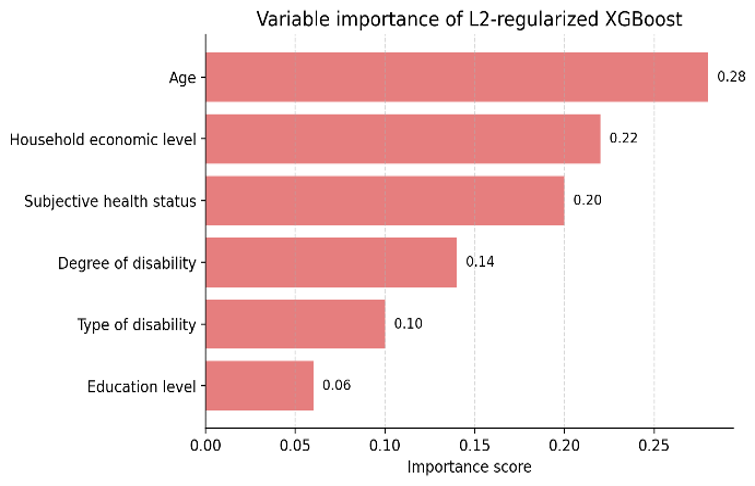
The first substantive result concerns the structure of predictor importance identified by the L2-regularized XGBoost model. Among the 75 candidate variables, six emerged as the most influential for employment retention: age, household economic level, subjective health status, degree of disability, type of disability, and education level. Figure 2 presents the importance ranking. Age displayed the largest importance score, indicating that retention risk changes meaningfully across the age profile of workers with disabilities. Household economic level and subjective health status followed closely, suggesting that retention is shaped not only by formal labour-market characteristics but also by the broader material and health conditions under which employment is sustained.
Figure 2. Variable importance of L2-regularized XGBoost
The remaining three predictors also convey an important pattern. Degree of disability and type of disability show that impairment-related structure still matters after demographic and socioeconomic considerations are introduced. However, their importance scores were lower than those for age, household economy, and health, implying that disability-specific characteristics do not act in isolation. Education level, although ranked sixth, remained within the compact group of dominant predictors and later emerged as the strongest positive correlate in the logistic model. Taken together, the ranking supports a multidimensional interpretation of retention in which socioeconomic, health, and disability characteristics interact rather than form separate explanatory blocks.
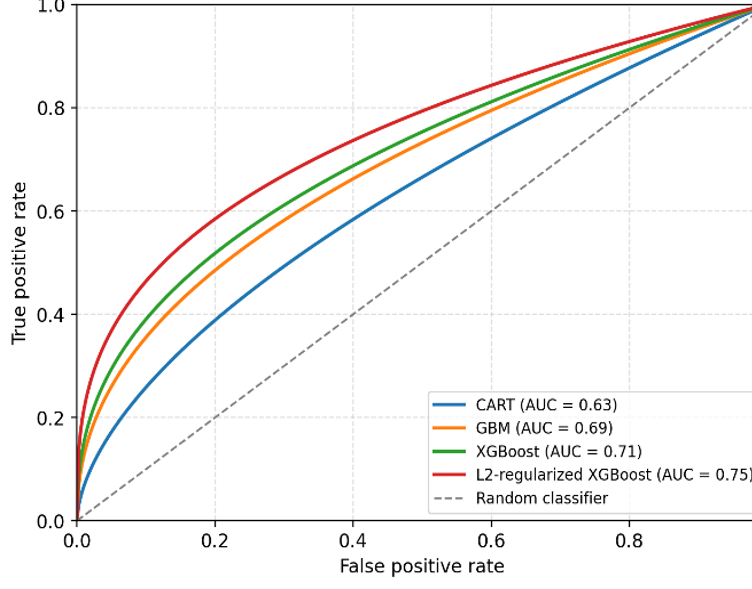
Comparative predictive evaluation is reported in Table 2 and visualised in Figure 3. CART achieved the weakest performance, with an accuracy of 0.61 and an AUC of 0.63. This result is unsurprising because simple tree models are highly interpretable but often struggle when the target depends on nonlinear interactions dispersed across many variables. GBM improved substantially over CART, reaching an accuracy of 0.68 and an AUC of 0.69. Conventional XGBoost produced a further gain, with an accuracy of 0.70 and an AUC of 0.71. The best performance was obtained by L2-regularized XGBoost, which achieved an accuracy of 0.74, precision of 0.72, recall of 0.71, F1-score of 0.72, and AUC of 0.75.
Table 2. Model performance comparison
|
Model |
Accuracy |
Precision |
Recall |
F1-Score |
AUC |
|
CART |
0.61 |
0.57 |
0.55 |
0.56 |
0.63 |
|
GBM |
0.68 |
0.65 |
0.63 |
0.64 |
0.69 |
|
XGBoost |
0.70 |
0.67 |
0.66 |
0.66 |
0.71 |
|
L2-regularized XGBoost |
0.74 |
0.72 |
0.71 |
0.72 |
0.75 |
Figure 3. ROC curves for CART, GBM, XGBoost, and L2-regularized XGBoost
These differences are not merely technical. In disability-employment policy, a model that generalises more effectively is important because decision support is often applied to populations that are heterogeneous and exposed to rapid contextual change. The superiority of the regularized model indicates that penalising complexity helped the algorithm avoid learning unstable patterns from the high-dimensional predictor set. The improvement in AUC also suggests that the model discriminates more consistently between workers who remain employed and those who do not, even when decision thresholds vary.
4.2 Logistic regression findings
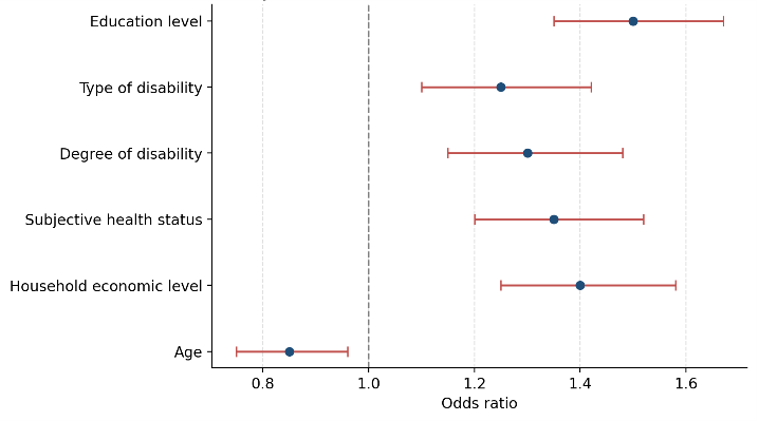
To make the predictor effects more interpretable, the six variables selected by L2-regularized XGBoost were entered into a multiple logistic regression model. The estimates are shown in Table 3 and Figure 4. Education level had the largest positive effect. Workers with at least high-school graduation had 1.50 times the odds of retention compared with their lower-education counterparts (95% CI: 1.35-1.67, p = 0.005). This result indicates that education is not simply a background characteristic. It likely improves retention through occupational flexibility, stronger communication with employers, and better access to less precarious jobs.
Figure 4. Adjusted odds ratios with 95% confidence intervals
Table 3. Multiple logistic regression results for key variables
|
Variable |
Odds Ratio |
95% CI |
p-Value |
Interpretation |
|
Age |
0.85 |
0.75-0.96 |
0.006 |
Negative association with retention |
|
Household economic level (good) |
1.40 |
1.25-1.58 |
<0.001 |
Positive association |
|
Subjective health status (good) |
1.35 |
1.20-1.52 |
<0.001 |
Positive association |
|
Degree of disability (mild) |
1.30 |
1.15-1.48 |
0.004 |
Positive association |
|
Type of disability (non-physical) |
1.25 |
1.10-1.42 |
0.015 |
Positive association |
|
Education level (high school or above) |
1.50 |
1.35-1.67 |
0.005 |
Strongest positive association |
Household economic level and subjective health status also showed substantial positive effects. A favourable household economic level was associated with an odds ratio of 1.40 (95% CI: 1.25-1.58, p < 0.001), while better subjective health status yielded an odds ratio of 1.35 (95% CI: 1.20-1.52, p < 0.001). These findings suggest that job retention is inseparable from the worker's broader life conditions. Stable household resources can support transport, treatment adherence, assistive devices, and stress buffering, all of which may help an employee remain employed. Likewise, better perceived health can improve work attendance, stamina, and confidence in workplace performance.
Disability severity and disability type retained independent significance after adjustment. Workers classified as having milder disability had 1.30 times the odds of retention (95% CI: 1.15-1.48, p = 0.004), while workers with non-physical disability type showed an odds ratio of 1.25 (95% CI: 1.10-1.42, p = 0.015). These estimates do not imply that one disability group is intrinsically suited to work and another is not. Rather, they indicate that the present labour market remains uneven in its capacity to accommodate diverse functional needs. In a more accessible labour system, the effect sizes related to disability category would likely diminish.
Age was the only negative predictor among the final six variables. The odds ratio for age was 0.85 (95% CI: 0.75-0.96, p = 0.006), showing that the probability of retention declines as age increases. This result is especially important because age was also the most influential predictor in the machine-learning ranking. The convergence of these two models suggests that aging within the disabled workforce is not a marginal issue. It is a central structural challenge for sustainable employment retention.
4.3 Neutrosophic interpretation of determinant structure
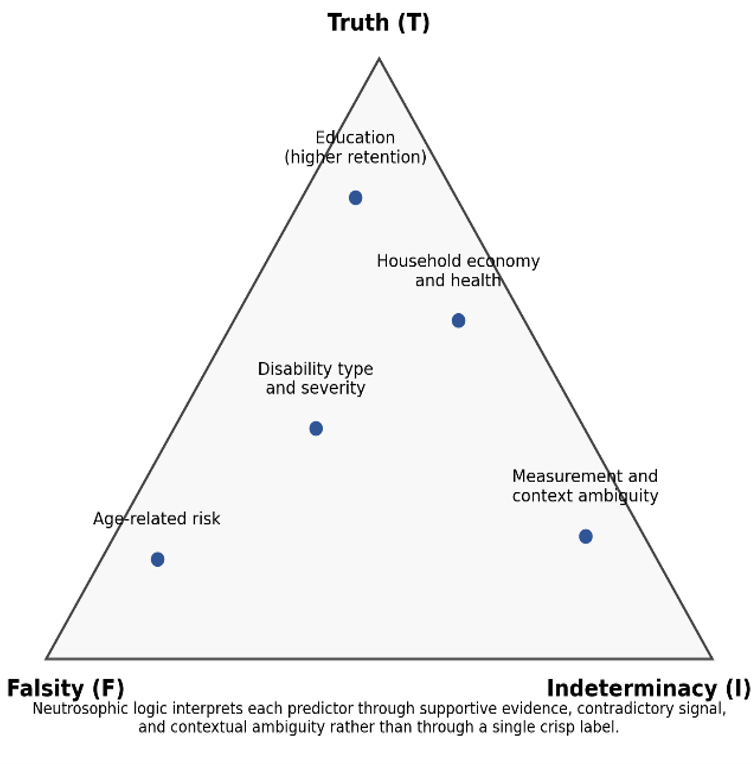
The neutrosophic interpretation adds a further layer to these results. Figure 5 illustrates how the major predictors can be understood through the simultaneous lenses of truth, falsity, and indeterminacy. Education is positioned relatively close to the truth pole because both the boosting model and the logistic model identify it as a stable positive signal for retention. Household economic level and health also lean toward truth, but with more visible indeterminacy because their practical meaning depends on service access, family support, benefit structures, and the dynamic relation between self-rated health and work demands.
Figure 5. Neutrosophic interpretation of the principal employment-retention predictors
Age-related risk lies closer to the falsity pole because increasing age reduces the odds of retention and appears to reflect a structurally adverse labour-market signal. However, the neutrosophic framework prevents this from being interpreted deterministically. Some older workers remain highly employable if their jobs are adaptable, if retraining is available, and if employers invest in accommodation. Disability type and severity occupy a middle position because they contain both true supportive signals and significant uncertainty: formal disability categories only partly represent the lived interaction between impairment, environment, and work-task design.
Table 4 translates this logic into a policy-oriented interpretation. The table does not present additional empirical coefficients. Instead, it organises the empirical findings into a neutrosophic matrix that distinguishes supportive evidence, contextual ambiguity, and countervailing risk for each key predictor. This translation is important because sustainable policy requires more than identifying which variables are statistically significant. It requires understanding where standardised intervention is appropriate and where tailored support remains necessary.
Table 4. Neutrosophic interpretation matrix and policy translation
|
Predictor |
Truth Signal |
Indeterminacy Source |
Falsity/Constraint Signal |
Policy Implication |
|
Education level |
Consistent positive predictor of retention |
Returns differ by occupation and age |
Low education can restrict job mobility |
Expand adult education, digital skills, and credential pathways |
|
Household economic level |
Material stability supports continuity in work |
May proxy family resources, transport, or benefit structure |
Economic insecurity amplifies exit risk |
Coordinate retention policy with income and transport support |
|
Subjective health |
Better perceived health supports attendance and role performance |
Self-rating may not fully capture fluctuating symptoms |
Poor health can trigger repeated disruption |
Integrate rehabilitation and health management with work support |
|
Degree of disability |
Milder impairment linked with higher retention in current labour conditions |
Administrative severity categories may miss environmental barriers |
Severe disability may increase mismatch where accommodation is weak |
Strengthen workplace adaptation and assistive-technology support |
|
Type of disability |
Some non-physical categories show better retention in the observed system |
Functional consequences vary widely within categories |
Physical barriers remain strong in inaccessible workplaces |
Target universal design and task redesign across disability groups |
|
Age |
A minority of older workers remain stable when support is strong |
Age effects depend on retraining and job redesign opportunities |
Average age increase lowers retention probability |
Adopt age-sensitive accommodation and retention services |
This study set out to improve the analysis of employment retention among workers with disabilities by combining predictive modelling and uncertainty-sensitive interpretation. The findings show that retention is shaped by a compact but multidimensional set of variables: age, household economic level, subjective health status, degree of disability, type of disability, and education level. The convergence between L2-regularized XGBoost and logistic regression strengthens confidence in these results. The machine-learning model efficiently screened a large predictor set and identified the most informative variables, while logistic regression clarified the direction and magnitude of their effects. This dual strategy is particularly useful for social-policy research because it balances predictive performance with interpretability.
The discussion explicitly compared these results with recent PSED-based and disability-employment studies. Prior Korean studies have shown that workplace facilities, job satisfaction, work environment, and health-related distress are closely related to retention-oriented outcomes among workers with disabilities [5, 6, 9]. The present findings were consistent with those studies but extended them by treating retention as a prediction-and-interpretation problem rather than as a single regression association.
One of the clearest substantive findings is the central importance of education. In the variable-importance ranking, education remained among the top six predictors, and in the logistic regression it emerged as the strongest positive correlate of retention. This result aligns with prior work emphasising the role of education in employability and sustainable labour outcomes for persons with disabilities [25-27]. Education likely operates through several pathways. It can increase access to jobs with more stable contracts and lower physical strain, improve problem-solving and communication in the workplace, and make occupational mobility more feasible when one job becomes unsuitable. In addition, educational attainment may reduce employer uncertainty by providing a visible signal of competence. From a policy perspective, this suggests that educational inequality remains a retention issue well beyond school age. Adult education, continuing vocational training, digital-skills programmes, and supported transition pathways may all contribute to stronger retention among disabled workers.
The strong effects of household economic level and subjective health status highlight the need to view employment retention as embedded within everyday life conditions rather than as a narrowly occupational phenomenon. Good household economic status was associated with higher odds of remaining employed, and better subjective health showed a similarly positive pattern. These findings are consistent with broader evidence linking economic precarity and poor health to unstable labour-market attachment [6, 28]. In practical terms, a worker's ability to maintain employment often depends on resources outside the formal workplace: the ability to pay for transport, receive timely treatment, replace assistive equipment, or absorb short-term disruptions without leaving the labour force. Health status also reflects more than biomedical function. It includes energy, pain, mental resilience, and perceived capability in daily work routines. The implication is that employment policy for disabled populations should be coordinated with public-health support, rehabilitation, transport assistance, and income-protection measures.
The negative effect of age deserves particular emphasis. Age was the most influential predictor in the L2-regularized XGBoost ranking and the only variable with an odds ratio below one in the regression model. This indicates that older disabled workers face a distinctive retention challenge. The result supports earlier literature showing that age-related discrimination, changing functional capacity, and the mismatch between work demands and adaptation opportunities may undermine sustained employment [4, 29]. A sustainable response requires age-sensitive retention strategies, including ergonomic redesign, phased task adjustment, targeted reskilling, and more proactive accommodation review as workers age.
Disability severity and disability type remained significant even after adjustment for education, age, household economy, and health. This finding should not be interpreted as a justification for deficit-based thinking. Rather, it indicates that workplaces and labour systems still provide uneven levels of accessibility. In an inclusive labour market, disability category would be less predictive of exit because support, technology, and organisational flexibility would compensate for functional mismatch more effectively. The observed effects therefore reveal not only the circumstances of workers, but also the limitations of institutions. They remind policymakers that retention problems cannot be solved entirely by improving individual skills. Environmental adaptation, universal design, anti-discrimination enforcement, and workplace accommodation are equally essential.
A major contribution of the study lies in its methodological integration of neutrosophic logic with machine learning. Many labour studies acknowledge uncertainty rhetorically but do not represent it analytically. The neutrosophic framework used here makes a practical distinction among supportive evidence, contradictory evidence, and indeterminacy. This matters because disability-employment variables are rarely perfect measures of lived reality. For example, subjective health can signal functional capacity, but it can also be shaped by mood, expectations, work stress, or comparison standards. Disability severity classifications may capture legal or administrative categories without fully representing the environmental burden of inaccessible workplaces. By making indeterminacy visible, the neutrosophic approach helps avoid overconfident policy interpretation.
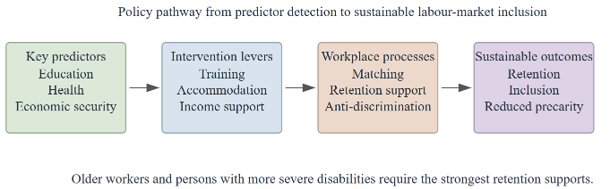
This framework also improves the translation of model findings into intervention design. When a factor is strongly aligned with truth, such as education in the present analysis, broad policy expansion may be justified. When a factor contains more indeterminacy, such as disability type or self-rated health, intervention may need to be more tailored. Figure 6 summarises this translation pathway from predictor detection to sustainable labour-market inclusion. The figure emphasises that retention is most likely to improve when individual predictors are linked to concrete intervention levers such as training, accommodation, income support, job matching, and anti-discrimination systems.
The stronger predictive performance of L2-regularized XGBoost compared with CART, GBM, and conventional XGBoost indicated that explicit control of model complexity improved generalization in high-dimensional disability-employment data. This interpretation was consistent with the broader methodological literature on gradient boosting and hyperparameter control [13]. Substantively, the emphasis on education, health, workplace support, and disability-related heterogeneity was also consistent with recent evidence on long-term job retention and workplace conditions among people with disabilities [14, 22, 23, 26]. The added value of the present study was that these factors were not discussed as isolated correlates; instead, they were organised into a combined model-validation and neutrosophic interpretation framework.
Figure 6. Policy pathway from predictor detection to sustainable labour-market inclusion
Several practical implications follow from the findings. First, retention policy should not be limited to job placement. Programmes should support continuation in employment through periodic assessment, skill upgrading, accommodation review, and follow-up services after hiring. Second, education and training policy should be integrated into disability employment strategy across the life course, including adult re-skilling and digital adaptation. Third, health and rehabilitation services should be linked more directly with employment support because subjective health is a major determinant of labour-market continuity. Fourth, income insecurity should be treated as a retention risk factor, not simply a welfare outcome. Financial support that stabilises transport, treatment, or caregiving may indirectly protect employment. Fifth, older disabled workers require targeted support, including flexible work design and age-specific employer engagement.
The study has limitations. First, the analysis relied partly on self-reported measures, which may introduce reporting bias. Second, although the data were longitudinal, the reported summary results do not fully exploit all possible dynamic modelling strategies, such as time-varying survival analysis or recurrent-event approaches. Third, the panel is based on registered disability categories and may not capture all forms of functional limitation or intersectional disadvantage. Fourth, the neutrosophic layer in this study was interpretive rather than a fully parameterised neutrosophic estimation procedure. This was a deliberate design choice to preserve transparency, but future work could extend the approach by constructing explicit neutrosophic scores or hybrid classifiers. Fifth, broader macroeconomic shocks and policy changes were not modelled directly, even though they may influence retention conditions.
A further limitation was that the analysis used a respondent-level final retention outcome rather than a full time-to-event model. This choice improved comparability across classifiers and reduced leakage risk, but it did not estimate the precise timing of employment exit. Future work should therefore test whether the same predictors remain stable when analysed with grouped survival models, recurrent-event models, or dynamic panel approaches.
Future research should combine regularized boosting with time-to-event designs, test subgroup differences across industries and regions, and develop operational neutrosophic indicators that can be embedded in disability-employment decision support systems without obscuring interpretability.
This study demonstrates that employment retention among workers with disabilities can be analysed more effectively when predictive modelling is combined with an explicit framework for uncertainty. Using Korean longitudinal panel data, the study showed that L2-regularized XGBoost outperformed CART, GBM, and conventional XGBoost, and that six predictors carried the greatest relevance for sustained employment: age, household economic level, subjective health status, degree of disability, type of disability, and education level. Logistic regression clarified that education, household economic status, health, milder disability, and non-physical disability type were positively associated with retention, whereas increasing age reduced the likelihood of remaining employed.
Beyond these empirical findings, the study makes a conceptual contribution by applying neutrosophic logic to the interpretation of disability-employment data. Rather than forcing each factor into a purely positive or negative category, the neutrosophic framework recognises that social data can contain supportive evidence, contradictory signals, and indeterminacy at the same time. This perspective is especially useful for sustainable development and public-health planning because it encourages interventions that are both evidence-driven and flexible.
Overall, the results indicate that sustainable labour-market inclusion for persons with disabilities requires more than employment entry. It requires long-term investment in education, health support, economic security, workplace accommodation, anti-discrimination systems, and age-sensitive retention policy. By integrating machine learning with neutrosophic reasoning, the study offers a practical framework for identifying policy priorities while retaining awareness of uncertainty in complex social data.
In this sense, the long-term contribution of the study was to show how sustainable employment policy can benefit from models that are not only predictive but also uncertainty-aware. The framework can guide future decision-support tools that identify high-risk workers while still preserving interpretive caution for disability categories, health self-ratings, and workplace-context variables that contain unavoidable indeterminacy.
This work was supported by the Basic Science Research Program through the National Research Foundation of Korea funded by the Ministry of Education (NRF-RS-2023-00237287, 2026S1A5A01004224).
[1] Jabłońska-Porzuczek, L.Z., Kalinowski, S.M. (2018). Analysis of the labor market situation of people with disabilities. Acta Universitatis Lodziensis. Folia Oeconomica, 4(336): 157-172. https://doi.org/10.18778/0208-6018.336.10
[2] Joseph, R. (2024). The self-sufficiency framework-revised: A full welfare/full work roadmap for poverty alleviation in contemporary social welfare systems. Journal of Poverty, 28(1): 22-46. https://doi.org/10.1080/10875549.2021.2011819
[3] Cheausuwantavee, T., Keeratiphanthawong, S. (2021). Employment for persons with disabilities in Thailand: Opportunities and challenges in the labor market. Journal of Population and Social Studies, 29: 384-400. https://doi.org/10.25133/JPSSv292021.024
[4] Bonaccio, S., Connelly, C.E., Gellatly, I.R., Jetha, A., Martin Ginis, K.A. (2020). The participation of people with disabilities in the workplace across the employment cycle: Employer concerns and research evidence. Journal of Business and Psychology, 35(2): 135-158. https://doi.org/10.1007/s10869-018-9602-5
[5] Kim, E.J., Kim, I., Kim, M.J. (2020). The impact of workplace disability facilities on job retention wishes among people with physical disabilities in South Korea. Sustainability, 12(18): 7489. https://doi.org/10.3390/su12187489
[6] Yang, J.M., Hong, J.S., Kim, J.H. (2024). Association between job satisfaction and stress or depressive symptom of employed persons with disabilities: Findings from the panel survey of employment for the disabled 2016-2023. International Journal of Mental Health Promotion, 26(10): 791-803. https://doi.org/10.32604/ijmhp.2024.056433
[7] Erickson, W.A., von Schrader, S., Bruyère, S.M., VanLooy, S.A. (2014). The employment environment: Employer perspectives, policies, and practices regarding the employment of persons with disabilities. Rehabilitation Counseling Bulletin, 57(4): 195-208. https://doi.org/10.1177/0034355213509841
[8] Yu, S.H., Choe, C. (2021). Gender differences in job satisfaction among disabled workers. PLoS ONE, 16(6): e0252270. https://doi.org/10.1371/journal.pone.0252270
[9] Jones, M., Mavromaras, K., Sloane, P.J., Wei, Z. (2018). The dynamic effect of disability on work and subjective well-being. Oxford Economic Papers, 70(3): 635-657. https://doi.org/10.1093/oep/gpy006
[10] Korea Employment Agency for Persons with Disabilities, Employment Development Institute. (2026). Panel survey of employment for the disabled: Survey overview and public data documentation. https://edi.kead.or.kr/ENG_Index.do.
[11] Byeon, H. (2024). A feature interaction based neural network approach: Predicting job turnover in early career graduates in South Korea. International Journal of Advanced Computer Science and Applications, 15(8): 326-335. https://doi.org/10.14569/IJACSA.2024.0150833
[12] Saidani, O., Menzli, L.J., Ksibi, A., Alturki, N., Alluhaidan, A.S. (2022). Predicting student employability through the internship context using gradient boosting models. IEEE Access, 10: 46472-46489. https://doi.org/10.1109/ACCESS.2022.3170421
[13] Chen, T., Guestrin, C. (2016). XGBoost: A scalable tree boosting system. In Proceedings of the 22nd ACM SIGKDD International Conference on Knowledge Discovery and Data Mining (KDD '16). Association for Computing Machinery, New York, NY, USA, pp. 785-794. https://doi.org/10.1145/2939672.2939785
[14] Kudla, A., Dinelli, E.J., Capraro, P., et al. (2025). Person-, job-, and environment-related factors associated with long-term job retention of people with physical disabilities. Journal of Occupational Rehabilitation, 35(4): 860-875. https://doi.org/10.1007/s10926-024-10245-4
[15] Abdel-Basset, M., Mohamed, M., Smarandache, F., Chang, V. (2018). Neutrosophic association rule mining algorithm for big data analysis. Symmetry, 10(4): 106. https://doi.org/10.3390/sym10040106
[16] Hüllermeier, E., Waegeman, W. (2021). Aleatoric and epistemic uncertainty in machine learning: An introduction to concepts and methods. Machine Learning, 110(3): 457-506. https://doi.org/10.1007/s10994-021-05946-3
[17] Jdid, M., Shahin, B., Al Suleiman, F. (2022). Important neutrosophic rules for decision-making in the case of uncertain data. International Journal of Neutrosophic Science, 18(3): 166-176. https://doi.org/10.54216/IJNS.1803014
[18] Rodriguez, R.C., Sanchez, J.O., Salcedo, V.L. (2022). Evaluation of social projects using neutrosophic AHP. International Journal of Neutrosophic Science, 19(1): 280-289. https://doi.org/10.54216/IJNS.190124
[19] Mohamed Ibrahim, A.M., Khan, Z., Al-Duais, F.S. (2023). A new modified logistic distribution: Properties and applications in uncertainty data modeling. International Journal of Neutrosophic Science, 20(2): 27-39. https://doi.org/10.54216/IJNS.200203
[20] Abdulbaqi, A.S., Al-Attar, B., Qudr, L.A.Z., et al. (2024). Efforts of neutrosophic logic in medical image processing and analysis. International Journal of Neutrosophic Science, 24(4): 376-386. https://doi.org/10.54216/IJNS.240428
[21] Ghanbari Talouki, A., Koochari, A., Edalatpanah, S.A. (2022). Applications of neutrosophic logic in image processing: A survey. Journal of Electrical and Computer Engineering Innovations, 10(1): 243-258. https://doi.org/10.22061/JECEI.2021.8069.474
[22] Aksnes, S.Y., Ulstein, J. (2024). Sustainable employment for people with disabilities: A scoping review on workplace practices and positive employment outcomes. Scandinavian Journal of Disability Research, 26(1): 189-210. https://doi.org/10.16993/sjdr.1089
[23] Teborg, S., Huenefeld, L., Gerdes, T.S. (2024). Exploring the working conditions of disabled employees: A scoping review. Journal of Occupational Medicine and Toxicology, 19: 2. https://doi.org/10.1186/s12995-023-00397-z
[24] Elsherif, A.Z., Salama, A.A., Khaled, O.M., et al. (2024). Unveiling big data insights: A neutrosophic classification approach for enhanced prediction with machine learning. Neutrosophic Sets and Systems, 72: 154-172. https://doi.org/10.5281/zenodo.13381926
[25] Gross, J.M., Monroe-Gulick, A., Nye, C., Davidson-Gibbs, D., Dedrick, D. (2020). Multifaceted interventions for supporting community participation among adults with disabilities: A systematic review. Campbell Systematic Reviews, 16(2): e1092. https://doi.org/10.1002/cl2.1092
[26] Park, J.Y., Park, E.Y. (2021). Factors affecting the acquisition and retention of employment among individuals with intellectual disabilities. International Journal of Developmental Disabilities, 67(3): 188-201. https://doi.org/10.1080/20473869.2019.1633166
[27] Magrin, M.E., Marini, E., Nicolotti, M. (2019). Employability of disabled graduates: Resources for a sustainable employment. Sustainability, 11(6): 1542. https://doi.org/10.3390/su11061542
[28] Benach, J., Vives, A., Amable, M., Vanroelen, C., Tarafa, G., Muntaner, C. (2014). Precarious employment: Understanding an emerging social determinant of health. Annual Review of Public Health, 35(1): 229-253. https://doi.org/10.1146/annurev-publhealth-032013-182500
[29] Kaye, H.S., Jans, L.H., Jones, E.C. (2011). Why don't employers hire and retain workers with disabilities? Journal of Occupational Rehabilitation, 21: 526-536. https://doi.org/10.1007/s10926-011-9302-8