Lim Seong Pek | Fatin Syamilah Che Yob* | Azie Azlina Azmi | Ju Xiao | M. Zaini Miftah | Choiril Anwar
© 2025 The authors. This article is published by IIETA and is licensed under the CC BY 4.0 license (http://creativecommons.org/licenses/by/4.0/).
OPEN ACCESS
Green schools, which incorporate eco-friendly procedures, sustainable infrastructure, and environmental education into learning environments. Their popularity is increasing due to the global emphasis on sustainability in education. Using the Web of Science database (2015-2024), this study provides a bibliometric analysis of research on the Pathway to Greener Schools, looking at publication trends, significant authors, co-citation networks, and thematic clusters. Six major research areas are identified by the analysis: policy implementation, cognitive benefits, stress reduction, outdoor learning, health and performance outcomes, and sustainability in education. The study shows that green schools may potentially support better learning outcomes and sustainable urban development, which is in line with the Sustainable Development Goals (SDGs) of the United Nations, especially SDG 4 (Quality Education) and SDG 11 (Sustainable Cities and Communities). Future studies should concentrate on addressing educational inequalities, standardizing sustainability metrics, and combining digital resources with environmental education. This study helps educators, legislators, and urban planners advance sustainability-driven education models by bridging the gap between research and real-world application. In the end, the Pathway to Greener Schools is crucial to raising future generations who are environmentally conscious, healthy, and motivated to learn.
green schools, sustainability education, environmental literacy, school well-being, eco-learning spaces
The education sector is essential to promoting sustainable development in light of growing environmental concerns and climate change. Schools serve as hubs for academic learning as well as the development of responsible global citizens. By encouraging eco-friendly practices, green infrastructure, and sustainability-driven curricula, the Pathway to Greener Schools concept emphasizes the incorporation of environmental sustainability into educational institutions [1]. This movement supports the urgent need for education to address environmental challenges and is in line with the Sustainable Development Goals (SDGs) 4 (Quality Education) and 13 (Climate Action) of the UN [2]. Growing awareness of climate issues and the need for educational institutions to lower their carbon footprint have been the driving forces behind the push for greener schools over the past few decades [3]. Sustainable educational models are still applied unevenly across various regions and educational systems, despite tremendous advancements [4]. A thorough review of current research trends, new themes, and possible knowledge gaps in the quest for environmentally friendly school environments can be obtained through bibliometric analysis.
Communities, teachers, and students all stand to gain greatly from the transition to greener schools. In addition to lessening their negative environmental effects, green schools also offer healthier learning environments, enhance indoor air quality, lower pollution exposure, and enhance the wellbeing of their students [5]. By incorporating sustainability into their curricula, educators can promote environmental literacy and give students the tools they need to solve ecological issues [6]. Waste reduction plans, sustainable gardening, and the use of renewable energy in schools are examples of activities that promote experiential learning and inspire students to actively support sustainability. Furthermore, by lowering operating expenses and allocating funds for educational improvements, energy-efficient school buildings eventually save money [7]. Schools must set an example and impart values that will help create future leaders who are responsible as societies transition to greener economies [8].
Even though sustainability is becoming increasingly important, many schools around the world continue to function using outdated frameworks that put academic achievement ahead of environmental awareness. Adoption of greener school initiatives is hampered by a lack of infrastructure, funding, and enforcement of policies [9]. Additionally, many educational systems limit students' exposure to practical sustainability practices by emphasizing theoretical knowledge over experiential environmental education [10]. Concerns concerning teachers' readiness are heightened by the fact that many of them lack the training required to successfully integrate sustainability into their lessons. Furthermore, unequal access to green learning environments has resulted from differences in the resources available to urban and rural schools [11]. Many developing nations find it difficult to implement eco-friendly school designs and curricula because of administrative and financial limitations, despite the fact that developed nations have made strides in this area. A thorough analysis of the literature is required to identify solutions to these issues and speed the shift to sustainable education.
Finding research trends, condensing the abundance of data on sustainable education, and deciding on future directions all depend on a bibliometric analysis of the Pathway to Greener Schools. By analyzing academic publications, citation trends, and significant research topics, this study will offer a methodical understanding of how educational institutions around the world are managing sustainability initiatives [12]. Researchers, educators, and policymakers can use the findings to identify best practices, successful models, and areas that need more research. Furthermore, by identifying workable solutions to remove obstacles to sustainability in education, this study will help close the gap between research and implementation [13]. Bibliometric analysis of the development of green schooling will assist stakeholders in creating focused interventions that support global sustainability goals as environmental concerns grow more urgent.
Because it provides a methodical and objective way to assess scholarly contributions in a particular field, bibliometric analysis is essential to the advancement of research. Bibliometric approaches offer data-driven insights into the academic landscape, in contrast to traditional literature reviews, which are frequently constrained by subjectivity and researcher bias [14]. By identifying important writers, organizations, and journals that have had a major impact on the conversation, bibliometric analysis makes it possible to conduct a methodical analysis of the development of sustainability-related research in education within the context of greener schools. The inclusion of noteworthy and trustworthy research is ensured by the use of the Web of Science (WoS) database in this study, boosting the validity and credibility of the results [15].
Advanced bibliometric techniques that provide a deeper understanding of the intellectual structures and thematic connections within a field of study include co-citation and co-occurrence analysis. Co-citation analysis finds significant works and research clusters that influence the conversation about greener schools by identifying studies that are frequently cited [15]. This makes it easier to identify important theoretical frameworks and methodological stances that have impacted educational sustainability [14]. Conversely, co-occurrence analysis looks at the connections between keywords, exposing interdisciplinary connections and pointing to new research directions [16]. To illustrate the relationships between various elements of greener schools, co-occurrence analysis, for example, can be utilized in this study to map the intersection of sustainability, education policy, green infrastructure, and environmental literacy [17]. Using these methods and the Web of Science database, this study methodically identifies themes, partnerships, and trends that support the development of sustainable teaching strategies.
Data analysis was performed using VOSviewer version 1.6.20. A minimum threshold of five co-occurrences per keyword was established to ensure conceptual relevance [18]. For author and institutional data, homonyms were manually verified, and institutional names were standardized to maintain consistency. Data cleaning and deduplication were conducted in Microsoft Excel before import into VOSviewer to ensure accuracy in network mapping and to avoid artificial fragmentation of clusters.
2.1 Search strategy
In order to guarantee the selection of up-to-date, pertinent, and superior literature from the Web of Science (WoS) database [18], the inclusion criteria (Table 1) for this bibliometric analysis on Pathway to Greener Schools have been meticulously developed. These standards aid in the dataset's refinement by guaranteeing that the publications that are retrieved accurately and thoroughly represent research trends in the field of sustainable education. To ensure that publications from a wide range of disciplines related to sustainability, education, environmental sciences, and policy studies are included, the WoS database (ALL categories) is initially used as the primary source. This broad selection captures interdisciplinary viewpoints on green schooling, which improves the analysis.
The study's timeframe, which runs from 2015 to 2024, guarantees that it will concentrate on current innovations, advancements, and debates related to the adoption of green school initiatives. This timeframe allows the analysis to reflect current research trends and emerging challenges, as sustainability in education has received increased attention recently. Only papers with "green school*" explicitly mentioned in their titles are included because the search field is restricted to Title Search (TS). By eliminating studies where green schools are only a minor topic, this guarantees a high level of relevance. The present analysis specifically aims to map the scholarly discourse that explicitly adopts the “green school” concept, expanding the search string would have introduced conceptual heterogeneity and reduced focus. This deliberate delimitation ensures that all retrieved documents directly engage with the green school model rather than general sustainability education.
Table 1. Inclusion criteria for bibliometric analysis
|
WoS Database |
ALL |
|
Time period |
2015 to 2024 |
|
Search field |
TS |
|
Search keywords |
"green school*" |
|
Document Type |
Article, Review Article & Proceeding Paper |
|
Language |
English |
Articles, review articles, and proceedings papers are the only document types covered. These document types contribute to the field in a methodical, peer-reviewed, research-based manner. The dataset is guaranteed to be primarily made up of empirical research, theoretical discussions, and thorough reviews by removing other document types like editorials, letters, and book chapters. In order to ensure consistency and accessibility in bibliometric analysis, the language criterion is finally set to English. Since academic publishing is primarily conducted in English, this criterion allows for a wider audience while preserving uniformity in the review and citation process.
3.1 Trend analysis
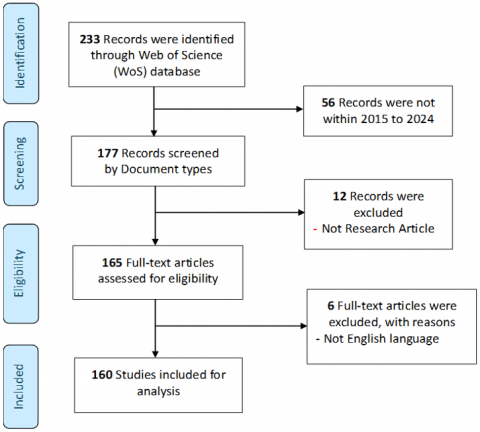
This bibliometric study's trend analysis sheds important light on the development, significance, and level of scholarly interest in the subject of green schools between 2015 and 2024. Following the application of the inclusion criteria, 160 publications in all were taken from the Web of Science (WoS) database (Figure 1). The analysis of the research trajectory, impact, and emerging themes in sustainable education is based on these studies. According to the citation analysis, there are 1,693 citing articles in total, with 1,636 refined after self-citations are eliminated. When self-citations are eliminated, the total number of times cited drops from 2,060 to 1,889, indicating a high level of scholarly interest in green school research. The field has moderate to strong academic influence, with an average of 12.88 citations per item. The substantial scholarly contribution of research in this field is further highlighted by the H-Index of 21, which shows that at least 21 articles have been cited at least 21 times.
Figure 1. PRISMA flowchart
The rise in publications over time indicates that researchers are growing more interested in green schools, according to quantitative data (Figure 2). This is probably due to their growing awareness of climate change, sustainability policies, and the part education plays in raising environmental awareness. Furthermore, the trend indicates a move away from theoretical discussion and toward empirical research that looks at the real application of green initiatives in educational settings. Additionally, the growing number of citing articles indicates that the topic has gained popularity in the larger discussion about sustainability and education, according to the citation patterns. The dataset's self-citations show how scholars in this area are constantly building on earlier discoveries to gain a deeper understanding of sustainable teaching practices.
Research gaps, such as the possible underrepresentation of studies in particular regions or the dearth of interdisciplinary approaches integrating education, policy, and technology in the context of green schools, are also made clear by the trend analysis. Future sustainability-driven educational practices will be greatly impacted by this analysis's deeper examination of emerging themes, important research contributors, and developing methodologies. By methodically examining publication growth, citation impact, and research influence, this trend analysis advances our knowledge of how green school initiatives have evolved in the academic literature. Additionally, it opens the door for more focused and scientifically backed sustainability projects in the field of education.
Figure 2. Quantity of publications and citations between 2015 and 2024
3.2 Performance analysis
The Pathway to Greener Schools bibliometric data performance analysis provides a comprehensive understanding of the academic landscape and the influence of research on green schools by identifying important contributors and highly cited works. The analysis examines the most important papers, sources, writers, institutions, and nations that have contributed to this field of study.
3.2.1 Documents
One of the most influential papers in the field is the Impact of Views to School Landscapes on Recovery from Stress and Mental Fatigue [19], which highlights the importance of green spaces in promoting student well-being and has the highest citation count (436). Kuo et al. [20] highlight the benefits of green spaces in the classroom and offer compelling evidence of a causal relationship between learning and nature experiences, with 184 citations. The impact of schoolyard greening on students' mental, physical, and social-emotional health is clarified by the 100-citation study [21]. Another notable study by Bikomeye et al. [22] looks at how schoolyard greening can enhance children's physical activity and socio-emotional health and has 53 citations. In a similar vein, Goldman et al. [23] investigated the impact of green school certification on students' environmental literacy and sustainable practices, citing 48 sources. These highly cited works demonstrate the high level of scholarly interest in the relationship between green spaces and educational outcomes.
3.2.2 Sources
With 23 publications, "Marketing the Green School: Form, Function, and the Future" has established itself as a significant platform for discussions about sustainable education and is among the most influential sources influencing green school research. "Environmental Education Research" has influenced the discussion of ecologically friendly education with eight publications and 70 citations. "Landscape and Urban Planning" is the most cited source with 5 publications and 568 citations, indicating that interdisciplinary groups are becoming more interested in integrating green spaces into educational facilities. "Frontiers in Psychology" (284 citations) and "International Journal of Environmental Research and Public Health" (61 citations) further emphasize the psychological and public health components of green school initiatives. The wide range of publication sources demonstrates the interdisciplinary nature of this field, which includes education, psychology, environmental science, and urban planning.
3.2.3 Authors
One of the leading authors in the field, Stevenson, K. T., has contributed significantly to the study of green education with four publications and fifty citations. Hovinga, D. and Maas, J. have made significant progress in the environmental and health aspects of school sustainability with three papers and 61 citations between them. Additionally, Azizinezhad, R., Jozi, S. A., Lahijanian, A., and Meiboudi, H. demonstrate that there is growing interest in sustainable school environments globally with three papers and 41 citations each. The impact of these researchers' citations highlights the significance of studies with a sustainability focus in shaping educational policies and infrastructure.
3.2.4 Organizations
With 6 publications and 676 citations, the University of Illinois is ranked first among the most influential universities, indicating its substantial scholarly influence on sustainability research. Vrije University Amsterdam contributes significantly to the European discussion on green schools with five publications and 166 citations. The University of Minnesota has contributed significantly to the development of school sustainability research, with 5 publications and 254 citations. The University of Melbourne (5 documents, 44 citations) and North Carolina State University (3 documents, 30 citations) further emphasize the research's global reach, which includes North America, Europe, and Australia. These groups have taken the lead in promoting evidence-based practices, policy-driven studies, and empirical research in the context of implementing green schools.
3.2.5 Countries
The USA leads the field of green school research with 60 publications and 1,088 citations, showcasing its leadership in sustainability education policies, urban greening, and environmental literacy programs. Indonesia is a prominent contributor to the Global South, with 15 publications and 54 citations, indicating the growing interest in sustainable education in developing nations. As demonstrated by Italy (7 publications, 43 citations) and the Netherlands (9 publications, 213 citations), Europe is actively engaged in sustainable school research. China and Australia illustrate the growing significance of sustainability in Asian and Oceanic educational systems with six documents each. Additionally, Malaysia (5 documents, 27 citations) and India (5 documents, 114 citations) show how important green school initiatives are becoming in South and Southeast Asia in accordance with international sustainability goals.
3.3 Co-citation analysis
Education, psychology, urban planning, and environmental science are strongly represented in the co-citation analysis of the most cited papers in the Pathway to Greener Schools research domain. The Pathway to Greener Schools research domain's top ten most co-cited articles (Table 2) demonstrate the depth and scope of academic research on green schoolyards, their advantages, and their effects on students' cognitive, physical, and mental health. The increasing agreement among academics that incorporating natural elements into school infrastructure is crucial for holistic student development is reflected in the frequent co-citation of these studies.
Table 2. Co-citations (Top 10 articles)
|
Rank |
Articles |
Title |
Citations |
Total Link Strength |
|
1 |
[24] |
Green schoolyards as havens from stress and resources for resilience in childhood and adolescence |
18 |
185 |
|
2 |
[25] |
Grounds for health: the intersection of green school grounds and health‐promoting schools |
17 |
139 |
|
3 |
[21] |
The impact of greening schoolyards on the appreciation, and physical, cognitive and social-emotional well-being of schoolchildren: A prospective intervention study |
16 |
183 |
|
4 |
[26] |
Benefits of nature contact for children |
15 |
144 |
|
5 |
[27] |
Grounds for movement: green school grounds as sites for promoting physical activity |
13 |
147 |
|
6 |
[20] |
Might school performance grow on trees? Examining the link between “greenness” and academic achievement in urban, high-poverty schools |
12 |
153 |
|
7 |
[28] |
Physical activity and social behaviors of urban children in green playgrounds |
12 |
136 |
|
8 |
[29] |
The restorative benefits of nature: Toward an integrative framework |
12 |
125 |
|
9 |
[30] |
Green schoolyards in low-income urban neighborhoods: natural spaces for positive youth development outcomes |
11 |
133 |
|
10 |
[31] |
Green spaces and cognitive development in primary schoolchildren |
11 |
107 |
The psychological and emotional advantages of green schoolyards are among the primary topics of the most frequently cited articles. Green spaces in schools have been shown to enhance mental resilience, reduce stress, and promote general well-being in a number of studies, including those by Chawla et al. [24] and Kaplan [29]. These results support the idea that natural school environments are essential for promoting emotional control and mental clarity, especially in light of the rise in student anxiety and academic pressure.
The encouragement of social interaction and physical activity is another common theme in green schoolyards. Green playgrounds promote movement and interactive play, which lowers sedentary behavior and promotes positive social interactions among students, according to studies like Bell and Dyment [25] and Raney et al. [28]. Given these findings, legislators and urban planners ought to take into account the direct influence that schoolyard design has on kids' lifestyle decisions.
Furthermore, the academic advantages of green school environments are highlighted by co-cited research. It has been demonstrated that being in nature improves cognitive function, focus, and academic performance [20, 31]. The argument for incorporating outdoor learning and biophilic design principles into educational settings is further supported by the Attention Restoration Theory (ART), which holds that natural settings aid in restoring cognitive function, lowering fatigue, and enhancing focus.
Discussions of accessibility to green schoolyards and environmental justice are also common. Low-income schools typically lack access to quality green spaces, which exacerbates health and education disparities [30]. This theme emphasizes the need for policy-driven interventions to ensure equitable access to sustainable learning environments, especially in urban and underprivileged communities.
3.3.1 Co-citation analysis by clusters
The co-citation analysis reveals four primary research clusters on Pathway to Greener Schools (Figure 3), each of which represents a distinct thematic focus (Table 3). The psychological and social well-being cluster highlights the emotional benefits of green spaces, whereas the cognitive and academic benefits cluster highlights the positive effects of nature on student learning. While the sustainability and environmental education cluster emphasizes the importance of integrating green principles into school curricula, the school infrastructure and design cluster emphasizes green architecture as a critical component of sustainable education.
The social, emotional, and psychological benefits of green school environments are the main focus of the 20 articles in this cluster. Studies such as those conducted by Chawla et al. [24] and van Dijk-Wesselius et al. [21] have shown that green schoolyards help kids develop resilience and emotional control while also lowering stress. Similarly, Dyment and Bell [27] and Raney et al. [28] highlight how nature-based learning environments encourage students to be physically active and build positive social relationships. The idea that green schoolyards foster social inclusion and equity is a key theme in this cluster [30], which shows that green schoolyard access in low-income neighborhoods. Existing studies support policy-driven strategies to ensure that all students, regardless of their socioeconomic background, benefit from school environments that incorporate nature, further support this argument [32]. This cluster positions green schoolyards as more than just aesthetic improvements by highlighting their significance for resilience-building, mental health, and equitable education.
This cluster, which consists of 15 articles, focuses on the educational benefits of green spaces in schools. Research such as Kuo et al. [20], Dadvand et al. [31] and Kuo et al. [33] demonstrate how green spaces improve students' cognitive development, focus, and academic performance. These studies provide empirical support for integrating green spaces into educational settings to enhance learning outcomes. Li and Sullivan [19] provide additional evidence for this claim by demonstrating how classroom natural views aid in stress relief and enhance cognitive function. Kaplan [29] provided a theoretical basis for these findings through the Attention Restoration Theory (ART), which explains how being in nature helps students recover from mental exhaustion and enhance focus. By showing a strong relationship between green spaces and cognitive abilities, this cluster offers convincing evidence for the design of schools with natural landscapes in order to improve educational performance.
The third cluster (12 articles) focuses on integrating sustainability into school policies and curricula. It includes studies by Henderson and Tilbury [34] and Otto and Pensini [35] on environmental education and whole-school sustainability initiatives. According to these studies, green schools not only improve their physical facilities but also help employees and students develop an awareness of the environment. Another important addition to this cluster is made by Olsson et al. [36], who examined how green schools encourage students to change their behavior and develop a greater awareness of sustainability. Malone and Tranter [37] claimed that outdoor learning initiatives in green schools enhance students' experiential sustainability education and environmental literacy. This cluster highlights the critical role that education plays in advancing sustainability initiatives, arguing that curricula, school policies, and teacher preparation programs should all incorporate green school initiatives for maximum impact.
Figure 3. Co-citation analysis (VOSviewer visualization)
This cluster, which consists of ten articles, focuses on how school infrastructure and architecture promote sustainability and student welfare. Bell and Dyment [25] and Schneider [38] investigated how well-designed school buildings and green spaces improve students' health and academic performance. Another significant study in this cluster discusses high-performance green schools as energy-efficient, environmentally sustainable learning environments [39]. Baker and Bernstein [40] supported this claim by highlighting the importance of sustainable materials, lighting, and air quality in school construction and by connecting the caliber of school buildings to the health of their students. Additionally, Edwards [41] highlighted the impact of environmental design on learning outcomes and student engagement, reinforcing the idea that school architecture must align with sustainability goals to create conducive learning environments. In order to encourage a policy shift toward sustainable school infrastructure, this cluster recommends that green building designs be prioritized in future school developments.
Table 3. Co-citation cluster on green schools
|
Cluster No. & Colour |
Cluster Labels |
No. of Articles |
Representative Publications |
|
Cluster 1 (Red) |
Psychological and Social Well-being in Green Schools |
20 |
[21, 22, 24, 27, 28, 30, 32, 42] |
|
Cluster 2 (Green) |
Cognitive and Academic Benefits of Green School Environments |
15 |
[19, 20, 26, 29, 31, 33, 43] |
|
Cluster 3 (Blue) |
Sustainability and Environmental Education |
12 |
[34-37, 44] |
|
Cluster 4 (Yellow) |
Green School Infrastructure and Design |
10 |
[25, 38-41, 45] |
3.4 Co-occurrence analysis
The Pathway to Greener Schools study's main themes and possible future research directions are insightfully summarized by the co-occurrence analysis of keywords. The most common term in the field (Table 4), "Green Schools" (25 occurrences, 42 link strength), emphasizes the importance of sustainable school environments and demonstrates the broad scholarly interest in this topic. "Green Schoolyards" (12 occurrences, 54 link strength) and "Design" (12 occurrences, 56 link strength) are closely related terms that further highlight the emphasis on the physical and structural elements of sustainability in educational institutions. These terms imply that the implementation of environmentally friendly infrastructures and their impact on students and learning outcomes are the subject of a substantial amount of research.
The high frequency of child-centered terms – "Children" (24 occurrences, 108 link strength) is the keyword with the strongest link – is another noteworthy finding that supports the idea that students are the main beneficiaries of research on green schools. Growing interest in the psychological and physiological advantages of natural school environments, particularly in stress reduction and general well-being, is reflected in the prominence of "Health" (20 occurrences, 69 link strength) and "Stress" (9 occurrences, 59 link strength). The idea that green school environments promote movement, outdoor play, and social interactions – all of which are essential for both physical health and cognitive engagement – is further supported by the co-occurrence of "Physical Activity" (11 occurrences, 55 link strength).
Table 4. The 15 most frequent keywords in the co-occurrence analysis
|
Rank |
Keyword |
Occurrences |
Total Link Strength |
|
1 |
Green schools |
25 |
42 |
|
2 |
Children |
24 |
108 |
|
3 |
Health |
20 |
69 |
|
4 |
Education |
18 |
56 |
|
5 |
Impact |
15 |
76 |
|
6 |
Sustainability |
15 |
35 |
|
7 |
Green school |
14 |
27 |
|
8 |
Design |
12 |
56 |
|
9 |
Green schoolyards |
12 |
54 |
|
10 |
Performance |
12 |
30 |
|
11 |
Physical-activity |
11 |
55 |
|
12 |
Stress |
9 |
59 |
|
13 |
Play |
9 |
46 |
|
14 |
Environmental education |
9 |
29 |
|
15 |
Attitudes |
9 |
24 |
The notable prevalence of "Education" (18 occurrences, 56 link strength) and "Environmental Education" (9 occurrences, 29 link strength) indicates that education is still a key pillar in this field. This demonstrates that school sustainability encompasses more than just the physical environment; it also involves curriculum development and pedagogy, with an emphasis on how green schools incorporate environmental education and encourage students to have pro-environmental attitudes. As demonstrated by the fact that "Attitudes" (9 occurrences, 24 link strength) appears as a recurring keyword, research on behavioral change and perception is an essential component of studies on sustainability education, especially when examining the long-term effects of exposure to green school environments on students' commitment to ecological responsibility.
The high frequency of "Impact" (15 occurrences, 76 link strength) and "Performance" (12 occurrences, 30 link strength) indicates that the influence of green schools is another important area of focus. These keywords show that scholars are actively examining the effectiveness of green school programs, especially in relation to the objectives of academic achievement, student engagement, environmental sustainability, and institutional efficiency. The notion that green school research is linked to more general international conversations on climate action, sustainable development, and policy-driven educational reforms is further supported by the term "Sustainability" (15 occurrences, 35 link strength).
3.4.1 Co-occurrence analysis by clusters
The co-occurrence analysis of 752 keywords (with a threshold of 52 and a minimum occurrence of 4) reveals six distinct clusters that define the Pathway to Greener Schools research landscape (Figure 4). These clusters highlight significant themes and connections in the literature with the aid of keyword frequency and link strength data (Table 5), providing a comprehensive understanding of the ways in which sustainability and education interact in green school research.
Figure 4. Co-occurrence analysis (VOSviewer visualization)
Table 5. Co-occurrence analysis of keywords on green schools
|
Cluster No. & Colour |
Cluster Label |
Number of Keywords |
Representative Keywords |
|
Cluster 1 (Red) |
Sustainability in Education and Environmental Awareness |
15 |
‘green schools,’ ‘education,’ ‘sustainability,’ ‘green school,’ ‘environmental education,’ ‘attitude,’ ‘knowledge’ |
|
Cluster 2 (Green) |
Health, Well-being, and School Performance |
13 |
‘children,’ ‘health,’ ‘impact,’ ‘design,’ ‘performance,’ ‘framework,’ ‘rating system’ |
|
Cluster 3 (Blue) |
Cognitive Benefits of Nature in Learning |
9 |
‘green schoolyards,’ ‘exposure,’ ‘attention,’ ‘benefits,’ ‘nature,’ ‘views’ |
|
Cluster 4 (Yellow) |
Green Spaces, Stress Reduction, and Equity |
7 |
‘stress,’ ‘environment,’ ‘urban,’ ‘green space,’ ‘health equity,’ ‘physical activity’ |
|
Cluster 5 (Purple) |
Outdoor Learning, Play, and Teacher Engagement |
6 |
‘physical-activity,’ ‘play,’ ‘grounds,’ ‘environmental-education,’ ‘teachers,’ ‘childhood’ |
The core concepts of sustainability in education are represented by the 15 keywords in the largest cluster, Sustainability and Environmental Education. Frequently occurring terms such as "Green schools" (25 occurrences, 42 link strength), "Sustainability" (15 occurrences, 35 link strength), and "Environmental education" (9 occurrences, 29 link strength) indicate a strong emphasis on integrating sustainability principles into school environments and curricula. The inclusion of "Attitude" and "Knowledge" suggests that research in this cluster regularly examines the ways in which green school initiatives impact students' attitudes, behaviors, and ecological awareness. Another important area of research is the pedagogical role of green schools, with studies looking at how environmental education aids in the development of a long-term sustainability consciousness in both teachers and students.
With 13 keywords, the second cluster, Health, Impact, and School Performance, looks at how green school initiatives impact students' performance and health. The fact that "Children" (24 occurrences, 108 link strength) is the most highly linked keyword in this field indicates that research in this area primarily focuses on student well-being as the primary outcome of green school designs. Research regularly evaluates how well green schools improve students' academic performance and general health, according to other widely used terms like "Health" (20 occurrences, 69 link strength), "Impact" (15 occurrences, 76 link strength), and "Performance" (12 occurrences, 30 link strength). "Design," "Framework," and "Rating system" are added to demonstrate that sustainability in education encompasses more than just theoretical frameworks; it also includes the use of practical assessment tools to evaluate sustainable school structures.
"Cognitive and Psychological Benefits of Green School Environments," the third cluster, focuses on how students' psychological and cognitive well-being is enhanced by being in natural school environments. The nine keywords in this cluster include frequently occurring terms such as "Green schoolyards" (12 occurrences, 54 link strength), "Exposure," "Attention," and "Benefits." The Attention Restoration Theory (ART), which maintains that natural environments enhance mental fatigue and cognitive function, is supported by all of these terms. The addition of "Views" supports research demonstrating that even passive exposure to greenery, such as gazing out a classroom window at trees, can enhance concentration and learning outcomes.
The fourth cluster – Green Spaces, Stress Reduction, and Health Equity – has seven keywords and emphasizes the advantages of green school environments for mental health and social equity. The prevalence of terms like "Stress" (9 occurrences, 59 link strength), "Green space," and "Environment" suggests that this field of study focuses on how nature-integrated school environments support stress reduction and emotional well-being. The term "health equity" is used to highlight research that examines variations in school access to green spaces, particularly in urban areas where environmental inequalities are more obvious. Additionally, the word "Urban" suggests that scholars are investigating the challenges and policy gaps related to creating green school environments in densely populated urban areas.
The fifth cluster, Play, Outdoor Learning, and Teacher Perspectives, is composed of six keywords that highlight the value of outdoor learning, movement, and teacher involvement in green school initiatives. The presence of "Physical-activity" (11 occurrences, 55 link strength), "Play" (9 occurrences, 46 link strength), and "Grounds" indicates that this field of study examines how schoolyard greening promotes social interaction and active learning through unstructured outdoor play. Additionally, the inclusion of "Teachers" in this cluster emphasizes the vital role that educators play in enabling experiential environmental learning opportunities and integrating sustainability into the curriculum. "Childhood" highlights the long-term effects of early outdoor education exposure on students' ecological behaviors and environmental consciousness.
Sustainability studies, education, psychology, and environmental science theories are all incorporated into the multidisciplinary field of study called "The Pathway to Greener Schools." Important frameworks such as the Attention Restoration Theory (ART) [29], the Social-Ecological Theory by Bronfenbrenner, and the Biophilia Hypothesis by Wilson serve as the foundation for the study's theoretical implications. Simultaneously, the practical implications cover student well-being, school design, educational policies, and sustainable practices in pedagogy.
4.1 Theoretical implications
The study's validation of the Attention Restoration Theory (ART) in the context of educational settings is among its most important theoretical contributions. According to ART, spending time in natural settings promotes cognitive recovery and lessens mental exhaustion [29]. This assertion is strongly supported by the results of the co-citation and co-occurrence analyses, since numerous studies have demonstrated that green schoolyards improve students' focus, memory, and general academic performance [20, 31]. The frequent usage of the keywords "Attention" and "Views" further supports the idea that even passive exposure to greenery through classroom windows improves students' focus and cognitive engagement. This theoretical understanding could expand the use of ART in sustainable school research beyond its conventional applications in psychology and urban planning.
The Biophilia Hypothesis, which holds that people are drawn to nature by nature, is another significant theoretical underpinning. According to research, adding green spaces to schools enhances students' emotional resilience, cognitive abilities, and general health [24, 25]. Green school environments can be therapeutic spaces for kids who are struggling with social and academic pressure, as evidenced by the strong co-citation of studies on stress management and well-being (for example, "Stress" is a commonly used keyword).
Additionally, by showing how green schools function as microsystems that affect student development, the study advances the Social-Ecological Theory. This is consistent with studies that demonstrate how school environments impact students' pro-sustainability behaviors and long-term environmental attitudes [32]. The notion that school-based interventions have a major influence on students' future decision-making and sense of environmental responsibility is further supported by the strong correlation between "Environmental Education," "Sustainability," and "Attitude" that was discovered in the keyword analysis.
4.2 Practical implications
In addition to theoretical advances, this research has important practical implications for teaching strategies, school infrastructure design, education policy, and sustainability implementation. The necessity for educational systems to implement sustainability-focused curricula is among the most urgent repercussions. The fact that "Education," "Environmental Education," and "Sustainability" occur together suggests that academics are adamant that green schools should include sustainability concepts in their curricula in addition to infrastructure [27, 35]. To foster students' ecological literacy, educators and policymakers should give top priority to curriculum innovations that incorporate nature-based learning, experiential learning, and practical environmental projects.
Significant implications also exist for the layout and operation of green school spaces. School planners and architects must incorporate nature into schoolyards, classrooms, and outdoor learning areas, per the results of the co-citation clusters on health, performance, and cognitive benefits [21]. To improve student wellbeing and academic performance, schools should give priority to biophilic design elements like gardens, natural lighting, ventilation, and green roofs. Unequal access to green schools, especially in urban and low-income areas, is a significant issue identified by the analysis [30]. To address these disparities, policymakers should set sustainability standards and fund urban school greening initiatives to guarantee that all students, regardless of socioeconomic background, benefit from green school environments.
The data this study offers can also be useful to educators and school officials. The co-occurrence of "Teachers," "Physical-Activity," and "Play" indicates that educators play a critical role in advancing outdoor learning and sustainable education [44]. For teachers to successfully incorporate outdoor education into their lessons, schools should offer professional development opportunities. Furthermore, adding "Play" and "Physical-Activity" to the curriculum can improve social interactions, student engagement, and general health, highlighting the importance of outdoor learning for child development.
There are significant governance and policy implications as well. The co-occurrence analysis's inclusion of "Policy," "Implementation," and "Funding" suggests that institutional and financial obstacles prevent green schools from being widely adopted [40]. Governments should create stronger legislative frameworks, such as tax credits, grants, and sustainability accreditation programs, to incentivize schools to embrace sustainable practices. Collaboration amongst stakeholders, such as legislators, environmental groups, and the commercial sector, can also improve long-term sustainability planning and funding sources.
The Pathway to Greener Schools' bibliometric analysis offers a thorough summary of thematic advancements, research trends, and knowledge gaps in the area of sustainable learning environments. This study methodically investigates how green schools may support academic achievement, student well-being, environmental awareness, and institutional sustainability initiatives using bibliometric techniques like trend analysis, performance analysis, co-citation analysis, and co-occurrence keyword mapping. By identifying six main research clusters, the findings demonstrate the interdisciplinary nature of green school research, which crosses the fields of education, psychology, environmental science, health, and urban planning.
One of the analysis's main conclusions is that green school environments are crucial parts of an all-encompassing educational experience rather than merely being architectural upgrades. Exposure to nature in educational settings appears to improve cognitive function (Attention Restoration Theory), potentially lowering stress levels and encouraging environmental consciousness (Biophilia Hypothesis). Additionally, studies have connected biophilic learning environments and green schoolyards to enhanced emotional resilience, increased student engagement, and better academic performance. Nevertheless, a number of obstacles still exist in spite of the expanding corpus of research, such as unequal access to green school environments, budgetary limitations, and policy gaps. Stronger educational and governmental initiatives are required to address the institutional, financial, and policy barriers that the co-occurrence analysis identifies as the primary impediments to the widespread adoption of green schools.
The findings of this study are consistent with the Sustainable Development Goals (SDGs) of the UN, specifically SDG 11 (Sustainable Cities and Communities) and SDG 4 (Quality Education). This analysis suggests that by creating more engaging, healthy, and cognitively stimulating environments, green schools enhance learning outcomes. A crucial element of SDG 4 is inclusive, equitable, and high-quality education. The findings demonstrate how incorporating green school models into urban planning can improve environmental sustainability and guarantee that all students, irrespective of socioeconomic status, have access to natural learning environments. The significance of creating sustainable urban environments is emphasized in Sustainable Development Goal 11.
To ensure that evidence-based sustainable education models are widely adopted in the future, policymakers, educators, and researchers must collaborate to close the gap between research and practice. Future studies should concentrate on addressing accessibility inequalities, creating consistent sustainability standards for educational establishments, and incorporating digital technology into green school programs. To optimize the advantages of green schools, stakeholders can create more efficient funding sources, rules, and teacher training initiatives by implementing the empirical results of this bibliometric study. Ultimately, this study supports the idea that creating healthy, involved, and environmentally conscious future generations requires sustainable school environments rather than merely being a luxury.
We would like to thank INTI International University, Malaysia, for the support in completing this study.
[1] Gill, A.R., Khan, A., Akram, K. (2025). The path towards a sustainable and green university: An analysis of Islamia University Bahawalpur, Pakistan. Environment, Development and Sustainability. https://doi.org/10.1007/s10668-024-05884-9
[2] Goel, A., Iyer-Raniga, U., Jain, S., Addya, A., Srivastava, S., Pandey, R., Rathi, S. (2023). Student perceptions of environmental education in India. Sustainability, 15(21): 15346. https://doi.org/10.3390/su152115346
[3] Kumar, J.S., Shobana, D. (2024). A study on green education in India: A pathway to sustainable development. World Journal of Advanced Research and Reviews, 22(3): 1747-1758. https://doi.org/10.30574/wjarr.2024.22.3.1911
[4] Bourke, N., Simmons, K., Ousley, M. (2022). Green schools: An examination of practices and possibilities in alabama. Interdisciplinary Journal of Environmental and Science Education, 18(4): e2292. https://doi.org/10.21601/ijese/12144
[5] Ma, W.B., Khan, A.J., Fayyaz, S., Curle, S., Gigauri, I. (2024). Am I safe at my educational place? Creating secure and sustainable urban learning spaces through green infrastructure and ecological education. Education and Urban Society, 56(9): 1118-1141. https://doi.org/10.1177/00131245241249980
[6] Sousa, S. (2022). Some reflections on the role of the eco-schools program in the promotion of sustainable HEIs: A case study in Portugal. Administrative Sciences, 12(4): 149. https://doi.org/10.3390/admsci12040149
[7] Coyle, K.J. (2020). Green schools in the United States. In International Explorations in Outdoor and Environmental Education, pp. 385-401. https://doi.org/10.1007/978-3-030-46820-0_21
[8] Bada, G.M., Adedayo, O.F., Olufemi, O.I. (2024). Sustainable education for underserved U.S. communities: Empowering students through environmental literacy and green job pathways. International Journal of Frontline Research in Multidisciplinary Studies, 4(1): 45-52. https://doi.org/10.56355/ijfrms.2024.4.1.0032
[9] Kamil, P.A., Putri, E., Ridha, S., Utaya, S., Utomo, D.H. (2020). Promoting environmental literacy through a green project: A case study at Adiwiyata School in Banda Aceh City. IOP Conference Series: Earth and Environmental Science, 485: 012035. https://doi.org/10.1088/1755-1315/485/1/012035
[10] Celestino, T. (2023). High school sustainable and green chemistry: Historical–epistemological and pedagogical considerations. Sustainable Chemistry, 4(3): 304-320. https://doi.org/10.3390/suschem4030022
[11] Eldek, M.H.A., Khedr, A.M.S., Nasr, M.A.A., Abdallah, N.M.M. (2024). Exploring the role of technology and innovation in vernacular architecture: A case study of the Green School in Bali. International Journal of Scientific and Research Publications, 14(2): 26-36. https://doi.org/10.29322/ijsrp.14.02.2023.p14605
[12] Bosco, R., Giacobbe, S., Mozingo, L.A., Valente, R. (2024). Urban green streets and water management safety hubs in public schools lots. IOP Conference Series: Earth and Environmental Science, 1402: 012011. https://doi.org/10.1088/1755-1315/1402/1/012011
[13] Pacini, A., Edelmann, H.G., Großschedl, J., Schlüter, K. (2022). A literature review on facade greening: How research findings may be used to promote sustainability and climate literacy in school. Sustainability, 14(8): 4596. https://doi.org/10.3390/su14084596
[14] Laurensia, L. (2024). Global trends research and application of green chemistry and education: A bibliometric analysis (1994–2023). Journal of Education for Sustainable Development Studies, 1(1): 28-40. https://doi.org/10.70232/nveahh04
[15] Jusoh, M.Y.F., Ishak, N.A. (2024). Energy and sustainability in education: A bibliometric analysis of research directions (2019-2023). International Journal of Education, Psychology and Counseling. https://doi.org/10.35631/ijepc.953023
[16] Lasino, Rukmana, A.Y., Mokodenseho, S., Aziz, A.M. (2023). Environmental education for sustainable development: A bibliometric review of curriculum design and pedagogical approaches. The Eastasouth Journal of Learning and Educations, 1(2): 65-75. https://doi.org/10.58812/esle.v1i02.108
[17] Ali, M.I., Arfandi, A. (2024). Synchronizing environmental education research trends: Promoting sustainable practices and enhancing scientific knowledge. International Journal of Environment, Engineering and Education, 6(1): 1-11. https://doi.org/10.55151/ijeedu.v6i1.124
[18] Wider, W., Jiang, L.L., Lin, J.M., Fauzi, M.A., Li, J.J., Chan, C.K. (2024). Metaverse chronicles: A bibliometric analysis of its evolving landscape. International Journal of Human–Computer Interaction, 40(17): 4873-4886. https://doi.org/10.1080/10447318.2023.2227825
[19] Li, D.Y., Sullivan, W.C. (2016). Impact of views to school landscapes on recovery from stress and mental fatigue. Landscape and Urban Planning, 148: 149-158. https://doi.org/10.1016/j.landurbplan.2015.12.015
[20] Kuo, M., Browning, M.H.E.M., Penner, M.L. (2018). Do lessons in nature boost subsequent classroom engagement? Refueling students in flight. Frontiers in Psychology, 8: 2253. https://doi.org/10.3389/fpsyg.2017.02253
[21] van Dijk-Wesselius, J.E., Maas, J., Hovinga, D., van Vugt, M., van den Berg, A.E. (2018). The impact of greening schoolyards on the appreciation, and physical, cognitive and social-emotional well-being of schoolchildren: A prospective intervention study. Landscape and Urban Planning, 180: 15-26. https://doi.org/10.1016/j.landurbplan.2018.08.003
[22] Bikomeye, J.C., Balza, J., Beyer, K.M. (2021). The impact of schoolyard greening on children's physical activity and socioemotional health: A systematic review of experimental studies. International Journal of Environmental Research and Public Health, 18(2): 535. https://doi.org/10.3390/ijerph18020535
[23] Goldman, D., Ayalon, O., Baum, D., Weiss, B. (2018). Influence of 'green school certification' on students' environmental literacy and adoption of sustainable practice by schools. Journal of Cleaner Production, 183: 1300-1313. https://doi.org/10.1016/j.jclepro.2018.02.176
[24] Chawla, L., Keena, K., Pevec, I., Stanley, E. (2014). Green schoolyards as havens from stress and resources for resilience in childhood and adolescence. Health & Place, 28: 1-13. https://doi.org/10.1016/j.healthplace.2014.03.001
[25] Bell, A.C., Dyment, J.E. (2008). Grounds for health: The intersection of green school grounds and health-promoting schools. Environmental Education Research, 14(1): 77-90. https://doi.org/10.1080/13504620701843426
[26] Chawla, L. (2015). Benefits of nature contact for children. Journal of Planning Literature, 30(4): 433-452. https://doi.org/10.1177/0885412215595441
[27] Dyment, J.E., Bell, A.C. (2008). Grounds for movement: Green school grounds as sites for promoting physical activity. Health Education Research, 23(6): 952-962. https://doi.org/10.1093/her/cym059
[28] Raney, M.A., Hendry, C.F., Yee, S.A. (2019). Physical activity and social behaviors of urban children in green playgrounds. American Journal of Preventive Medicine, 56(4): 522-529. https://doi.org/10.1016/j.amepre.2018.11.004
[29] Kaplan, S. (1995). The restorative benefits of nature: Toward an integrative framework. Journal of Environmental Psychology, 15(3): 169-182. https://doi.org/10.1016/0272-4944(95)90001-2
[30] Bates, C.R., Bohnert, A.M., Gerstein, D.E. (2018). Green schoolyards in low-income urban neighborhoods: Natural spaces for positive youth development outcomes. Frontiers in Psychology, 9: 805. https://doi.org/10.3389/fpsyg.2018.00805
[31] Dadvand, P., Nieuwenhuijsen, M.J., Esnaola, M., Forns, J., et al. (2015). Green spaces and cognitive development in primary schoolchildren. Proceedings of the National Academy of Sciences, 112(26): 7937-7942. https://doi.org/10.1073/pnas.1503402112
[32] Stevenson, K.T., Moore, R., Cosco, N., Floyd, M.F., Sullivan, W., Brink, L., Gerstein, D., Jordan, C., Zaplatosch, J. (2020). A national research agenda supporting green schoolyard development and equitable access to nature. Elementa: Science of the Anthropocene, 8(1): 406. https://doi.org/10.1525/elementa.406
[33] Kuo, M., Browning, M.H.E.M., Sachdeva, S., Lee, K., Westphal, L. (2018). Might school performance grow on trees? Examining the link between "greenness" and academic achievement in urban, high-poverty schools. Frontiers in Psychology, 9: 1669. https://doi.org/10.3389/fpsyg.2018.01669
[34] Henderson, K., Tilbury, D. (2004). Whole school approaches to sustainability: An international review of sustainable school programs. Report Prepared by the Australian Research Institute in Education for Sustainability (ARIES) for the Department of the Environment and Heritage, Australian Government. https://research-management.mq.edu.au/ws/portalfiles/portal/20643932/Publisher_version_open_access_.pdf.
[35] Otto, S., Pensini, P. (2017). Nature-based environmental education of children: Environmental knowledge and connectedness to nature, together, are related to ecological behaviour. Global Environmental Change, 47: 88-94. https://doi.org/10.1016/j.gloenvcha.2017.09.009
[36] Olsson, D., Gericke, N., Boeve-de Pauw, J., Berglund, T., Chang, T. (2019). Green schools in Taiwan–Effects on student sustainability consciousness. Global Environmental Change, 54: 184-194. https://doi.org/10.1016/j.gloenvcha.2018.11.011
[37] Malone, K., Tranter, P.J. (2003). School grounds as sites for learning: Making the most of environmental opportunities. Environmental Education Research, 9(3): 283-303. https://doi.org/10.1080/13504620303459
[38] Schneider, M. (2002). Do school facilities affect academic outcomes? National Clearinghouse for Education Facilities. https://files.eric.ed.gov/fulltext/ED470979.pdf.
[39] Gordon, D.E. (2010). Green schools as high performance learning facilities. National Clearinghouse for Educational Facilities. https://files.eric.ed.gov/fulltext/ED512700.pdf.
[40] Baker, L., Bernstein, H. (2012). The impact of school buildings on student health and performance. A Call for Research. https://vgbc.vn/wp-content/uploads/2019/06/McGrawHill_ImpactOnHealth.pdf.
[41] Edwards, B.W. (2006). Environmental design and educational performance: With particular reference to 'green' schools in Hampshire and Essex. Research in Education, 76(1): 14-32. https://doi.org/10.7227/RIE.76.2
[42] van Dijk-Wesselius, J.E., van den Berg, A.E., Maas, J., Hovinga, D. (2020). Green schoolyards as outdoor learning environments: Barriers and solutions as experienced by primary school teachers. Frontiers in Psychology, 10: 2919. https://doi.org/10.3389/fpsyg.2019.02919
[43] Becker, C., Lauterbach, G., Spengler, S., Dettweiler, U., Mess, F. (2017). Effects of regular classes in outdoor education settings: A systematic review on students' learning, social and health dimensions. International Journal of Environmental Research and Public Health, 14(5): 485. https://doi.org/10.3390/ijerph14050485
[44] Shay-Margalit, B., Rubin, O.D. (2017). Effect of the Israeli "green schools" reform on pupils' environmental attitudes and behavior. Society & Natural Resources, 30(1): 112-128. https://doi.org/10.1080/08941920.2016.1171939
[45] Kuo, F.E., Faber Taylor, A. (2004). A potential natural treatment for attention-deficit/hyperactivity disorder: Evidence from a national study. American Journal of Public Health, 94(9): 1580-1586. https://doi.org/10.2105/ajph.94.9.1580