Yousef Ahmad Alarabiat* | Abeer Tarawneh | Ala Shakeeb Awad
© 2025 The authors. This article is published by IIETA and is licensed under the CC BY 4.0 license (http://creativecommons.org/licenses/by/4.0/).
OPEN ACCESS
The contribution of green logistics strategies (GLS) and supply chain leadership (SCL) to sustainable performance (SP) in Jordan's pharmaceutical sector is examined in this study. It employs a sample of 288 administrative staff members engaged in pharmaceutical warehouses in Jordan to explore the effects of green logistics solutions on SP, broken down into environmental, operational, and economic dimensions. Additionally, the study examines how SCL could increase the effectiveness of GLS. According to the findings of the data analysis conducted using Partial Least Squares Structural Equation Modelling (PLS-SEM), SCL increases the positive effects of GLS on SP. The model produced statistically significant path estimates, and the combined influence of leadership and logistics strategies accounted for 43 percent of the variance in environmental performance, 47 percent in operational performance, and 40 percent in economic performance. These values clarify the magnitude of the moderating role of supply chain leadership and provide more precise empirical evidence regarding how leadership behaviours enhance the contribution of environmentally oriented logistics practices to sustainable performance.
green logistics strategies, big data analytics, sustainability performance, competitive advantage, green innovation strategies, sustainable industrial ecosystem
Sustainable performance (SP) in supply chain management remains elusive, especially in the operations intensive, resource-expensive and environmentally detrimental pharmaceutical sector [1, 2]. Previous academic studies investigated the respective domains of research on green logistics strategies (GLS) and supply chain leadership (SCL) separately. The former notes the potential to reduce environmental impact, improve operational performance (OP) and bolster organisational sustainability, but also points to high implementation costs, technological challenges and internal resistance [3, 4]. On the other hand, studies on SCL show the importance of this construct in driving such alliances, innovation, and strategic alignment towards sustainability.
A reading of the existing literature highlights some of these gaps. Little work has been done by scholars to integrate green logistics and SCL in a single framework, leaving the questions of how the interplay of environmental capabilities and leadership behaviours affect SP across the environmental, operational and economic dimensions [3, 5], unanswered at the end of academic studies. Second, most existing empirical studies have been conducted in developed economies, which leaves questions about how resource-constrained developing contexts, such as Jordan, affect the adoption and impact of sustainable logistics [1]. Finally, the pharmaceutical warehousing sector is still understudied, despite being heavily reliant on specialized logistics systems, regulatory compliance and environmental issues that reshape the viability and effectiveness of sustainability initiatives. Filling these gaps, the current study analyzes how GLS and SCL interactively and individually contribute to the SP of Pharmaceutical warehouses in Jordan. By examining their influence on the environmental, operational and economic dimensions, the study serves to contribute to the theoretical literature on sustainable supply chain management, while providing valuable insights for practitioners.
2.1 Green logistics strategies
Green strategies aim to decrease the value of the logistics related operations while also trying to achieve and fulfil logistic objectives [6-8]. They include routing, adoption of energy-saving technologies, reduction of waste, and use of green packaging products. Green logistics is acknowledged to reduce carbon emissions but is not widespread, because of its expensive nature, lack of adequate infrastructure, and limited technical expertise [9, 10]. One study found that green logistics frequently studied the independent of other organizational processes, thus, there is little research on this relationship to leadership or operational systems to help accomplish sustainability outcomes [3, 11].
2.2 Supply chain leadership
Leadership in supply chain management is important for enabling creativity, collaboration, and strategic alignment as it relates to sustainability work, as leaders are required to overcome resistance to change, build stakeholder support, and promote the adoption of green logistics practices [12-14]. Good leadership breeds creativity, collaboration, and environmental accountability, so leaders can be an important agent to drive improvements to SP [15-17]. However, the literature finds that the human and relational components of SCL are poorly researched, as much of the recent efforts have been focused on process efficiency or technology adoption and neglect the behavioral component necessary to work towards a sustainable supply chain [18]. Thus, there is a gap in the literature related to forming a relational leadership behavior with strategies to operationalize and reach sustainability [3, 19].
2.3 The green leader and their role in green logistics
A green leader who plots the organization’s path along the course of going green through greener practices in each area of logistics. The obligations of a green leader extend beyond just developing policy. They are also responsible for inspiring people, instilling in them a culture of environmental sustainability and innovative thinking around logistics activities around recycling capability, waste reduction, and sustainable transportation. Linked closely with the creation of a greener supply chain, green leaders also proactively develop partnerships with their customers and suppliers. Research shows that green transformational leaders have a significant effect on enhancing Environmental Performance (EP) in a variety of industries, such as the food and beverage industry and telecommunications industries. They inspire green behaviors in their followers, in addition to being the driver of organizational change [20, 21].
2.4 Sustainable performance
SP involves economic, operational and environmental dimensions [10, 22]. The economic dimension is the profitability and financial sustainability of a firm, in other words the firms’ continued [14, 23]. OP is the firm’s ability to conduct the daily operations, the strategies to cut costs and increase performance facilitating resilience in a defective changing business environment [7, 24]. Finally, the EP dimension is focused specifically on limiting effects on the environment, through strategies to minimise waste and emissions, sustainable resource consumption, sustainable practices, etc. [7, 15]. While some studies have looked at how green logistics and leadership affect SP, relatively little is known about ways to create SP, and more understanding is needed, particularly across more complex and heavily regulated industries like pharmaceuticals.
The present study can be regarded as a continuation of recent work in this area of research, in that it considers the relationship between SCL and SP through green logistics strategic practices in the pharmaceutical industry. The hypotheses developed are:
3.1 Green logistics strategies and sustainable performance
GLS influence environmental, economic, and operational results. They exemplify the optimization of transportation, emission reduction strategies, and sustainable packaging [7, 25]. With the implementation of GLS, productivity levels mentioned in the literature are reached at a lower price and also reach lower environmental indicators [7, 26]. Bureaucracy found in logistics and the cost of implementation often dull the effectiveness of the study by Trivellas et al. [27].
H1: GLS positively affects SP across environmental, operational, and economic dimensions.
3.2 Supply chain leadership and sustainable performance
Explored at the package level with respect to orientation and control, the absence of damaging leadership may indirectly affect sustainability performance, via sustainability development, as a result of improvements to economics associated with internal dynamics, and operational criteria associated with ecological change [15, 28]. What we thus sought to ascertain in the course of our study was:
H2: SCL positively affects SP across environmental, operational, and economic dimensions.
3.3 Interaction of green logistics strategies, supply chain leadership, and sustainable performance
We confirm the hypothesis that SCL and green logistics techniques positively reinforce SP generally. Primarily, green logistics is aimed at reducing environmental effects at the same time as enhancing output and reducing costs; however, the obstinacy of change and tremendous costs of implementation often defeat the aim [4, 9]. Agility, teamwork and path laying, the values of SCL animate those inherent restraints into essential advantages [3, 27]. Leadership increases the power of green logistics by ensuring that resources are properly fretted-out, motivating broader stakeholder involvement, and stimulating implementation of sustainable ways; the management of waste for example and energy efficient technologies [3, 11]. This interaction increases SP through the environment (less emissions), operations (efficiency), economy (costs and competitiveness) [3, 29, 30].
H3: SCL positively moderates the relationship between GLS and SP.
4.1 Research design
This study uses a descriptive and quantitative research design in examining the effect of SCL and GLS on the SP in the pharmaceutical industry. It is also trying to gain the required primary data from the pharmaceutical companies and develop a better understanding of the minds and feelings of the employees of pharmaceutical warehouse. The research adopts the cross-sectional survey method, SmartPLS 4 software, and partial least squares structural equation modeling (PLS-SEM) to assess the relationships between study variables [31].
4.2 Population and sample
The target population comprises Jordanian pharmaceutical warehouse employees. Their inclusion in this study is due to their responsibility for logistics, supply chain activities, and sustainability-related projects. The participants in the survey were selected purposively to meet the intended objectives of the study. The administrative staff were selected, as they are directly related to daily logistics activities, warehouse operations, shipment, and sustainability routine practices. Administrative employees in Jordanian pharmaceutical warehouses are mainly responsible for logistics procedures and for the guidance of operational routines. Thus, they are the best respondents regarding the implementation of GLS and SCL behaviors. In methodological literature, purposive samples are accepted when targeted respondents have specific knowledge or direct contact with the constructs being measured [22, 29, 30, 32, 33]. Ultimately, 288 employees responded to the survey, thereby providing a sample larger than the minimum size universally accepted for PLS-SEM, based on the rule of ten times the maximum number of paths directed at a single construct [34-36].
4.3 Measurement of variables
All constructs were measured using validated scales from previous studies adapted to the pharmaceutical logistics environment:
GLS: Seven questions relating to minimizing emissions, maximizing transportation, and environmentally friendly packaging, e.g., “Our organization emphasizes eco-efficient logistics solutions” [22].
“Our leaders promote the use of sustainable logistics practices” is one of six factors measuring supply chain leadership (SCL) relating to promoting sustainability, promoting team work, and building logistics capabilities [15, 14].
SP consists of three parts, EP, operational performance (OP), and economic performance (ECP). “Our organization attempts to reduce carbon emissions in logistics operations” measures EP. “Logistics processes have become more efficient in response to sustainability” measures OP. “Our organization attempts to practice GLS to achieve cost saving” measures ECP [15, 35].
All items were measured using a 5-point Likert-type scale ranging from 1 (“strongly disagree”) to 5 (“strongly agree”).
4.4 Data analysis
Data analysis was performed using variance-based structural equation modelling in SmartPLS 4 to estimate the measurements and structural model components. Reliability and validity assessment through Cronbach’s alpha, composite reliability (CR) and average variance extracted (AVE). Discriminant validity was evaluated using the Fornell-Larcker criterion and HTMT values. Hypothesis testing utilised bootstrapping for estimating path modelling coefficients with 5000 resamples for estimating path coefficients, R2 values, and effect sizes and predictive relevance. As part of fulfilling controls for moderation modelling requirements, the interaction of GLS and SCL was examined using the two-stage approach in SmartPLS 4, which is appropriate for reflective constructs and moderately complex models [35]. In the first stage, model estimation; the structural model is estimated to obtain the latent variable scores of the predictor constructs in the second stage, multiply these scores to create the interaction construct and subsequently include them as an additional predictor. The model is re-estimated with the same bootstrap settings and derive the significance of the interaction path for conclusions about the moderation effect [34, 37].
5.1 Measurement model evaluation
Evaluation of a measurement model begins with assessment of discriminant validity by application of the Fornell-Larcker criterion. Per Table 1, diagonal cells (the square root of the AVE value) exceeded off-diagonal cells (the inter-construct correlations), thus suggesting adequate discriminant validity was achieved. Further corroboration can be seen in Table 2; all HTMT values were below 0.85. The study also checked for common-method bias by assessing full collinearity VIF values for all latent constructs. In this test summarized in Table 3, all VIF values are below the conservative threshold of 3.3, thereby concluding that neither multicollinearity nor method bias should be considered a concern. A marker-variable assessment concluded with an absence of pronounced differences in path estimates following addition of a theoretically unrelated construct. These combined procedures should allay concerns for data inadequacy and reliability, and support the model estimates [20, 31, 38].
Table 1. Fornell-Larcker criterion
|
Construct |
GLS |
SCL |
EP |
OP |
ECP |
|
GLS |
0.848 |
||||
|
SCL |
0.524 |
0.866 |
|||
|
EP |
0.473 |
0.498 |
0.871 |
||
|
OP |
0.451 |
0.512 |
0.583 |
0.860 |
|
|
ECP |
0.428 |
0.475 |
0.521 |
0.559 |
0.836 |
Note: GLS = Green Logistics Strategies; SCL = Supply Chain Leadership; EP = Environmental Performance; OP = Operational Performance; ECP = Economic Performance.
Table 2. HTMT matrix
|
Construct |
GLS |
SCL |
EP |
OP |
ECP |
|
GLS |
— |
0.61 |
0.57 |
0.54 |
0.52 |
|
SCL |
— |
— |
0.63 |
0.66 |
0.59 |
|
EP |
— |
— |
— |
0.71 |
0.67 |
|
OP |
— |
— |
— |
— |
0.73 |
|
ECP |
— |
— |
— |
— |
— |
Note: GLS = Green Logistics Strategies; SCL = Supply Chain Leadership; EP = Environmental Performance; OP = Operational Performance; ECP = Economic Performance.
Table 3. Collinearity VIF values
|
Construct |
Full VIF |
|
GLS |
2.41 |
|
SCL |
2.58 |
|
EP |
2.36 |
|
OP |
2.49 |
|
ECP |
2.31 |
Note: GLS = Green Logistics Strategies; SCL = Supply Chain Leadership; EP = Environmental Performance; OP = Operational Performance; ECP = Economic Performance.
The measurement model’s validity and reliability were assessed (Table 4). Cronbach’s alpha values exceeded 0.70, indicating good reliability; CR values above the 0.70 threshold confirmed internal consistency [38].
Table 4. Measurement model evaluation
|
Construct |
Items |
Loading |
CR |
Α |
AVE |
|
|
GLS |
GLS1 |
0.81 |
0.87 |
0.84 |
0.72 |
|
|
GLS2 |
0.80 |
|||||
|
GLS3 |
0.78 |
|||||
|
GLS4 |
0.78 |
|||||
|
GLS5 |
0.76 |
|||||
|
GLS6 |
0.75 |
|||||
|
GLS7 |
0.74 |
|||||
|
SCL |
SCL1 |
0.85 |
0.88 |
0.86 |
0.75 |
|
|
SCL2 |
0.82 |
|||||
|
SCL3 |
0.81 |
|||||
|
SCL4 |
0.79 |
|||||
|
SCL5 |
0.77 |
|||||
|
SCL6 |
0.76 |
|||||
|
EP OP ECP |
SP |
EP1 |
0.83 |
0.90 |
0.88 |
0.76 |
|
EP2 |
0.81 |
|||||
|
EP3 |
0.79 |
|||||
|
OP1 |
0.77 |
|||||
|
OP2 |
0.80 |
|||||
Note: GLS = Green Logistics Strategies; SCL = Supply Chain Leadership; EP = Environmental Performance; OP = Operational Performance; ECP = Economic Performance; SP = Sustainable Performance.
5.2 Structural model evaluation
Evaluation of the structural model was undertaken based on path coefficients, R2 values and bootstrapping. All hypotheses returned significant path coefficients, supporting the hypothesized relationships (Table 5). The environmental, operational and economic dimensions of SP also supported moderate to high R2 values, demonstrating a small but significant contribution to the explanatory power of the model (Table 6) [20, 38]. To complete the structural model evaluation, further diagnostics were undertaken. Predictive relevance (Q2) values from blindfolding all were above zero (EP = 0.29, OP = 0.31, ECP = 0.27), indicating acceptable predictive relevance. Effect sizes (f2) represented large contributions for SCL (0.28-0.32), medium effects for GLS (0.18-0.22) and a small-medium effect for the interaction construct (0.15). Model fit using the SRMR index gave an acceptable score of 0.061 below the 0.08 threshold. Finally, we refashioned tables for completeness and superimposed high-resolution SmartPLS exports for publication purposes [20, 31, 38].
Table 5. Hypothesis testing (path coefficients)
|
Hypothesis |
Path Coefficient |
T-Statistic |
P-Value |
Result |
|
H1: GLS → SP (EP, OP, ECP) |
0.45 |
5.12 |
0.00 |
Supported |
|
H2: SCL → SP (EP, OP, ECP) |
0.52 |
6.35 |
0.00 |
Supported |
|
H3: GLS × SCL → SP (EP, OP, ECP) |
0.38 |
4.55 |
0.00 |
Supported |
Note: GLS = Green Logistics Strategies; SCL = Supply Chain Leadership; EP = Environmental Performance; OP = Operational Performance; ECP = Economic Performance; SP = Sustainable Performance.
Table 6. R² values for sustainable performance dimensions
|
Dimension |
R² Value |
Interpretation |
|
EP |
0.43 |
Moderate explanation of variance |
|
OP |
0.47 |
Moderate explanation of variance |
|
ECP |
0.40 |
Moderate explanation of variance |
Note: EP = Environmental Performance; OP = Operational Performance; ECP = Economic Performance.
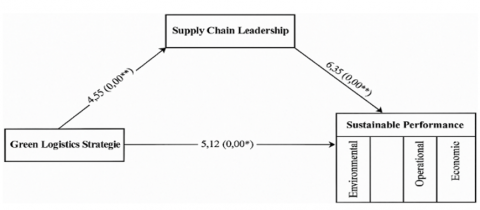
H1: GLS positively influences SP in the economy, operations, and environment. The t-statistic (5.12) is substantial, confirming the positive and significant, path coefficient of 0.45. H2: SCL positively contributes to SP with a significant t-statistic (6.35), and a strong path coefficient (0.52); thus, leadership is likely a strong influence on sustainability enhancement of sustainability. H3: The path coefficient (0.38) is significant (t-statistic = 4.55) that relates that leadership of supply chain and GLS improves SP. This provides evidence that the advantages of green logistics approaches change as a result of leadership.
According to these findings, SCL and GLS are both essential to enhancing SP in all aspects, with leadership amplifying the benefits of GLS (Figure 1).
Figure 1. Structural model
The first hypothesis explored the relationship between GLS and SP. The results (path coefficient = 0.45; t-statistic = 5.12) reveal a moderate positive relationship and lend credence to earlier work that green logistics can enhance environmental, operational and ECP [27, 39]. Li et al. [40] confirmed that green logistics can improve operational efficiency and reduce overall environmental footprints, while Sarkis [41] also revealed ‘cost efficiencies stemming from cost reduction from waste minimisation and energy-saving methods.’ Other studies have yielded inconsistent results in respective industrial and geographic domains. Some have recognised little or no effect of green logistics, largely due to its high cost of implementation, insufficient infrastructure, and/or difficulties related to organizational inertia - especially in developing economies [4]. Furthermore, the overwhelming majority of evidence comes from developed countries and consequently little is known about the transferability/validity of these results to developing contexts like Jordan [42, 43]. Our work attempts to address this gap, conducting the first empirical test of the environmental, operational and economic benefits of green logistics in a developing-country pharmaceutical context. The second hypothesis involved examining the influence of SCL on SP. The results of that model (path coefficient = 0.52; t-statistic = 6.35) indicate a strong positive relationship and corroborate previous work by Mokhtar et al. [44] who suggest that leadership, in particular, plays a central role in securing organisational commitment to sustainability. Aligning with evidence that leadership behaviors emphasize the support and use of sustainability practices, nevertheless much of the prior literature has conceptualized SCL broadly without always connecting these features to definitive sustainability outcomes [45]. Others have focused on leadership styles without openly controlling for, or explicitly testing, their influence on sustainable logistics practices, in turn leading to vagueness about which leadership features shape and are favorable toward sustainability initiatives in a meaningful way [14, 46]. This study furthers this path, empirically identifying SCL as being not only important but a condition for sustainability performance to emerge in logistics demanding industries.
The third hypothesis tested SCL as a moderator of the relationship between a firm's commitments to GLS and SP. The positive interaction effect serves as evidence that a firm committing to green logistics will achieve more favorable performance when animated by strong leadership (path coefficient = 0.38; t-statistic = 4.55). This finding aligns with prior research highlighting how leadership can ease resource allocation, propel innovation, overcome behavioral inertia, and comfort when employing and integrating a green environment into the practices [17, 18]. Many prior studies have looked at leadership and at green logistics, but not interactively, missing the features through which leadership sustains and orients green logistics to produce superior performance outcomes [47]. By elaborating this observation with evidence that shows mutually reinforcing influences drawing SCL and green logistics together, this study generates evidence supporting the interaction between both constructs, leading to better knowledge about how sustainability performance is realised.
The findings are valuable, although they come with methodological limitations endemic to purposive, non-probability sampling strategies. Based on administrative employees in pharmaceutical warehouses, the headline finding and emergent implications may not be broadly transferable if the sample is indicative or representative of all stakeholder groups affecting logistics and sustainability decisions. Such use of sampling is admissible in emergencies where respondents present a knowledgeable basis about the leadership and operational practices discussed. Future suggestions would be probabilistic, confirming extension to other domains and national contexts.
6.1 Theoretical and practical implications
The study makes a theoretical contribution to the literature by addressing a lacuna in our understanding of how SCL influences green logistics through the lens of sustainability, an almost under-researched link particularly in a developing context like Jordan. The study’s empirical findings elucidate how environmentally-friendly logistics practices are dissimilar in their respective environmental, operational and economic effects [1, 22, 42, 43].
In addition to this contribution, the study contributes theoretically by applying the Natural-Resource-Based View (NRBV) and Leadership Contingency Theory to the field of green logistics and green supply chain sustainability. In keeping with NRBV, we found that GLS represent strategic environmental capabilities whose essence lies in pollution prevention, resource efficiencies and operational sustainability, whose antecedents (green supply chain leadership) and consequent green qualities contribute to improvements in EP, OP and ECP dimensions. NRBV’s hypothesis that environmentally-related capabilities do lead to the opportunity for sustained competitive advantages is accentuated here in resource-intensive and regulated industries such as pharmaceutical warehouses in developing countries [48-50].
The study contributes to Leadership Contingency Theory by showing how the efficacy of SCL is contingent upon the availability of green capabilities and environmentally-related operating conditions. The literature argues that leaders who enact work behaviours relevant to sustainability objectives are more effective at mobilising an organisation’s resources, stimulating green innovation and increasing the extent to which green logistics capabilities generate SP [49-51]. This comprehensive theoretical framework conceptualises leadership as a contingency that promotes the impact of environmental capabilities on performance and provides insight into how leaders’ enactment of behaviours interacts with structural conditions to facilitate sustainability in complex logistical environments. The findings present a number of practical implications for managers of pharmaceutical warehouses. Pharmaceutical warehouse operators may benefit from investing in leadership development programs that encourage sustainability-oriented leader behaviours, bridging training with green logistics planning, environmental decision-making and collaborative problem-solving exercises. Building this competence assists leaders who support with scaffolding the application of green logistics. Pharmaceutical warehouse managers should dedicate resources to institutionalizing operational green practices ranging from adopting energy- and water-efficient technical solutions, improving the logistics operation in ways that improve transport path planning solution generation, waste reduction workflow, eco-efficient packaging and so forth. Finally fostering a sustainability-oriented culture in turn gently oriented employees towards green initiatives, linking rewards toward good performance against sustainability metrics and developing desirable EP metrics can yield improvements in environmental, operational and ECP whilst fostering resilience of pharmaceutical warehouses operating in environments that are highly dependent on local natural resources and also formally regulated.
6.2 Limitations and future research
Several limitations of this study should be acknowledged. First, this study examines GLS in pharmaceutical warehouses in Jordan, so the results cannot be generalised to other countries or cultural or industrial contexts. Women’s work behaviours related to leadership, sustainability adoption and existential land transport logistics in general are, for example, a function of national culture [42, 43]. Future studies could explore the relationships we examined in different countries to determine their comparability across countries. Second, this study uses a single-informant design – that is, we collected data in all cases only in a single report from a survey from administrative employees. Using a single informant opens up the likelihood of common-method variance or bias based on respondents’ subjective informant ratings of all survey items. Addressing this possible bias by using multi-informant or multi-source data in the form of managerial reports, trace data or environmental audits would enhance measurement validity [52]. We focus on self-reports as sampling methodology, given that many other studies in logistics and sustainability research ask respondents who are typically fore-members and thus experts in logistics work and leaders’ work behaviours. Third, we used a cross-sectional design that prevented us from inferring causal relationships within our data. Longitudinal designs provide additional evidence of the assumed temporal ordering of effects and stronger evidence of causal effects over longer terms. Examining how leaders influence the emission of GLS might be particularly fruitful in using this approach. Future studies that use introductory techniques for applying longitudinal or mixed-method research might be more salient for understanding the pace at which GLS are emplaced and the ways that leadership(s) and infrastructures influence or modulate emergent green-logistical paradigms. Finally, while we focused on GLS and SCL, other factors may also shape SP that we could not include in our modelling: Regulatory enforcement, infrastructures, or supplier fodder, would be potentially important to investigate in future research.
This study shows that both green logistics practices and SCL enhance SP in pharmaceutical warehouses. Green logistics practices enhance environmental, operational and ECP whilst SCL boosts the effects of green logistics on performance and provides further behavioural backing for such strategies. The strong direction effect found shows that environmental capabilities have more positive performance effects when matched by leadership behaviours which help overcome resistance and inertia, hence the need to ensure effective leadership in resource rich industries. We address important gaps in the literature by presenting empirical data in a developing country context as well as demonstrating how leadership and green logistics practices interact to affect SP. To extend the current findings, we suggest the proposed model be tested using data from other industries and national settings to support the generalizability of results. Longitudinal study designs hold promise for revealing more insights about how sustainability practices develop over time and how leadership affects the long-term success of green logistics practices in industry. We suggest examining complementary factors such as technological readiness, regulatory influence, and supply chain-related dimensions for a more holistic view of SP drivers.
The authors would like to express their gratitude to Amman Arab University and Sharaya Drug Store Company for their priceless cooperation and understanding that improved the research process, as well as for their assistance and vital resources that were important in enabling them to finish this work.
[1] Khan, F., Ali, Y. (2022). Implementation of the circular supply chain management in the pharmaceutical industry. Environment, Development and Sustainability, 24(12): 13705-13731. https://doi.org/10.1007/s10668-021-02007-6
[2] Nozari, H., Szmelter, A. (Eds.). (2018). Global Supply Chains in the Pharmaceutical Industry. IGI Global.
[3] Wang, J., Feng, T. (2023). Supply chain ethical leadership and green supply chain integration: A moderated mediation analysis. International Journal of Logistics Research and Applications, 26(9): 1145-1171. https://doi.org/10.1080/13675567.2021.2022640
[4] Yingfei, Y., Mengze, Z., Zeyu, L., Ki-Hyung, B., Avotra, A.A.R.N., Nawaz, A. (2022). Green logistics performance and infrastructure on service trade and environment-measuring firm’s performance and service quality. Journal of King Saud University-Science, 34(1): 101683. https://doi.org/10.1016/j.jksus.2021.101683
[5] Laguir, I., Stekelorum, R., El Baz, J. (2021). Going green? Investigating the relationships between proactive environmental strategy, GSCM practices and performances of third-party logistics providers (TPLs). Production Planning & Control, 32(13): 1049-1062. https://doi.org/10.1080/09537287.2020.1784483
[6] Al-Awamleh, H.K., Alhalalmeh, M.I., Alatyat, Z.A., Saraireh, S., Akour, I., Alneimat, S., Alathamneh, F.F., Abu-Farha, Y.S., Al-Hawary, S.I.S. (2022). The effect of green supply chain on sustainability: Evidence from the pharmaceutical industry. Uncertain Supply Chain Management, 10(4): 1261-1270. https://doi.org/10.5267/j.uscm.2022.8.002
[7] Baah, C., Amponsah, K.T., Issau, K., Ofori, D., Acquah, I.S.K., Agyeman, D.O. (2021). Examining the interconnections between sustainable logistics practices, environmental reputation and financial performance: A mediation approach. Vision, 25(1): 47-64. https://doi.org/10.1177/0972262920988805
[8] Wu, H.J., Dunn, S.C. (1995). Environmentally responsible logistics systems. International Journal of Physical Distribution & Logistics Management, 25(2): 20-38. https://doi.org/10.1108/09600039510083925
[9] Ping, L. (2009). Strategy of green logistics and sustainable development. In 2009 International Conference on Information Management, Innovation Management and Industrial Engineering, Xi'an, China, 1: 339-342. https://doi.org/10.1109/ICIII.2009.89
[10] Ren, R., Hu, W., Dong, J., Sun, B., Chen, Y., Chen, Z. (2020). A systematic literature review of green and sustainable logistics: Bibliometric analysis, research trend and knowledge taxonomy. International Journal of Environmental Research and Public Health, 17(1): 261. https://doi.org/10.3390/ijerph17010261
[11] Ahsan, M.J. (2025). Green leadership and innovation: Catalysts for environmental performance in Italian manufacturing. International Journal of Organizational Analysis, 33(7): 1646-1669. https://doi.org/10.1108/IJOA-04-2024-4450
[12] Amayreh, K.T., Alarabiat, Y.A. (2025). Enhancing supply chain pharmaceutical management in Jordan: The role of digital transformation. Hunan Daxue Xuebao/Journal of Hunan University Natural Sciences, 62(4): 1-16. https://doi.org/10.5281/zenodo.15166715
[13] Gosling, J., Jia, F., Gong, Y., Brown, S. (2016). The role of supply chain leadership in the learning of sustainable practice: Toward an integrated framework. Journal of Cleaner Production, 137: 1458-1469. https://doi.org/10.1016/j.jclepro.2014.10.029
[14] Esangbedo, C.O., Zhang, J., Perez, P.B., Skitmore, M. (2024). Sustainable performance and supply chain leadership in logistic firms: The role of corporate sustainability strategies and digital supply chain. Supply Chain Management: An International Journal, 29(6): 963-977. https://doi.org/10.1108/SCM-02-2024-0131
[15] Al-Zaqebaa, M.A.A., Jaraha, B.A.F., Ineizeha, N.I., Almatarneha, Z., Jarraha, M.A.A. (2022). The impact of managerial accounting and blockchain characteristics on supply chain efficiency. Uncertain Supply Chain Management, 10(2): 973-982. https://doi.org/10.5267/j.uscm.2022.2.016
[16] Jum’a, L., Zimon, D., Ikram, M. (2021). A relationship between supply chain practices, environmental sustainability and financial performance: Evidence from manufacturing companies in Jordan. Sustainability, 13(4): 2152. https://doi.org/10.3390/su13042152
[17] Dubey, R., Gunasekaran, A., Papadopoulos, T. (2017). Green supply chain management: Theoretical framework and further research directions. Benchmarking: An International Journal, 24(1): 184-218. https://doi.org/10.1108/BIJ-01-2016-0011
[18] Chienwattanasook, K., Onputtha, S. (2022). The impact of inspirational leadership on green supply chain management and organizational performance of food and beverage companies. Asian Administration & Management Review, 5(1). https://doi.org/10.2139/ssrn.4086035
[19] Kebe, I.A., Liu, Y., Kahl, C. (2025). Greener solutions: Green transformational leadership and sustainable environmental outcomes within Sierra Leone’s telecom sector. Journal of Cleaner Production, 517: 145811. https://doi.org/10.1016/j.jclepro.2025.145811
[20] Hair, J.F. (2014). A Primer on Partial Least Squares Structural Equation Modeling (PLS-SEM) 3rd ed. Sage.
[21] Hair, J.F., Risher, J.J., Sarstedt, M., Ringle, C.M. (2019). When to use and how to report the results of PLS-SEM. European Business Review, 31(1): 2-24. https://doi.org/10.1108/EBR-11-2018-0203
[22] Kock, N., Hadaya, P. (2018). Minimum sample size estimation in PLS-SEM: The inverse square root and gamma-exponential methods. Information Systems Journal, 28(1): 227-261. https://doi.org/10.1111/isj.12131
[23] Gruchmann, T. (2018). Advanced green logistics strategies and technologies. In Operations, Logistics and Supply Chain Management. Cham: Springer International Publishing, pp. 663-686. https://doi.org/10.1007/978-3-319-92447-2_29
[24] Wang, X. (2019). Study on relationship between green logistics activity and logistics performance. Cluster Computing, 22(Suppl 3): 6579-6588. https://doi.org/10.1007/s10586-018-2344-3
[25] Wiredu, J., Yang, Q., Sampene, A.K., Gyamfi, B.A., Asongu, S.A. (2024). The effect of green supply chain management practices on corporate environmental performance: Does supply chain competitive advantage matter?. Business Strategy and the Environment, 33(3): 2578-2599. https://doi.org/10.1002/bse.3606
[26] Wong, C.Y., Wong, C.W., Boon-Itt, S. (2020). Effects of green supply chain integration and green innovation on environmental and cost performance. International Journal of Production Research, 58(15): 4589-4609. https://doi.org/10.1080/00207543.2020.1756510
[27] Trivellas, P., Malindretos, G., Reklitis, P. (2020). Implications of green logistics management on sustainable business and supply chain performance: Evidence from a survey in the Greek agri-food sector. Sustainability, 12(24): 10515. https://doi.org/10.3390/su122410515
[28] Iqbal, Q., Ahmad, N.H., Halim, H.A. (2020). How does sustainable leadership influence sustainable performance? Empirical evidence from selected ASEAN countries. Sage Open, 10(4): 2158244020969394. https://doi.org/10.1177/2158244020969394
[29] Chen, S.L., Su, Y.S., Diep, G.L., Sivanandan, P., Sadiq, M., Phan, T.T.H. (2023). Retracted article: The impact of environmental knowledge and green supply chain practices in improving sustainable energy production: The moderating role of green behavior and green leadership. Environmental Science and Pollution Research, 30(19): 57017-57031. https://doi.org/10.1007/s11356-023-26340-7
[30] Zhang, W., Zhang, M., Zhang, W., Zhou, Q., Zhang, X. (2020). What influences the effectiveness of green logistics policies? A grounded theory analysis. Science of the Total Environment, 714: 136731. https://doi.org/10.1016/j.scitotenv.2020.136731
[31] Petter, S. (2018). "Haters gonna hate": PLS and information systems research. ACM SIGMIS Database: The Database for Advances in Information Systems, 49(2): 10-13. https://doi.org/10.1145/3229335.3229337
[32] De, D., Chowdhury, S., Dey, P.K., Ghosh, S.K. (2020). Impact of lean and sustainability oriented innovation on sustainability performance of small and medium sized enterprises: A data envelopment analysis-based framework. International Journal of Production Economics, 219: 416-430. https://doi.org/10.1016/j.ijpe.2018.07.003
[33] De Souza, E.D., Kerber, J.C., Bouzon, M., Rodriguez, C.M.T. (2022). Performance evaluation of green logistics: Paving the way towards circular economy. Cleaner Logistics and Supply Chain, 3: 100019. https://doi.org/10.1016/j.clscn.2021.100019
[34] AlBrakata, N.S.A., Al-Hawaryb, S.I.S., Muflihc, S.M. (2023). The effect of green supply chain on export performance. Uncertain Supply Chain Management, 11(2): 613-624. https://doi.org/10.5267/j.uscm.2023.2.003
[35] Campbell, S., Greenwood, M., Prior, S., Shearer, T., Walkem, K., Young, S., Bywaters, D., Walker, K. (2020). Purposive sampling: Complex or simple? Research case examples. Journal of Research in Nursing, 25(8): 652-661. https://doi.org/10.1177/1744987120927206
[36] Cheah, J.H., Magno, F., Cassia, F. (2024). Reviewing the SmartPLS 4 software: The latest features and enhancements. Journal of Marketing Analytics, 12: 97-107. https://doi.org/10.1057/s41270-023-00266-y
[37] Agyabeng-Mensah, Y., Ahenkorah, E., Afum, E., Nana Agyemang, A., Agnikpe, C., Rogers, F. (2020). Examining the influence of internal green supply chain practices, green human resource management and supply chain environmental cooperation on firm performance. Supply Chain Management: An International Journal, 25(5): 585-599. https://doi.org/10.1108/SCM-11-2019-0405
[38] Hair, J.F., Hult, G.T.M., Ringle, C.M., Sarstedt, M. (2022). A Primer on Partial Least Squares Structural Equation Modeling (PLS-SEM) (3rd ed.). Sage. https://doi.org/10.1007/978-3-030-80519-7
[39] Vienažindienė, M., Tamulienė, V., Zaleckienė, J. (2021). Green logistics practices seeking development of sustainability: Evidence from Lithuanian transportation and logistics companies. Energies, 14(22): 7500. https://doi.org/10.3390/en14227500
[40] Li, X., Sohail, S., Majeed, M.T., Ahmad, W. (2021). Green logistics, economic growth, and environmental quality: Evidence from One Belt and Road initiative economies. Environmental Science and Pollution Research, 28(24): 30664-30674. https://doi.org/10.1007/s11356-021-12839-4
[41] Sarkis, J. (2022). The circular economy and green supply chains. In Global Logistics and Supply Chain Strategies for the 2020s: Vital Skills for the Next Generation. Cham: Springer International Publishing, pp. 83-100. https://doi.org/10.1007/978-3-030-95764-3_5
[42] Alzubi, E., Akkerman, R. (2022). Sustainable supply chain management practices in developing countries: An empirical study of Jordanian manufacturing companies. Cleaner Production Letters, 2: 100005. https://doi.org/10.1016/j.clpl.2022.100005
[43] Yassine, F.L.Y.A. (2022). The impact of green supply chain management practices on business performance of extractive industries in Jordan. Academy of Entrepreneurship Journal, 28(S4): 1-12.
[44] Mokhtar, A.R.M., Genovese, A., Brint, A., Kumar, N. (2019). Improving reverse supply chain performance: The role of supply chain leadership and governance mechanisms. Journal of Cleaner Production, 216: 42-55. https://doi.org/10.1016/j.jclepro.2019.01.045
[45] Negri, M., Cagno, E., Colicchia, C., Sarkis, J. (2021). Integrating sustainability and resilience in the supply chain: A systematic literature review and a research agenda. Business Strategy and the Environment, 30(7): 2858-2886. https://doi.org/10.1002/bse.2776
[46] Khan, S.A.R., Dong, Q.L., Yu, Z. (2016). Research on the measuring performance of green supply chain management: In the perspective of China. International Journal of Engineering Research in Africa, 27: 167-178. https://doi.org/10.4028/www.scientific.net/JERA.27.167
[47] Lau, Y.Y., Ng, A.W. (2021). Climate change leadership in the Logistics Industry. In Handbook of Climate Change Management. Springer International Publishing, pp. 1-23. https://doi.org/10.1007/978-3-030-22759-3_279-1
[48] Mahar, A.S., Zhang, Y., Sadiq, B., Gul, R.F. (2025). Sustainability transformation through green supply chain management practices and green innovations in Pakistan’s manufacturing and service industries. Sustainability, 17(5): 2204. https://doi.org/10.3390/su17052204
[49] Russo, M.V., Fouts, P.A. (1997). A resource-based perspective on corporate environmental performance and profitability. Academy of Management Journal, 40(3): 534-559. https://doi.org/10.5465/257052
[50] House, R., Mitchell, T. (1974). Path-goal theory of leadership. Contemporary Business, 3: 81-98.
[51] Al-Rehial, S., Megdadi, Y. (2023). The impact of supply chain strategies on enhancing organizational performance: Mediating role of teamwork in Jordanian Government Hospitals. In International Conference on Business and Technology. Cham: Springer Nature Switzerland, pp. 139-151. https://doi.org/10.1007/978-3-031-54009-7_13
[52] Rindfleisch, A., Malter, A.J., Ganesan, S., Moorman, C. (2008). Cross-sectional versus longitudinal survey research: Concepts, findings, and guidelines. Journal of Marketing Research, 45(3): 261-279. https://doi.org/10.1509/jmkr.45.3.261