Martin A. Aweh* | Tossou Atchrimi
© 2025 The authors. This article is published by IIETA and is licensed under the CC BY 4.0 license (http://creativecommons.org/licenses/by/4.0/).
OPEN ACCESS
Sustainable urban development calls for policies that ensure safe and inclusive access to public open spaces, yet little is known about implementation in fragile urban contexts. Focused on Kaya, a fragile city of Burkina Faso, this study examines how official discourses and the perceptions of urban public action actors explain the challenges of implementing policies for accessible and inclusive public open spaces (POS). We conducted 14 unstructured interviews with urban actors and analysed 8 urban policy and planning documents from 2006 to 2024. Data were coded in NVivo 15 using a hybrid analytic approach combining a deductive framework derived from the research question and literature with inductive coding for emergent themes. Two recurrent patterns stand out: (i) diversion of planned public open spaces to other uses; and (ii) the persistence of undeveloped, non-functional, public open spaces, revealing a gap between the official discourse, which reaffirms the right to the city and spatial justice, and the perceived reality. Drawing on these findings, we propose an actionable framework for fragile cities that implies (1) publicising and enforcing land-use rules; (2) reserving space for informal activities to free land for POS and promote multifunctional spaces; and (3) prioritising accessibility/inclusiveness on political agendas.
accessibility, fragility, inclusiveness, public action, public open space, spatial justice
Access for all to public open spaces such as green spaces, public gardens, urban parks, public squares, playgrounds and recreation areas in cities is a major challenge for achieving the SDGs. According to the New Urban Agenda guidelines, the planning, design, preservation and use of public spaces require appropriate policy and legal frameworks, standards and practices, and holistic and integrated approaches [1]. However, in the context of sub-Saharan Africa, a number of authors have highlighted the failures of urban policies in the face of the challenges of socio-spatial injustices created by accelerated urban growth [2-5].
As early as the 1980s, an analysis of urban planning policies in developing countries showed that, faced with the limitations of urban planning based on large-scale urban development schemes, public authorities were turning to smaller-scale urban projects and urban management, often involving the participation of local people and the private sector [6]. Despite these adjustments, the literature two decades later has shown that socio-spatial inequalities in sub-Saharan cities remain unresolved by the succession of urban policies developed [5, 7, 8]. According to Owusu and Crentsyl [9], the reforms inspired by neo-liberal paradigms since the 1980s that have guided policies to modernise African cities have led to unequal and fragmented urbanisation, calling into question the right to the city for all.
In Burkina Faso, urbanisation has intensified over the past decade as a result of the cumulative effect of population growth and the security crisis, which has led to an influx of displaced people from rural areas to urban centres considered safer [10, 11]. This urbanisation is fuelling multidimensional fragility, illustrated by significant political, economic, social, security and climate challenges [12, 13]. In fragile cities, social inequalities are glaring and public authorities have insufficient capacity to respond to political, social, economic, security and environmental challenges [14-17].
In Kaya, one of the secondary towns hard hit by the effects of the security crisis, several multinational and national actors are working alongside the State and the municipality to implement urban projects aimed at providing access for all to basic urban infrastructure and facilities [18]. Although the literature deals extensively with the challenges of urban planning in West Africa and the structural limits of public policies [2, 5, 7, 19], few studies have looked in depth at the extent to which the context of fragility influences the effective implementation of urban policies, particularly those aimed at inclusive access to public open spaces. Similarly, few studies have analysed the perceptions of those involved in urban public action (public officials, private sector actors, multinational partners, civil society organisations) on these issues in a context of fragility.
Considering the perspective of sustainable urban development set by the New Urban Agenda [1], the following question is at the heart of the article: How do official discourses and the perceptions of actors involved in urban public action explain the challenges of implementing policies for accessible and inclusive public open spaces in Kaya, Burkina Faso? We hypothesise that challenges perceived by public action actors in implementing policies for accessible and inclusive public open spaces in Kaya are manifestations of urban fragility, where deficits of authority, capacity, and legitimacy undermine policy effectiveness. The study aims to explore how official discourses and the perceptions of urban public action actors explain the challenges of implementing policies for accessible and inclusive public open spaces in Kaya, Burkina Faso. The study uses a qualitative approach and a theoretical framework built around the right to the city, spatial justice, urban fragility and public action to conduct the investigations. The data is drawn from a documentary analysis of national and local urban policies and from non-directive interviews conducted with urban public action actors. The article proceeds with the literature review, then methods, followed by results and discussion, and concludes with implications for policy in fragile urban contexts.
2.1 Accessibility and inclusiveness: Two dimensions of the right to the city and spatial justice in the city
Accessibility and inclusiveness in the city can be analysed from the perspective of the right to the city and spatial justice. The right to the city formulated by Lefebvre [20] was originally a utopian and revolutionary claim that has been revived in the light of the challenges of urbanisation and sustainable urban development [21]. Although there are contradictions as to how the right to the city should be put into practice, it is important to note that this notion has now been taken up by international organisations advocating the inclusive urbanisation of cities [9]. According to UN-Habitat, the right to the city advocates urban humanism that translates into equitable access to urban resources, the right of all to security and participation in city management [1]. This principle establishes a strong link between inclusive urban development and spatial justice, understood as the capacity of public policies to correct inequalities in the use of and access to urban spaces, infrastructure and services [22, 23].
From this perspective, accessibility and inclusiveness appear to be two cardinal dimensions of spatial justice and the right to the city. Aweh et al. [24] approach accessibility from the angles of physical, social, and economic access to public resources and services, taking as examples factors such as distance, specific facilities for the elderly or disabled, cost conditions, and safety concerns. Inclusivity analyses the participation of people in the design and management of facilities and services, social justice through the absence of discrimination against social groups based on identity, and cohesion among different social groups in the city. Yet, even when policies claim to guarantee such accessibility and inclusiveness, forms of exclusion persist in practice.
In relation to public spaces, exclusion does not always involve formal bans. According to Margier [25], it can be constructed through local practices of appropriation and tacit norms, establishing a "soft dispersion" that reclassifies the uses of public space and sidelines certain groups. According to Van Hollebeke et al. [26], the formal accessibility of a public space can mask forms of exclusion aimed at users perceived as undesirable; in such cases, physical, social or regulatory barriers are (re)put in place.
Drawing on a case study in Ouagadougou (Burkina Faso), Biehler [27] shows how urban modernisation projects can, in fact, constrain the accessibility of public spaces for specific social groups. This situation is explained by the fact that distance, cost, and travel time act as social filters that exacerbate inequalities, especially for residents forced to relocate to the outskirts. The author also notes that the forms of management (privatisation or public management) and the quality of maintenance of public spaces influence their accessibility by either reducing or encouraging their use [27].
2.2 Urban policies and the context of urban fragility
Urban policies set out the intentions of public authorities in terms of the organisation, operation and regulation of urban centres. According to UN-Habitat [28], all urban policies aim to improve the economic, social and environmental functioning of cities by responding to the challenges posed by urban growth and growing inequalities. Chenal [29] distinguishes three levels of intervention by public authorities in the city: urban policies, which provide the general framework and way of thinking about the city; urban planning, which provides a long-term vision of the city; and urban management, which consists of the day-to-day implementation of urban policies and plans.
The effectiveness of urban policies depends very much on the context in which they are implemented. The notion of urban fragility is an approach that provides in-depth knowledge of territories. The concept of urban fragility emerged alongside that of state fragility at the turn of the 1990s [30]. A fragile State or a fragile city combines two conditions that put the risks of its collapse or dislocation into perspective: on the one hand, the territory faces risks that may be political, security, economic, social or environmental, and on the other hand, the actors in the territory are unable to cope with these risks [15]. Fragility is analysed alongside resilience, which reflects the ability of stakeholders to adapt to or recover from shocks [31]. To be effective, the OECD stresses that public policies must be based on local dynamics and the resilience of stakeholders [13].
2.3 Public action as a framework for analysing policies on the accessibility and inclusiveness of public open spaces
According to Spyridonidis [32], beyond the multiple definitions, public space can be understood as the spatial translation of a historically, socially and culturally defined collectivity. In other words, public space is a place where social actors can co-presence outside their domestic setting [33]. Chenal [29] points out that, unlike other types of space in the city, public spaces are in principle free of any construction. Public spaces, including streets, pavements, squares, gardens and parks, as well as wasteland, vacant lots, car parks, etc., have essential urban functions: distribution and circulation [34].
Public spaces are now a central issue in sustainable urban planning, particularly in African cities where rapid urbanisation is not accompanied by sufficient public infrastructure, facilities, and services [5, 35]. An integral part of public spaces, public open spaces refer more specifically to vacant land or lightly built-up areas accessible to the public and used for leisure purposes [33], and which contribute to the quality and beauty of the environment [24, 36].
Policies aimed at improving the accessibility and inclusiveness of public open spaces are a matter for public action. Public action is defined as all the interactions between the state and a variety of actors that enable public policies to be implemented [37]. As a sociological approach, public action highlights the negotiated and conflictual dimension of public solutions to problems of general interest [38]. The analysis of public action aims to provide answers to three main components of any public policy: the aims and objectives of the action, the instruments and mechanisms used, and the effects and perceptions of the actors [39].
In a context where a diversity of actors are involved in public action, often with divergent rationales, representations and interests, these actors can be seen as strategic actors in the sense of Crozier and Friedberg [40], as intelligent actors guided by their stakes, constraints and resources.
3.1 Study area
The study area is Burkina Faso, with the town of Kaya as the empirical field site. Burkina Faso, the former Upper Volta, is a landlocked Sahelian country in West Africa with a surface area of 274,000 km² and an estimated population of 20,505,155 in 2019, 51.7% of whom are women (Figure 1) [41]. The urbanisation rate rose from 6.4% in 1975 to 26.1% in 2019, quadrupling the urban population in 45 years. Since 2015, mainly due to the spiral of terrorism and political instability in the Sahel region, Burkina Faso has been classified as a fragile country [13, 42]. Kaya, a secondary town in the north of the country, has been severely affected by the combined effects of rapid urbanisation, insecurity and the influx of internally displaced people [14].
3.2 Study design
The nature of the research question guided the choice of a qualitative approach to conduct the study. This so-called comprehensive approach seeks to analyse the actors as they act, based on their discourse, their intentions and the terms and conditions of their actions and interactions [43]. At the heart of the qualitative approach is the actor, that is the individual or collective person who is not considered as a simple subject but as an agent of action [44]. Two qualitative methods were used to conduct the study: documentary analysis and individual interviews. Based on the theoretical foundations described above, the conceptual framework of the study (Figure 2) illustrates the relationships between urban fragility, public action, the right to the city, spatial justice and accessibility and inclusiveness of public open spaces.
Figure 2. Conceptual framework
3.3 Methodological process
The methodological process adopted for this qualitative study is summarised in Figure 3, which outlines the sequence linking data collection, analysis, and interpretation.
Figure 3. Overview of the qualitative methodological process
3.4 Documentary analysis
Bowen [45] defines documentary analysis as a qualitative and systematic approach that consists of examining and interpreting documents (printed or digital) with a view to extracting meaning, better understanding a phenomenon, and producing empirical knowledge. This method was chosen for our study because of its advantages: the availability of public documents, which are generally freely accessible, and the approach's efficiency, which allows us to obtain the data from the document selection stage onward.
Figure 4. Burkina Faso national policy architecture
Table 1. List of documents selected
|
Policy Title |
Policy Scale |
Policy Type |
Year of Publication |
Issuing Institution |
Ref. |
|
National Decentralisation Policy |
National |
Policy |
2017 |
Ministry of Territorial Administration and Decentralization, Burkina Faso |
[46] |
|
National Urban Reconfiguration Strategy |
National |
Policy |
2024 |
Ministry of Urban Planning and Housing, Burkina Faso |
[47] |
|
National Housing and Urban Development Strategy |
National |
Policy |
2021 |
Ministry of Urban Planning, Housing and the City, Burkina Faso |
[48] |
|
Urbanism and Construction Law |
National |
Law |
2006 |
National Assembly, Burkina Faso |
[49] |
|
National Law on Land Use Planning and Sustainable Development |
National |
Law |
2018 |
National Assembly, Burkina Faso |
[50] |
|
Urban Planning Reference Framework |
national |
Regulation |
2024 |
General Directorate of Urban Planning, Servicing and Topography, Burkina Faso |
[51] |
|
Kaya Master Plan |
local |
Plan |
2014 |
BADCOM and General Directorate of Urban Planning, Topography and Servicing, Burkina Faso |
[52] |
|
Land Use Plan for the City of Kaya |
local |
Plan |
2021 |
Municipality of Kaya and General Directorate of Urban Planning, Servicing and Topography, Burkina Faso |
[53] |
The targeted documents span multiple levels of Burkina Faso’s national policy architecture (Figure 4). Moreover, operational policy instruments that explicitly frame the accessibility and inclusiveness of public open spaces at the national and municipal levels were preferred. Documents were screened for (i) scale of action (national frameworks and Kaya-specific instruments), (ii) nature and legal force (laws, strategies, master/land-use plans, guides), and (iii) relevance, authenticity and public accessibility. We initially identified a larger pool, but removed obsolete drafts and broad cross-sector strategies that only indirectly affected public open spaces. The final corpus of eight documents provides non-redundant coverage of the policy landscape related explicitly to accessibility and inclusiveness of public open spaces. The selected documents are presented in Table 1.
3.5 Conduct of the interviews
To gather the perceptions of urban public action stakeholders, we opted for the research interview as defined by Wengraf [54]. In this approach, the aim is to encourage the interviewee to produce continuous discourse, with the interviewer limiting himself to follow-up questions designed to elicit further speech or to clarify what the interviewee is saying. This approach allows the respondent's own representations, experiences, and logic to emerge while minimising the influence of the researcher's imposed structure.
3.5.1 Participants and recruitment method
The interview involved 14 male and female participants aged between 35 and 60. Profiles span five actor groups: central state administrations, municipal services, urban planners/consultants, development partners, and civil society. Inclusion required direct involvement in POS planning/management or related urban policies. Participants were recruited by purposive sampling to cover these five groups, complemented by targeted referrals. Table 2 presents interview participants, codes and characteristics.
Table 2. Interview participants, codes and characteristics
|
Code |
Occupation/Role |
Gender |
Years of Experience |
Sector |
|
P1 |
National urban planning official |
Male |
20-25 |
Public |
|
P2 |
National urban planning official |
Female |
10-15 |
Public |
|
P3 |
National Environment Department official |
Male |
4-10 |
Public |
|
P4 |
Kaya Municipal executive |
Female |
5-10 |
Public |
|
P5 |
Kaya Municipal land services official |
Male |
5-10 |
Public |
|
P6 |
Kaya Municipal technical officer |
Male |
0-5 |
Public |
|
P7 |
Kaya Municipal technical officer |
Female |
0-5 |
Public |
|
P8 |
Planning/architecture consultant |
Male |
25-30 |
Private |
|
P9 |
Planning/architecture consultant |
Male |
20-25 |
Private |
|
P10 |
Planning/architecture consultant |
Male |
20-25 |
Private |
|
P11 |
International development agency staff |
Male |
25-30 |
Development partner |
|
P12 |
Bilateral cooperation programme staff |
Female |
10-15 |
Development partner |
|
P13 |
Civil society organisation leader (housing) |
Male |
5-10 |
Civil society |
|
P14 |
Women traders’ association member |
Female |
15-20 |
Civil society |
Sample size followed the information power principle [55]: given our focused aim, a theory-informed coding frame, and information-rich informants, a modest number of participants was sufficient. We applied an iterative stopping rule: after coding 12 interviews, we continued until two consecutive interviews produced no new first-order codes. Saturation was reached at 14 interviews, and the final two interviews primarily elaborated existing themes rather than generating new ones. While Guest et al. [56] advise larger samples for heterogeneous groups (often 20 to 40 participants), our narrow scope, high participant expertise, and triangulation with eight policy/planning documents increased information power and justified closure at 14.
3.5.2 Data collection
Data was collected using non-directive interviews in French, the official language of Burkina Faso. The theme of the interview was "The challenges of implementing accessibility and inclusiveness policies for public open spaces in Kaya, Burkina Faso". The data was recorded using smartphones and then transcribed into Word. All participants provided informed consent, and all data were anonymised.
3.6 Thematic analysis of documents and interviews with NVivo 15
Thematic analysis consists of identifying the ideas that emerge from the data and organising them into themes related to the issue under study of Fereday and Muir-Cochrane [57]. The thematic analysis in this work was based on a hybrid analytic strategy. A deductive parent codebook was derived from the research questions and relevant literature, then inductively expanded during interview coding with child codes for unanticipated patterns. The consolidated codebook was then applied to all interviews and documents. To avoid the risk of circularity [43], relevant codes were added as the reading progressed when the data revealed aspects not anticipated by the theory. The coding grid was entered, the documents coded and the results interpreted using NVivo 15 software.
The unit of analysis was the paragraph for interview transcripts, and the policy article or paragraph for documents. We kept a full audit trail, including a versioned codebook, analytic memos for each interview and document, and brief notes documenting key analytical decisions. The first author carried out coding. To strengthen dependability, we used memo-based checks of how codes were applied, peer debriefing with the senior co-author, and a stability check in which two transcripts were re-coded after two weeks. A sample of the code tree is provided in Figure A1.
3.7 Methodological limitations
The criteria used to select documents for the documentary analysis, although justified, may introduce a selection bias, as some potentially important documents may have been omitted or may not have been available in a public version. In addition, the choice of the non-directive interview technique, although suitable for exploring the representations and logics of action of the stakeholders, exposes the researcher to an interpretative bias when analysing the verbatims, particularly in the choice of coding, categorisation and hierarchisation of themes. Despite these limitations, the triangulation of the data (official documents and interviews), the transparency of the methodological procedures and the support of the conceptual framework reinforce the internal validity of the study and the relevance of the interpretations proposed.
The results are presented in two parts. The first part presents the results of the documentary analysis, while the second presents the perceptions of the actors involved in public action. In many of the interviews, the challenges relating to accessibility and inclusiveness of public open spaces policies implementation were formulated in broader terms, often extending beyond the city of Kaya, reflecting perceptions on a national scale. Thus, although Kaya is an entry point for the analysis, the results also shed light on systemic issues characterising urban public action in Burkina Faso.
4.1 Official discourse in urban policies at the national level and at the level of the city of Kaya
The thematic analysis of urban policy documents made it possible to identify a structured set of themes and sub-themes relating to the official discourses on accessibility and inclusiveness of public spaces. These results reveal both the normative objectives of the policies and the contextual constraints that limit their application.
4.1.1 The urban planning challenges in Kaya illustrate a problem of uncontrolled urbanisation in the country
Among the challenges raised by urban policies, accessibility or inclusiveness concerns are considered globally. The central theme identified by urban policies at the national level is the uncontrolled and spread-out urbanisation of cities. Social and security concerns, including people's living conditions, access to public services, the security crisis and the influx of internally displaced people into cities, account for the most significant proportion of this theme. Political and institutional instability also appears to be a major challenge identified by urban policies, as the National Housing and Urban Development Strategy points out:
"As for Burkina Faso's national political context, since the popular uprising of 2014 it has experienced political instability marked in particular by a civil transition in 2015, major socio-political upheavals between 2015 and 2021 and two military transitions resulting from the institutional upheavals of 24 January and 30 September 2022."
In the urban planning documents for the town of Kaya, the socio-spatial challenges are reflected in rapid urbanisation, largely driven by squatter settlements, and the arrival of large numbers of internally displaced people is given the most significant weight in official discourse. Governance problems, such as uncontrolled land transfers, particularly in the reserves allocated to public spaces, and poor coordination between stakeholders, are highlighted as governance challenges.
4.1.2 Political will for inclusive governance and sustainable, socially equitable cities
Official statements at the national level clearly state the desire for equitable and inclusive access to public spaces. The National Housing and Urban Development Strategy emphasises that:
“The availability of and access to public space, social and community facilities and safe public transport for all help to guarantee social integration and create safer cities”.
The documents analysed underline the importance of an inclusive urban policy based on building partnerships between the public and private sectors. In view of the challenges facing the city of Kaya, the local authorities are keen to provide better access to services and facilities for a fast-growing population through urban planning. Priorities include strengthening governance capacities, in particular compliance with planning documents, adapting to climate change and preserving the blue and green belts. The strategy includes improving the road network and drainage, as well as developing and protecting green spaces and wooded areas. The aim is to build a sustainable, inclusive and resilient urban framework, capitalising on local assets to boost the economy and improve quality of life.
An analysis of national documents shows that policies for social inclusion and equity rely on planning instruments, regulatory tools, a multi-actor institutional framework and an approach to mobilising financial resources based on partnership between the State, local authorities, the private sector and technical and financial partners to improve access to urban services and reduce inequalities. According to the Urbanism and Construction Law:
"Urban development is carried out using the following urban planning documents: the Master Development and Urban Planning Scheme and the Land Use Plan".
Faced with the new dynamic of urbanisation induced by the influx of internally displaced persons, the official discourse opts for a strategy of "reconfiguration" of cities that will have to rely on a new generation of local planning instruments better adapted to the socio-spatial challenges, accessibility of urban services and security. The urban planning framework sets out specific criteria for the planning and implementation of public open spaces to meet urban needs and ensure spatial justice. The law obliges those involved in urban public action to respect and implement local urban planning documents, which are considered to be reference frameworks for action by the various public and private actors.
4.2 Perceptions of urban public action stakeholders on the challenges of implementing accessible and inclusive policies for public open spaces
The perceptions of those involved in urban public action on the challenges of implementing accessible and inclusive policies for open public spaces are presented by theme, based on the coding carried out on the interviews.
4.2.1 Governance and institutional capacity challenges
The actors' perceptions highlighted several challenges that have been grouped under the theme of governance and institutional capacity (see Figure 5(a)). P3 emphasised that urban policies promote the accessibility and inclusiveness of open public spaces, but objected:
"There is a lack of rigour, ignorance and poor application of the texts".
The phenomenon of open public spaces being diverted to other uses and the inability of the public authorities to develop and make usable the public spaces planned in official documents is widely shared by the stakeholders interviewed. For P4, the challenge is seen in the following terms:
"Three spontaneous markets set up by local people in public spaces have been cleared by the municipality. As for the places of worship already built in public spaces, the situation is very sensitive.”
4.2.2 POS planning and development challenges
The participants' perceptions highlighted a second group of challenges, grouped under the theme "Challenges related to planning and design," as described in Figure 5(b). For P5, the challenges of planning and development are expressed in terms of inadequate planning:
"There is the underestimation of spaces dedicated to worship in development plans, forcing the practice of diverting green spaces."
Still addressing the same theme, the perceptions reveal that existing public open spaces exclude certain social groups, particularly persons with disabilities. According to P3:
“Most of these public spaces are not properly designed to accommodate all social groups.”
Although participants recognised that urban policies advocate a fair spatial distribution of public open spaces, especially through the standards that guide urban planning, interviewee P13 observed that these intentions remain largely theoretical:
“In land development plans, green areas and public spaces are generally allocated in every neighbourhood, but they remain undeveloped.”
(a) Governance and institutional capacity challenges in implementing public open space policies
(b) Planning and design challenges affecting the accessibility and inclusivity of public open spaces
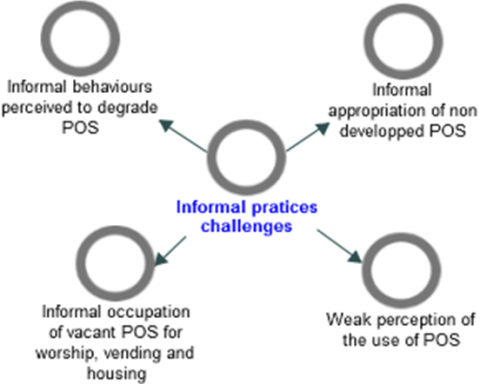
(c) Challenges associated with informal practices around public open spaces
(d) Perceived effects of challenges on the effective accessibility and inclusiveness of public open space
Figure 5. POS accessibility and inclusivity policy implementation challenges
4.2.3 Challenges linked to the informal practices of stakeholders
Participants perceive informal practices as obstacles to the implementation of urban policies (see Figure 5(c)). The phenomenon of informal appropriation of spaces intended to be developed as public gardens and green spaces is occupied for other uses, in particular commerce and worship. The words of P8 illustrate this situation:
"When you look at undeveloped green spaces, the occupation is the opposite, it's a mess because everyone has access to it and there are no standards for occupation because most of the undeveloped green spaces today are occupied by economic activities by local people".
Awareness of the importance of public open spaces for collective well-being remains generally low, owing to a limited understanding of the public good in prevailing social representations. As P7 explained:
“In the Burkinabe mindset, something that is public belongs to everyone and to no one.”
Continuing his remarks, P7 argued that the illegal occupation of public open spaces for purposes other than their intended use stems from this social perception.
Figure 6 illustrates the informal occupation of public open spaces in Kaya.
Figure 6. Undeveloped public open space (POS) in Kaya was diverted to a mosque
4.2.4 Challenges linked to the security and humanitarian context
The security situation, which has led people to move to cities, is seen as an obstacle to the effectiveness of accessibility and inclusion policies.
As P11 put it:
"Given the current high demographic pressure due to insecurity, these public spaces are used as temporary shelters for internally displaced people".
To corroborate this observation, P4 referred to a case experienced by the Kaya municipality, noting that
“three spontaneous markets were established by internally displaced people on public spaces.”
4.2.5 Perceived impacts on the accessibility and inclusiveness of public open spaces
One category of stakeholder perceptions relates to the effects induced by the challenges hindering the implementation of policies on accessibility and inclusiveness of public open spaces, as shown in Figure 5(d).
According to P8, policies lead to illusory accessibility and inclusivity of public open spaces:
“Most of the reserved areas today are accessible to everyone, but in reality, it is a meaningless accessibility because the objective has not yet been achieved. The expected level of development has not been reached. Why do we call it a green space? It is not a green space; it is land reserved for the development of one. That’s how I see it.”
In the same vein, P11 made the following observation:
“We find ourselves in a situation where public open spaces exist theoretically in urban development plans but, in practice, either do not exist or are non-functional”.
The discussion that follows aims to interpret these results in the light of the theoretical framework used, to establish a constant tension between the official discourse on the accessibility and inclusiveness of public open spaces and the perceptions of those involved in urban public action.
5.1 A discrepancy between official discourse and actor perceptions challenges the right to the city and spatial justice
The results revealed that official discourse clearly affirms the political will to promote accessible and inclusive public spaces. At the level of Kaya, this desire is reaffirmed in urban planning documents. This discourse is contrasted by the perceptions of those involved in urban public action, who describe an illusion of accessibility due to an ineffective political will. These perceptions are supported by the observation that planned open public spaces have been built into the urban fabric but have not been developed or have been diverted for other uses. This contradiction highlights the challenges that the city of Kaya, in particular, and the cities of Burkina Faso in general face in making a reality of the right to the city as advocated by UN-Habitat [1], which defends equitable access to urban resources. The results are in line with the findings of Owusu and Crentsyl [9], who stress that African countries adhere to the international discourse on the right to the city enshrined in the SDGs and the New Urban Agenda, but continue to implement official practices or tolerate popular practices that are totally out of step with them. This observation supports Watson analysis [7], which shows that, the practice of urban planning based on master plans or project-based urban planning with the involvement of international partners has not succeeded in reducing socio-spatial inequalities in African cities.
5.2 Shortcomings in public action
Despite a relevant link between the challenges, objectives and implementation strategy of urban policies, the perceptions of the actors reveal profound institutional weaknesses: lack of financial resources, absence of political will, misuse of public open spaces, lack of monitoring and transparency, as well as low levels of citizen participation. This situation highlights a lack of public action in relation to public open spaces, as defined by Lavigne Delville and Ayimpam [37], who argue that public action involves the interaction between the state and a range of players that enable public policies to be implemented. Furthermore, the results are in align with Amoush et al. [58] findings that underline that factors such as corruption, lack of financial resources and regulatory gaps influence negatively planning for sustainable development.
The case of the diversion of urban land dedicated to public open spaces shows that the translation of official discourse on accessibility and inclusiveness into reality is at the heart of often contradictory stakeholder logics and power games between the administration, technical partners, the private sector and users, as Crozier and Friedberg [40] pointed out. These observations also reveal the conflictual dimension, as highlighted by Kumar [38], which characterises urban public action in the case of the implementation of policies on accessibility and the invisibility of public open spaces. Lascoumes and Le Gales [39] provided a profound explanation. The gap observed between discourse and reality points to a biased agenda-setting process in which the accessibility and inclusivity of public open spaces, although included in urban policies, remain marginal in political and budgetary decisions.
5.3 Accessibility and inclusiveness policies put to the test in a context of fragility
Although urban policies have highlighted a context of fragility, particularly political (political and institutional instability) and security (terrorist attacks, influx of internally displaced persons into cities), they are having difficulty overcoming these challenges to become operational. The actors' perceptions reinforce this position by emphasising that, as a result of the security crisis, open public spaces are being diverted from their initial function (leisure, greenery, meeting place) to accommodate internally displaced persons, in the case of the town of Kaya. Furthermore, the overall challenges related to governance, planning and design, and shortcomings of public action refer to fragility, which can be analysed through the three classic dimensions of fragility defined by Ziaja et al. [30] (see Figure 7).
5.4 Mechanisms linking urban fragility to weak implementation of public open space policies
In light of the findings from the documentary analysis and the participants’ accounts, the mechanisms linking urban fragility to the weak implementation of accessibility and inclusiveness policies for public open spaces can be understood as stemming from two major causal dynamics.
First, insecurity has led the State and municipal authorities, including the municipality of Kaya, to revise public action priorities. In very practical terms, a substantial share of available resources has been reallocated to emergency responses and humanitarian assistance for internally displaced persons. This budgetary reallocation has taken place at the expense of planned investment in the development. As a result, projects intended to ensure physical and social accessibility for all have stagnated or been abandoned, thereby reinforcing inequalities in the use and enjoyment of public open spaces.
Second, political and institutional instability undermines the continuity of urban policies and the authority of local institutions. The installation of a transitional regime, together with changes across the state and municipal administrative apparatus, has weakened both policy follow-up and the enforcement of public policies concerning equitable access to public open spaces. Each political transition brings a reconfiguration of priorities and a loss of institutional memory, which slows decision-making and implementation processes and reduces the authorities' capacity to uphold regulations governing the occupation and use of public space.
These dynamics resonate with broader findings in the literature. Bryceson [16] highlights that insecurity in fragile African cities often compels local governments to redirect budgets toward immediate social stability rather than long-term infrastructure and public-space investment. Likewise, Resnick [8] shows that recurrent political turnover and elite competition undermine urban policy continuity and the authority of local administrations, further weakening the implementation of accessibility and inclusiveness policies.
5.5 Between discourse and reality: contributions to understanding public action in a fragile context
The results of the study on the challenges of implementing accessibility and inclusiveness policies for public open spaces allow us to draw several major conclusions that go beyond the case of Kaya, shedding light on the constraints of urban public action in a context of fragility. In line with authors who have worked on the challenges of urban policies in sub-Saharan African cities [2, 3, 7, 58, 59], the study highlights the gap between planning geared towards sustainable urban development objectives and the reality experienced and observed by the actors interviewed. Policies show a clear desire to promote the accessibility and inclusiveness of public open spaces, but institutional, financial and security constraints and the practices of actors produce illusory and theoretical accessibility and spatial injustice. So, despite the diversity of urban policies that have been tried out over the decades, particularly urban planning and project-based urban planning, the study shows that the challenge lies not so much in the quality of urban policies as in the development of public action capable of meeting the challenges of the multidimensional fragility that hinders their implementation. Figure 8 details the recommendations for effective implementation of public open spaces accessibility and inclusiveness policies in a context of multidimensional fragility.
Figure 8. Recommendations for effective implementation of public open spaces accessibility and inclusiveness policies in a context of multidimensional fragility
Given the paucity of knowledge about the challenges involved in implementing urban policies in a context of fragility, the study focused on the case of policies for the accessibility and inclusiveness of public open spaces, which are a key issue in the sustainable development objectives.
The study findings show that there is a discrepancy between the official discourse on accessibility and inclusiveness and the perceptions of the actors interviewed. While official discourse is consistent with international frameworks such as the SDGs and the New Urban Agenda in advocating the inclusive city of Kaya, the reality portrayed by the actors shows a very different situation. The significant challenges that emerged are weak governance and institutional capacity, inappropriate planning and development approaches, and public action constrained by the context of fragility, thereby supporting our research hypothesis. Two recurrent patterns stand out: (i) diversion of planned public open spaces to other uses; and (ii) the persistence of undeveloped, hence non-functional, public open spaces. To meet these challenges, the study puts forward recommendations to address challenges in implementing accessibility and inclusiveness policies in Kaya and other cities in Burkina Faso, and for building resilient urban public action in the face of multidimensional fragility.
This research has certain limitations which may restrict the generalizability of the findings. First, the perceptions reported are context-specific and may not fully capture the diversity of views present in other fragile cities. Second, the study focused mainly on the perspectives of institutional and other public action actors, leaving out a more systematic assessment of residents’ everyday practices and experiences of public open spaces.
The research study opens the way to future perspectives that could comparatively analyse other fragile cities in Burkina Faso or West Africa, in order to identify common patterns and local specificities in the challenges of implementing accessibility and inclusiveness policies. It also raises questions about the conditions under which urban public action can be taken to reconcile resilience, spatial justice and the effective right to the city in a context of multidimensional crises.
This work is supported by the World Bank, the Association of African Universities and CERViDA-DOUNEDON.
Sample code tree of implementation challenges for accessibility and inclusiveness of public open spaces from official discourses and actors' perceptions.
Figure A1. Sample code tree of implementation challenges for accessibility and inclusiveness of public open spaces from official discourses and actors' perceptions
[1] UN-Habitat. (2020). New urban agenda. https://unhabitat.org/about-us/new-urban-agenda.
[2] Echendu, A.J. (2020). Urban planning — “It’s all about sustainability”: Urban planners’ conceptualizations of sustainable development in Port Harcourt, Nigeria. International Journal of Sustainable Development and Planning, 15(5): 593-601. https://doi.org/10.18280/ijsdp.150501
[3] Eshetu, S.B., Yeshitela, K., Sieber, S. (2021). Urban green space planning, policy implementation, and challenges: The case of Addis Ababa. Sustainability, 13(20): 11344. https://doi.org/10.3390/su132011344
[4] Cobbinah, P.B., Asibey, M.O., Opoku-Gyamfi, M., Peprah, C. (2019). Urban planning and climate change in Ghana. Journal of Urban Management, 8(2): 261-271. https://doi.org/10.1016/j.jum.2019.02.002
[5] UN-Habitat. (2014). The State of African Cities 2014: Re-Imagining Sustainable Urban Transitions. UN-Habitat.
[6] Stren, R., White, R. (1989). African Cities in Crisis: Managing Rapid Urban Growth. Boulder, CO: Westview Press.
[7] Watson, V. (2013). African urban fantasies: Dreams or nightmares? Environment and Urbanization, 26(1): 215-231. https://doi.org/10.1177/0956247813513705
[8] Resnick, D. (2014). Urban governance and service delivery in African cities: The role of politics and policies. Development Policy Review, 32(s1): s3-s17. https://doi.org/10.1111/dpr.12066
[9] Owusu, G., Crentsyl, A. (2020). The right to the city: An African perspective. In Vivre Et Construire Le Droità La Ville: Expérience Au Sud: La Dimension Politique Des Pratiques Citadines. Presses Universitaires de Paris Nanterre, pp. 38-52.
[10] PNUD. (2024). Rapport annuel PNUD Burkina Faso 2023. Burkina Faso. https://www.undp.org/fr/burkina-faso/publications/rapport-annuel-pnud-2023.
[11] ONU-HABITAT. (2023). Note de briefing. Burkina Faso 2023. https://unhabitat.org/sites/default/files/2023/07/note_de_briefing_burkina_faso_fr.pdf?utm_source=chatgpt.com.
[12] OCDE. (2023). States of fragility 2022. OECD Publishing, Paris. https://doi.org/10.1787/c7fedf5e-en
[13] OCDE. (2021). States of fragility 2020. OECD Publishing, Paris. https://doi.org/10.1787/ba7c22e7-en
[14] Aweh, M.A., Atchrimi, T. (2024). Understanding urban fragility and resilience in Kaya, Burkina Faso, based on the perceptions of urban actors. International Journal of Sustainable Development and Planning, 19 (10): 3759-3769. https://doi.org/10.18280/ijsdp.191006
[15] OECD. (2018). States of Fragility 2018. Paris: OECD Publishing. https://doi.org/10.1787/9789264302075-en
[16] Bryceson, D.F. (2006). Fragile cities: Fundamentals of urban life in East and Southern Africa. In African urban economies: Viability, vitality or vitiation? London: Palgrave Macmillan UK, 3-38.
[17] de Boer, J. (2022). The fragile city. In The Climate City. Wiley, pp. 279-288. https://doi.org/10.1002/9781119746294.ch17
[18] Mairie de Kaya. (2023). The municipality's projects. https://mairiedekaya.bf/les-projets-de-la-commune/.
[19] Lall, S.V., Henderson, J.V., Venables, A.J. (2017). Africa’s Cities: Opening Doors to the World. World Bank. https://doi.org/10.1596/978-1-4648-1044-2
[20] Lefebvre, H. (1996). Writings on Cities. Wiley-Blackwell.
[21] UN-Habitat. (2010). State of the World’s Cities 2010/2011: Cities for All – Bridging the Urban Divide. UN-Habitat.
[22] Soja, E.W. (2010). Seeking Spatial Justice. University of Minnesota Press.
[23] Marcuse, P. (2010). Spatial justice: Derivative but causal of social justice. In Justice et Injustices Spatiales. Presses Universitaires de Paris Nanterre, Paris Nanterre, pp. 75-92.
[24] Aweh, M.A., Sana, D., Atchrimi, T. (2025). Accessibility and inclusiveness of public open spaces in fragile contexts: A case study of Kaya, Burkina Faso. Sustainability, 17(7): 3115. https://doi.org/10.3390/su17073115
[25] Margier, A. (2013). Sharing public space. The conflicting realities of access and marginalization. Cahiers de Géographie du Québec, 57(161): 175-192. https://doi.org/10.7202/1024899ar
[26] Van Hollebeke, S., Berger, M., Carlier, L. (2021). Les espaces publics et leurs indésirables: Interactions, institutions, politiques. Les Politiques Sociales, 12(1): 4-26. https://doi.org/10.3917/lps.211.0004
[27] Biehler, A. (2006). Renouveau urbain et marginalisation. Le cas d'habitants du centre-ville de Ouagadougou–Burkina Faso. Revue Tiers Monde, 185(1): 57-78. https://doi.org/10.3917/rtm.185.0057
[28] UN-Habitat. (2014). Evolution of national urban policies. https://unhabitat.org/evolution-des-politiques-urbaines-nationales.
[29] Chenal, J. (2013). Modèles de planification de l’espace urbain. La ville ouest-africaine. MetisPresses, Genève. https://doi.org/10.1684/sec.2013.0395
[30] Ziaja, S., Grävingholt, J., Kreibaum, M. (2019). Constellations of fragility: An empirical typology of states. Studies in Comparative International Development, 54(2): 299-321. https://doi.org/10.1007/s12116-019-09284-3
[31] de Boer, J. (2015). Resilience and the fragile city: Reducing vulnerability to complex urban crises. UN University.
[32] Spyridonidis, C. (2007). Present-day concepts and values for public space design. Études Balkaniques, 14(1): 201-212. https://doi.org/10.3917/balka.014.0009
[33] Carmona, M. (2021). Public Places Urban Spaces. Routledge. https://doi.org/10.4324/9781315158457
[34] Panerai, P., Depaulle, J.C., Demorgeon, M. (2018). Analyse Urbaine. Parenthèses, Paris.
[35] Kamana, A.A., Radoine, H., Nyasulu, C. (2024). Urban challenges and strategies in African cities – A systematic literature review. City and Environment Interactions, 21: 100132. https://doi.org/10.1016/j.cacint.2023.100132
[36] UN-Habitat. (2015). Global Public Space Toolkit: From Global Principles to Local Policies and Practice. https://www.local2030.org/library/82/Global-Public-Space-Toolkit--From-Global-Principles-to-Local-Policies-and-Practice.pdf.
[37] Lavigne Delville, P., Ayimpam, S. (2018). Public policy and public action in Africa, between practical norms, political dynamics and outside influences. Anthropologie & Développement, 48-49: 7-23. https://doi.org/10.4000/anthropodev.656
[38] Kumar, M. (2013). A view of public action as collective action: Evidence from an Indian village. India Review, 12(2): 70-91. https://doi.org/10.1080/14736489.2013.788883
[39] Lascoumes, P., Le Gales, P. (2007). Introduction: Understanding public policy through its instruments—From the nature of instruments to the sociology of public policy instrumentation. Governance, 20(1): 1-21. https://doi.org/10.1111/j.1468-0491.2007.00342.x
[40] Crozier, M., Friedberg, E. (1980). Actors and Systems: The Politics of Collective Action. University of Chicago Press.
[41] United Nations, DESA. (2019). World population prospects 2019. https://api.pageplace.de/preview/DT0400.9789210046428_A39188428/preview-9789210046428_A39188428.pdf.
[42] FFP. (2023). Fragile States Index 2023 – Annual Report. https://fragilestatesindex.org/wp-content/uploads/2023/06/FSI-2023-Report_final.pdf.
[43] Merriam, S.B., Tisdell, E.J. (2016). Qualitative Research: A Guide to Design and Implementation. Jossey-Bass/Wiley.
[44] Valentine, G. (2001). Social Geographies: Space and Society (1st ed.). Routledge. https://doi.org/10.4324/9781315839271
[45] Bowen, G.A. (2009). Document analysis as a qualitative research method. Qualitative Research Journal, 9(2): 27-40. https://doi.org/10.3316/QRJ0902027
[46] MATD. (2019). Politique nationale de decentralization au BURKINA FASO. https://www.giz.de/de/downloads/giz2019-de-burkina-faso-dezentralizierung.pdf.
[47] MUH. (2024). Strategie Nationale de Reconfiguration Urbaine. Ouagadougou. https://fr.scribd.com/document/809687910/STRATEGIE-NATIONALE-DE-RECONFIGURATION-URBAINE-VF-11-11-2024-1.
[48] MHUV. (2021). Stratégie Nationale de l’Habitat et du Développement Urbain. https://www.mhuv.gov.dz/?page_id=5458&lang=fr.
[49] Assemblée Nationale. (2006). Loi N°017-2006/AN portant code de l’urbanisme et de la construction au Burkina Faso. https://natlex.ilo.org/dyn/natlex2/natlex2/files/download/101259/BFA-101259.pdf.
[50] Assemblée Nationale du Burkina Faso. (2018). Loi N°024-2018/AN portant loi d’orientation sur l’aménagement et le développement durable du territoire. https://faolex.fao.org/docs/pdf/bkf216465.pdf.
[51] République du Burkina Faso. (2024). DÉCRET N°2024-0900/PRES/PM/MUAFH/MATDS/MEFP portant adoption du Référentiel de programmation urbaine au Burkina Faso (à titre de régularisation). https://www.scribd.com/document/887825973/DECRET-N-2024-0900-Referentiel-de-Programmation-Urbain-2.
[52] Ministère de l'Urbanisme, des Affaires Foncières et de l'Habitat. (2014). Schema Directeur d’Aménagement et d’Urbanisme de Kaya. https://www.mhu.gov.bf/fileadmin/user_upload/storages/fichier/sdau_kaya_final_2.pdf?utm_source=chatgpt.com.
[53] AAPUI. (2024). Land use plan of Kaya: Presentation report, final version. Ouagadougou. Available from the Ministry of Urbanism and Housing.
[54] Wengraf, T. (2001). Qualitative Research Interviewing: Biographic Narrative and Semi-Structured Methods. SAGE.
[55] Malterud, K., Siersma, V.D., Guassora, A.D. (2016). Sample size in qualitative interview studies. Qualitative Health Research, 26(13): 1753-1760. https://doi.org/10.1177/1049732315617444
[56] Guest, G., Namey, E., Chen, M. (2020). A simple method to assess and report thematic saturation in qualitative research. PLoS ONE, 15(5): e0232076. https://doi.org/10.1371/journal.pone.0232076
[57] Fereday, J., Muir-Cochrane, E. (2006). Demonstrating rigor using thematic analysis: A hybrid approach of inductive and deductive coding and theme development. International Journal of Qualitative Methods, 5(1): 80-92. https://doi.org/10.1177/160940690600500107
[58] Amoush, M.A.M., Khomyshyn, I., Dragan, I., Filippova, V., Bukanov, H. (2024). Planning for sustainable development: A case study of the legal factors in the public administration system. International Journal of Sustainable Development and Planning, 19(3): 1053-1059. https://doi.org/10.18280/ijsdp.190323
[59] Watson, V. (2009). ‘The planned city sweeps the poor away…’: Urban planning and 21st century urbanisation. Progress in Planning, 72(3): 151-193. https://doi.org/10.1016/j.progress.2009.06.002