Ridwan* | Riri Maria Fatriani | Isman | Md Mahmudul Alam | Reza Amarta Prayoga | Susi Puspita Sari | Arwansyah Kirin
© 2025 The authors. This article is published by IIETA and is licensed under the CC BY 4.0 license (http://creativecommons.org/licenses/by/4.0/).
OPEN ACCESS
Sustainable forest management is crucial for addressing environmental challenges and supporting local communities. This study explores the role of social networks as a form of social capital in supporting sustainable forest management in the Datuk Sinaro Putih customary forest. Through an exploratory qualitative approach, data were collected via interviews, participant observation, and document analysis in the Batu Kerbau and Dusun Baru Jambi indigenous communities. The findings reveal that both internal and external social networks foster resilience, promoting forest protection based on local wisdom. Key forms of resilience—relational, normative, and structural—are critical in preventing deforestation and mitigating external pressures such as corporate encroachment and illegal mining. Strengthening these social networks, particularly through partnerships with governments, NGOs, and research institutions, can enhance equitable and sustainable forest governance. The practical implications highlight the importance of replicating local practices to support community-based Sustainable Development Goals (SDGs). This research contributes to the understanding of how social networks in indigenous communities can support sustainable forest management and offers valuable insights for policymakers, researchers, and practitioners involved in sustainable forest governance.
social capital, social networks, sustainable forest governance, customary forest management, indigenous communities, community-based resilience
Sustainable development has emerged as one of the central challenges of our time, addressing complex environmental and social issues through a unified global effort. The Sustainable Development Goals (SDGs), established by the United Nations, provide a framework to guide this global action, with specific targets set for 2030. Social, institutional, economic, environmental, and technological factors are among the factors that influence the success of sustainable development [1]. Forest management plays a critical role in achieving several SDGs, particularly those related to climate action (SDG 13), life on land (SDG 15), and peace, justice, and strong institutions (SDG 16). Effective forest governance ensures the long-term health of ecosystems, protects biodiversity, and supports the livelihoods of communities who depend on these resources.
While the importance of sustainable forest management is widely recognized, the governance of these forests often faces external pressures, such as illegal logging, land grabs, and expansion by large-scale plantations. Various forestry and environmental problems originate from human activities in many places [2]. Many of these challenges stem from the failure to incorporate sustainable principles into forest management practices. The consequences of unsustainable practices are far-reaching, causing environmental degradation, the loss of biodiversity, and negative impacts on local communities’ well-being [3]. These challenges underscore the need for an integrated approach to forest governance that considers both local knowledge and external partnerships.
Indigenous communities have long played a key role in forest conservation, often managing forests through sustainable practices based on traditional ecological knowledge and customary laws. However, external pressures have intensified, threatening the effectiveness of these governance systems. Social capital, particularly in the form of social networks, has been identified as a key factor in strengthening the resilience of these governance systems. Social networks help build cooperation, solidarity, and trust within communities, enabling them to better resist external threats and manage their resources sustainably [4].
This study aims to examine the role of social networks in supporting the principles of sustainable development in the governance of the Datuk Sinaro Putih customary forest. By investigating the dynamics of social networks within the Batu Kerbau and Dusun Baru Jambi indigenous communities, this research highlights the role of relational, normative, and structural resilience in the community’s ability to protect its forest resources from external pressures. The study also explores the impact of external partnerships with government agencies, NGOs, and research institutions in strengthening these governance systems.
The novelty of this research lies in its focus on the social network approach to customary forest governance, an area that remains underexplored in the context of Indonesia’s indigenous communities. By exploring how local social networks contribute to sustainable forest management, this research contributes valuable insights into how social capital can support the achievement of SDGs. Furthermore, the findings are significant for policymakers, environmental NGOs, and practitioners working on forest conservation and community-based resource management, offering practical strategies for enhancing social networks to foster sustainable governance.
2.1 Sustainable forest governance and social networks
Forest governance is a crucial aspect of achieving SDGs, particularly SDG 13 (Climate Action), SDG 15 (Life on Land), and SDG 16 (Peace, Justice, and Strong Institutions). Forests provide essential ecosystem services, including biodiversity conservation, carbon sequestration, and regulation of water cycles. They also support the livelihoods of millions of people, especially those in indigenous communities who rely on forest resources for sustenance and income [3]. However, the effective governance of forests is often hindered by external pressures such as land-use changes, economic exploitation, and inadequate policies from governmental and corporate entities [5]. These challenges necessitate the integration of sustainable forest management practices that prioritize environmental, social, and economic considerations, ensuring that forests are preserved for future generations.
In this context, social networks play a significant role in forest governance. Social networks, composed of relationships, trust, and norms within and between communities, are key to fostering cooperation and promoting collective action for sustainable forest management. Indigenous communities have developed social networks over generations, which are rooted in kinship, cultural values, and shared norms. These networks create the foundation for strong community resilience, enabling communities to manage forest resources sustainably even in the face of external pressures [4]. Social networks facilitate communication, resource mobilization, and collaboration between community members, which are essential for preventing illegal resource extraction, such as logging and mining, and for enforcing forest protection.
2.2 Role of social capital in forest management
The concept of social capital is central to understanding how communities build resilience in the face of external pressures. Social capital, as defined by Putnam [6], refers to the resources embedded in social networks that enable individuals and groups to act collectively for mutual benefit. In the context of forest governance, social capital encompasses the relationships, trust, and shared norms that enable communities to cooperate in forest conservation efforts. Social capital can take various forms, including bonding capital (strong ties within groups), bridging capital (connections between different groups), and linking capital (connections to external actors such as NGOs and government agencies).
The role of social capital in sustainable forest management has been widely acknowledged in the literature. Strong relational networks, formed through kinship and cultural values, help communities respond to threats and manage conflicts that arise from forest governance. These relational ties promote a sense of shared responsibility and collective action, ensuring the protection of forest resources [7]. Moreover, normative resilience, which involves the enforcement of customary laws and norms through social networks, plays a key role in regulating forest use and ensuring that sustainable practices are adhered to reference [8].
Furthermore, structural resilience is an essential component of social capital, particularly in terms of building strategic relationships with external actors. Partnerships with environmental NGOs, government bodies, and academic institutions enhance the capacity of indigenous communities to protect their forests and assert their rights against external threats. These partnerships not only provide legal support but also offer access to resources, training, and policy advocacy, strengthening the community’s ability to resist external pressures and maintain sustainable forest management practices [9].
2.3 Challenges in forest governance
Despite the strength of social networks within indigenous communities, external pressures continue to threaten the sustainability of customary forests. The expansion of commercial agriculture, including palm oil plantations, illegal mining, and logging, poses significant threats to forest ecosystems. These external pressures undermine the effectiveness of local forest governance systems and exacerbate conflicts over land and resource use. Furthermore, government policies that prioritize economic development over environmental conservation often contribute to the degradation of forests by facilitating the encroachment of large-scale industrial activities into customary forest areas [5].
The lack of recognition of indigenous land rights further compounds these challenges. In many cases, government policies fail to protect the rights of indigenous communities, resulting in the loss of access to their forests and the erosion of their governance systems. This highlights the need for policies that empower indigenous communities and strengthen their capacity to manage their forests sustainably. External partnerships, particularly with NGOs and international research institutions, play a crucial role in advocating for the recognition of indigenous land rights and supporting communities in their efforts to protect their forests [7].
2.4 Social networks and SDGs
Social networks are integral to the achievement of several SDGs, particularly SDG 13 (Climate Action), SDG 15 (Life on Land), and SDG 16 (Peace, Justice, and Strong Institutions). By leveraging social capital, indigenous communities can enhance their adaptive capacity to climate change, protect biodiversity, and strengthen local institutions. The role of strong institutions in ensuring effective forest governance aligns with broader principles of good governance, which emphasize transparency, accountability, and participatory decision-making [10].
The community’s ability to resist external pressures through strong social networks aligns with the goals of SDG 13, as it promotes climate resilience and sustainable land-use practices. Similarly, the protection of customary forests contributes to SDG 15 by ensuring the preservation of terrestrial ecosystems and biodiversity. Furthermore, SDG 16 is supported by the strengthening of local governance systems, as social networks enhance the capacity of indigenous communities to manage resources effectively and advocate for their rights.
2.5 Theoretical underpinnings
The theoretical frameworks that guide this study include social capital theory, resilience theory, and institutional theory, each of which contributes to understanding the role of social networks in sustainable forest governance. Social capital theory provides a foundation for this study by explaining how the relationships and networks within communities create value and enable collective action [6]. Social capital is essential for building trust and fostering cooperation, which are crucial for the effective management of forest resources. In indigenous communities, social capital allows for the enforcement of customary laws and the mobilization of collective action to protect forests. Resilience Theory emphasizes the ability of systems to absorb shocks and adapt to environmental changes [11]. In the context of forest governance, resilience refers to the capacity of communities to withstand and recover from external threats, such as land-use changes and climate change. This theory highlights the importance of relational resilience, normative resilience, and structural resilience, which enable communities to adapt to challenges and maintain sustainable forest management practices. Institutional theory focuses on the role of formal and informal rules in shaping behavior and governance [12]. In the context of indigenous forest management, customary laws and social norms serve as informal institutions that regulate forest use and ensure sustainability. These informal institutions, supported by social networks, help indigenous communities manage their forests effectively and resist external pressures.
3.1 Research design
The study follows an exploratory qualitative design, which is ideal for investigating complex social phenomena, especially when in-depth understanding of local practices and community dynamics is required. Guided by a constructivist framework, this research views social reality as a collective and dynamic construct, shaped by culture, history, and power relations. This approach emphasizes the significance of understanding how local traditions, customs, and social networks contribute to the sustainable management of customary forests in indigenous communities.
3.2 Study area
The research was conducted in Batu Kerbau Village and Dusun Baru, Pelepat District, Bungo Regency, Jambi, Indonesia (Figure 1). These villages are home to the Datuk Sinaro Putih customary law community, which has been managing its customary forest for generations from their ancestors [13]. The Datuk Sinaro Putih customary forest covers an area of 1889 hectares, divided into several village areas. The forest is renowned for its successful preservation and sustainable management, earning the Kalpataru Award from the President of the Republic of Indonesia in 2004, the highest environmental award in the country [14]. The long-standing preservation of this forest serves as a valuable case study for examining the role of social networks in supporting sustainable forest governance.
Figure 1. Map of study area
3.3 Data collection methods
Data collection for the study took place between February and October 2024, utilizing various qualitative methods to
provide a comprehensive understanding of the role social networks play in forest governance. These methods included in-depth interviews, participant observation, document analysis, and social network mapping, each chosen to capture different facets of the community's governance and its social dynamics (Table 1).
In-depth, semi-structured interviews were conducted with a purposive sample of key informants, selected based on their involvement in forest management and their knowledge of the community’s governance practices. Interviews were held with traditional leaders, members of the Customary Forest Management Institution (LPHA), public figures, government representatives, environmental NGO staff, and local observers. These interviews provided insights into both the internal social networks within the community and its external relationships with partners. Each interview lasted between 60 to 120 minutes and was conducted in the local language to allow participants to express themselves freely.
Participant observation was also employed to gain an insider’s perspective on the community’s social dynamics. The researcher took part in customary deliberations, forest patrols, and community events related to forest conservation. This direct involvement enabled the researcher to observe how social networks function in practice, particularly in how community members cooperate, enforce customary laws, and collectively act to protect the forest.
Table 1. Categories of informants, their roles, and key themes addressed in the interviews
|
Informant Category |
Roles |
Data Collection Focus |
Key Themes |
|
Datuk Sinaro Putih and Parabokalo Adat (Traditional Leaders) |
Guardians of customary ecological wisdom values, social network connectors, conflict mediators, and legitimizers of customary forest sustainability practices. |
In-depth semi-structured interviews |
The main role of customary leaders, the decisions they make, customary sanctions, relations between residents to protect customary forests, relations with the government and NGOs. |
|
Customary Forest Management Institution (LPHA) Members |
Guardians of the forest, conducting regular patrols. |
In-depth semi-structured interviews |
Practical experience, forms of coordination, social support, forms of threats to forests, challenges faced in forest management. |
|
Public Figures |
Influencers in public opinion and networks. |
Semi-structured interviews |
Social activities in forest conservation, perceptions of social solidarity, involvement in social networks and advocacy, support for forest conservation. |
|
Village Government |
Local governance |
In-depth semi-structured interviews |
Village policies, programs, budget support, coordination with traditional leaders, and formal institutional relations with customs. |
|
NGO Staff |
Mentors, advocates, and strengthen social networks. |
In-depth interviews |
Role of NGOs, activities and programs, efforts to strengthen social networks, involvement in advocacy for indigenous peoples, challenges and obstacles. |
|
Local Observers |
Observing social dynamics and their impact on forest sustainability. |
Participant observation |
Protection and preservation of customary forests, ecosystem changes, patterns of cooperation and internal/external relations, trust, and obedience. |
During the nine-month fieldwork period (February–October 2024), participant observations were conducted periodically and based on events. The observation schedule consisted of: routine monthly observations aligned with the community's activity cycle, such as customary forest patrols, community meetings, and routine interactions related to forest management. Monthly observations were chosen because key customary activities and forest-related routines occur monthly or based on events.
Intensive event-based observation is conducted whenever a significant event occurs in the community. Examples of these events include customary deliberations, conflict mediation, land use disputes, seasonal ecological changes, or external engagement with government agencies or non-governmental groups. This combined event-based and periodic method ensures adequate observation and remains in line with the community's activity routines.
Researchers participate as moderate participants (moderate active participation), which means a combination of limited active involvement and observation that maintains analytical distance. Researchers do not influence customary decision-making processes. Instead, they participate only to the extent necessary to understand the social dynamics, interaction patterns, and institutional mechanisms involved in customary forest management. This type of participation includes: attending customary deliberations as invited guests, without expressing opinions or changing the course of the discussion, supervising forest patrols with LPHA members to gain an understanding of patrol procedures, the types of threats faced, and how members coordinate. Then attending village meetings and conservation activities to learn about communication patterns, leadership roles, and collective action practices. Throughout the activity, the researcher remained a non-interventionist participant and engaged only within culturally and ethically permissible boundaries. The researcher also maintained the role of a focused observer. Without disrupting customary authority or influencing community practices, this balanced approach allowed the researcher to gain a deep contextual understanding.
As researchers from outside the community, we recognize that the researcher's presence can influence community behavior at the beginning of the study. However, by gradually building trust, the community can mitigate negative impacts by participating in informal activities, regularly interacting with traditional leaders, and participating in community activities. Over time, the community eventually becomes accustomed to the researcher's presence, and their activities return to normal. Furthermore, the researcher is present in activities as a non-interventionist participant, meaning the researcher does not influence the usual processes or decisions. Therefore, the researcher's presence reduces the likelihood of behavioral changes caused by their presence.
To complement the interviews and observations, document analysis was conducted to examine official reports, village policies, and records from the Customary Forest Management Institution. This helped contextualize the community’s forest governance within the formal legal and policy framework. The analysis of these documents also provided insights into the role of external actors such as NGOs and government bodies in supporting the community’s conservation efforts.
Social network mapping was utilized to visually represent the relationships among the key actors involved in forest governance. This method allowed for the identification of community members’ roles and their connections to external actors. The network map helped to illustrate the flow of information, power, and resources within the community and its relationships with external partners, providing a clearer understanding of how social capital influences forest governance.
Ethical considerations were prioritized throughout the study. Informed consent was obtained from all participants, ensuring they understood the purpose of the research and its potential impact. Confidentiality was maintained, and participants were assured that their identities would remain anonymous. The researcher was careful to respect the cultural norms and practices of the indigenous community throughout the data collection process.
3.4 Data analysis techniques
The data analysis followed an interactive process as outlined by Miles et al. [15]. This process involved data presentation, reduction, and drawing conclusions. The analysis began with coding the interview data, observation notes, and document analysis. As key themes emerged, they were categorized based on their relevance to the research focus. The categories identified included the role of social networks, resilience in forest management, and the interaction between internal and external actors.
Thematic analysis was employed to examine the qualitative data. This involved identifying recurring patterns and themes within the social networks and their role in supporting forest governance. Social network mapping was also conducted to visualize the connections between different actors and their influence on the forest management processes.
Triangulation was employed to ensure the validity and reliability of the findings. This involved comparing data from different sources, including interviews, observations, and documents, to ensure consistency and accuracy in the results. Non-relevant information was removed, and essential insights were highlighted to focus on the most pertinent aspects of social capital and sustainable forest governance.
4.1 Social network resilience from policy changes and outside party expansion
The Datuk Sinaro Putih Indigenous community’s social networks serve as a protective shield, helping them overcome external pressures such as the expansion of plantation companies, illegal gold miners, illegal logging, and unfavorable land-use policies. These networks connect community members and form collective actions that protect the customary forests effectively.
Several forms of resilience were identified within the community's social networks, specifically:
Table 2. Threats overcome by the Datuk Sinaro Putih indigenous community
|
Threats |
Years |
Forms |
Actors |
Response and Resolution |
Status |
|
Palm oil plantations (PT Prima Mas Lestari, PT Cita Sawit Harum, PT Inhutani V) |
1998-1999 |
Land grabbing |
Plantation companies |
Addressed through mobilizing inter-tribal solidarity, cross-village coordination, and joint support from the KKI Warsi |
Resolved |
|
Illegal gold mining |
2020-present |
Mining on the forest border |
Illegal gold miners |
Increased forest patrols, discussions with local governments, and formal reporting to the Indonesian National Police to address the threat of illegal gold mining |
Ongoing |
|
Forest encroachment by the Anak Dalam tribe |
2022 |
Palm oil plantations |
Nomadic Anak Dalam tribe |
|
Resolved |
|
Illegal logging |
1998-2000 |
Cutting trees |
Neighboring village community |
Addressed through collective patrols and customary sanctions |
Resolved |
Relational resilience: Social networks in the community develop from genealogical ties, where individuals share common descent and territorial control. These bonds, passed down through generations, form a strong foundation for collective solidarity in times of external threats, such as when palm oil companies attempted to seize their land. In these instances, coordinated collective action between hamlets, alongside support from environmental NGOs such as the Indonesian Conservation Group (KKI) Warsi, successfully protected the customary forest areas from destruction (Table 2).
The threats shown in Table 2 indicate that the Datuk Sinaro Putih community has successfully overcome multiple challenges to forest sustainability, from palm oil plantations to illegal mining. Internal collective action, law enforcement, and support from external networks, such as the government, environmental NGOs, and research institutions, are used to respond to each threat. For example, threats from palm oil companies in 1998-1999 were successfully addressed through mobilizing inter-tribal solidarity, cross-village coordination, and joint support from the KKI Warsi, which resulted in the recognition of customary land boundaries. From 2020 to the present, LPHA has increased forest patrols, discussions with local governments, and formal reporting to the Indonesian National Police to address the threat of illegal gold mining. However, this threat is ongoing, so these measures must be long-term.
Furthermore, the Orang Rimba (Anak Dalam) encroachment case in 2022 was resolved through a report followed up by the Indonesian National Police, as well as customary deliberation and negotiation based on customary law, thus preventing further conflict. From 1998 to 2000, the threat of illegal logging was addressed through collective patrols and customary sanctions, which successfully reduced illegal logging. Therefore, some threats have been completely resolved, such as illegal logging and the expansion of palm oil companies, while others, such as illegal gold mining, remain and require ongoing monitoring and cooperation.
Normative resilience: Customary regulations, enforced through customary deliberations and sanctions, contribute to forest governance. Social networks operate as a buffer, preventing external interventions that could disrupt the forest's sustainability. The transmission of cultural values through informal education, rituals, and daily practices has enabled the community to maintain moral and ethical norms that guide their collective actions in forest conservation.
Structural resilience: The community has established strategic relationships with external actors, including government bodies, environmental NGOs, and international research institutions like CIFOR. These partnerships have increased the community's bargaining power and provided additional resources for protecting their customary forests.
4.2 Social networks as social and cultural capital in customary forest management
The social networks within the Datuk Sinaro Putih indigenous community serve as both social capital and cultural capital in the context of forest management. These networks, based on trust, shared norms, and communication, play a critical role in preventing the exploitation of the forest by both internal and external actors.
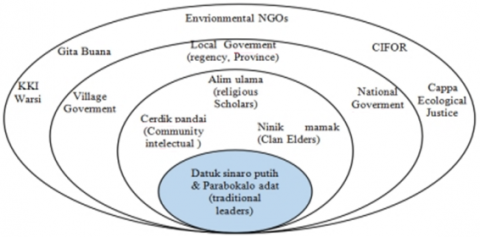
The social networks are complex and multi-layered, with strong kinship ties based on matrilineal traditions (Figure 2). These kinship networks help maintain social cohesion and are key to enforcing customary laws regarding the protection of the forest. Leadership within each tribe—such as the Ninik Mamak (tribal elders), Alim Ulama (religious leaders), and Cerdik Pandai (community intellectuals)—plays a strategic role in controlling behavior and managing conflicts, particularly when land use conflicts arise with external parties.
Figure 2. Layers of social network in Datuk Sinaro Putih indigenous community
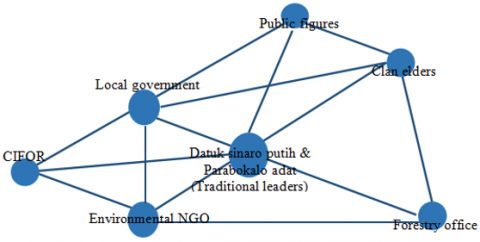
Figure 3. Social network map of the Datuk Sinaro Putih forest governance
Additionally, external social networks with local governments, village authorities, and NGOs have provided the community with legal support, training, and access to resources (Figure 3). These relationships help to strengthen the community’s bargaining position when dealing with outside threats to the forest.
The network's bonding capital within tribes strengthens internal cohesion, while bridging capital facilitates inter-group cooperation and knowledge transfer for conservation efforts (Table 3). The linking capital creates vertical relationships with external parties, allowing the community to leverage resources and secure the legal recognition of their customary forests.
During fieldwork, empirical evidence gathered clearly demonstrates how bonding, bridging, and connecting social capital helps strengthen customary forest management in the Datuk Sinaro Putih community. Cross-ethnic mobilization in the face of palm oil company expansion in 1998–1999, voluntary participation of members from various ethnic groups in LPHA patrols, and collective participation in the enforcement of customary sanctions and customary deliberations demonstrate the presence of bonding social capital. Shared cultural values, such as the transmission of solidarity values through seloko adat (traditional sayings) and kinship ties, demonstrate strong internal cohesion in this action. The Seloko adat values in the case of Datuk Sinaro Putih function as moral standards and the basis for collective action when the community faces threats such as corporate expansion and encroachment [16].
Table 3. Forms of the customary community’s social network in maintaining the sustainability of customary forests
|
Social Capital |
Social Network |
Nature |
Findings |
Empirical Evidence |
|
Bonding |
Between traditional figures and tribe members |
Internal bond |
High solidarity |
Inter-tribal mobilization against palm oil company expansion (1998–1999), volunteer members from various tribes participated in LPHA patrols, eforcement of sanctions and collective participation in customary deliberation, values of solidarity passed down through seloko adat ( customary sayings) and kinship |
|
Bridging |
Between Indigenous groups and indigenous forest guard groups |
Inter-group relations |
Knowledge transfer and innovation in conservation |
Joint patrols between indigenous groups and LPHA, cross-group collaboration to monitor and report ecological threats, sharing knowledge about the boundaries and methods of conservation of customary forests |
|
Linking |
Between Indigenous communities and external parties (NGOs, local governments, CIFOR) |
Vertical relationship |
Access to resources and legal recognition of customary forests |
Advocacy for the legality of customary forests with KKI Warsi, cooperation between indigenous communities and local governments in mapping and verifying customary forest boundaries, indigenous communities collaborate with Cifor in research and participatory mapping of customary forests |
Collaboration between indigenous groups and LPHA forest rangers also demonstrates the existence of bridging social capital, particularly through joint patrols, integrated ecological monitoring, and the exchange of information on indigenous territory boundaries and conservation techniques. In protecting indigenous forests, this relationship demonstrates strong intergroup bonds.
Finally, the vertical relationships between indigenous communities and external actors such as NGOs, local governments, and CIFOR are demonstrated. This is demonstrated by their long-term advocacy with KKI Warsi for legal recognition of customary forests, their collaboration with the government in mapping and verifying customary forest boundaries, and their collaborative research and participatory mapping with CIFOR. Individuals who are accustomed to participating in environmental activities with environmental NGOs and other institutions tend to have much higher environmental awareness than those who have never had such experiences [17]. Overall, the empirical findings demonstrate that social capital is a connecting force.
Relational resilience within the Datuk Sinaro Putih indigenous community prevented a palm oil company from taking over their land primarily through collective resistance based on solidarity across tribes and hamlets, rather than compensation mechanisms. When the company attempted to expand onto their customary land in 1998–1999, the community was able to respond quickly thanks to genealogical ties, shared identity, and strong social networks.
Coordinated collective action, such as refusing land release, strengthening customary legitimacy through customary deliberations, and cross-village coordination, created a strong community position that was unassailable by the company. Furthermore, stable relationships enabled the formation of strategic alliances with external parties, particularly the Warsi Community Empowerment Group (KKI Warsi). KKI Warsi assisted in advocacy, legal capacity building, and negotiations with the government.
This internal-external partnership is what prompted the government to recognize customary land boundaries. Consequently, the company's claim is invalid. There is no evidence of compensation-based settlements, success in preventing land grabbing depends entirely on community collaboration, customary coordination, and support from external networks supporting customary forest protection.
In the indigenous community of Datuk Sinaro Putih, matrilineal traditions serve as a genealogical basis, a structure for the inheritance of tribal identity, and a determinant of the relationship between kinship and customary authority. Because they operate within a specific territory and serve distinct functions, these traditions do not conflict with formal government structures. Within formal governance (village and sub-district), the state system maintains a neutral stance in administrative decision-making, while customary authority and forest management continue to be exercised through a matrilineal structure led by the Ninik Mamak. These two systems work together.
The interaction between the two is characterized by functional coexistence, with matrilineal traditions strengthening the social legitimacy of customary leadership, enabling strong internal coordination, and fostering community trust in customary decisions. Meanwhile, formal structures serve as important channels for administrative legitimacy, communicating government plans, and supporting the recognition of customary forests. Thus, matrilineal traditions maintain internal social cohesion, and formal structures support the recognition of customary forests.
4.3 Principles of sustainable development in managing forest
The Datuk Sinaro Putih indigenous community has effectively integrated sustainable development principles into its forest management practices. These principles align with several Sustainable Development Goals (SDGs), demonstrating the community's commitment to both environmental preservation and social well-being (Table 4).
In particular, the community has made significant strides in supporting SDG 13, which focuses on climate action. To mitigate the impacts of climate change, the community has adopted adaptive strategies such as prohibiting the clearing of forests for the expansion of palm oil or rubber plantations. Because they were previously traumatized by the flood disaster that destroyed their agricultural land [14]. Furthermore, they actively engage in replanting efforts in areas that have been degraded, fostering the restoration of vital ecosystems.
Their commitment to SDG 15, which aims to protect life on land, is evident in their stewardship of customary forest areas, including Batu Kerbau and Lubuk Tebat. These areas are essential for maintaining biodiversity, and their protection contributes directly to sustaining terrestrial ecosystems. By preserving these forests, the community plays a crucial role in safeguarding the natural environment for future generations.
Table 4. Dimensions of the resilience of the Datuk Sinaro Putih indigenous community and its contribution to the SDGs
|
Dimensions |
Characteristics |
Implementation |
Contribution to SDGs |
|
Relational |
Dynamic, based on genealogical ties |
Rejection of palm oil company expansion into customary forests |
SDG 15 protects terrestrial ecosystems: protects customary forests from palm oil company expansion SDG 13 Climate action: assisting indigenous peoples-based adaptation |
|
Normative |
Customary norms in customary rules and customary sanctions passed down from generation to generation |
Customary sanctions for customary forest encroachers, customary rules as a moral compass not to disturb customary forests |
SDG 16 Inclusive and effective institutions: strengthening customary sanctions and customary rules SDG 4.7 Education for cultural values and sustainability: passing down from generation to generation |
|
Structural |
Strategic relationships with external parties and strengthening Indigenous peoples' bargaining |
Participate in dialogues and discussions on land use and NGOs and forestry research institutions (CIFOR) |
SDG 17 Partnerships to achieve the goals: strategic partnerships of Indigenous peoples with governments, environmental NGOs, and CIFOR |
In addition, the community's governance system upholds SDG 16, which promotes peace, justice, and strong institutions. The role of strong institutions in ensuring effective forest governance aligns with broader principles of good governance, which emphasize transparency, accountability, and participatory decision-making [10]. Through regular customary deliberations, the community reinforces local governance structures and ensures that forest management is both responsive and resilient to internal and external challenges. This inclusive decision-making process strengthens the community’s ability to protect their forests while also contributing to broader societal goals.
The resilience of the Datuk Sinaro Putih community is deeply rooted in their social capital. Their ability to protect their customary forests, while simultaneously advancing sustainable development, reflects the harmonious integration of traditional knowledge and contemporary environmental practices. Through these efforts, the community contributes to achieving key global sustainability targets.
The findings from this study highlight the critical role that social networks and social capital play in supporting sustainable forest governance in indigenous communities. The Datuk Sinaro Putih indigenous community offers a compelling example of how relational, normative, and structural resilience within social networks can effectively counteract external pressures that threaten forest sustainability.
5.1 Social capital and resilience
The study’s findings support the growing body of literature that underscores the importance of social capital in sustainable forest management. Previous studies have shown that strong social networks can enhance collective action, enabling communities to resist deforestation and environmental degradation [4]. The Datuk Sinaro Putih community’s resilience, driven by relational ties and collective action, mirrors similar findings in other indigenous communities worldwide [18]. The genealogical ties in Datuk Sinaro Putih Communities that form the foundation of the community’s social networks [19] contribute to a sense of shared responsibility for the forest, reinforcing social cohesion and solidarity when faced with external threats.
Moreover, the community’s ability to navigate external pressures, such as plantation expansion and illegal mining, through collective action is consistent with the findings of previous research, which suggests that community resilience is strongly influenced by the capacity to form strategic external alliances [7]. The community's partnerships with environmental NGOs, local governments, and research institutions have played a pivotal role in strengthening their bargaining power and ensuring the sustainability of their forest governance. Past experiences related to disasters also encourage communities to protect forests in various locations [20].
5.2 The role of customary regulations in forest governance
The study further illustrates how normative resilience, through customary regulations, has enabled the community to protect its forests for generations. The role of customary laws, passed down through generations, is crucial in shaping behavior and fostering collective action among community members. The use of customary sanctions and seloko (customary proverbs) aligns with previous studies that emphasize the significance of traditional ecological knowledge and indigenous governance systems in forest conservation [8]. This normative framework provides a powerful mechanism for forest protection, ensuring that social networks remain cohesive and adaptive to changing circumstances.
5.3 Implications for SDGs
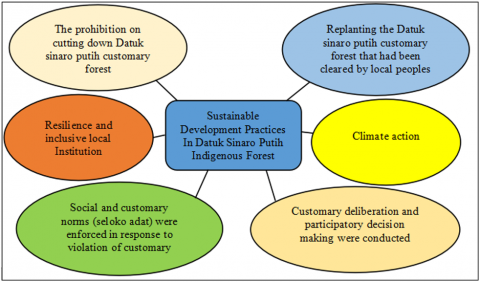
The findings also demonstrate how social networks contribute to the achievement of SDGs, particularly SDGs 13, 15, and 16 (Figure 4). By protecting their customary forests, the Datuk Sinaro Putih community contributes to the preservation of biodiversity and the stability of ecosystems, fulfilling the targets of SDG 15. Furthermore, their adaptive strategies in response to climate change, such as forest replanting and sustainable land use, align with the goals set under SDG 13. Adaptation to climate change has become a global priority today [21].
The community’s efforts also exemplify the importance of strong local institutions in advancing SDG 16, as the governance system ensures that forest management is both inclusive and effective. This underscores the role of indigenous peoples in environmental governance, as they possess deep-rooted knowledge and practices that support sustainable forest management [22].
Figure 4. Sustainable development practices in Datuk Sinro Putih indigenous forest
This study explored the role of social networks and social capital in strengthening the sustainable governance of the Datuk Sinaro Putih customary forest, highlighting the critical role that relational, normative, and structural resilience plays in protecting the forest from external pressures. The findings demonstrate that these social networks, rooted in strong internal cohesion and strategic external partnerships, enable the community to effectively manage and safeguard their forest resources, contributing to the broader goals of sustainable development. The study confirms that the sustainability of customary forest governance is significantly supported by social networks that foster cooperation, knowledge-sharing, and collective action. Relational ties based on kinship, cultural values, and shared norms create a strong foundation for community resilience, while strategic relationships with external actors enhance the community’s bargaining power. The Datuk Sinaro Putih community’s ability to overcome threats such as illegal mining, logging, and plantation expansion highlights the potential of social capital as a tool for forest conservation. The key takeaway from this research is that strengthening social networks, both within the community and with external partners, is essential for enhancing sustainable forest governance and leveraging social capital to drive positive environmental outcomes.
The findings from this study have several practical implications for indigenous communities, environmental organizations, and policymakers involved in forest management. By focusing on the strengthening of social networks, communities can build greater resilience against external pressures that threaten their forests. Practitioners should consider integrating social network-building efforts into their projects to enhance the effectiveness of community-led forest governance. Policymakers must create frameworks that recognize and support the role of social capital in environmental conservation, ensuring that indigenous communities are empowered to manage their resources sustainably.
This study contributes to the advancement of social capital and resilience theories by illustrating how indigenous communities mobilize social networks to support sustainable forest governance. It introduces a conceptual framework that synthesizes Resilience Theory and Social Capital Theory, emphasizing how relational, normative, and structural dimensions of resilience collectively strengthen adaptive capacity in the face of environmental threats such as illegal logging. By unpacking the multi-level dynamics of social capital and its interaction with both traditional and formal institutional arrangements, the study provides a theoretically robust foundation for future inquiry into community-based conservation and sustainable development.
While this study provides valuable insights, it is not without limitations. The research focuses on a single community, which limits the generalizability of the findings to other indigenous groups or regions. Future research could include comparative analyses across different indigenous communities to assess the broader applicability of these findings. Additionally, the study relies on qualitative data, and incorporating quantitative approaches could provide a more comprehensive understanding of the impact of social networks on forest sustainability. Further research may also explore the economic and political factors that influence the effectiveness of social networks in forest governance.
The authors would like to thank the Ministry of Higher Education, Science and Technology Republic of Indonesia for providing funding for this research with contract No.: 131/C3/DT.05.00/PL/2025.
[1] Shashyna, M., Lepeyko, T., Shevchuk, N., Gaidutskyi, A., Tomanek, M. (2023). Features of ensuring sustainable regional development in the face of globalization challenges. International Journal of Sustainable Development and Planning, 18(12): 3713-3723. https://doi.org/10.18280/ijsdp.181203
[2] Supriyadi, Purwanto, Hartati, S., Nufus, M., Masyithoh, G., Rosariastuti, R., Aryani, W., Mona Prinandhika, G., Asmara, A.N.D., Abdurrohman, A. (2023). Evaluating land carrying capacity in Mount Bromo’s special purpose forest areas. International Journal of Sustainable Development and Planning, 18(12): 3867-3872. https://doi.org/10.18280/ijsdp.181218
[3] Su, H., Krol, M.S., Hogeboom, R.J. (2022). The role of context in identifying linkages between SDG 2 (food) and SDG 6 (water). Sustainability Science, 17(4): 1605-1618. https://doi.org/10.1007/s11625-022-01158-3
[4] Savari, M., Khaleghi, B. (2023). The role of social capital in forest conservation: An approach to deal with deforestation. Science of the Total Environment, 896: 165216. https://doi.org/10.1016/j.scitotenv.2023.165216
[5] Kimengsi, J.N., Balgah, R.A. (2021). Colonial hangover and institutional bricolage processes in forest use practices in Cameroon. Forest Policy and Economics, 125: 102406. https://doi.org/10.1016/j.forpol.2021.102406
[6] Putnam, R.D. (2000). Bowling Alone: The Collapse and Revival of American Community. New York: Simon & Schuster.
[7] Dawson, N., Carvalho, W.D., Bezerra, J.S., Todeschini, F., Tabarelli, M., Mustin, K. (2023). Protected areas and the neglected contribution of indigenous peoples and local communities: Struggles for environmental justice in the Caatinga dry forest. People and Nature, 5(6): 1739-1755. https://doi.org/10.1002/pan3.10288
[8] Diepart, J.C., Scurrah, N., Beban, A., Gironde, C., Campbell, N.Y. (2023). The recognition and formalization of customary tenure in the forest landscapes of the Mekong region: A Polanyian perspective. Journal of Land Use Science, 18(1): 211-226. https://doi.org/10.1080/1747423X.2023.2206814
[9] Coppinger, C.R., Gorman, M., Markey, A., Stanley, D.A. (2023). Are indicators useful for measuring and supporting the sustainability of forest use? A Zambian case study. Forest Policy and Economics, 149: 102926. https://doi.org/10.1016/j.forpol.2023.102926
[10] Khalid, M.A., Alam, M.M., Said, J. (2016). Empirical assessment of good governance in the public sector of Malaysia. Economics & Sociology, 9(4): 289-304. https://doi.org/10.14254/2071-789X.2016/9-4/18
[11] Holling, C.S. (1973). Resilience and stability of ecological systems. Annual Review of Ecology and Systematics, 4(1): 1-23. https://doi.org/10.1146/annurev.es.04.110173.000245
[12] North, D.C. (2002). Institutions, Institutional Change and Economic Performance. Cambridge University Press.
[13] Ridwan, R., Afrizal, A., Maryam, S., Sari, S. (2022). Socio-economic perspective of indigenous community conflict with corporation. In ICON 2021: Proceedings of the 1st International Conference on Economic and Education, Padang, Indonesia. http://doi.org/10.4108/eai.14-12-2021.2318332
[14] Ridwan, Afrizal, Maryam, S., Athahirah, A.U., Candrianto, Sari, S.P. (2022). Collaboration between government and indigenous Peoples for forest conservation and preventing deforestation: Study on the Datuk Sinaro Putih indigenous forest in Indonesia. Baltic Journal of Law & Politics, 15(7): 368-376. https://versita.com/menuscript/index.php/Versita/article/view/1033.
[15] Miles, M.B., Huberman, A.M., Saldana, J. (2018). Qualitative Data Analysis: A Methods Sourcebook. SAGE Publications.
[16] Ridwan, Maryam, S, Epriadi, D., Rizki, Alam, M.M., Sari, S.P., Kirin, A. (2025). Role of customary forest recognition and social trust in community-based biodiversity conservation in Bungo, Jambi, Indonesia. Biodiversity, 26(9): 4511-4521. https://doi.org/10.13057/biodiv/d260923
[17] Carr, J.A., Petrokofsky, G., Spracklen, D.V., Lewis, S.L., et al. (2021). Anticipated impacts of achieving SDG targets on forests-A review. Forest Policy and Economics, 126: 102423. https://doi.org/10.1016/j.forpol.2021.102423
[18] Ridwan, A., Maryam, S., Sari, S.P. (2022). Why traditional leaders succeed in fighting indigenous forest? The case of Datuk Sinaro Putih traditional community. Journal of Positive School Psychology, 6(2): 1150-1159.
[19] Khan, U. (2022). A study on the contribution of Saudi citizens towards Sustainable Development Goals in the attainment of environmental sustainability. International Journal of Sustainable Development and Planning, 17(8): 2593-2600. https://doi.org/10.18280/ijsdp.170828
[20] Ali, M.I., Malik, A., Rahim, A. (2022). Environmental knowledge and attitude of coastal community in decision making to participate in mangrove rehabilitation in Sinjai District South Sulawesi Indonesia. International Journal of Sustainable Development and Planning, 17(8): 2579-2584. https://doi.org/10.18280/ijsdp.170826
[21] Mulyasari, G., Cahyadinata, I., Irham, Hadi, A.I. (2025). Modelling adaptation to climate change among small-scale fishermen in Bengkulu Province in Indonesia. Challenges in Sustainability, 13(4): 508-524. https://doi.org/10.56578/cis130403
[22] Purnomo, E.P., Agustiyara, A., Ramdani, R., Trisnawati, D.W., Anand, P.B., Fathani, A.T. (2021). Developing the assessment and indicators for local institutions in dealing with forest fire dilemmas. Forests, 12(6): 704. https://doi.org/10.3390/f12060704