Muhammad Arifin Nasution* | Wiro Oktavius Ginting | Erika Revida | Februati Trimurni | Arga Abdi Rafiud Darajat Lubis
© 2025 The authors. This article is published by IIETA and is licensed under the CC BY 4.0 license (http://creativecommons.org/licenses/by/4.0/).
OPEN ACCESS
This study presents a novel model for local governance—Evaluative, Participatory, Adaptive Model Based on Performance and Data (EPABKD)—designed to enhance planning coherence, stakeholder engagement, and responsiveness in decentralized systems. The model reconfigures the traditional CIPP evaluation framework by embedding participatory evaluation, real-time feedback, and performance-based alignment into a unified, adaptable system. Developed and tested within a subnational governance context, EPABKD addresses common planning challenges such as symbolic participation, fragmented data use, and plan–budget mismatches. It institutionalizes stakeholder roles through independent evaluation boards and applies tools like the Program Alignment Index (PAI) to ensure coherence between strategic documents and implementation. Unlike existing models such as CIPP, CIPPO, Logic Models, or the Kirkpatrick framework, D-SMART integrates digital tools, stakeholder governance, and SDG-linked performance tracking in a unified and adaptive architecture. Its successful application demonstrates potential for broader use in localizing Sustainable Development Goals (SDGs) and improving public accountability. The study contributes to evaluation and planning literature by advancing a participatory, performance-based alternative to static, technocratic approaches in sustainable development governance.
participatory governance, sustainable development, performance-based planning, adaptive evaluation, local governance, policy alignment, CIPP model innovation
Regional development planning in decentralized systems increasingly demands not only institutional autonomy but also strategic coherence, data integration, and citizen participation [1, 2]. In Indonesia, local governments are legally empowered to design their own development strategies (RPJMD), annual programs (RKPD), and budgets (APBD). However, persistent misalignments among these instruments and weak participatory mechanisms hinder the realization of Sustainable Development Goals (SDGs) [3-5].
Among existing evaluation tools, the CIPP (Context, Input, Process, Product) model is widely used for its structured and formative evaluation framework [6, 7]. Introduced by Stufflebeam in the 1970s, it evaluates not only outcomes but also the contextual and procedural factors shaping program success [8-10]. However, critics argue that in dynamic policy environments—particularly decentralized governance—the CIPP model often lacks integration with digital platforms, real-time feedback systems, and participatory processes [11-13]. Its linear and static structure limits applicability in fragmented planning environments, where coordination, responsiveness, and inclusivity are essential [14, 15].
In addition to CIPP, several other evaluation frameworks—such as the CIPPO model, the Kirkpatrick model, and Logic Models—have been widely applied across education, training, and development sectors. CIPPO extends CIPP by adding an “Outcomes” component but remains limited in addressing participatory governance and digital adaptability. The Kirkpatrick model evaluates impact through four levels (reaction, learning, behavior, and results), yet it lacks policy integration and stakeholder feedback mechanisms essential in public sector planning. Logic Models, though visually intuitive, typically follow linear logic and offer limited flexibility for real-time corrections or feedback loops in multi-stakeholder environments. These limitations reveal a gap in models capable of integrating adaptive feedback, data-driven planning, and multi-stakeholder participation in decentralized governance contexts [16-18].
These limitations are evident in regional contexts such as Dairi Regency, where program fragmentation, underutilization of digital tools like SIPD, and procedural citizen engagement continue to challenge effective planning and evaluation [16-18]. Recent studies suggest that modern governance requires evaluation frameworks that are not only evidence-based but also adaptable and participatory—able to integrate stakeholder feedback and support plan–budget coherence throughout the policy cycle [19-21].
As digital platforms proliferate, systems like Indonesia’s SIPD provide real-time tracking of financial and development indicators. These tools have proven effective in increasing transparency and coordination when supported by institutional capacity and participatory governance [22, 23]. Simultaneously, participatory planning mechanisms—such as citizen scorecards, community forums, and multi-actor coalitions—have gained traction for enhancing legitimacy, responsiveness, and policy relevance [6, 24]. Yet, few evaluation models successfully merge digital systems and participatory structures into a cohesive planning framework [25, 26].
To address this gap, this study introduces the EPABKD framework (Evaluative, Participatory, Adaptive Model Based on Performance and Data), which restructures the foundational logic of CIPP by embedding five dynamic components. In its operationalized form within Dairi Regency, EPABKD takes shape as the D-SMART model (Dairi – Sustainable Monitoring, Alignment, and Result-Based Transformation)—a planning-evaluation hybrid designed for scalability in decentralized, digitally diverse, and SDG-oriented governance environments [27-29].
To guide this inquiry, the study is structured around the following research questions:
2.1 Research design and iterative model development
This study adopts a design-based qualitative research (DBQR) approach to conceptualize, construct, and validate the D-SMART model as a modernized extension of the classical CIPP evaluation framework. DBQR is uniquely suited to dynamic policy environments because it allows for iterative model development, empirical testing, and contextual adaptation through stakeholder feedback and field validation [30].
To structure this intervention, the authors developed the EPABKD (Evaluative, Participatory, Adaptive Based on Performance and Data) framework—a meta-evaluation model informed by adaptive governance, stakeholder theory, and performance-based planning principles.
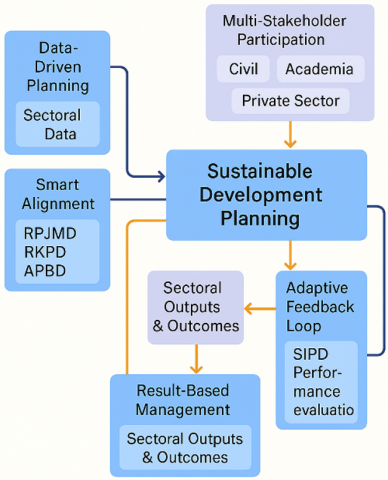
EPABKD is designed as a generalizable architecture for decentralized evaluation and planning systems. Within this study, EPABKD is contextualized and tested in Dairi Regency through the construction of the D-SMART model (Dairi – Sustainable Monitoring, Alignment, and Result-Based Transformation), which serves as its operational embodiment. D-SMART functions as a real-world prototype of EPABKD, adapted to Dairi’s planning instruments, institutional dynamics, and digital infrastructure (Figure 1).
These phases ensured that the model was not only grounded in governance theory and SDG frameworks but also reflected the empirical realities of subnational planning in decentralized systems.
Figure 1. The D-SMART model: A participatory and digital framework for regional sustainable development planning
2.1.1 Iterative model development in the DBQR process
In line with the principles of design-based qualitative research (DBQR), the development of the D-SMART model followed a structured and cyclical process of refinement. This included three core phases:
Drawing from CIPP theory, adaptive governance literature, and participatory evaluation models, the authors constructed the initial EPABKD framework. Consultations with three policy experts and a review of existing evaluation models informed the selection of its five core components.
The prototype was applied to the Dairi Regency planning environment. Through document analysis (RPJMD, APBD), interviews (n = 15), and SIPD dashboard observations, critical feedback emerged. These findings shaped component-level refinements—for instance, formalizing stakeholder boards and restructuring quarterly review loops.
A revised version, D-SMART, was tested using simulated planning cycles for 2022–2023. It was then reviewed by five evaluators (local and national) using a Likert rubric for feasibility, clarity, and scalability. Simulation outputs—including improved RPJMD–APBD alignment and integration of community proposals—guided final revisions.
This iterative process aligns with DBQR principles of design, enactment, analysis, and redesign, ensuring that the resulting model is not only theory-informed but also empirically grounded and locally usable [30, 31].
These components interact cyclically, reinforcing sectoral coherence, participatory legitimacy, and data-informed planning. Together, they transform static evaluation logic into an adaptive and participatory planning architecture.
2.2 Case selection and scope
The study centers an exercise of SMART model on Dairi Regency, a district in North Sumatra, Indonesia, where selected for its representative features of decentralized planning: a complete suite of policy instruments (RPJMD, RKPD, RENSTRA, APBD), mid-level fiscal autonomy, and partial adoption of digital systems (e.g., SIPD). Dairi reflects common subnational governance challenges such as fragmented planning cycles, procedural participation, and low plan–budget alignment—making it an appropriate testbed for model validation.
The unit of analysis included:
2.3 Data collection and sources
2.3.1 Thematic coding and NVIVO application
Thematic analysis was conducted using NVivo 14 to organize and interpret qualitative data gathered from stakeholder interviews and observational sources. The coding strategy followed a hybrid approach, combining deductive themes derived from the research questions (e.g., policy alignment, participation, data integration) with inductive themes that emerged from interview transcripts.
Transcripts were first uploaded into NVivo and segmented into manageable excerpts. Initial coding categories (“nodes”) were developed based on five core dimensions:
(1) Planning–Budget Coherence, (2) Stakeholder Participation, (3) Data Utilization, (4) Evaluation Logic, and (5) SDG Orientation.
During the second cycle of coding, these nodes were refined and expanded based on emerging subthemes, such as “symbolic participation,” “digital underutilization,” and “political budgeting.”
Example Coding Excerpt:
Matrix coding queries were used to cross-tabulate themes by stakeholder group (e.g., BAPPEDA vs. DPRD) to identify differences in perception. Coding reliability was ensured through peer review among the authors, and discrepancies were resolved through memo-based reflections.
To ensure analytical validity and contextual depth, four data streams were triangulated as summarized in Table 1.
All qualitative data were thematically coded using NVivo 14 through a hybrid inductive–deductive approach, detailed in Section 2.3.1, with analysis centered on five dimensions: policy alignment, stakeholder inclusion, data integration, evaluation logic, and SDG orientation [32].
Table 1. Overview of data sources and analytical purposes
|
Data Type |
Source |
Purpose |
|
Policy Documents |
RPJMD, RKPD, APBD, RENSTRA OPD |
Mapping alignment, performance indicators, and priorities |
|
Legal Frameworks |
Law No. 23/2014, Law No. 25/2004, Perda 3/2024 |
Establishing planning mandates and institutional roles |
|
Stakeholder Interviews |
BAPPEDA, DPRD, CSOs, academics (n = 15) |
Identifying institutional gaps, participation, and logic |
|
Observational Data |
Musrenbang forums, SIPD dashboard audits |
Validating participatory and digital practices in real time |
2.4 Analytical framework and component mapping
The D-SMART model consists of five interlinked components that are systematically embedded across the regional planning and budgeting cycle. Each component is mapped to relevant governance instruments, emphasizing digital integration and alignment with SDG targets (see Table 2).
Table 2. D-SMART component integration across planning instruments (linked to program alignment and SDG tracking tools)
|
Model Component |
RPJMD Linkage |
RKPD / APBD Function |
SIPD / Digital Tool Integration |
|
Data-Driven Planning |
Strategic goals, baseline |
Indicators and budget targets |
Sector dashboards, KUA–PPAS |
|
Smart Alignment |
Mission logic |
Program priorities (Renja-OPD) |
e-Matching, e-Budgeting |
|
Multi-Stakeholder Input |
Musrenbang public forums |
Proposal feedback, community reps |
SIPD access logs, civic suggestions |
|
Adaptive Feedback Loop |
Mid-term review clauses |
APBD-P adjustments |
SIPD quarterly monitoring |
|
Result-Based Management |
IKU–IKK indicators |
Output-to-performance tracking |
SAKIP, e-Monev integration |
To assess alignment performance, the Alignment Index (AI) was calculated using the formula:
Alignment Index $(A I)=\frac{\sum P_a}{\sum P_t} \times 100$
where,
This index quantifies the policy-program coherence before and after D-SMART’s application. The development and use of the Alignment Index (AI), referred to here as the Program Alignment Index (PAI), draws upon alignment and coherence principles found in results-based budgeting and strategic public management frameworks [1, 3, 27]. While not statistical in nature, the index provides a quantitative proxy for coherence between strategic goals (RPJMD) and budget execution (APBD), which is a core challenge in decentralized governance. It was designed for diagnostic simplicity, ensuring usability in subnational governments where planning complexity and data fragmentation often hinder sophisticated impact evaluation.
The PAI’s validation followed a triangulated strategy:
While the index does not measure impact, it serves as a practical tool for strategic monitoring, enabling real-time tracking of plan–budget coherence and highlighting misalignments early in the policy cycle.
2.5 Model validation strategy
The model was validated using a multi-method triangulation strategy:
2.6 Ethical considerations
This study followed institutional ethical protocols. All participants provided informed consent. Sensitive budget and policy data were anonymized, securely stored, and used solely for research purposes, in accordance with national guidelines for public sector research.
3.1 Data sources and analytical basis
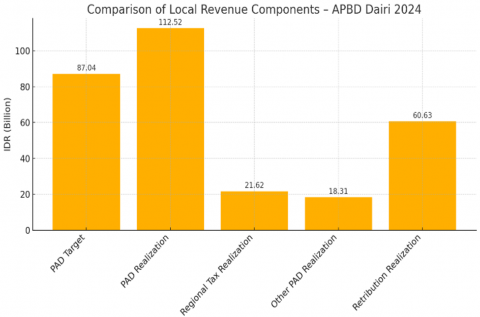
Despite the RPJMD’s stated commitment to digital transformation, inclusive infrastructure, and participatory development, APBD execution revealed structural incoherence. A stark example lies in the mismatch between fiscal targets and actual revenue realization (Figure 2 and Table 3).
This reactive revenue pattern illustrates the absence of a fiscal-policy alignment mechanism, reinforcing the need for Smart Alignment, a core component of the D-SMART model. Moreover, capital expenditures (Belanja Modal) remained marginal relative to operational spending, undermining infrastructure and innovation ambitions.
Table 3. Realization of local revenues against RPJMD targets
|
Revenue Type |
Target (IDR B) |
Realization (IDR B) |
% Realization |
Remarks |
|
Local Own-Source Revenue (PAD) |
87.04 |
112.52 |
129.3% |
Overshot due to retribution spike |
|
Regional Tax |
~32.65 |
21.62 |
66.2% |
Underperformed |
|
Regional Retribution |
~4.39 |
60.63 |
1,382% |
No linkage to RPJMD targets |
|
Other Legal PAD |
~38.60 |
18.31 |
47.4% |
Under-realized |
Figure 2. Revenue composition of APBD Dairi 2024 regional retribution far exceeded its target, while core revenue components underperformed
3.2 Deficits in participatory and adaptive planning
Forums such as Musrenbang remained largely procedural, with minimal conversion of community proposals into actionable budget allocations. The TEPD (Regional Evaluation Team) existed informally and lacked legal mandate or resources, while mid-year evaluations remained budget-centric rather than policy-responsive. SIPD tools were underutilized, primarily functioning as a reporting interface rather than a dynamic planning or monitoring platform as shown in Table 4.
Table 4. Governance challenges identified in stakeholder interviews
|
Theme |
Quote |
Stakeholder Type |
|
Planning–Budget Incoherence |
“Programs are inserted during budgeting without links to RPJMD outcomes.” |
BAPPEDA |
|
Weak Participation |
“Musrenbang feels symbolic. Our ideas never reach the budget level.” |
CSO |
|
SIPD Underutilization |
“We submit documents to SIPD but don’t use it for planning or monitoring.” |
OPD |
|
Political Budgeting |
“Changes in APBD reflect lobbying, not performance.” |
DPRD |
|
No Feedback Mechanism |
“No tool exists to adjust plans quarterly based on performance.” |
Academic |
3.3 Component-level validation of the D-SMART model
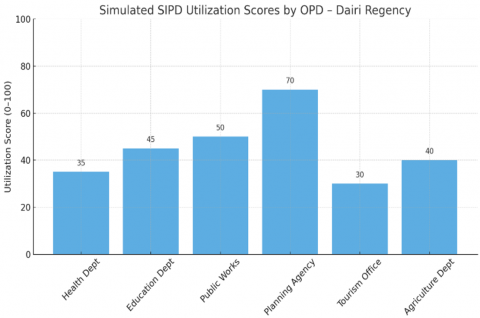
Sectoral data remained siloed, non-standardized, and inaccessible for planning. Most departments continued to rely on static formats such as spreadsheets or PDFs, while SIPD dashboards remained significantly underutilized (Figure 3).
Figure 3. Simulated SIPD utilization by OPD in Dairi Regency planning agency showed moderate usage; most line departments lagged
D-SMART addresses this through integrated sector dashboards and centralized access via SIPD-linked tools.
Using the Program Alignment Index (PAI):
$\begin{gathered} { Program\ Alignment\ Index\ (PAI) }= \left(\frac{ { Number\ of\ Programs\ funded\ in\ APBD }}{ { Total\ Strategic\ Programs\ in\ RPJMD }}\right) \times 100\end{gathered}$
Example: 6 of 10 RPJMD programs were funded in 2024 PAI = 60% (Table 5).
Table 5. Sample alignment between RPJMD and APBD
|
Program ID |
Program Name |
RPJMD |
APBD |
|
PRG-001 |
Youth Empowerment |
✓ |
✓ |
|
PRG-003 |
Tourism Revitalization |
✓ |
✗ |
|
PRG-007 |
Public WiFi Access |
✓ |
✗ |
|
PRG-010 |
Climate-Resilient Agriculture |
✓ |
✗ |
40% of RPJMD strategic priorities lacked budget execution—highlighting urgent need for D-SMART’s alignment dashboard.
Participation lacked continuity and authority. D-SMART introduces a Stakeholder Evaluation Board with formal quarterly reporting and input rights.
No structured process exists for intra-year program revision. D-SMART embeds Triannual Digital Review Cycles via SIPD dashboards, enabling data-based mid-cycle corrections.
Current indicators focus on activity counts (e.g., “number of trainings”). D-SMART emphasizes outcome-linked SDG indicators such as reduction in maternal mortality or improvements in youth employment.
3.4 Validation outcomes of the D-SMART model
The D-SMART model underwent multi-method validation as described in Section 2.5, with each method contributing distinct evidence of the model’s utility and robustness.
In the head-to-head comparison with the classical CIPP model, D-SMART scored higher across all six evaluative dimensions (Table 6):
Table 6. Comparative performance: D-SMART vs. classical CIPP
|
Criterion |
CIPP Avg Score |
D-SMART Avg Score |
|
Adaptability |
2.7 |
4.6 |
|
Data Use |
2.1 |
4.5 |
|
Stakeholder Inclusion |
3.0 |
4.8 |
|
SDG Linkage |
2.4 |
4.3 |
|
Planning Coherence |
2.9 |
4.7 |
|
Digital Compatibility |
2.2 |
4.6 |
These results validate D-SMART’s superiority in addressing real-world governance challenges through structured innovation.
Five evaluators (three local policy practitioners, two national planning experts) rated the model's:
Qualitative feedback highlighted the model’s ease of integration into SIPD and its potential for broader use across Indonesian districts.
Simulation of Dairi’s 2022–2023 planning cycle using D-SMART demonstrated:
Cross-checking budget execution data revealed that D-SMART’s adaptive review cycles could have identified and corrected policy lags at least one quarter earlier than current mechanisms.
3.5 Discussion
The classical CIPP (Context, Input, Process, Product) model, though foundational in evaluation theory, struggles to address the complexities of decentralized, SDG-oriented governance. Its limitations—static sequencing, weak stakeholder integration, and lack of digital feedback—are increasingly incompatible with the adaptive demands of modern policy environments [28, 33, 34].
This study positions the D-SMART model as a strategic upgrade, retaining CIPP’s structured logic while embedding digital tools, participatory mechanisms, and real-time performance tracking. Each CIPP element is re-engineered: Context integrates live sectoral data; Input aligns strategic and fiscal codes; Process introduces digital review cycles; Product emphasizes SDG-linked outcomes; and a fifth domain—Governance—institutionalizes stakeholder inclusion (Table 7).
These innovations position D-SMART as a hybrid governance tool that bridges evaluation, strategic planning, and participatory oversight. Unlike prior adaptations (e.g., CIPPO), D-SMART fully integrates data, decentralization, and democracy, making it highly relevant for SDG localization and responsive governance [30, 31, 35].
Table 7. Comparative framework: classical CIPP vs. D-SMART innovations
|
Component |
CIPP Focus |
D-SMART Advancement |
|
Context |
Needs-based |
Real-time SIPD data |
|
Input |
Planning logic |
Policy–budget alignment |
|
Process |
Implementation monitoring |
Quarterly digital reviews |
|
Product |
Output evaluation |
SDG-linked outcome metrics |
|
Governance |
Not covered |
Stakeholder evaluation boards |
3.6 Comparative review of evaluation models
While the classical CIPP framework remains a widely used foundation for program evaluation in governance contexts, alternative models such as CIPPO, the Kirkpatrick Model, and Logic Models also offer unique evaluative logics that merit discussion.
The CIPPO Model, an extension of CIPP, introduces an additional "Outcomes" component to better reflect long-term impact. However, it remains largely linear and does not explicitly embed digital adaptability or participatory structures, which are central to decentralized governance.
The Kirkpatrick Model, originally designed for training evaluation, focuses on four levels: Reaction, Learning, Behavior, and Results. Although robust for capacity-building programs, it lacks policy alignment tools and does not emphasize citizen participation or data integration—key elements in the D-SMART model.
The Logic Model visualizes causal chains between inputs, activities, outputs, and outcomes. It is widely used in development evaluation but is often criticized for its static structure and limited applicability in complex, multi-stakeholder environments. D-SMART, by contrast, emphasizes adaptive feedback loops and cyclical responsiveness.
Thus, D-SMART fills a crucial gap by integrating participatory governance, digital platforms, and SDG alignment within an adaptive and performance-oriented framework (Table 8).
Table 8. Summarizes how D-SMART compares across key criteria
|
Model |
Participation |
Digital Integration |
Policy Alignment |
SDG Linkage |
Feedback Cycles |
|
CIPP |
Limited |
No |
Moderate |
Indirect |
Annual/Static |
|
CIPPO |
Low |
No |
Low |
Indirect |
Outcome-focused |
|
Kirkpatrick |
None |
No |
Low |
Not applicable |
Linear |
|
Logic Model |
Limited |
No |
Indirect |
Weak |
Static |
|
D-SMART |
High |
Yes |
High |
Explicit |
Triannual |
4.1 Conclusion
This study introduced the D-SMART model as a participatory, adaptive, and performance-based evaluation framework tailored for decentralized governance. Grounded in a redesign of the classical CIPP model, D-SMART integrates real-time data systems (e.g., SIPD), program alignment tools, and stakeholder-driven evaluation to address persistent gaps in regional planning—such as plan–budget incoherence, procedural participation, and static evaluation cycles.
Applied to Dairi Regency, the model revealed:
As a contextualized application of the broader EPABKD framework, the D-SMART model demonstrated that adaptive, participatory, and performance-based evaluation systems can significantly enhance coherence, responsiveness, and citizen inclusion in local governance.
4.2 Policy implications
The study identifies five key policy actions for institutionalizing the D-SMART model in decentralized governance contexts. To support implementation planning, these recommendations are prioritized based on two criteria: feasibility of adoption (technical/legal readiness) and urgency of need (based on gaps identified during the study). Table 9 below presents the ranked implications.
Table 9. Prioritized policy recommendations for local governments
|
Policy Recommendation |
Description |
Priority |
|
Institutionalize Stakeholder Evaluation Boards |
Legalize and fund formal evaluation boards to review planning performance quarterly. |
High |
|
Operationalize the Program Alignment Index (PAI) |
Integrate PAI into local planning systems (e.g., BAPPEDA tools) to ensure RPJMD–APBD coherence. |
High |
|
Upgrade SIPD Functionality |
Move beyond passive reporting by activating dashboards and integrating review triggers. |
Medium |
|
Establish Participatory Feedback Loops |
Implement triannual digital reviews with community scoring of government programs. |
Medium |
|
Embed SDG-Based Performance Indicators |
Replace activity-based indicators with outcome-based KPIs aligned with SDG targets. |
Low |
This prioritization reflects the immediate need for institutional and operational coherence mechanisms, while also recognizing the medium-term importance of participatory and digital integration. Long-term reforms such as SDG indicator embedding require broader institutional shifts and thus follow in sequence.
Limitations and Future Research
While this study provides a contextually grounded evaluation model for adaptive local governance, several limitations must be acknowledged.
Future research should test D-SMART’s applicability in other decentralized governance contexts—both within and outside Indonesia—and examine its scalability under varying degrees of digital capacity, civic engagement, and institutional maturity.
[1] Putra, A.A., Hasibuan, H.S., Tambunan, R.P., Lautetu, L.M. (2024). Integration of the sustainable development goals into a regional development plan in Indonesia. Sustainability, 16(23): 10235. https://doi.org/10.3390/su162310235
[2] Annahar, N., Widianingsih, I., Muhtar, E.A., Paskarina, C. (2023). The road to inclusive decentralized village governance in Indonesia. Sustainability, 15(11): 8616. https://doi.org/10.3390/su15118616
[3] Wajdy, M.F., Warsono, H., Yuwono, T., Herawati, A.R. (2025). Reflecting on 20 years of regional development planning in Indonesia: A systematic literature review. Journal of Information Systems Engineering and Management, 10: 76-89. https://doi.org/10.52783/jisem.v10i12s.1716
[4] Vujanovic, P. (2017). Decentralisation to promote regional development in Indonesia. OECD Economic Department Working Papers. https://doi.org/10.1787/d9cabd0a-en
[5] Bokun, K., Nazarko, J. (2023). Smart villages concept — A bibliometric analysis and state-of-the-art literature review. Progress in Planning, 175: 100765. https://doi.org/10.1016/j.progress.2023.100765
[6] Pakpahan, R.T. (2024). Evaluating implementation of e-government public services in Dki Jakarta towards a smart city using the cipp and kirkpatrick evaluation model. Moestopo International Review on Social, Humanities, and Sciences, 4(1): 88-99. https://doi.org/10.32509/mirshus.v4i1.86
[7] Rahman, R.A.T., Irianto, G., Rosidi, R. (2019). Evaluation of E-budgeting implementation in provincial government of DKI Jakarta using CIPP model approach. Journal of Accounting and Investment, 20(1): 94-114. https://doi.org/10.18196/jai.2001110
[8] Stufflebeam, D.L., Zhang, G. (2017). The CIPP Evaluation Model: How to Evaluate for Improvement and Accountability. Guilford Publications.
[9] Nasution, M.A., Ginting, W.O., Revida, E., Trimurni, F. (2025). Evaluation model of sustainable development planning in regional policy implementation and local government administration. International Journal of Environmental Engineering and Development, 3: 13-26. https://doi.org/10.37394/232033.2025.3.2
[10] Ninghardjanti, P., Murtini, W., Hindrayani, A., Sangka, K.B. (2023). Evaluation of the smart Indonesia program as a policy to improve equality in education. Sustainability, 15(6): 5114. https://doi.org/10.3390/su15065114
[11] Stufflebeam, D.L. (2000). The CIPP model for evaluation. In Evaluation Models: Viewpoints on Educational and Human Services Evaluation. Dordrecht: Springer Netherlands, pp. 279-317. https://doi.org/10.1007/0-306-47559-6_16
[12] Marshall, S., Farndon, D., Hudson-Smith, A., Kourniotis, A., Karadimitriou, N. (2024). Urban design and planning participation in the digital age: Lessons from an experimental online platform. Smart Cities, 7(1): 615-632. https://doi.org/10.3390/smartcities7010025
[13] Gower, A., Hotker, M., Grodach, C. (2023). Digital participation models as public engagement tools in planning: A concept exploration. Planning Theory & Practice, 24(5): 663-678. https://doi.org/10.1080/14649357.2023.2278099
[14] Finney, T.L. (2020). Confirmative evaluation-A new CIPP model. Wayne State University.
[15] Kapucu, N., Ge, Y., Rott, E., Isgandar, H. (2024). Urban resilience: Multidimensional perspectives, challenges and prospects for future research. Urban Governance. https://doi.org/10.1016/j.ugj.2024.09.003
[16] Chanthalangsy, P., Yeh, B.I., Choi, S.J., Park, Y.C. (2024). Program evaluation of postgraduate obstetrics and gynecology training in Lao people’s democratic republic-using the CIPP model. BMC Medical Education, 24(1): 44. https://doi.org/10.1186/s12909-023-04942-6
[17] Siswadi, Y., Houghty, G.S., Agustina, T. (2019). Implementation of the CIPP evaluation model in Indonesian nursing schools. https://doi.org/10.20473/jn.v14i3.17046
[18] Musifuddin, M., Yunitasari, D., Murcahyanto, H. (2024). CIPP model approach to school-based management program evaluation. Nidhomul Haq: Jurnal Manajemen Pendidikan Islam, 9(1): 104-116. https://doi.org/10.31538/ndh.v9i1.4440
[19] Hilmiyati, F., Panggabean, T.E., Khoirunnisa, R.N., Siregar, M.S., Santosa, T.A. (2024). The effectiveness of the CIPP evaluation model in science learning in the era of the industrial revolution 4.0. Jurnal Obsesi: Jurnal Pendidikan Anak Usia Dini, 8(6): 1375-1384.
[20] Fairuz, F., Suwiryo, D.H., Sunarya, E. (2024). Evaluation of teacher empowerment programs in optimizing the quality of education services using the CIPP model. SIBATIK JOURNAL: Jurnal Ilmiah Bidang Sosial, Ekonomi, Budaya, Teknologi, Dan Pendidikan, 3(4): 459-474. https://doi.org/10.54443/sibatik.v3i4.1872
[21] Evans, J., Paterson, M., Castan, M., Purtell, J., Ballin, M. (2024). Participatory and proactive: Real-time rights-based recordkeeping governance for the alternative care of children. Records Management Journal, 34(2/3): 171-189. https://doi.org/10.1108/rmj-11-2023-0069
[22] Zou, Y., Razali, F., Mustakim, S.S.B. (2024). Exploring universal implementation strategies: Comparative analysis of CIPP models. International Journal of Academic Research in Progressive Education and Development, 13(3): 1084-1102. http://doi.org/10.6007/IJARPED/v13-i3/21838
[23] Ansell, C., Sørensen, E., Torfing, J. (2022). Implementing solutions based on collaborative adaptation. In Co-Creation for Sustainability: The UN SDGs and the Power of Local Partnership. Emerald Publishing Limited, pp. 137-150. https://doi.org/10.1108/978-1-80043-798-220220010
[24] Nurrafi’Arfitsani, A. (2025). Inovasi perencanaan anggaran belanja kegiatan melalui sistem informasi pemerintahan daerah (SIPD) di badan kesatuan bangsa dan politik kabupaten sidoarjo. Public Service and Governance Journal, 6(1): 46-57. https://doi.org/10.56444/psgj.v6i1.2385
[25] Pribadi, U., Iqbal, M., Ibrahim, M.A., Juhari, Ahdarrijal, Y. (2024). Nexus of public organization, transparency, and accountability in Indonesia's digital governance. Journal of Public Affairs, 24(3): e2940. https://doi.org/10.1002/pa.2940
[26] Rey, L., Fortin, A. (2023). Participatory evaluation, deliberation and democracy. In Handbook of Public Policy Evaluation. Edward Elgar Publishing, pp. 132-153. https://doi.org/10.4337/9781800884892.00017
[27] OECD. (2022). OECD guidelines for citizen participation processes. OECD Public Governance Reviews. https://doi.org/10.1787/7759a39c-en
[28] Yang, S.Y. (2024). Construction and operation of college labor education curriculum evaluation system based on CIPP model. Journal of Education, Humanities and Social Sciences, 27: 581-587. https://drpress.org/ojs/index.php/EHSS/article/view/18301/17831.
[29] Tariq, W., Chen, Y., Tariq, A., Sumbal, M.S. (2024). Digital governance for sustainable futures: A holistic review, framework, and roadmap. Elsevier. https://doi.org/10.2139/ssrn.4834787
[30] Cochrane, T., Galvin, K., Glasser, S., Osborne, M., Buskes, G., Rajagopal, V. (2024). Exploring Design-Based Research as a framework for addressing pedagogical problems faced by higher education: A panel discussion. ASCILITE Publications, 171-173. https://doi.org/10.14742/apubs.2024.1335
[31] Allsop, D.B., Chelladurai, J.M., Kimball, E.R., Marks, L.D., Hendricks, J.J. (2022). Qualitative methods with NVivo software: A practical guide for analyzing qualitative data. Psych, 4(2): 142-159. https://doi.org/10.3390/psych4020013
[32] Pasupuleti, M.K. (2024). Chapter I: Integrating quantitative and qualitative approaches using advanced statistical tools SPSS Amos and NVivo in modern research. In Advanced Statistical Tools and Techniques in Modern Research: Integrating Quantitative and Qualitative Approaches With SPSS Amos and NVivo. National Education Services, pp. 1-30. https://doi.org/10.62311/nesx/48547
[33] Ratnay, G., Indriaswuri, R., Widayanthi, D.G.C., Atmaja, I.M.P.D., Dalem, A.A. (2022). CIPP evaluation model for vocational education: A critical review. Education Quarterly Reviews, 5(3): 1-8. https://doi.org/10.31014/aior.1993.05.03.519
[34] Roza, D.F., Lubis, S.N., Sihombing, L., Kesuma, S.I., Lubis, A.A.R.D. (2025). Strengthening rural economies through integrated agriculture: Evidence from Southeast Aceh using input–output modeling. International Journal of Sustainable Development and Planning, 20(4): 1595-1601. https://doi.org/10.18280/ijsdp.200421
[35] Hilmi, M.I. (2022). Evaluation of Cippo Model Program in Elderly Empowerment.