Ronny Trian Surbakti | Syarifa Hanoum* | Mohamad Yusak Anshori | Jaroslaw Korpysa | Mahmood Shubbak
© 2025 The authors. This article is published by IIETA and is licensed under the CC BY 4.0 license (http://creativecommons.org/licenses/by/4.0/).
OPEN ACCESS
This systematic literature review explores the role of green practices in enhancing environmental and economic sustainability across various industries. Amid growing global awareness of climate change, businesses increasingly adopt green practices such as sustainable supply chain management, green product innovation, and eco-friendly waste management to reduce environmental impacts, comply with regulations, and meet consumer expectations. Utilizing the PRISMA protocol and PICOS framework, this study rigorously analyzed 58 relevant documents to assess the effectiveness of green practices in achieving sustainability outcomes. The findings reveal that green practices positively impact operational efficiency, cost reduction, and corporate reputation, while also addressing challenges specific to different sectors. The review identifies key drivers and barriers in implementing green practices and highlights the importance of cross-sector collaboration and supportive policies. This study provides valuable insights for businesses and policymakers seeking to integrate sustainability into strategic decision-making, thus promoting resilient, eco-conscious business models that contribute to the United Nations SDGs.
green practices, environmental and economics sustainability, systematic literature review, SDGs
Sustainability and the implementation of green practices have become vital concerns for modern industries, driven by increasing environmental pressures, rising consumer expectations, and growing regulatory demands [1]. The mounting evidence of climate change impacts, such as rising carbon dioxide levels and increasing frequency of natural disasters, has prompted industries to adopt green practices as a strategy to mitigate their environmental footprint and contribute to sustainable development [2]. The shift toward green practices reflects a broader alignment with frameworks such as the Triple Bottom Line (TBL), which emphasizes economic, social, and environmental performance. This approach has transformed the traditional view of corporate success, advocating for balanced development that supports environmental integrity and social equity alongside economic gains [1]. Industries are increasingly recognizing that these practices not only fulfill social responsibility but also enhance operational efficiencies, reduce costs, and improve resilience in a volatile market. Moreover, consumer demand for environmentally responsible products has surged, creating a competitive incentive for businesses to adopt sustainable practices. Green innovation, which encompasses the development of eco-friendly products and the implementation of sustainable processes, has proven advantageous in meeting these market demands while ensuring regulatory compliance [2]. Consequently, industries that proactively engage in green practices position themselves as leaders in environmental stewardship, meeting the expectations of both consumers and regulatory bodies. In essence, green practices are not only crucial for addressing environmental degradation but also serve as a pathway to long-term business success, making sustainability an integral part of strategic decision-making [3].
Implementing green practices can lead to increased profits, cost savings, and competitive advantages [4]. Green practices enhance corporate performance by fostering sustainable performance and responsible environmental stewardship [5]. Green practices drive corporate innovation, particularly in the chemical manufacturing sector, where eco-friendly practices have been linked to increased innovation [6].
Implementing green practices is vital for sustainability, offering economic, environmental, and social benefits. Overcoming internal and external barriers through strategic frameworks and continuous improvement processes can enhance the adoption and effectiveness of these practices across different sectors.
Green practices enable companies to significantly reduce operational costs. Through green process innovation [7]. Companies can reduce energy and resource consumption during production. In addition, green product innovation can help reduce the use of hazardous materials and improve product efficiency, ultimately lowering production costs and increasing the company's profit margins. These efficiencies are particularly important for companies operating in industries that require intensive use of resources. While the green transition offers opportunities for growth, it also brings new social and economic challenges. These companies need to address these challenges in order to maximize the benefits of green practices [8]. Companies that implement green practices frequently gain a competitive edge, as consumers become more concerned about the environmental impact of the items they purchase [9]. This positive image gives the company an advantage in acquiring more customers who are willing to pay a premium for environmentally friendly products. Companies that employ green practices can help to achieve sustainable development, which benefits both the environment and society. This can help the company's reputation as a socially responsible institution, attracting new customers and investors [8]. Green business practices help to improve a company's financial performance [9]. Companies that use green production procedures can save money on materials and energy, increase production efficiency, and minimize waste. This not only improves profitability, but it also boosts the company's worth in the eyes of stakeholders such as investors and shareholders. Green practices are anticipated to improve the company's financial performance in a sustainable fashion by providing multiple financing options, improving energy efficiency, and increasing investment with an agenda aligned with the principles of Environment, Social, and Governance (ESG) [10].
One of the most significant benefits of green practices is their capacity to reduce greenhouse gas emissions, air pollution, and water use, study [11] demonstrated how green supply chain management can mitigate negative environmental impacts by assuring more resource-efficient and environmentally friendly industrial processes. This involves lowering emissions during the manufacturing process, utilizing recyclable materials, and minimizing hazardous waste. On the other hand, Green practices also encourage companies to manage resources more effectively, which encourage the use of technologies and practices that reduce the excessive use of ecological value to the environment but also bring positivity to the environment by reducing waste and optimally managing resources, companies can demonstrate their commitment to the environment, which in turn improves their environmental performance for the better [12]. Increasingly stringent environmental regulations in many countries encourage companies to adopt green practices to avoid legal sanctions. In many countries, governments provide tax breaks for businesses that invest in green technologies and use environmentally friendly manufacturing techniques [13]. These incentives not only save operating expenses but also improve organizations' global competitiveness. Companies that implement green practice systems typically have a positive reputation, which can boost stakeholders' and society's trust in the organization [14]. Green practices have a favorable impact on compliance with existing standards, and by implementing them intensively, businesses can not only decrease risk but also increase competitiveness and financial performance [15]. Green practices contribute directly to the achievement of the United Nations' SDGs [16]. Stressed the importance of environmental sustainability in the global framework, which includes reducing carbon emissions and maintaining biodiversity.
Green practices in business are increasingly essential due to rising environmental concerns and regulatory pressures [17]. These practices span various aspects of business operations, from human resource management to supply chain management, and offer numerous benefits.
As countries commit to climate targets under frameworks like the Paris Agreement, measuring and improving the operational efficiency of power plants becomes essential [27]. The implementation of green practices offers various benefits, including environmental advantages such as reduced pollution, waste, and resource consumption [17]. These reductions contribute significantly to preserving natural ecosystems and promoting long-term sustainability. Economic benefits include cost savings, improved efficiency, and competitive advantage [17]. By lowering operational costs and increasing resource efficiency, companies can strengthen their market position and profitability. Additionally, social benefits involve enhanced corporate reputation and increased customer satisfaction [18]. Companies adopting green practices are often perceived positively by consumers, leading to stronger brand loyalty and community trust [19]. Sustainable Energy Development Requires Integrated Technological and Policy Innovations [28].
In the broader sustainability discourse, green practices serve as a critical link between technical performance and environmental responsibility. By incorporating undesirable outputs into performance evaluations, energy producers are encouraged to adopt greener technologies and operational strategies that prioritize emissions reductions. This aligns with global calls for decarbonization and SDGs, particularly SDG 7 (affordable and clean energy) and SDG 13 (climate action) [27].
Adopting green practices in business is crucial for achieving sustainability and gaining a competitive edge. While challenges exist, the benefits of improved environmental performance, cost savings, and enhanced corporate reputation make green practices a valuable investment for businesses.
2.1 Research gap
The key research gaps addressed in this study are presented in Table 1. These include the lack of comparative research on the impact of green practices and the limited understanding of cross-sector collaboration needed to support sustainable business practices.
Table 1. Research gap
|
Research Gap |
Description |
|
Lack of Comparative Research |
|
|
Limitations of Cross-Sector Collaboration |
|
2.2 Research question
The research process is made more structured, transparent, and repeatable by combining the PRISMA Protocol, PICOS, and systematic literature review. PRISMA facilitates the open reporting and oversight of the literature selection process, whereas PICOS provides a framework to ensure that the selected studies are relevant to the research question. By combining these two methods, researchers can conduct a more comprehensive and perceptive literature review, ensuring that the conclusions are not only backed by credible studies but also cover a variety of relevant subjects. With this approach, the study might provide a comprehensive understanding of green practices and how they affect the overall sustainability of firms. PRISMA is a guideline designed to improve the transparency and quality of reports in systematic reviews and meta-analyses. With these guidelines, reviews not only ensure that the research process is systematic and replicable but also minimize the risk of bias that may arise from the design of an individual study or industry sponsorship. Therefore, the application of PRISMA in this review contributes to an unbiased and comprehensive synthetic presentation of evidence, ultimately supporting the methodological strength and reliability of the study results [29]. On the other hand, PICOS is a valuable platform for developing research topics [16]. PICOS has five components: population, intervention, comparison, outcome, and research design. Implementing all of these may definitely improve data collection and screening of relevant and high-quality research, boosting the validity and trustworthiness of the results acquired [30].
Table 2 outlines the PICOS framework used in this study to structure the research focus on green practices. It defines the target population, types of interventions, comparison groups, expected outcomes, and the study design to evaluate the long-term impact of sustainability initiatives across industries.
Table 2. PICOS element
|
PICOS |
Explanation |
|
Population |
Companies in various industry sectors, including manufacturing, services, and retail have adopted green practices. |
|
Intervention |
Implementation of green practices such as green process innovation, green product innovation, green supply chain management, and sustainable waste management strategies. |
|
Comparison |
Comparison between businesses that implement green practices and businesses that do not implement green practices to assess differences in impact. |
|
Outcome |
Impact on environmental (reduced carbon emissions, energy efficiency) and economic (reduced costs, increased profitability, corporate reputation) sustainability. |
|
Study Design |
Observational studies and meta-analysis of the implementation of green practices in different sectors to evaluate long-term impacts. |
To enhance transparency and reproducibility, each component of the PICOS framework was operationalized through defined inclusion and exclusion criteria, as applied during the systematic screening process:
These criteria ensured that the final pool of 58 articles provided a robust and relevant evidence base to examine the intersection of green practices and sustainability performance in business contexts.
Based on the PICOS method described above, the Boolean Keywords String search in Scopus as follows:
("green practices" OR "green business" OR "environmentally friendly practices" OR "sustainable business practices") AND ("environmental sustainability" OR "economic sustainability" OR "environmental impact" OR "carbon reduction" OR "resource efficiency") AND ("business performance" OR "financial performance" OR "corporate sustainability" OR "economic impact") AND ("green supply chain" OR "green innovation" OR "green product" OR "green process")
Furthermore, using the PRISMA protocol in systematic literature review (SLR) which consists of four main steps to select relevant articles. Here is the method described in this article:
Based on the PRISMA framework, the inclusion and exclusion criteria were as follows:
As part of the article selection process for the systematic literature review, specific elimination criteria were applied to ensure the relevance and quality of the sources. These criteria include publication year, subject area, document type, publication stage, keywords, source type, language, and open access status. A summary of the applied criteria is presented in Table 3.
Table 3. Elimination criteria method (PRISMA protocol)
|
No. |
Elimination Criteria |
Elimination Element |
|
1 |
Range (Year) |
2019 – 2024 |
|
2 |
Subject Area |
Business, Management, Environmental Science, Social Science |
|
3 |
Document Type |
Article, Review and Conference Paper |
|
4 |
Publication Stage |
Final |
|
5 |
Keywords |
Sustainability, Literature Review, Sustainable Development, Systematic Literature Review |
|
6 |
Source Type |
Journal, Conference Proceeding |
|
7 |
Language |
English |
|
8 |
Open Access |
All Open Access |
|
Total Article |
58 articles |
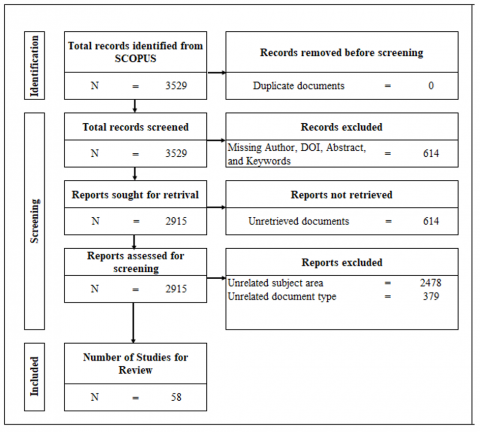
The article selection process follows the PRISMA (Preferred Reporting Items for Systematic Reviews and Meta-Analyses) guidelines to ensure transparency and rigor. Figure 1 presents the PRISMA flow diagram, showing the number of records identified, screened, excluded, and finally included in this systematic review. From an initial 3,529 documents identified through Scopus, a total of 58 relevant studies were included after applying exclusion criteria.
Figure 1. PRISMA protocol
In the discussion section, we delve into the implications of our findings on green practices and their role in enhancing both environmental and economic sustainability. This section builds on the systematic literature review conducted through the PRISMA protocol and PICOS framework, providing a rigorous and transparent approach to document selection and analysis.
Using PRISMA, we meticulously filtered through thousands of studies, narrowing them down based on relevance, methodology, and quality. We defined study quality based on criteria adapted from evidence-based review practices. Although we did not employ formal tools like CASP or AMSTAR, we considered a study to be of high quality if it clearly defined objectives, used transparent sampling and data collection methods, applied rigorous analysis techniques, and maintained consistency between its findings and conclusions. Studies lacking these elements were deemed to have lower methodological quality and were excluded. This process began with identifying relevant studies using Boolean search strings and gradually filtering them through inclusion criteria, such as publication year, subject area, and document type. Ultimately, 58 articles were selected, reflecting a well-rounded overview of industry efforts toward sustainability.
The PICOS framework guided our analytical approach by defining Population, Intervention, Comparison, Outcome, and Study design. This allowed us to systematically compare companies adopting green practices with those that do not. This comparison was not always found within single comparative studies. Instead, it was often inferred across separate case studies, some focusing on firms applying green practices, and others on those that did not. While this approach allowed for thematic synthesis, it is important to note that such inter-study comparisons may lack the control of within-study designs. Through this structured synthesis, the discussion will explore the nuanced benefits and challenges associated with green practices, offering insights into how these practices shape sustainable business models across diverse industries. For example, the manufacturing sector demonstrated significant improvements in resource efficiency and cost reduction through the adoption of green process innovation and waste minimization strategies. The logistics industry showed notable gains in carbon footprint reduction by implementing green transportation and packaging practices. In the hospitality sector, green human resource management (GHRM) practices contributed to increased employee engagement and alignment with sustainability values, enhancing both social and environmental outcomes. These sector-specific applications highlight the adaptability of green practices and their varied impacts depending on operational characteristics and environmental priorities.
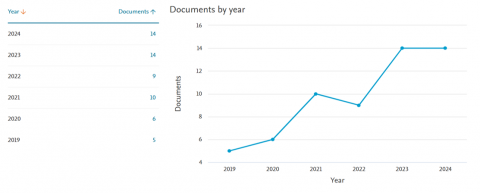
The distribution of the reviewed articles by publication year is shown in Figure 2. The number of relevant publications has increased over time, with the highest number recorded in 2023 and 2024 (14 documents each), indicating growing academic interest in sustainability-related topics within the last five years.
Figure 2 presents the trend of publication distribution over the period 2019 to 2024, showing how academic interest in sustainability-related topics has evolved. The total number of documents included in this review is 58, with a noticeable upward trajectory over time.
Figure 2. Descriptive analysis of systematic literature review (document by year, Scopus)
In 2019, only 5 documents met the inclusion criteria, indicating limited scholarly output on green practices and sustainability within that year. This number slightly increased to 6 documents in 2020, suggesting growing, but still modest, attention to the topic. A more significant rise is observed in 2021, with 10 documents, marking the beginning of a sharper upward trend.
Although there was a slight decline in 2022 (with 9 documents), this was followed by a substantial increase in 2023 and 2024, both years contributing 14 documents each — the highest in the entire review period. This sharp increase in the last two years signals a surge in scholarly attention and urgency regarding environmental sustainability, particularly in the context of global challenges such as climate change, the COVID-19 pandemic recovery, and shifting regulatory expectations in both developed and developing economies.
The growing number of studies also reflects the increasing integration of green practices, corporate sustainability, and systematic review methodologies into mainstream academic discourse, especially in disciplines such as business, environmental science, and social science. This pattern affirms the relevance and timeliness of conducting this systematic review, as it captures the momentum and evolution of sustainability research over the last five years.
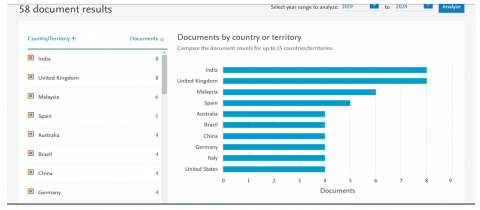
Figure 3 illustrates the geographical distribution of the 58 documents included in this systematic literature review, based on the countries or territories of contributing authors. The data reveal that India and the United Kingdom are the leading contributors, each producing 8 relevant publications within the specified period (2019–2024). This is followed by Malaysia with 6 documents, and Spain, Australia, Brazil, China, and Germany, each contributing 4 to 5 publications.
Figure 3. Descriptive analysis of systematic literature review (document by country territory, Scopus)
This distribution highlights a diverse international interest in sustainability-related research topics, particularly those related to green practices, sustainable development, and systematic reviews. The presence of both developed countries (such as the UK, Germany, and Australia) and developing nations (such as India, Malaysia, Brazil, and China) suggests that the issues surrounding environmental sustainability and corporate responsibility are increasingly viewed as global priorities.
Moreover, the contributions from emerging economies, especially in Asia, indicate an accelerating engagement with sustainability transitions in regions where industrial growth and environmental impact are often deeply intertwined. These findings reflect not only the global scope of the topic but also the importance of context-specific research in shaping effective sustainability strategies across different economic and regulatory environments.
The chart illustrates the trend in the number of documents published annually from 2019 to 2024. Starting from 2019 with 5 documents, there is a noticeable upward trend in publications over the years, reaching 14 documents by 2023 and maintaining the same number in 2024.
The growth is particularly significant between 2020 and 2021, where the number of documents increased from 6 to 10, reflecting a heightened interest or focus on the research topic. Although there was a slight dip to 9 documents in 2022, this decline was followed by a sharp increase in 2023, marking the peak at 14 documents. This peak level of publication is sustained in 2024, indicating a consistent level of research activity or interest in the field in recent years.
Overall, this steady rise, punctuated by a minor drop, suggests a growing academic or industry attention to the topic, with sustained interest through 2023 and 2024.
The chart representing the number of documents by country or territory among the 58 documents selected in the study. India and the United Kingdom lead with the highest number of documents, each contributing 8. Malaysia follows with 6 documents, while Spain ranks next with 5 documents. Australia, Brazil, China, and Germany each contribute 4 documents, showing a moderate level of research activity in these countries. Italy and the United States round out the list with 3 documents each.
This distribution highlights significant contributions from countries across different continents, indicating a global interest in green practices. India and the United Kingdom, both leading contributors, suggest a strong research focus on sustainability topics in both emerging and developed markets. Malaysia's presence with a notable number of documents also emphasizes the interest in green practices within Southeast Asia. This variety in geographic representation underscores the universal relevance of green practices and the shared challenges and interests across different economies.
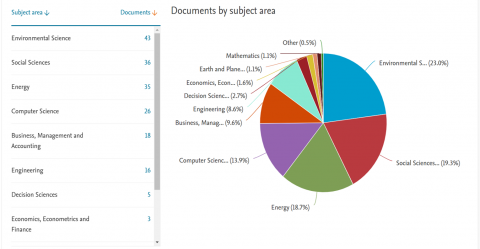
The chart (Figure 4) shows the distribution of the 58 selected documents by subject area. Environmental Science leads with 43 documents, accounting for 23.0% of the total, followed by Social Sciences with 36 documents (19.3%) and Energy with 35 documents (18.7%). Computer Science and Business, Management and Accounting contribute 26 (13.9%) and 18 documents (9.6%), respectively. Engineering holds 16 documents (8.6%), while Decision Sciences and Economics, Econometrics and Finance have 5 (2.7%) and 3 documents (1.6%), respectively. Smaller categories include Mathematics and Earth and Planetary Sciences, each with a minimal presence.
Figure 4. Descriptive analysis of systematic literature review (document by subject area, Scopus)
This distribution highlights that Environmental Science dominates the research landscape for green practices, reflecting a strong focus on ecological and sustainability issues. The substantial presence of Social Sciences and Energy indicates an interdisciplinary approach, where societal impacts and energy-related aspects are also key areas of interest. Computer Science and Business, Management, and Accounting represent significant contributions, emphasizing the role of technology and business strategies in implementing green practices. This wide range of subject areas showcases the multifaceted nature of green practices research, spanning environmental, social, technical, and economic dimensions, thereby underlining the comprehensive impact and relevance of sustainability across different fields.
Some of the advantages include increased operational efficiency, lower costs, and a stronger brand reputation among environmentally sensitive consumers. Companies that use green practices not only reduce negative environmental impacts but also improve their market competitiveness.
Green practices have a substantial impact on economic and environmental sustainability across a variety of industrial sectors. Based on the synthesis of 58 reviewed articles, approximately 79% reported improved economic performance, and 64% documented environmental benefits such as carbon emission reduction and energy efficiency. Notably, 33% of studies observed an increase in Return on Assets (ROA) after implementing green practices, particularly through strategies like green supply chain management (GSCM) and energy optimization.
Key findings include:
6.1 Suggestions for further research
While this review has highlighted the substantial benefits of green practices in promoting both environmental and economic sustainability across various industry sectors, several research gaps remain that warrant further investigation. Future studies are encouraged to conduct comparative cross-sector analyses to assess the relative effectiveness of green practices in distinct contexts such as manufacturing, services, and agribusiness. Additionally, longitudinal research is needed to evaluate the long-term impacts of green practice implementation on both financial and non-financial performance outcomes. Further inquiry into the role of public policy and incentive mechanisms such as green tax incentives, carbon trading schemes, and environmental financing is essential to understand how these tools can accelerate the adoption of green practices, especially among small and medium-sized enterprises (SMEs) in developing countries. Moreover, multi-stakeholder and cross-sector collaboration studies, involving partnerships between government, private enterprises, and non-governmental organizations, could yield deeper insights into the enabling and inhibiting factors for implementing sustainable practices in modern business environments.
[1] Nogueira, E., Gomes, S., Lopes, J.M. (2023). Triple bottom line, sustainability, and economic development: What binds them together? A bibliometric approach. Sustainability, 15(8): 6706. https://doi.org/10.3390/su15086706
[2] Guinot, J., Barghouti, Z., Chiva, R. (2022). Understanding green innovation: A conceptual framework. Sustainability, 14(10): 5787. https://doi.org/10.3390/su14105787
[3] Aftab, J., Veneziani, M., Sarwar, H., Abid, N. (2024). Do green practices drive business excellence in SMEs? Investigating how green entrepreneurial orientation improves firm’s performance. Total Quality Management & Business Excellence, 35(5-6): 529-558. https://doi.org/10.1080/14783363.2024.2315442
[4] Barakagira, A., Paapa, C. (2024). Green practices implementation for environmental sustainability by five-star hotels in Kampala, Uganda. Environment, Development and Sustainability, 26(4): 9421-9437. https://doi.org/10.1007/s10668-023-03101-7
[5] Sun, J., Sarfraz, M., Ivascu, L., Ozturk, I. (2023). Unveiling green synergies: Sustainable performance through human resource management, CSR, and corporate image under a mediated moderation framework. Environmental Science and Pollution Research, 30(45): 101392-101409. https://doi.org/10.1007/s11356-023-29468-8
[6] Munir, T., Watts, S. (2024). Exploring eco-friendly business practices and corporate innovation in Pakistan. International Journal of Innovation Science. https://doi.org/10.1108/IJIS-03-2024-0078
[7] Xie, Q., Su, Y.Y., Khan, A., Hishan, S.S., Ahmad Lone, S. (2022). The investigation of sustainable environmental performance of manufacturing companies: Mediating role of organizational support and moderating role of CSR. Economic Research-Ekonomska Istraživanja, 35(1): 4128-4148. https://doi.org/10.1080/1331677X.2021.2011369
[8] Vignochi, L., Lezana, Á.G.R., de Andrade Paines, P. (2019). Entrepreneurial leadership cognitive model. Ciência da Informação, 48(2): 41-52.
[9] Ashton, W., Russell, S., Futch, E. (2017). The adoption of green business practices among small US Midwestern manufacturing enterprises. Journal of Environmental Planning and Management, 60(12): 2133-2149. https://doi.org/10.1080/09640568.2017.1281107
[10] Singh, A., Dwivedi, A., Agrawal, D., Bag, S., Chauhan, A. (2024). Can sustainable and digital objectives synchronize? A study of ESG activities for digital supply chains using multi-methods. Business Strategy and the Environment, 33(8): 8413-8435. https://doi.org/10.1002/bse.3925
[11] Tseng, M.L., Li, S.X., Lim, M.K., Bui, T.D., Yuliyanto, M.R., Iranmanesh, M. (2023). Causality of circular supply chain management in small and medium-sized enterprises using qualitative information: A waste management practices approach in Indonesia. Annals of Operations Research, 1-42. https://doi.org/10.1007/s10479-023-05392-5
[12] Achaku, M.M., Agbeaze, E.K., Ekoja, G.O., Asortse, S. (2022). Green entrepreneurship and performance of small and medium enterprises in North-Central Nigeria. Environmental Economics, 13(1): 126-140. https://doi.org/10.21511/ee.13(1).2022.11
[13] Duarte, S., do Rosário Cabrita, M., Cruz-Machado, V. (2023). Green supply chain practices: Toward a sustainable industry development. E3S Web of Conferences, 409: 01004. https://doi.org/10.1051/e3sconf/202340901004
[14] Li, W., Sun, Y., Gao, Y. (2022). Relationship between green entrepreneurship orientation, integration of opportunity and resource capacities and sustainable competitive advantage. Frontiers in Psychology, 13: 1068734. https://doi.org/10.3389/fpsyg.2022.1068734
[15] Huang, X., Ullah, M., Wang, L., Ullah, F., Khan, R. (2024). Green supply chain management practices and triple bottom line performance: Insights from an emerging economy with a mediating and moderating model. Journal of Environmental Management, 357: 120575. https://doi.org/10.1016/j.jenvman.2024.120575
[16] Agrawal, R., Majumdar, A., Majumdar, K., Raut, R.D., Narkhede, B.E. (2022). Attaining sustainable development goals (SDGs) through supply chain practices and business strategies: A systematic review with bibliometric and network analyses. Business Strategy and the Environment, 31(7): 3669-3687. https://doi.org/10.1002/bse.3057
[17] Tahir, A.H., Umer, M., Nauman, S., Abbass, K., Song, H. (2024). Sustainable development goals and green human resource management: A comprehensive review of environmental performance. Journal of Environmental Management, 370: 122495. https://doi.org/10.1016/j.jenvman.2024.122495
[18] Sajjad, A. (2019). Greening the supply chain: A framework for best practices. Clean, Green and Responsible? Soundings from Down Under, 191-209. https://doi.org/10.1007/978-3-030-21436-4_11
[19] Gelmez, E., Özceylan, E., Mrugalska, B. (2024). The impact of green supply chain management on green innovation, environmental performance, and competitive advantage. Sustainability, 16(22): 9757. https://doi.org/10.3390/su16229757
[20] Santos, H., Lannelongue, G., Gonzalez-Benito, J. (2019). Integrating green practices into operational performance: Evidence from Brazilian manufacturers. Sustainability, 11(10): 2956. https://doi.org/10.3390/su11102956
[21] Lutfi, A., Alqudah, H., Alrawad, M., Alshira’h, A.F., Alshirah, M.H., Almaiah, M.A., Alsyouf, A., Hassan, M.F. (2023). Green environmental management system to support environmental performance: what factors influence SMEs to adopt green innovations? Sustainability, 15(13): 10645. https://doi.org/10.3390/su151310645
[22] Afshar Jahanshahi, A., Al-Gamrh, B., Gharleghi, B. (2020). Sustainable development in Iran post-sanction: Embracing green innovation by small and medium-sized enterprises. Sustainable Development, 28(4): 781-790. https://doi.org/10.1002/sd.2028
[23] El-Kassar, A.N., Singh, S.K. (2019). Green innovation and organizational performance: The influence of big data and the moderating role of management commitment and HR practices. Technological Forecasting and Social Change, 144: 483-498. https://doi.org/10.1016/j.techfore.2017.12.016
[24] Asha'ari, M.J., Daud, S. (2019). The influence of cleaner production and resource efficiency on corporate sustainability performance: The moderating role of organisation size. International Journal of Environmental Technology and Management, 22(4-5): 364-383. https://doi.org/10.1504/IJETM.2019.104768
[25] Hassan, M.G., Nordin, N., Ashari, H. (2015). Sustainable manufacturing practices implementation in Malaysia industries. Jurnal Teknologi (Sciences & Engineering), 77(4): 49-56. https://doi.org/10.11113/jt.v77.6042
[26] Karaman, A.S., Kilic, M., Uyar, A. (2020). Green logistics performance and sustainability reporting practices of the logistics sector: The moderating effect of corporate governance. Journal of Cleaner Production, 258: 120718. https://doi.org/10.1016/j.jclepro.2020.120718
[27] Hanoum, S., Ardiantono, D.S., Rachmad, R., Ramadhandy, R.A., Irawan, M.I., Korpysa, J. (2023). Optimizing greenhouse gas emissions: A productivity-efficiency analysis of Indonesian coal-fired power plants. In 2023 IEEE Technology & Engineering Management Conference-Asia Pacific (TEMSCON-ASPAC), Bengaluru, India, pp. 1-8. https://doi.org/10.1109/TEMSCON-ASPAC59527.2023.10531576
[28] Rachmad, R., Irawan, M.I., Hanoum, S. (2024). Economic strategies and efficiency of power plants in Indonesia to achieve net zero emissions. International Journal of Energy Economics and Policy, 14(6): 213-221. https://doi.org/10.32479/ijeep.17053
[29] Eftimov, L., Kitanovikj, B. (2023). Artificial intelligence-driven HR practices in SMEs: A Prisma-compliant scoping literature review. In the Ninth International Scientific-Business Conference LIMEN Leadership, Innovation, Management and Economics: Integrated Politics of Research, Graz, Austria, pp. 13-20. https://doi.org/10.31410/LIMEN.S.P.2023.13
[30] Asad, M., Majali, T.E., Aledeinat, M., Abdelkarim Almajali, D., Akhorshaideh, A.H.O. (2023). Green entrepreneurial orientation for enhancing SMEs financial and environmental performance: Synergetic moderation of green technology dynamism and knowledge transfer and integration. Cogent Business & Management, 10(3): 2278842. https://doi.org/10.1080/23311975.2023.2278842