Pranvera Dalloshi | Mentor Borovci* | Donat Rexha
© 2025 The authors. This article is published by IIETA and is licensed under the CC BY 4.0 license (http://creativecommons.org/licenses/by/4.0/).
OPEN ACCESS
As international trade continues to expand, non-tariff barriers (NTBs): such as technical regulations, standards, and conformity assessments are gaining prominence. These measures, often referred to as technical barriers to trade (TBTs), pose significant challenges for businesses, particularly those in less developed countries aiming to access markets like the European Union (EU). While these requirements aim to ensure the safety and quality of products for EU customers, they often present substantial challenges for firms from countries like Kosovo. This study explores the potential escalation in costs as well as the economies of scale stemming from enhanced EU product requirements compliance. Based on a comprehensive survey of Kosovar manufacturing firms and logistic regression analysis, the findings indicate that operational adjustments required for compliance with EU product standards significantly increase the likelihood of firms experiencing difficulties in this process. Additionally, the study reveals the potential for achieving economies of scale, highlighting both the challenges and potential opportunities this process entails. Understanding this duality is essential for businesses navigating the complexities of exporting to the EU, ultimately fostering informed decision-making and strategic actions. To the best of our knowledge, this is the first study that makes a substantial contribution to the field, by providing empirical analysis of the financial implications of EU product compliance for manufacturing businesses in Kosovo. Kosovo’s economy is import-dependent, and its manufacturing exports are limited and often concentrated in low-complexity products, while manufacturing sector is dominated by Small and Medium-Sized Enterprises (SMEs), faces limited institutional support for compliance infrastructure and constrained access to international markets.
international trade, EU compliance standard, manufacturing firms, economies of scale, export challenges
As global tariff trade barriers diminish, the primary emphasis in international trade is transitioning towards non-tariff barriers (NTB) [1], which includes regulatory prerequisites for products, commonly known as technical barriers to trade (TBTs). To ensure that a company's products meet quality, safety and performance standards imposed by host market, as well as to sustain competitiveness in the global market, a crucial factor is conformity with technical requirements. The majority of global markets apply stringent standards and technical prerequisites for products and the EU is among these markets. However, due to its extensiveness, it is attractive for enterprises operating beyond its borders. Therefore, aligning with the technical requirements of products and conducting conformity evaluations stand as two pivotal facets for businesses within the manufacturing sector. Such considerations are frequently perceived as barriers to the expansion of exports, particularly for small and new businesses coming from less developed countries. These companies face additional costs due to the need to modify the product, process, or service, in order to align with the EU requirements, specifically the technical requirements for products and the assessment of conformity. Consequently, the academic literature frequently labels this obstacle as non-tariff barriers (NTBs), due to the possibility of discouraging producers from pursuing the EU market because of the augmented overheads involved [2-4].
The new EU legislative framework established in 2008, reinforced the prerequisites for placing a wide range of products into the EU market by strengthening the market surveillance extensively. Considering it is a framework comprised of directives and regulations, it often presents challenges for businesses operating beyond the EU's borders, as it can be complicated to fully comprehend and implement.
Kosovo is a non-EU member state that entered into the Stabilization Association Agreement (SAA) in 2015. SAA is a pact that significantly streamlines trade between the two markets, EU on one side and Kosovo on the other. This agreement has grown to be profitable, especially for Kosovo which has a deeply unfavorable trade balance, with a substantial trade deficit. As per records from the Kosovo Agency of Statistics [5] the trade deficit at the end of 2023 stood at 5.05 billion euros. Simultaneously, data sourced from the Central Bank of Kosovo (CBK) reveals that Kosovar exports constitute 29% of the country's total toward EU, with Germany emerging as the primary export destination at 36% participation [6]. This observation can be supported by the concentration of the Kosovar diaspora in Germany, leading to enhanced commercial connections and readily accessible market insights. Moreover, when dissecting exports by economic categories, we can discern the top three contributors: base metals and related articles, plastics, tires and associated articles, as well as prepared food items, beverages and tobacco.
The EU market is an attractive area for Kosovar businesses, mainly due to its substantial consumer base, thus increasing the potential for enhanced profitability among local enterprises and also bearing significance for Kosovo as a whole, by increasing exports and thereof economic growth. Therefore, the central objective of this research is to conduct a comprehensive analysis of the impact of complying with EU product requirements on the financial performance of Kosovar enterprises. This encompasses examining the potential escalation in costs as well as the economies of scale stemming from enhanced product quality and expanded access within both the EU market and other market spheres. Through this exploration, the study unveils the dynamic challenges faced by companies hailing from smaller and less developed nations. As such, comprehending the implications tied to adapting to these provisions can prove invaluable to manufacturing businesses within Kosovo, as well as in any other country where enterprises seek to penetrate the EU market. The insights derived from this research can facilitate and motivate these businesses in ensuring conformity with both local and international standards. Furthermore, this study has the potential to reveal the challenges and opportunities related to these requisites, thereby aiding policymakers and enterprises in making well-informed and strategic decisions.
To guide this investigation, the study is driven by the following research questions:
RQ1: Does compliance with EU product requirements increase the likelihood of firms experiencing operational difficulties?
RQ2: Does compliance with EU product requirements lead to economies of scale in manufacturing firms in Kosovo?
Kosovo’s economy remains heavily import-dependent, while its manufacturing exports are limited and often focused in low-complexity products. The sector is dominated by small and medium-sized enterprises (SMEs), faces limited institutional support for compliance infrastructure and constrained access to international markets. Unlike manufacturers in EU member states, firms in Kosovo are required to comply with EU product standards without benefiting from the institutional and financial support structures available within the Union. These include access to EU structural funds, integrated certification systems, and centralized regulatory assistance, which are largely absent in Kosovo’s context. For many of them, compliance becomes more than just a technical or financial task. It turns into a broader strategic challenge, especially within an environment shaped by post-conflict recovery and institutional gaps. This study provides a unique contribution by examining the implications of such compliance for manufacturing firms in an emerging economy still navigating post-conflict reconstruction and structural transformation, offering empirical insights into a rarely studied, yet highly relevant, economic setting at the intersection of EU integration and local industrial development.
This study utilizes the logit model to examine the challenges associated with aligning with EU product requirements as a determinant in the decision-making process for exporting. The research methodology closely adheres to the approach used by Chen et al. [7] who investigated the connection between varying standards and the export choices of individual firms within developing countries.
The rest of this paper is organized as follows: Section 2 provides a comprehensive overview of pertinent literature. In Section 3, the data employed in this study is outlined and the specific empirical model employed is specified. Section 4 delivers the descriptive and empirical findings derived from the study. Lastly, Section 5 encompasses the conclusions drawn from the research.
Literature shows that non-tariff barriers (NTBs), including divergences in regulatory frameworks and product standards, pose a more significant obstacle to trade than traditional tariffs [8-11]. Moreover, the literature demonstrates that costs incurred due to compliance with EU product requirements discourage participation in the EU market [3, 12, 13]. Harmonized standards, mandated by the EU within the European Economic Area (EEA), which encompass technical specifications for product design, function and manufacturing processes to meet safety, health and environmental criteria have compelled numerous businesses to alter their production processes, product content, or even their services. Such alterations often cause additional costs that are beyond the means of some companies. This is confirmed by Fernandes et al. [14] who emphasize that adhering to standards can potentially increase export costs.
These expenditures encompass both fixed costs associated with enhancing production systems, acquiring specialized processing and storage equipment, implementing quality control protocols and securing certifications, as well as variable costs linked to delays and inspection procedures. Shepherd [3] argues that higher costs due to adaptation to the demands of foreign target markets for products can discourage market entry, particularly for companies from less developed countries, due to the reason that these firms face greater financial, managerial, technological and informational constraints.
Supporting this, Soon and Thompson [15] illustrate how non-tariff barriers (NTBs) such as sanitary regulations imposed by Russia on chicken imports significantly affected international trade. Their study found that these NTBs led to increased domestic prices and a substantial decline in imports, highlighting how technical barriers can act as de facto trade restrictions.
In the same context, by analyzing the trade effects between the European Union's Group of 15 (EU-15) and the People's Republic of China, influenced among other factors, by national and international technology standards, Mangelsdorf [12] concludes that when the costs of adhering to established standards become prohibitively high, firms are less inclined to engage in exports. In some cases, certain firms may opt not to export at all. In addition, Cipollina and Demaria [13] discovered that certain non-tariff barriers, such as technical requirements, quality controls and other formalities, exert a negative impact on trade. They attribute this effect to the additional costs incurred by these measures, interpreting them as hindrances to the flow of trade.
A theoretical model developed by Calo-Blanco and Naya [16] shows that while preferential trade agreements may benefit high-cost importers, forming customs unions and introducing non-tariff barriers can reduce overall welfare while increasing domestic firm profits, suggesting governments may prioritize producer interests over consumer welfare. Moreover, literature findings indicate that non-tariff barriers (NTB) tend to exert a higher negative impact on the export values of low-income countries compared to high-income ones [17-19]. In the same vein, Chen et al. [20] conducted an analysis to determine whether standards influence export performance and trade costs for developing countries and concluded that technical regulations in industrialized countries have an adverse effect on a firm’s propensity to export. They used the World Bank Technical Barriers to Trade Survey, which included 619 firms across 17 developing nations. These results confirm the fact that the performance of companies in adapting to regulatory changes is influenced not only by internal capabilities but also by external environmental factors.
On the other hand, Shepherd and Wilson [21], using empirical data to assess the trade impacts of voluntary food and agriculture standards within the EU, demonstrate that the effects of standards, especially whether they act as barriers or catalysts, vary significantly across specific sectors. Therefore, their main findings indicate that non-harmonized EU standards particularly negatively affect lightly processed products, whereas highly processed goods are less impacted. Notably, these standards have a more pronounced effect on developing country exporters of less processed products compared to their impact on developed country exporters.
It is widely acknowledged that the EU's technical requirements and EU’s product safety policy have always been intricate and challenging for businesses seeking compliance [22]. This complexity may be one of the reasons why small businesses with limited resources struggle to access the EU market. Furthermore, a single product may be subject to multiple regulations, further complicating the path to market entry, raising the question why is there a legal requirement for compliance in the first place? In this regard, Twigg-Flesner [23] argued that “if there were no legal conformity requirement, it would be necessary for the consumer and trader to agree on the quality and other aspects of the goods or digital content whenever a new contract is signed. This would be clearly impractical as it would be a waste of time and resources to re-negotiate every time a person wants to buy something”. In the same way, Fliess et al. [2] argue that the declaration of conformity facilitates international trade. However, as already pointed out the costs linked to adhering to EU regulations may hinder competitiveness. This observation aligns with the findings of Kanjevac Milovanović et al. [24], who identified a decrease in competitiveness among companies experiencing an increase in costs associated with obtaining the CE marking.
The associated increased costs and competition due to globalization and technological progress may have pushed companies of different sectors to produce mass market products [25] as a strategy to reduce certain costs. In this context, Tsougkou et al. [26] underscore the complexity of product adaptation strategies and their performance implications, highlighting the multidimensional nature of international product adaptation and its varying impacts on different performance outcomes. Moreover, they argue that adaptation strategies must be aligned with broader organizational considerations.
In addition, a firm's ability to integrate environmental and strategic factors plays a critical role in determining its overall performance, suggesting that successful adaptation is not only a technical or regulatory response but also a strategic and context-dependent process [27-29]. Supporting this view, Safonov et al. [30] argue that the effective functioning of a market economy depends on the presence of clear and well-defined rules, which guide firms’ adaptive strategies and reinforce consistency in market behavior.
Summarizing the literature findings, we can say that the EU justifies the extensive EU product requirements by the fact that it is focused on its consumer health, safety and environmental protection, while technical standards tend to ensure product and process quality. Moreover, EU legislation on product requirements seeks to reduce information asymmetry between buyers and sellers [31]. However, ensuring compliance with EU product requirements poses a unique set of challenges [22].
Despite the growing body of literature on non-tariff barriers and compliance with EU product requirements, existing studies have overlooked the specific context of Kosovo, a developing, non-EU country with a unique combination of limited institutional infrastructure and high export aspirations toward the EU market. Moreover, to the best of our knowledge there is no research that has tended to focus both on the costs and the benefits of compliance addressing both dimensions simultaneously. This study contributes to filling this gap by offering a dual analysis of the financial implications of compliance, examining not only the challenges and costs incurred by manufacturing firms, but also the potential for achieving economies of scale. By focusing on Kosovo’s manufacturing sector, this research provides original, context-specific insights that are largely absent from the current academic discourse and relevant for policymakers and firms operating in similar economic environments.
3.1 Data and sample
This study uses data collected by a questionnaire specifically designed for businesses in the manufacturing sector in Kosovo, whether they were engaged in exporting or not. The questionnaires were administered by direct visits to the respective companies.
The questionnaire was developed in a two-step validation process. First, it was reviewed by a panel of academic experts in international trade and industrial economics to assess the content validity and ensure that the questions aligned with the research objectives. Second, a pilot test was conducted with a small sample of five manufacturing firms. This sample was not included in the final dataset. Feedback from this pilot phase was used to improve the clarity, relevance and sequencing of the questions. This process helped ensure that the questionnaire would yield reliable and meaningful data for analysis.
The questionnaire comprised four sections:
Section A: gathered general information about the companies, including their size, legal status, the number of employees, whether they exported products to the EU and how they perceived the importance of exporting to the EU.
Section B: In this section, respondents were queried about compliance with manufacturing standards. They were asked if they possessed internationally recognized quality certifications and the number of standards they had to adhere to when exporting.
Section C: contained specific questions on the costs associated with adapting to EU product requirements. It focused on the types of costs incurred when initiating exports, including product testing, certification, technical specifications, labeling, packaging, compliance with safety and health standards, adherence to environmental regulations and the employment of managerial, engineering, technical, or other staff to align business processes, products, or services with EU legal requirements. The questionnaire consisted of binary (yes/no) and multiple-choice questions to identify the types and nature of compliance-related costs incurred by firms.
Section D: addressed revenue-related inquiries. Participants were asked whether the revenues generated from exports covered the costs of adapting to EU requirements. Additionally, they were questioned about whether complying with EU product requirements led to increased sales in countries where such requirements were not necessary, such as Kosovo or other third countries.
Section E: is focused on the institutional support received by manufacturing businesses and their requests to the government of Kosovo.
Before taking part in the study, all participants were given a consent form that clearly explained the purpose of the research, what it involved, and any potential risks or benefits. By signing the form, they confirmed that they understood the information and agreed to participate.
Given the sensitivity of financial data related to costs and revenues, the questions in the questionnaire were formulated to avoid requesting specific numerical values. While this approach was necessary to ensure participant comfort, it does present a limitation. Some statistical analyses that might have been beneficial are rendered unfeasible due to the absence of concrete data. Moreover, another limitation derives due to limited data from Non-Exporting Businesses since the questionnaire was designed to gather data also from non-exporting businesses.
One of the research objectives was to explore the challenges faced by non-exporting businesses and understand their reasons for not exporting to the EU. Unfortunately, due to low participation from this group, we were unable to achieve this objective. This limitation suggests a potential area for future research, allowing other researchers to delve into this aspect.
A total of 95 manufacturing companies based in Kosovo were initially included in the survey. However, during the data cleaning process, it was necessary to ensure that the data met specific criteria or standards for accuracy and completeness. As a result, after implementing the data cleaning policy, only 88 of these companies had all the required and sufficiently reliable data available to proceed with running the analytical model. The list of manufacturing companies, along with their addresses and contact information, was obtained from the Kosovo Business Registration Agency.
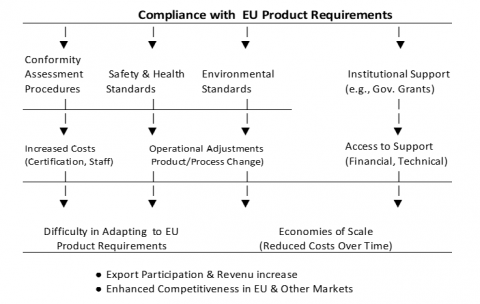
In the following, we present the study's conceptual framework.
Figure 1 illustrates the key variables and relationships examined in the study, focusing on the impact of compliance with EU product requirements on business costs, economies of scale and export performance.
Figure 1. Explanation of framework components
3.2 Model and variables specification
To analyze the relationship between the independent variables and the dichotomous dependent variable we utilize the logistic regression model. Logistic regression is commonly used when the dependent variable is binary (i.e., taking on two possible values). In this case, the dependent variable represents whether a firm found it difficult (1) or not difficult (0) to comply with the product requirements in the EU.
The logistic regression model formulates the probability of the dependent variable taking the value of 1 as a function of the independent variables [32]. The model can be expressed as:
$\mathrm{P}($ Difficulty $=1)=\frac{1}{1+e^{-z}}$ (1)
where, Z is the linear combination of predictors.
$\mathrm{z}=\beta_0+\beta_1 X_1+\beta_2 X_2+\cdots+\beta_n X_n$ (2)
where, $X_1, X_2, \ldots, X_n$ are independent variables (predictors). $\beta_0$ is the intercept, and $\beta_1, \beta_2, \ldots, \beta_n$ are regression coefficients.
Before running the logistic regression, we checked whether the data met the assumptions of logistic regression. The first assumption is that the dependent variable should be categorical. This assumption is fulfilled as described above that the dependent variable represents whether a firm found it difficult (1) or not difficult (0) to comply with the product requirements in the EU. Second assumption is that the data should be independent, which means that there is no relationship between the observations. The dataset contains 88 observations which exhibit independence. No multicollinearity in the data is expected. To test this, we ran the correlation matrix which shows that there are moderate correlations and there doesn't seem to be extremely high correlation between any pair of independent variables, which is a typical indicator of severe multicollinearity. As well as we performed the Variable Inflated Factor which yielded a mean value of 1.48, confirming that multicollinearity is not a concern in our model.
The functional form of the model is presented below:
$\begin{gathered}Z_i=\beta_0+\beta_1 \text { Size }_i+\beta_2 \text { eucompreq }_i+ \\ +\beta_3 \text { techfinance }_i++\beta_4 \text { staffupgrade }_i+ \\ \beta_5 \text { iso }_i++\beta_6 \text { gov }_i+\varepsilon_i\end{gathered}$ (3)
In the equation, Z–is represented in two ways. In the first model, it expresses the difficulty of complying with the product requirements in the EU. In the second model the Z is represented by variable intending to measure the economies of scale that happened due to compliance with EU product requirements. While, $i$ stands for the company, β₀, β₁, β₂, β₃, β₄, β₅ and β₆ represent the coefficients to be estimated for each independent variable. The logistic transformation $\left(\frac{1}{1+e^{-z}}\right)$ ensures that the predicted probability lies between 0 and 1, suitable for a binary dependent variable.
In Table 1, the description for each variable is given.
Table 1. Variable description
|
Variables |
Meaning |
|
Size |
Microenterprise (1-9 employees)- Reference group Small enterprise (10-49 employees) Medium enterprise (50-249 employees) Large enterprise with over 250 employees |
|
Eucompreq |
The variable eucompreq is a binary (dummy) variable constructed to capture whether a firm is affected by any of the three main types of EU product-related regulatory requirements: Conformity assessment procedures (e.g., CE marking, testing, certification), Safety and health standards, Environmental regulations (e.g., RoHS, REACH, packaging waste directives). The variable is coded as 1 if the company reported the Safety and health standards or Environmental regulations as the highest costs incurred due to EU product requirements, and 0 otherwise. |
|
Techfinance |
Techfinance is a binary variable coded as 1 if the respondent reported having to secure additional financing to meet the technological requirements necessary to adapt the process or product in compliance with EU product requirements. This variable captures the financial impact of complying with EU standards, particularly where it involves investing in new equipment, processes, or certifications. |
|
Staffupgrade |
Staffupgrade is a binary variable coded as 1 if the respondent reported hiring managerial, engineering, or technical staff to meet EU product requirements. The variable also captures indirect efforts related to staff development or training, assuming that compliance with EU legislation often necessitates upgrading workforce skills in addition to headcount expansion. |
|
ISO |
ISO is a binary variable coded as 1 if the respondent reported having implemented ISO standards in the company prior to beginning in compliance with EU product requirements, and 0 otherwise. |
|
Gov |
Govis a binary variable coded as 1 if the respondent reported receiving institutional support on how to comply with EU product requirements. |
|
Difficulty |
Difficulty is a binary (dummy) variable coded as 1 if the respondent reported experiencing difficulties in meeting conformity requirements for exporting to the European Union, and 0 otherwise. This variable captures the presence of perceived or actual obstacles faced by firms when attempting to comply with EU product standards. |
|
Economies of scale |
Economies of scale is a binary variable coded as 1 if the respondent reported experiencing a reduction in production costs over time as a result of increased production volumes or efficiency improvements following compliance with EU product requirements, and 0 otherwise. |
The challenge in defining the variables arises in structuring the matrix that consolidates the extensive EU product requirements. According to scholarly work by de Melo and Nicita [33] the technical measures encompass a spectrum of factors, namely labeling prerequisites, conformity assessment, as well as measures pertaining to the technical specifications of the product, encompassing certification, testing and inspection. However, in this study, we used a binary variable to have more focused analysis of the perceived cost intensity of specific regulatory dimensions, while still reflecting the broader spectrum of EU technical requirements This approach also helps address model limitations related to the inclusion of multiple variables.
The decision to operationalize the variables “difficulty” and “economies of scale” as a binary variable was driven by the nature of the survey instrument and the need to ensure response clarity for non-expert participants. For the economies of scale, firms were asked whether they had observed a reduction in production costs attributable to increased production volumes or efficiency improvements after aligning with EU product requirements. While no exact numerical threshold was imposed, this subjective self-assessment was necessary due to the sensitive nature of cost data and the lack of standardized financial reporting across firms. To minimize ambiguity, the question was framed with explanatory examples (e.g., cost savings from larger production batches, reduced per-unit costs after investments), and the concept was piloted for clarity during the validation phase. Despite this subjectivity, the binary approach enabled a consistent and analyzable framework across diverse firm profiles.
In the following, we present and discuss the results derived from the questionnaire. These results will be discussed in terms of data description and the empirical model utilized.
4.1 Results of complying with EU product requirements on the difficulty of the export process
Descriptive statistics of the data, presented in the Table 2, reveal very important information. The data show that 70% of respondents faced challenges during the compliance process. On the other hand, 68% of them experienced productivity or cost reduction after being in compliance with EU product requirements.
The respondents were asked about the importance of EU exports in relation to their total production. To answer this question, they were provided with a rating scale ranging from "very important" to "not at all important". The processed data shows that export to EU is highly significant for Kosovo companies, with 84% who choose the option “very important”. Moreover, the data show a variation of participation of the export value in total production, ranging from 20% to 100%, with an average of 55%. This indicates that there are many companies do not export total production to the EU but a portion is for sale on the local or other markets. This observation is supported by 75% of surveyed companies who declared that aligning with EU requirements for products influenced additional sales in countries where these requirements were not mandatory (such as Kosovo or other third countries), this due to increased product reliability. Furthermore, 72% of the respondents stated that the revenues generated from exports covered the costs incurred due to compliance with EU requirements. At first glance, the finding that 72% of firms reported revenues covering compliance costs may seem inconsistent with the 70% who experienced significant difficulties during the compliance process. However, these two findings reflect different phases of the compliance trajectory. The high percentage of firms reporting difficulties primarily captures the initial adjustment period, during which companies face cost pressures, technical barriers, and organizational changes. In contrast, revenue recovery is realized over time, once firms have adapted their processes and gained access to EU markets. This suggests a time lag between the incurrence of costs and the realization of revenue gains, consistent with the idea that while compliance is initially burdensome, it may offer longer-term commercial benefits.
When asked about the need to ensure new capital used to cover additional costs occurred due to align with EU export requirements, approximately 57% of the respondents affirmed that. Among them, 41% opted for credit financing, only 5% chose equity and 11% utilized a combination of credit and equity. These results are supporting by other authors who argue that adhering to EU product requirements necessitates financial outlays, encompassing fixed costs for enhancing production processes, procuring specialized processing and storage equipment and implementing rigorous quality control protocols [14].
Table 2. Descriptive statistics N=88
|
|
Mean |
Std. Dev. |
Max |
Min |
|
Difficulty |
.7045455 |
.4588614 |
0 |
1 |
|
Economyofs~ |
.6704545 |
.4727418 |
0 |
1 |
|
ISO |
.4545455 |
.5007831 |
0 |
1 |
|
Size |
2.306818 |
.8887283 |
1 |
4 |
|
Eucompreq |
.6477273 |
.4804158 |
0 |
1 |
|
Staffupgrade |
.5454545 |
5007831 |
0 |
1 |
|
Techfinance |
.5681818 |
.498168 |
0 |
1 |
|
Gov |
.4318182 |
.498168 |
0 |
1 |
Table 3. Logistic regression results for reported difficulties in complying with EU product requirements
|
Dependent Variable |
Difficult (1) or Not Difficult (0) to Comply with the EU Product Requirements |
|
|
|
Odds ratios |
P>|z| |
|
Size |
|
|
|
2 |
.9631441 |
-0.04 |
|
3 |
3.263303 |
1.07 |
|
4 |
4.571549 |
0.97 |
|
Eucompreq |
4.007215 |
1.79* |
|
Techfinance |
8.797549 |
2.46*** |
|
Staffupgrade |
28.17685 |
3.74*** |
|
ISO |
.9770977 |
-0.03 |
|
Gov |
.2657412 |
-1.58 |
|
_cons |
.1322045 |
-1.57 |
|
|
|
|
|
Model Chi-square |
LR χ²(8), p-value |
χ²=49.86, p<0.001 |
|
Pseudo R² |
|
0.467 |
|
Hosmer-Lemeshow GoF Test |
χ²(8), p-value |
χ²=4.94, p=0.764 |
|
Classification Accuracy |
% Correctly Classified |
87.5% |
|
Link Test |
_hat/_hatsq |
_hat: p<0.001 _hatsq: p=0.253 |
The notations *, **, and *** correspond to significance levels of 0.1, 0.05, and 0.01, respectively
Moreover, changes in production process or product quality often entails the recruitment of personnel with specific qualifications. When asked about this, 54% of businesses reported the need to hire supplementary staff or train the existing one upon embarking on the export journey. Notably, recruiting such staff posed a significant challenge, with their availability rated as "very difficult" by a majority of these businesses.
Before running a logistic regression, it is essential to perform data preparation, exploratory data analysis (EDA) and diagnostic tests to ensure that the data meets the assumptions and requirements of the model. Therefore, we conducted hypothesis tests and assessment of the overall fit of the model using goodness-of-fit statistics. The results are presented in the Table 3 and commented further in.
The goodness-of-fit of the model was assessed using multiple diagnostic tests. The Hosmer and Lemeshow Test yielded a p-value of 0.764, indicating that there is no evidence of a poor fit. The pseudo-R² value shows that the model explained approximately 46.7% of the variation in the dependent variable. The model also demonstrated strong classification performance, correctly classifying 87.5% of observations. Finally, the link test confirmed that the model is properly specified, indicating no specification error.
For each predictor variable the odds ratio and z-statistic are provided. As expected, the coefficients of variables denoting the product requirement costs, as well as variables signifying additional staff expenses and financing of technologies costs resulting from the adoption of EU product requirements, exhibit a positive sign indicating a difficulty facing for those who have to be in compliance with them. The data reveal that staff costs stemming due to modification to the product, process, or service to comply with the specific EU product requirements, as well as additional financing to meet the technological requirements imposed by EU product legislation have a positive and significant impact on the difficulty of complying with the requirements. Specifically, firms that reported hiring additional technical or managerial staff or training them due to compliance needs (staffupgrade) were 28 (OR=28.18) times more likely to report (p<0.01) difficulty. This large effect may be explained by skill gaps in Kosovo’s labor market, especially in areas such as quality control, certification processes, and technical standardization. Firms often face challenges in recruiting staff with the specialized knowledge required to meet EU compliance obligations, which significantly increases the burden and perceived difficulty of compliance. This is consistent with prior research highlighting the limited availability of technical expertise in developing economies during regulatory transitions. In addition to these compliance-specific gaps, Kosovo's broader education and training system faces structural challenges that further limit the supply of qualified professionals. These include a mismatch between university curricula and labor market needs, limited investment in vocational education and training (VET), and weak collaboration between industry and academic institutions [34].
Similarly, firms that secured additional financing to meet technological requirements imposed by EU legislation (techfinance) were almost 9 (OR=8.80) times more likely to report difficulty (p<0.05).
The variable representing whether firms faced product-related regulatory requirements (eucompreq) also showed a positive association with perceived difficulty at the 10% significance level. This suggests that encountering safety, health, or environmental standards imposes higher compliance costs compared to companies that only had to implement conformity assessment procedures. Firms reporting exposure to these stricter requirements were four times more likely to experience difficulties (OR=4.01).
Our findings resonate with the conclusions drawn in the paper by Fernandes et al. [14] where it is highlighted that stricter standards in the importing country, compared to the exporting nation, decrease the likelihood of firms exporting their products. This effect is more pronounced for smaller exporters compared to larger ones [35]. Furthermore, the analysis conducted by Chen et al. [20] suggests that testing procedures and lengthy inspection processes result in a 9% and 3% reduction in exports, respectively.
4.2 Results on the impact of EU product requirements on economies of scale
Furthermore, to assess the enduring impact of complying with the EU product requirements on a business, we employed the second model as described in the methodology section. In this model, the dependent variable is the economy of scale, which is binary in nature. It effectively represents the business's stance on whether it succeeded in diminishing production costs as a result of increased production volumes or efficiency improvements following compliance with EU product requirements. The results of this model are presented in Table 4.
Table 4. Impact of EU product requirements on economies of scale: Logistic regression results
|
Dependent Variable |
Economy of Scale (1) or Not (0) After the Adaption of the EU Product Requirements |
|
|
|
Odds ratios |
P>|z| |
|
Size |
|
|
|
2 |
4.861936 |
2.05*** |
|
3 |
4.541881 |
1.78* |
|
4 |
3.534356 |
1.09 |
|
Eucompreq |
.5805621 |
-0.84 |
|
Techfinance |
3.822447 |
2.05** |
|
Staffupgrade |
3.152819 |
1.81* |
|
ISO |
7.00665 |
3.07*** |
|
Gov |
.8289439 |
-0.28 |
|
_cons |
.0985745 |
-2.09*** |
|
Model Chi-square |
LR χ²(8), p-value |
χ²=27.98, p=0.0005 |
|
Pseudo R² |
|
0.251 |
|
Hosmer-Lemeshow GoF Test |
χ²(8), p-value |
χ²=10.91, p=0.2068 |
|
Classification Accuracy |
% Correctly Classified |
79.55% |
|
Link Test |
_hat/_hatsq |
_hat: p<0.000, _hatsq: p=0.513 |
The notations *, **, and *** correspond to significance levels of 0.1, 0.05, and 0.01, respectively.
The postestimation tests show that the model is statistically significant, has moderate explanatory power, and good classification accuracy.
The logistic regression analysis reveals that, among the studied factors, additional staff costs have a significant positive effect on achieving economies of scale. So, companies that hired technical or managerial staff for compliance purposes are over 3 times (OR=3.28) more likely to experience economies of scale, though the significance is marginal (p<0.1). As expected, firms that secured additional financing to meet technological requirements imposed by EU legislation (techfinance) were almost 4 times (OR=3.8) more likely to report economy of scale (p<0.05). This may reflect that such investments are not only directed toward meeting regulatory requirements but also lead to restructuring of production processes in ways that enable scalable growth.
Although the link between economies of scale and some of the additional costs derived due to compliance to the EU's product requirements is positive, it is not statistically significant. However, having implemented ISO prior to initiating EU product compliances is shown to have a positive (OR=7.00) and significant impact on the likelihood of achieving economies of scale (p<0.01). While, external factors like government support alone are not sufficient to drive cost efficiency.
The results show that small and medium sized companies experience economies of scale comparing to micro-ones. Companies of these categories are approximately 5 times more likely to report economies of scale compared to the smallest firms (reference category), with effects being highly significant (p<0.01). While, large firms (size group 4) also show a positive association (OR=3.5), the result is not statistically significant. This may be attributed to the fact that larger firms often already operate with established production processes and have likely already realized much of their scale efficiency prior to EU compliance.
Our results are in line with those of Fuchs and Köstner [36] who found a positive relationship of product adoption on sales growth and profitability. This underscore that compliance with EU standards can drive economies of scale by promoting standardized production processes and facilitating access to broader markets. However, Blind et al. [37] point out that institutional reformation is also a catalyst for promoting the growth of international trade considering that production requires coordination and collaboration between market actors.
Countries with higher income levels possess greater resources to prioritize the safety and well-being of its citizens therefore they set up standards and requirements to be fulfilled by businesses, but they also render it more attractive to businesses from abroad. Given its attractiveness, numerous businesses aim to penetrate this market, although gaining entry has grown progressively challenging. These businesses are often referred to as "standard takers" a term coined by Maskus et al. [38]. Once a business successfully complies with the stringent standards set by the country, it experiences heightened productivity and competitiveness, both within its home country and in various international markets [39, 40]. As presented above, our study affirms the significant impact of EU product requirement costs on the challenges businesses face when exporting to the EU. However, it is essential to consider a comprehensive perspective, acknowledging that adherence to these requirements can also lead to economies of scale, especially derived from new hired staff, new technology and compliance with International Organization for Standardization. These efficiencies help companies offset the associated costs, ultimately granting them a competitive edge. This advantage is not only evident in the local market but also extends to broader market arenas. Therefore, our study reveals that while compliance presents challenges, it simultaneously offers opportunities for enhanced competitiveness and growth. A holistic understanding of this duality is crucial for businesses aiming to navigate the complexities of exporting to the EU successfully.
The finding that hiring or upgrading staff significantly increases the likelihood of facing compliance difficulties (OR=28.18) stands in partial contrast to Chen et al. [20], who emphasized technical standards and testing procedures as primary compliance obstacles in developing countries. While technical barriers are indeed crucial, the evidence from Kosovo highlights an often-overlooked dimension, which is the human capital constraint. In environments with limited pools of specialized technical and managerial expertise, the need to recruit or train staff becomes a significant burden in itself, thus amplifying the perceived difficulty of compliance. This adds a new layer to existing literature by demonstrating how labor market gaps can act as indirect but critical barriers to regulatory adaptation.
The positive association between ISO certification and achieving economies of scale aligns with the findings of Goedhuys and Sleuwaegen [39], who showed that ISO-certified firms tend to perform better in competitive environments due to internal efficiency gains and quality assurance mechanisms. In the Kosovar context, ISO certification appears to facilitate firms’ strategic and operational readiness to adapt to EU product standards, even if it does not reduce short-term compliance costs. This supports the argument that certification enhances long-term competitiveness, particularly by enabling firms to scale production and streamline processes in alignment with international expectations.
The established disparity between businesses originating from high-income and low-income countries necessitates a focused discussion on how government institutions can facilitate market entry for businesses from lower-income countries into markets with stringent technical product requirements [17]. Addressing this concern is pivotal in this research, as it revolves around gathering and analyzing respondents' specific requests and recommendations for both Kosovo's institutions and businesses aiming to access these demanding markets. In this study, surveyed businesses were queried regarding the support they received from government institutions. Results indicated that 57% of them acknowledged requesting government assistance, while 67% confirmed receiving the requested support. This assistance primarily took the form expediting customs procedures, streamlining administrative formalities and providing guidance and counseling, including grants or subsidies for equipment acquisition.
Furthermore, businesses were asked about their requirements to the pertinent state institutions. The findings revealed that, initially and predominantly, businesses of the manufacturing sector in Kosovo sought direct financial support. Following this, their focus shifted towards seeking consultancy services from experts. Lastly, they emphasized the importance of education and staff training, indicating a hierarchy of preferences for assistance. When asked about the tips they have for businesses that aim to export to the EU, 52% of them suggested the production of quality products, 11% suggested obtaining detailed knowledge about EU requirements for products, while 11% suggested market research before the product is placed in the EU.
An interesting finding concerns the variable representing ISO certification. While it does not significantly affect the perceived difficulty of compliance (Model 1), it has a strong and statistically significant positive effect on achieving economies of scale (Model 2). One possible explanation for this difference lies in the nature of ISO standards themselves. ISO certification typically involves structured processes for quality management, documentation, and continual improvement. These features may not directly reduce the initial costs or complexity of EU compliance but that can enhance long-term efficiency. Firms with pre-existing ISO systems may be better equipped to optimize production processes, reduce waste, and implement changes more effectively, resulting in cost savings over time. This supports the idea that ISO-certified firms have a greater internal capacity to absorb and adapt to regulatory changes, even if they do not initially perceive fewer compliance difficulties.
The result reinforces the understanding that more stringent regulatory areas, which often require changes in production inputs, waste management, labeling, or product design, are among the most burdensome elements of EU compliance for firms in developing countries.
It is essential to highlight that in 2015, Kosovo entered into a Stabilization Association Agreement with the EU. As indicated by Qorraj and Jusufi [41] the primary advantages of this agreement are anticipated to manifest in the realm of institutional reform rather than fostering increased trade with the EU or enhancing the competitiveness of Kosovar products. Similar conclusions are drawn by Kaminski and de la Rocha [42] asserting that the SAA process presents distinct prospects for the Western Balkan countries. They propose that aligning the SAA process with EU standards can enhance institutional efficiency and enable these nations to reap benefits from their association with the EU. Therefore, the intensified integration of realities enabled by SAA is anticipated to enhance export perspectives, consequently leading to improved visibility and performance for production companies in the Western Balkans.
5.1 Study limitations
While our study provides valuable insights into the impact of EU product requirements on the costs and benefits of manufacturing companies coming from a small low-income country, it is important to acknowledge a limitation related to the sample size of companies surveyed. Larger-scale studies often use more extensive and diverse sample, allowing for a more comprehensive understanding of the subject. In contrast, our study, due to its smaller sample size, provides a focused perspective that, while insightful, may warrant further validation through larger and more diverse samples.
Another notable limitation of this study is that it does not distinguish between different product categories or levels of processing when evaluating the impact of EU product requirements, as was done by Shepherd and Wilson [21].
Finally, this study does not account for the timeframe within which firms achieve economies of scale following compliance with EU product requirements. While the analysis identifies a relationship between compliance-related factors and reported cost efficiencies, it does not capture whether these benefits emerge immediately after compliance or accumulate gradually over time. Future research incorporating longitudinal data would help clarify the temporal dynamics of how and when firms begin to realize economies of scale as a result of regulatory adaptation. Such studies would offer deeper insight into the sustainability of regulatory adaptation and the dynamic benefits of market integration.
This study evaluates the relationship between the difficulties encountered by Kosovar businesses of the manufacturing sector when embarking into EU exports and the nature of EU product requisites. Additionally, it examines how exporting to the EU impacts achieving economies of scale. The findings reveal that while compliance introduces considerable challenges, especially in terms of additional staffing and financing needs, it also presents opportunities for firms to become more efficient. Notably, firms that had implemented ISO standards prior to compliance and those of moderate size were significantly more likely to report benefits in the form of economies of scale. These results suggest that internal preparedness and capacity play a critical role in shaping how firms experience the outcomes of regulatory adaptation. These results are in line with findings from Maskus et al. [38], who conclude that costs associated with technical regulations may limit the market access.
From a practical standpoint, the study has important implications. For businesses, particularly small and medium-sized enterprises (SMEs), the findings highlight the value of investing in quality management systems and skilled personnel to better absorb the demands of regulatory compliance.
Moreover, the insights derived from this paper are paramount for Kosovo's policymakers, providing a basis for crafting supportive policies that help businesses overcome export-related obstacles. On another front, the discovery of a positive impact from the hiring of new staff on achieving economies of scale emphasizes the crucial role of comprehending trade dynamics for fostering business growth. This knowledge empowers businesses to carefully evaluate their cost structures and strategies, thereby augmenting their competitiveness through effective alignment with these legal requirements. The same conclusions were derived by Kanjevac Milovanović et al. [24], who confirm the positive impact of EU directives on the competitiveness of enterprises.
Based on these findings, several actionable recommendations emerge for Kosovo’s policymakers. First, the government should consider subsidizing ISO certification and product testing services for small and medium-sized enterprises (SMEs), particularly those entering EU markets for the first time. Reducing the financial burden of initial compliance would help more firms overcome early-stage barriers. Second, the state could actively foster technical cooperation between EU institutions and Kosovar firms, such as through knowledge exchange programs, capacity-building workshops, or public-private partnerships aimed at developing compliance infrastructure and regulatory expertise. These measures could mitigate the challenges highlighted by this study.
Overall, the conclusions drawn from this research contribute significantly to the discourse about trade relations between Kosovo and the EU. An understanding of the challenges compliance with the EU product prerequisites on Kosovar businesses sheds light on potential areas of cooperation, negotiation or support that can enhance trade relationships and economic growth.
It is important to clarify that this research and its findings do not advocate for a reduction in EU product standards. Rather, the aim is to emphasize that a profound comprehension of the challenges in complying with EU product requirements enables businesses to proactively address these obstacles. This proactive approach ultimately enhances their global competitiveness and market reach, particularly within the EU.
The acquisition of the data for this research was made possible through the financial support provided by the Erasmus program for the project “EU Business Law”. We express our sincere gratitude to the European Union for funding this project, which significantly contributed to the successful execution of our study. Furthermore, we extend our sincere appreciation to the dedicated master's students who actively contributed to the data gathering process as valuable members of the Erasmus project team.
The views and conclusions expressed in this paper are solely those of the authors and do not necessarily reflect the official position or opinions of the European Union or the Erasmus program.
[1] UNCTAD, G. (2013). Non-tariff measures to trade: economic and policy issues for developing countries. Developing Countries in International Trade Studies. United Nations Conference on Trade and Development. Palais des Nations, Rm. E-8065, CH-1211 Geneva 10, Switzerland. https://unctad.org/system/files/official-document/ditctab20121_en.pdf.
[2] Fliess, B., Gonzales, F., Schonfeld, R. (2008). Technical barriers to trade: Evaluating the trade effects of supplier's declaration of conformity. OECD Publishing, No. 78. https://doi.org/10.1787/235814036326
[3] Shepherd, B. (2009). Product standards, international harmonization, and export diversification. Working Paper. https://developing-trade.com/wp-content/uploads/2014/11/Working-Paper-DTC-2010-2.pdf.
[4] Freeman, D., Meijerink, G., Teulings, R. (2022). Trade benefits of the EU and the internal market. The Hague, The Netherlands: CPB Netherlands Bureau for Economic Policy Analysis. https://www.cpb.nl/sites/default/files/omnidownload/CPB-Communication-Trade-benefits-of-the-EU-and-the-Internal-Market.pdf.
[5] Kosovo Agency of Statistics. (2025). External sector statistics. https://askdata.rks-gov.net/pxweb/en/ASKdata/ASKdata__External%20trade__Yearly%20indicators/tab08.px/table/tableViewLayout1/.
[6] Central Bank of Kosova. Exports by trading partner. https://view.officeapps.live.com/op/view.aspx?src=https%3A%2F%2Fbqk-kos.org%2Frepository%2Fdocs%2Ftime_series%2F35%2520Exports%2520-%2520by%2520trading%2520partner.xls&wdOrigin=BROWSELINK.
[7] Chen, M.X., Wilson, J.S., Otsuki, T. (2008). Standards and export decisions: Firm-level evidence from developing countries. The Journal of International Trade & Economic Development, 17(4): 501-523. https://doi.org/10.1080/09638190802250027
[8] Fugazza, M., Maur, J.C. (2008). Non-tariff barriers in CGE models: How useful for policy? Journal of Policy Modeling, 30(3): 475-490. https://doi.org/10.1016/j.jpolmod.2007.10.001
[9] In't Veld, J. (2019). The economic benefits of the EU Single Market in goods and services. Journal of Policy Modeling, 41(5): 803-818. https://doi.org/10.1016/j.jpolmod.2019.06.004
[10] Ur-Rashid, H.H., Khan, M.A. (2024). Standards and non-tariff barriers in trade-A case study of South Asia. Structural Change and Economic Dynamics, 69: 427-437. https://doi.org/10.1016/j.strueco.2024.03.002
[11] Kinzius, L., Sandkamp, A., Yalcin, E. (2019). Trade protection and the role of non-tariff barriers. Review of World Economics, 155(4): 603-643. https://doi.org/10.1007/s10290-019-00341-6
[12] Mangelsdorf, A. (2011). The role of technical standards for trade between China and the European Union. Technology Analysis & Strategic Management, 23(7): 725-743. https://doi.org/10.1080/09537325.2011.592267
[13] Cipollina, M., Demaria, F. (2020). The trade effect of the EU’s preference margins and non-tariff barriers. Journal of Risk and Financial Management, 13(9): 203. https://doi.org/10.3390/jrfm13090203
[14] Fernandes, A.M., Ferro, E., Wilson, J.S. (2019). Product standards and firms’ export decisions. The World Bank Economic Review, 33(2): 353-374. https://doi.org/10.1093/wber/lhw071
[15] Soon, B.M., Thompson, W. (2020). Non-tariff barrier on chicken imports into Russia: Impact on production, trade and prices. Journal of Policy Modeling, 42(3): 583-596. https://doi.org/10.1016/j.jpolmod.2019.11.002
[16] Calo-Blanco, A., Naya, J.M. (2005). Economic integration, non-tariff barriers and social welfare. Journal of Economic Integration, 20(2): 318–328. https://doi.org/10.11130/jei.2005.20.2.318
[17] Hernandez, M. (2019). The rising importance of non-tariff measures and their use in free trade agreements impact assessments. Global Development and Environment Institute, Tufts University. https://www.bu.edu/eci/files/2020/01/19-03_Hernandez_NTMs.pdf.
[18] Ferro, E., Wilson, J.S., Otsuki, T. (2013). The effect of product standards on agricultural exports from developing countries. World Bank Policy Research Working Paper. The World Bank, 6518. https://hdl.handle.net/10986/15878.
[19] Chin, L., Yousefi, A. (2017). Non-Tariff barriers and their effect on export: Evidence from 5 ASEAN countries. Munich Personal RePEc Archive. MPRA p. 118781. https://mpra.ub.uni-muenchen.de/118781/.
[20] Chen, M.X., Otsuki, T., Wilson, J.S. (2006). Do standards matter for export success? World Bank Publications, Vol. 3809. http://hdl.handle.net/10986/8821.
[21] Shepherd, B., Wilson, N.L. (2013). Product standards and developing country agricultural exports: The case of the European Union. Food Policy, 42: 1-10. https://doi.org/10.1016/j.foodpol.2013.06.003
[22] Ruohonen, J. (2022). A review of product safety regulations in the European Union. International Cybersecurity Law Review, 3(2): 345-366. https://doi.org/10.1365/s43439-022-00057-8
[23] Twigg-Flesner, C. (2020). Conformity of goods and digital content/digital services. Esther Arroyo Amayuelas & Sergio Cámara Lapuente (dirs.), El Derecho Privado en el Nuevo Paradigma Digital, Barcelona-Madrid, Marcial Pons. https://ssrn.com/abstract=3526228.
[24] Kanjevac Milovanović, K., Arsovski, S., Kokić Arsić, A., Pavlović, A., Ćurčić, S. (2011). The impact of CE marking on the competitiveness of enterprises. Strojarstvo: Časopis Za Teoriju I Praksu U Strojarstvu, 53(6): 445-453. https://www.researchgate.net/publication/291848265_The_impact_of_CE_marking_on_the_competitiveness_of_enterprises.
[25] Pettoello-Mantovani, C., Olivieri, B. (2022). Food safety and public health within the frame of the EU legislation. Global Pediatrics, 2: 100020. https://doi.org/10.1016/j.gpeds.2022.100020
[26] Tsougkou, E., Cadogan, J.W., Boso, N., Hodgkinson, I. R., Oliveira, J.S., Laukkanen, T., Yazdani, N., Story, V.M. (2025). International product adaptation and performance: A systematic analysis of the literature and agenda for future research. Journal of World Business, 60(1): 101597. https://doi.org/10.1016/j.jwb.2024.101597
[27] Prasetio, J.E., Kurniawan, A. (2023). Moderating effects of business strategy and environmental uncertainty on the relationship between personal characteristics and performance of Indonesian SMEs. International Journal of Sustainable Development & Planning, 18(9): 2819-2828. https://doi.org/10.18280/ijsdp.180920
[28] Hollender, L., Zapkau, F.B., Schwens, C. (2017). SME foreign market entry mode choice and foreign venture performance: The moderating effect of international experience and product adaptation. International Business Review, 26(2): 250-263. https://doi.org/10.1016/j.ibusrev.2016.07.003
[29] Eren Erdoğmuş, İ., Bodur, M., Yilmaz, C. (2010). International strategies of emerging market firms: Standardization in brand management revisited. European Journal of Marketing, 44(9/10): 1410-1436. https://doi.org/10.1108/03090561011062907
[30] Safonov, Y., Abramova, A., Kotelevets, D., Lozychenko, O., Popov, O., Khamis Almazrouei, S.Z.H. (2022). Analysis of regulatory policy in the context of sustainable development of eastern european countries. International Journal of Sustainable Development & Planning, 17(7): 2049-2056. https://doi.org/10.18280/ijsdp.170719
[31] Marchini, A., Riganelli, C., Diotallevi, F., Polenzani, B. (2021). Label information and consumer behaviour: Evidence on drinking milk sector. Agricultural and Food Economics, 9(1): 8. https://doi.org/10.1186/s40100-021-00177-5
[32] Long, J.S., Freese, J. (2014). Regression Models for Categorical Dependent Variables Using Stata (3rd ed.). Stata Press. https://www.stata-press.com/books/preview/long3-preview.pdf.
[33] De Melo, J., Nicita, A. (2018). Non-tariff measures: Economic assessment and policy options for development. United Nations Conference on Trade and Development (UNCTAD). https://unctad.org/system/files/official-document/ditctab2018d3_en.pdf.
[34] Ziberi, B., Rexha, D., Ukshini, K. (2021). Skills mismatch in the labor market: The future of work from the viewpoint of enterprises in case of Kosovo. Journal of Governance and Regulation, 10(3): 104-116. https://doi.org/10.22495/jgrv10i3art9
[35] Fontagné, L., Orefice, G., Piermartini, R., Rocha, N. (2021). Product standards and margins of trade: Firm-level evidence. Economia Politica, 38(1): 31-56. https://doi.org/10.1016/j.jinteco.2015.04.008
[36] Fuchs, M., Köstner, M. (2015). Standardisation and adaptation of firms' export marketing strategies in familiar European and non-familiar non-European markets. European Journal of International Management, 9(3): 306-325. https://doi.org/10.1504/EJIM.2015.069163
[37] Blind, K., Mangelsdorf, A., Niebel, C., Ramel, F. (2018). Standards in the global value chains of the European Single Market. Review of International Political Economy, 25(1): 28-48. https://doi.org/10.1080/09692290.2017.1402804
[38] Maskus, K.E., Otsuki, T., Wilson, J.S. (2005). The cost of compliance with product standards for firms in developing countries: An econometric study. World Bank Publications. World Bank Policy Research Working Paper, Vol. 3590.
[39] Goedhuys, M., Sleuwaegen, L. (2013). The impact of international standards certification on the performance of firms in less developed countries. World Development, 47: 87-101. https://doi.org/10.1016/j.worlddev.2013.02.014
[40] Wayoro, D. (2024). International standards certification and firms’ performance: A study of three west African countries. Journal of African Development, 25(2): 237-264. https://doi.org/10.5325/jafrideve.25.2.0237
[41] Qorraj, G., Jusufi, G. (2018). The EU stabilisation and association agreement for the western balkans: Between challenges and opportunities. Croatian International Relations Review, 24(81): 51-68. https://doi.org/10.2478/cirr-2018-0003
[42] Kaminski, B., de la Rocha, M. (2003). Stabilization and association process in the Balkans: Integration options and their assessment. World Bank, 1818 H St, NW, Washington D.C. 20433. https://hdl.handle.net/10986/18140.