Ihsen Abid
© 2025 The author. This article is published by IIETA and is licensed under the CC BY 4.0 license (http://creativecommons.org/licenses/by/4.0/).
OPEN ACCESS
This study investigates the drivers of labor force participation and GDP growth in the Gulf Cooperation Council (GCC) region from 1990 to 2023, emphasizing the roles of youth employment, urbanization, export performance, and foreign direct investment (FDI). Using the Arellano-Bond dynamic panel data estimation method, the study models interdependent relationships between labor force participation, GDP growth, and key macroeconomic indicators while addressing endogeneity and dynamic feedback effects. The analysis reveals that lagged labor force participation has a strong positive and highly significant effect (coefficient = 0.821, p < 0.001), indicating persistence in workforce engagement. Urbanization exerts a significant positive influence (coefficient = 0.271, p = 0.007), while GDP growth shows a positive but marginally significant effect (coefficient = 0.219, p = 0.076). Exports of goods and services have a negative and significant impact on labor force participation (coefficient = –0.076, p = 0.024), suggesting structural mismatches between export industries and labor market needs. ICT imports and FDI have statistically insignificant effects. Regarding GDP growth, past growth trends (p < 0.01), labor force participation, urbanization, and general exports significantly enhance economic performance. In contrast, ICT goods exports negatively correlate with GDP growth, and FDI contributes modestly but significantly. This study provides novel empirical evidence on the differential impact of macroeconomic drivers on labor force participation and growth in GCC economies, particularly highlighting the persistent influence of urbanization, the negative association of export sectors with labor absorption, and the limited role of ICT and FDI. It contributes to the literature by dissecting the sectoral misalignments in labor demand and proposing policy directions to promote inclusive growth, especially through youth integration, urban labor planning, and strategic trade and investment alignment.
labor force participation, GDP growth, GCC region, youth employment, urbanization, exports, foreign direct investment
The relationship between labor force participation and economic growth is a central focus for policymakers aiming to achieve sustainable and inclusive development. As economies evolve, understanding the factors that drive both labor market dynamics and economic performance is crucial for formulating effective policies. This research explores the critical determinants influencing labor force participation and GDP growth, with a specific focus on youth employment, urbanization, export competitiveness, and foreign direct investment (FDI). These factors are interconnected and shape the trajectory of economic development, especially in emerging economies seeking to harness their demographic advantages and accelerate economic transformation.
This study specifically focuses on the Golf Cooperation Countries (GCC) region, analyzing the period from 1990 to 2023. The GCC region presents a unique and dynamic context for examining labor force participation and GDP growth due to its diverse economic structures, varying stages of urbanization, significant youth populations, and fluctuating levels of foreign investment. The region's countries have experienced rapid demographic changes, urbanization, and shifts in the global economy, all of which have important implications for both the labor market and economic performance. The findings from this analysis offer valuable insights into the challenges and opportunities faced by GCC economies in promoting inclusive and sustainable growth.
Labor force participation, particularly among youth, plays a pivotal role in determining the overall productivity and potential of an economy. As youth make up a significant portion of the working-age population in many GCC countries, policies aimed at enhancing youth employment are essential for fostering broad-based economic growth. At the same time, economic growth is intricately linked to a variety of variables, such as past performance (lagged GDP growth), urbanization trends, export activities, and FDI inflows, all of which interact to shape a nation's long-term economic trajectory.
In this study, we analyze the factors influencing both GDP growth and labor force participation in the GCC region using advanced econometric techniques, specifically the Arellano-Bond dynamic panel-data estimation method. By leveraging robust standard errors, we aim to provide insights into the relationship between these variables and offer policy recommendations that can drive sustainable economic growth and enhance labor market outcomes, particularly for youth in the GCC region.
Through this research, we aim to contribute to the broader understanding of the interdependencies between labor force participation and GDP growth in the GCC region, providing actionable insights for policymakers looking to leverage their demographic potential for long-term economic prosperity.
This paper is structured as follows: the first section presents a review of the literature on labor force participation and GDP growth, highlighting the theoretical and empirical frameworks that guide our analysis. The second section outlines the research methodology, and the data sources used for the study. The third section presents the results from the dynamic panel-data estimation models, followed by a discussion of the findings in the context of existing research. Finally, the conclusion synthesizes the key policy implications and offers recommendations for policymakers to promote inclusive and sustainable economic growth in the GCC region.
The relationship between labor force participation and economic growth has long been a subject of academic inquiry, with numerous studies seeking to clarify the mechanisms that link these two variables [1, 2]. Economic growth and labor market outcomes are influenced by a range of factors, including demographic trends, educational attainment, urbanization, trade dynamics, and policy interventions. This literature review synthesizes the existing research through four main thematic strands, labor force participation and economic growth, urbanization and labor market dynamics, export competitiveness and employment, and FDI and job creation. Special attention is paid to the specificities of the Gulf Cooperation Council (GCC) region, where unique demographic pressures, rapid urban expansion, export dependency, and foreign capital inflows shape the complex interplay between labor force participation and economic development.
2.1 Labor force participation and economic growth
A strong consensus exists that labor force participation (LFP) is both a driver and an outcome of economic growth. Maestas et al. [1] and Hosan et al. [2] emphasized that increasing LFP, especially among underrepresented groups like women and youth, can enhance economic productivity by expanding the available labor pool. At the same time, economic growth creates jobs and encourages participation, especially in emerging sectors [3]. However, the strength and direction of this relationship vary across countries due to institutional, demographic, and labor market differences [4]. In the GCC context, where youth unemployment is high and labor market nationalization efforts are ongoing, understanding the bidirectional relationship between LFP and growth is crucial. Abid [5] provided evidence on how macroeconomic factors shape labor market outcomes in the MENA region, supporting this paper’s emphasis on labor dynamics. Our study extends this literature by examining these dynamics using a dynamic panel framework tailored to the GCC’s unique labor structures.
2.2 Urbanization and labor market dynamics
Urbanization is frequently cited as a catalyst for economic development and labor force integration. Churchill [6] and Zahari and Kaliannan [7] highlight how urban agglomerations improve productivity through infrastructure concentration, scale economies, and labor market fluidity. For the GCC, rapid urban expansion, often fueled by public investment, has reshaped labor markets, particularly through migration and youth employment patterns [2, 8]. Chaabouni and Abid [9] further explore how energy consumption and urbanization pressures intersect in GCC economies, emphasizing the economic implications of spatial expansion. However, urbanization also brings risks: pressures on housing, services, and informal employment can undermine inclusive growth [10]. Our study contributes to this debate by empirically testing the effect of urbanization on both GDP growth and labor force participation in a high-urbanization, resource-rich context.
2.3 Export competitiveness and employment
Exports are a central driver of economic performance, particularly in small open economies. Studies like Maestas et al. [1] and Hosan et al. [2] argue that greater export activity stimulates GDP through higher demand, job creation, and productivity spillovers. In the GCC, however, this relationship is complicated by a historic overreliance on oil exports and a limited absorption of domestic labor in high-export sectors. The IMF [11] and other regional assessments underscore the need for export diversification to sectors like manufacturing and ICT to improve labor outcomes. Abid and Gafsi [12] support this by demonstrating that economic complexity and technological integration are essential for sustainable growth in Saudi Arabia’s export-driven economy. Our analysis builds on this literature by evaluating whether increased exports, particularly beyond hydrocarbons, translate into higher labor force participation and GDP growth, or whether structural mismatches persist.
2.4 FDI and job creation
The growth-enhancing role of foreign direct investment (FDI) is well-documented, particularly regarding capital inflows, technology transfer, and productivity gains [13, 14]. However, its impact on employment, especially youth participation, depends heavily on the nature of FDI. While FDI in labor-intensive sectors can create jobs, investment in capital-intensive industries often yields limited employment gains [15]. In the GCC, FDI has traditionally targeted oil and infrastructure, but diversification efforts are shifting attention to ICT, manufacturing, and tourism. Abid [16] offers evidence on the relationship between FDI, sectoral dynamics, and employment growth in the MENA region, emphasizing the nuanced role of foreign capital in labor markets. Our study investigates the differentiated impact of FDI on labor market participation and GDP growth, offering empirical clarity on a topic with mixed findings.
This review highlights how our study builds on existing findings by integrating these key factors into a dynamic empirical model. We provide novel insights into how urbanization, trade performance, and FDI intersect with labor force participation and GDP growth, an area where GCC-specific analyses remain limited. Our approach contributes to filling this gap using updated data and robust econometric techniques.
This study employs dynamic panel data estimation techniques to investigate the factors influencing labor force participation and GDP growth in the Golf Cooperation Countries Region (GCC) countries (Bahrain, Kuwait, Oman, Qatar, Saudi Arabia, and the United Arab Emirates) over the period from 1990 to 2023. The key objective is to understand how variables such as labor force participation, GDP growth, urbanization, exports, ICT goods exports, and foreign direct investment (FDI) impact labor market dynamics and economic performance in the region.
3.1 Data and variables
The study uses data from reputable sources, including the World Bank’s World Development Indicators and International Labour Organization datasets. These sources provide consistent, comparable macroeconomic and labor market data across GCC countries.
The key variables used in the analysis are summarized in Table 1.
Table 1. Data description
|
Variable |
Code |
Description |
|
Economic Growth Indicator |
GDPC |
GDP growth (constant 2015 US$) |
|
Labor Market and Demographics |
LAB |
Labor force participation rate for ages 15-24 (%) |
|
Urban Development |
URB |
Urban population |
|
Trade and Openness |
EXP |
Exports of goods and services (% of GDP) |
|
Technology and Innovation |
ICTE |
ICT goods exports (% of total goods exports) |
|
Economic Integration & Globalization |
FDIP |
Foreign direct investment, net inflows (% of GDP) |
GDP growth (GDPC) measures annual economic expansion in constant 2015 U.S. dollars and serves as the primary indicator of economic performance. Youth labor force participation (LAB) captures the percentage of individuals aged 15–24 who are actively participating in the workforce, a crucial demographic for long-term economic sustainability given the youth-heavy population structures in the GCC. Urban population (URB) represents the share of people residing in urban areas, offering insight into the effects of urbanization on infrastructure development, productivity, and access to economic opportunities. Exports of goods and services (EXP), expressed as a percentage of GDP, reflect trade openness and the role of external demand in economic activity. The ICT goods exports variable (ICTE) measures the share of technology-based products in total goods exports, which serves as a proxy for innovation and digital sector development, particularly relevant for youth employment due to the sector’s demand for technologically skilled labor. Foreign direct investment inflows (FDIP), expressed as a percentage of GDP, capture the extent of economic integration and globalization, and are essential for capital formation, industrial development, and technology transfer. The sectoral destination of FDI also affects its impact on employment, with labor-intensive industries offering greater potential to absorb young workers.
To ensure the reliability of the panel dataset, listwise deletion was applied in cases where entire country-year observations had substantial missing values. For minor and isolated gaps, particularly in continuous time series, linear interpolation was used cautiously, based on observable trends and within acceptable statistical margins. This approach balances completeness with data integrity, minimizing potential bias from imputation.
The correlation matrix (Table 2) underscores key relationships between the economic development and employment rate and other variables, highlighting its interdependence with economic and technological factors.
The correlation between GDP growth (GDPC) and urban population (URB) is strongly positive, indicating that urbanization tends to be closely associated with higher GDP growth. This could suggest that urban areas contribute significantly to economic activities driving GDP growth. There is a moderate positive correlation between GDP growth and ICT goods exports (ICTI), suggesting that increased exports of technology goods may support economic growth. Conversely, GDP growth is negatively correlated with LAB, EXP, and FDIP. These negative relationships might indicate structural factors where changes in the labor market, trade openness, or foreign direct investment don’t necessarily align positively with GDP growth, perhaps due to specific economic dynamics or dependencies.
The correlation between labor force participation (LAB) and urban population (URB) is strongly negative, suggesting that as urbanization increases, labor force participation, particularly for certain groups like youth, may decline. This might reflect challenges like youth unemployment in urbanized areas. LAB has a moderate positive correlation with exports (EXP), suggesting that trade openness could positively influence labor market participation. The correlations between LAB and ICT goods imports (ICTI) and FDIP are relatively weak, indicating a limited direct association between labor participation and these variables. This might suggest that technology imports or foreign investment have indirect or sector-specific effects on the labor market rather than a broad, observable impact.
Table 2. Correlation results
|
Variable |
GDPC |
LAB |
URB |
EXP |
ICTI |
FDIP |
|
GDPC |
1.0000 |
|
|
|
|
|
|
LAB |
-0.3876 |
1.0000 |
|
|
|
|
|
URB |
0.9343 |
-0.6486 |
1.0000 |
|
|
|
|
EXP |
-0.3209 |
0.5174 |
-0.4352 |
1.0000 |
|
|
|
ICTI |
0.6924 |
-0.2882 |
0.6292 |
-0.1261 |
1.0000 |
|
|
FDIP |
-0.2699 |
0.1788 |
-0.2180 |
0.4107 |
-0.3394 |
1.0000 |
Table 3. Descriptive statistics
|
Variable |
Obs |
Mean |
Std. Dev. |
Min |
Max |
|
GDPC |
204 |
25.2686 |
1.1321 |
22.9687 |
27.3851 |
|
LAB |
198 |
3.6586 |
0.3803 |
2.7837 |
4.2724 |
|
URB |
204 |
14.7898 |
1.1018 |
12.9201 |
17.1569 |
|
EXP |
186 |
4.0492 |
0.3159 |
2.8274 |
4.6878 |
|
ICTI |
129 |
1.5927 |
0.4348 |
0.3293 |
2.8443 |
|
FDIP |
204 |
1.9558 |
3.5828 |
-6.0966 |
29.5201 |
The descriptive statistics of the dataset provide an overview of the behavior of the variables (Table 3).
The descriptive statistics offer valuable insights into the economic structure of the GCC region. Overall, the region experiences moderate and stable economic growth, with some variation between countries and years. The labor force participation rate for youth is relatively low on average, indicating potential challenges in youth employment, but there are differences across countries. Urbanization levels vary, with some countries showing higher urban populations, while others are less urbanized. Exports, as a percentage of GDP, contribute modestly to economic output, though there are noticeable differences in how export-oriented each country is. Foreign direct investment inflows are also a moderate contributor to GDP, but there is significant variation, with some countries attracting substantial investment while others experience lower or even negative inflows. Lastly, the share of ICT-related exports within total goods exports remains small on average, but certain countries demonstrate a stronger focus on technology exports. These statistics highlight the diversity of economic conditions within the region, reflecting varying levels of industrialization, urbanization, trade dependence, and technological development.
3.2 Methodology
The analysis is based on the Arellano-Bond dynamic panel data estimation method, which is suitable for handling dynamic panel data. This method accounts for endogeneity by using lagged values of the dependent variable and other independent variables as instruments [17]. The Arellano-Bond estimator is designed to mitigate the problems of autocorrelation and heteroskedasticity, which can arise in panel data settings.
Model specification
The model for labor force participation is estimated to use the lagged dependent variable as an instrument, with independent variables such as GDP growth, urban population, exports of goods and services, ICT goods exports, and foreign direct investment included as predictors. The labor force participation model is specified as:
$\begin{gathered} L A B_{i t}=\alpha+\beta_1 \cdot L_1 L A B_{i t}+\beta_2 \cdot{ GDPC }_{i t}+\beta_3 \cdot U R B_{i t} +\\\beta_4 \cdot E X P_{i t}+\beta_5 \cdot I C T E_{i t} +\beta_6 \cdot F D I P_{i t}+\varepsilon_{i t}\end{gathered}$ (1)
For the GDP growth model, similar instruments are used to address endogeneity, with variables such as labor force participation, urbanization, exports, and FDI affecting GDP growth. The GDP growth model is specified as:
$\begin{gathered}G D P C_{i t}=\alpha+\beta_1 \cdot L_1 G D P C_{i t}+\beta_2 \cdot L A B_{i t}+ \\ \beta_3 \cdot U R B_{i t}+\beta_4 \cdot E X P_{i t}+\beta_5 \cdot I C T E_{i t}+\beta_6 \cdot F D I P_{i t}+ \varepsilon_{i t}\end{gathered}$ (2)
where:
$\mathrm{L}_1 \mathrm{LAB}_{\text {it }}$ is the lagged value of labor force participation, capturing the dynamic nature of labor market trends.
$\mathrm{L}_1 \mathrm{GDPC}_{\mathrm{it}}$ is the lagged value of GDP growth, capturing the dynamic nature of economic growth trends.
$\mathrm{LAB}_{\mathrm{it}}$ represents the labor force participation rate for country i at time t.
$\mathrm{GDPC}_{\mathrm{it}}$ denotes the GDP, representing economic growth.
$\mathrm{URB}_{\mathrm{it}}$ represents the urban population.
$\mathrm{EXP}_{\mathrm{it}}$ is the exports of goods and services as a percentage of GDP.
$\mathrm{ICTE}_{\mathrm{it}}$ is the ICT goods exports.
$\mathrm{FDIP}_{\mathrm{it}}$ refers to foreign direct investment inflows as a percentage of GDP; $\varepsilon_{\mathrm{it}}$ is the error term.
Prior to estimating the model, several preliminary steps are undertaken to ensure the robustness and reliability of the results.
Panel cross-sectional dependence estimations
We assess cross-sectional dependence on the panel data. Cross-sectional dependence occurs when the error terms across individual cross-sectional units are correlated. We apply tests such as Pesaran’s CD test [18] to detect any potential correlation across the cross-sections in the dataset. If cross-sectional dependence is found, this could indicate the need for adjusted standard errors or alternative methods to correct for this dependency (e.g., robust standard errors).
Robust standard errors are a method of adjusting the standard errors of coefficient estimates in regression models to account for certain violations of classical assumptions, such as heteroskedasticity, autocorrelation, or cross-sectional dependence. They help ensure that inference (e.g., hypothesis testing and confidence intervals) is valid even when the assumptions of ordinary least squares (OLS) regression are violated.
Slope heterogeneity tests
Next, we test slope heterogeneity, which evaluates whether the relationship between the dependent and independent variables varies across countries or regions. The Pesaran and Yamagata test [19] for slope homogeneity is applied to determine whether a common slope can be assumed or if country-specific slopes need to be considered in the model. This test is important for ensuring the appropriate specification of the model, particularly in the context of diverse countries within the GCC region.
Cross-sectional Augmented Dickey-Fuller (CADF)
To assess the stationarity of the variables, we use the Cross-sectional Augmented Dickey-Fuller (CADF) test [20], which is designed to handle panel data with cross-sectional dependence. The CADF test helps verify whether the time series for each cross-section (country) are stationary or whether differencing is required to eliminate unit roots. Stationarity is a crucial assumption for time-series models, and the CADF test accounts for potential correlations between countries, which are common in regional panels.
Cointegration tests
Given the possibility of long-run relationships among the variables, we conduct cointegration tests to check for any stable, long-term equilibrium relationships between the dependent and independent variables. We apply the Pedroni [21] panel cointegration test, which is robust to the presence of cross-sectional dependence. The test allows us to determine whether the variables are cointegrated, indicating a long-run relationship, and thereby guiding the choice of appropriate dynamic modeling techniques.
Figure 1. Flowchart representation of the econometric analysis process
The Arellano-Bond difference GMM estimator was chosen due to its suitability for dynamic panel data with potential endogeneity and fixed effects, especially in cases where the number of countries (N) is small and time periods (T) are relatively larger. To avoid instrument proliferation, we employed instrument collapsing and restricted lag depth, following Roodman [22]. Hansen and Arellano-Bond AR tests were used to assess instrument validity and serial correlation, respectively.
Diagnostic tests
The models' validity is further examined using the Sargan and Hansen J-tests for overidentifying restrictions, which test whether the instruments used in the GMM estimation are valid [23] and with the AR (2) test for autocorrelation to ensure there is no second-order autocorrelation in the first-differenced errors, which could violate the GMM assumption.
Methodological flow
To provide a clear overview of the empirical approach, the methodological pipeline follows these key steps presented in Figure 1.
4.1 Panel cross-sectional dependence estimations
Table 4 summarizes the results of the Pesaran Scaled LM: CD-test for cross-sectional dependence, highlighting the significant cross-sectional dependence for each variable in the dataset.
These results suggest that the economic variables (GDP growth, labor participation, urbanization, exports, ICT goods exports, and FDI) are not independent across the countries in the GCC region. This interdependence implies that shocks or changes in one country might influence others, and the regional dynamics should be considered when modeling or analyzing these variables.
Table 4. Cross-Sectional Independence test results of CD-test results
|
Variable |
CD-Test |
P-Value |
Average Joint T |
Mean ρ |
Mean abs(ρ) |
|
GDPC |
21.7030 |
0.0000 |
34.0000 |
0.9600 |
0.9600 |
|
LAB |
2.2470 |
0.0250 |
33.0000 |
0.1000 |
0.3700 |
|
URB |
21.9900 |
0.0000 |
34.0000 |
0.9700 |
0.9700 |
|
EXP |
8.9750 |
0.0000 |
28.4700 |
0.4200 |
0.4900 |
|
ICTI |
6.6040 |
0.0000 |
20.4000 |
0.3800 |
0.4300 |
|
FDIP |
2.5360 |
0.0110 |
34.0000 |
0.1100 |
0.1800 |
Table 5 presents a summary of the results from the Pesaran, Friedman, and Frees tests for cross-sectional independence.
Table 5. Cross sectional dependence test results of pesaran, friedman and frees
|
Test |
Test Statistic |
P-Value |
|
Pesaran |
7.9800 |
0.0000 |
|
Friedman |
45.6080 |
0.0000 |
|
Frees |
1.3560 |
Exceed the critical value |
All three tests (Pesaran's, Friedman's, and Frees') indicate significant cross-sectional dependence, as evidenced by their test statistics being significant at standard significance levels. This suggests that the observations across panel groups (countries or regions) are correlated, and this dependence must be accounted for in any further analysis to avoid biased estimates.
4.2 Slope heterogeneity tests
The results of the slope heterogeneity test [19] assess whether the slope coefficients across the countries in the GCC region are homogeneous or heterogeneous (Table 6).
Table 6. Slope heterogeneity test results
|
Statistic |
Value |
P-Value |
|
Delta |
7.1690 |
0.0000 |
|
Adjusted Delta |
8.7290 |
0.0000 |
The results of the slope heterogeneity test indicate that the slope coefficients are not homogeneous across the panel groups, as both the unadjusted and adjusted Delta statistics are significant. This suggests that the relationships between the variables (GDP growth, labor force participation, urban population, exports, ICT imports and FDI) vary across the countries or regions in the dataset.
The detection of cross-sectional dependence implies that economic and labor market dynamics in one GCC country are likely influenced by developments in others, possibly due to shared structural characteristics, policy coordination, or economic integration. As such, standard panel estimators that assume independence across cross-sections could lead to inefficient or biased estimates. This justifies the use of robust panel estimators, such as the Arellano-Bond GMM approach, which can handle interdependence and dynamic relationships. Similarly, the presence of slope heterogeneity indicates that a one-size-fits-all model would overlook meaningful variation across countries. For example, the effect of FDI on youth labor participation may differ between countries with diversified economies and those more reliant on oil exports. Therefore, the analysis must be interpreted with attention to country-specific contexts, and future research might consider estimation techniques that explicitly allow for heterogeneous slope coefficients (e.g., mean group or pooled mean group estimators) to further enhance robustness.
4.3 Cross-sectional Augmented Dickey-Fuller (CADF)
Table 7 summarises the results of the Pesaran's CADF test to asset the stationarity of the variables.
Table 7. Pesaran's CADF test results
|
Variable |
T-Bar |
P-Value |
Variable |
T-Bar |
P-Value |
|
GDPC |
-2.2170 |
0.1270 |
DGDPC |
-3.4550 |
0.0000 |
|
LAB |
-2.6220 |
0.0100 |
DLAB |
-2.8070 |
0.0040 |
|
URB |
-1.7230 |
0.5590 |
DURB |
-2.4430 |
0.0420 |
|
EXP |
-2.7300 |
0.0070 |
DEXP |
-3.4470 |
0.0000 |
|
ICTI |
-0.7510 |
0.2260 |
DICTI |
-1.6410 |
0.0500 |
|
FDIP |
-2.7030 |
0.0080 |
DFDIP |
-4.8970 |
0.0000 |
The CADF test results indicate that most variables (GDPC, URB and ICTI) are not stationary in their levels, as the p-values exceed 0.05. However, for variables LAB, EXP and FDIP and the first differences of GDPC, URB, and ICTI, the results indicate stationarity, as the p-values are below 0.05. This suggests that these variables do not have unit roots in their first differences and can be considered stationary in that form.
4.4 Cointegration tests
The cointegration test results are presented in Table 8.
Table 8. Panel co-integration test results
|
Test |
Statistic |
P-Value |
|
Kao Test |
Modified Dickey-Fuller t |
0.1468 |
|
|
Dickey-Fuller t |
0.0176 |
|
|
Augmented Dickey-Fuller t |
0.0143 |
|
|
Unadjusted Modified Dickey-Fuller t |
0.2029 |
|
|
Unadjusted Dickey-Fuller t |
0.0225 |
|
Pedroni Test |
Modified Phillips-Perron t |
0.0116 |
|
|
Phillips-Perron t |
0.3938 |
|
|
Augmented Dickey-Fuller t |
0.3211 |
|
Westerlund Test |
Variance ratio |
0.4845 |
The cointegration tests yield mixed results. The Kao and Pedroni tests suggest evidence of cointegration, especially through the Dickey-Fuller t and Modified Phillips-Perron t statistics. However, the Westerlund test fails to find cointegration.
The mixed evidence from the cointegration tests implies that while there are long-run equilibrium relationships between the variables in some specifications or under certain assumptions (as indicated by Kao and Pedroni), these relationships may not be robust across all countries or consistent over time (as Westerlund's test suggests). This ambiguity does not invalidate the model but signals caution in interpreting long-run coefficients. It highlights the heterogeneity and possible structural differences across the GCC countries, which could weaken the power of certain cointegration tests that rely on homogeneity assumptions. Therefore, the econometric strategy must accommodate both short-run dynamics and long-run tendencies—justifying the use of dynamic panel methods like the Arellano-Bond estimator, which focuses on short-run relationships while remaining robust in the presence of uncertain or weak cointegration evidence. Additionally, reporting both short-run and long-run findings separately can improve transparency and robustness of inference.
4.5 Panel data estimation
The results of the Arellano-Bond dynamic panel-data estimation results for GDP growth are presented in Table 9.
The Arellano-Bond dynamic panel-data estimation highlights the factors affecting GDP growth. The lagged GDP growth rate has a positive and significant coefficient, indicating moderate persistence in GDP growth over time. The labor force participation rate shows a positive and weakly significant effect, suggesting that higher youth labor force participation contributes to economic growth, albeit modestly. Urban population growth also has a positive influence on GDP growth but is marginally insignificant, indicating that urbanization may play a role in boosting growth, though its impact is not strongly supported statistically. Exports of goods and services have a significant positive effect on GDP growth, highlighting the importance of trade openness and export performance in driving economic growth. On the other hand, ICT goods exports have a negative but statistically insignificant effect, suggesting limited evidence for their direct role in growth within this model. Foreign direct investment also shows a positive but insignificant coefficient, indicating that its impact on GDP growth is not conclusive. Finally, the constant is negative and significant, capturing unexplained baseline effects that might detract from growth. Overall, the results emphasize the significant roles of trade, youth labor force participation, and previous growth rates in fostering GDP growth, while urbanization and FDI exhibit weaker or inconclusive effects. Structural challenges may limit the influence of ICT goods exports in this context.
To ensure the robustness of the estimates, robust standard errors are calculated to account for heteroskedasticity and potential autocorrelation within the panels.
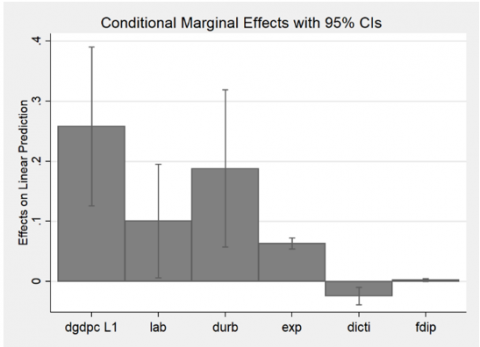
The Arellano-Bond dynamic panel-data estimation using robust standard errors reveals significant relationships between key factors and GDP growth. The lagged GDP growth rate has a positive and highly significant coefficient, indicating that a 1 percentage point increase in last period’s GDP growth is associated with a 0.26 percentage point increase in current GDP growth, reflecting persistence in economic growth over time. The labor force participation rate also has a positive and significant effect, suggesting that a 10% increase in labor input leads to approximately a 1.0 percentage point increase in GDP growth, highlighting how expanding the workforce contributes directly to economic expansion. Urban population growth further demonstrates a significant positive impact on GDP growth, emphasizing the role of urbanization in driving economic performance, with a 1 unit increase in urbanization linked to about a 0.19 percentage point rise in GDP growth, underscoring the benefits of urban infrastructure and agglomeration economies. Exports of goods and services have a highly significant and positive effect, highlighting the importance of trade and export activity in boosting economic growth; specifically, a 1 percentage point increase in exports corresponds to a 0.06 percentage point increase in GDP growth. Conversely, ICT goods exports show a significant negative relationship with GDP growth, potentially reflecting structural challenges or inefficiencies in leveraging ICT-related trade for economic expansion. Foreign direct investment has a small but significant positive effect, suggesting that a 1 percentage point increase in FDI inflows relative to GDP results in a 0.002 percentage point increase in GDP growth, indicating a modest but positive contribution. Overall, the results underscore the crucial roles of trade, urbanization, youth labor participation, and FDI in fostering GDP growth, while also pointing to potential inefficiencies in ICT goods exports. The findings highlight the need for targeted policies to better leverage trade and technological advancements for sustainable economic development.
Figure 2 illustrates the predicted marginal effects of key explanatory variables on GDP growth, estimated from the Arellano-Bond dynamic panel model. The marginal effects show how a one-unit increase in each independent variable, holding other factors at their mean values, affects the expected GDP growth rate. Variables include labor force participation (LAB), urbanization (DURB), exports (EXP), ICT goods imports (DICTI), and foreign direct investment (FDIP). This visualization helps to interpret the economic significance of each factor on growth dynamics.
The results of Arellano-Bond dynamic panel-data estimation provide useful insights into the factors influencing the Labor force participation rate are presented in Table 10.
Table 9. Arellano-Bond dynamic panel-data estimation results for GDP growth
|
Dependent Variable: GDP Growth |
||||||
|
Variable |
Arellano-Bond dynamic panel-data estimation |
Arellano-Bond dynamic panel-data estimation - Robust standard error |
||||
|
Coefficient |
Std. Err. |
P-Value |
Coefficient |
Std. Err. |
P-Value |
|
|
L1.DGDPC |
0.2581 |
0.0907 |
0.0040 |
0.2581 |
0.0675 |
0.0000 |
|
LAB |
0.1008 |
0.0515 |
0.0500 |
0.1008 |
0.0482 |
0.0370 |
|
DURB |
0.1882 |
0.1017 |
0.0640 |
0.1882 |
0.0668 |
0.0050 |
|
EXP |
0.0633 |
0.0234 |
0.0070 |
0.0633 |
0.0047 |
0.0000 |
|
DICTI |
-0.0243 |
0.0151 |
0.1070 |
-0.0243 |
0.0074 |
0.0010 |
|
FDIP |
0.0023 |
0.0017 |
0.1740 |
0.0023 |
0.0011 |
0.0390 |
|
_cons |
-0.6101 |
0.2309 |
0.0080 |
-0.6101 |
0.1725 |
0.0000 |
|
Wald chi2 |
53.4100 |
|
|
Wald chi2 |
629.8900 |
|
|
Prob > chi2 |
0.0000 |
|
|
Prob > chi2 |
0.0000 |
|
Table 10. Arellano-Bond dynamic panel-data estimation results for Labor force participation rate
|
Dependent variable: Labor force participation rate |
||||||
|
|
Arellano-Bond dynamic panel-data estimation |
Arellano-Bond dynamic panel-data estimation - Robust standard error |
||||
|
Variable |
Coefficient |
Std. Err. |
P-value |
Coefficient |
Std. Err. |
P-value |
|
L1.LAB |
0.8210 |
0.0540 |
0.0000 |
0.8210 |
0.0702 |
0.0000 |
|
DGDPC |
0.2192 |
0.0905 |
0.0150 |
0.2192 |
0.1237 |
0.0760 |
|
DURB |
0.2711 |
0.0991 |
0.0060 |
0.2711 |
0.1009 |
0.0070 |
|
EXP |
-0.0760 |
0.0239 |
0.0010 |
-0.0760 |
0.0337 |
0.0240 |
|
DICTI |
-0.0054 |
0.0154 |
0.7260 |
-0.0054 |
0.0062 |
0.3810 |
|
FDIP |
-0.0004 |
0.0018 |
0.8240 |
-0.0004 |
0.0016 |
0.8070 |
|
_cons |
0.9408 |
0.2322 |
0.0000 |
0.9408 |
0.3262 |
0.0040 |
|
Wald chi2 |
299.3500 |
|
|
Wald chi2 |
569.5400 |
|
|
Prob > chi2 |
0.0000 |
|
|
Prob > chi2 |
0.0000 |
|
Figure 2. Marginal impact of independent variables on GDP growth
The results of the Arellano-Bond dynamic panel-data estimation reveal important insights into the factors influencing the labor force participation rate. The lagged labor force participation rate shows a strong positive and highly significant coefficient, indicating that youth labor force participation has substantial persistence over time. GDP growth has a positive and statistically significant effect, suggesting that economic expansion provides more opportunities or incentives for youth to engage in the labor market. Similarly, urban population growth positively affects participation, highlighting the role of urbanization in facilitating access to jobs and resources for young workers. However, exports of goods and services have a negative and significant relationship, possibly reflecting structural issues or a mismatch between export-oriented industries and youth employment opportunities. On the other hand, ICT goods exports and foreign direct investment show no significant impact on youth labor force participation, indicating limited direct influence of these factors on youth employment decisions. Overall, the findings emphasize the importance of economic growth and urbanization while pointing to potential challenges in trade-related industries for engaging the youth workforce.
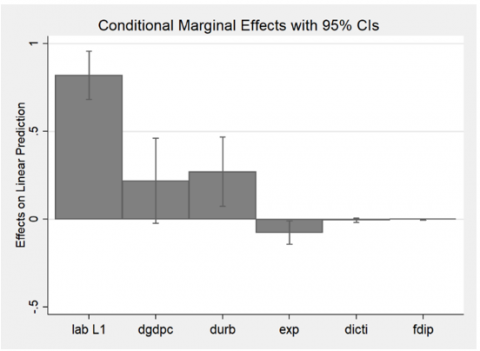
The Arellano-Bond dynamic panel-data estimation using robust standard errors provides key insights into the factors influencing labor force participation rates. The lagged labor force participation rate remains highly significant, confirming the strong persistence of youth participation over time, with a 1 percentage point increase in last period’s participation leading to a 0.82 percentage point increase in the current rate. GDP growth has a positive coefficient but becomes marginally insignificant, suggesting its influence is weaker when accounting for robust standard errors; specifically, a 1 percentage point increase in GDP growth is associated with a 0.22 percentage point increase in labor force participation, though this effect is only marginally significant. Urban population growth continues to exhibit a positive and significant impact, reinforcing the role of urbanization in supporting youth labor force participation, where a 1 unit increase in urbanization corresponds to a 0.27 percentage point rise in labor participation. Exports of goods and services show a significant negative effect, indicating potential structural barriers or misalignments between export-driven industries and youth employment, with a 1 percentage point increase in exports linked to a 0.08 percentage point decrease in labor force participation. Meanwhile, ICT goods exports and foreign direct investment remain statistically insignificant, suggesting limited direct effects on youth labor participation. Overall, these results emphasize the importance of addressing structural challenges in trade-related industries and urbanization while recognizing the weaker impact of economic growth when robust standard errors are applied.
Figure 3 summarizes the marginal effects of GDP growth, urbanization, exports, ICT goods imports, and foreign direct investment on labor force participation rates.
Figure 3. Marginal impact of independent variables on labor force participation rates
4.6 Diagnostic tests
The autocorrelation tests for the Arellano-Bond dynamic panel-data estimation are provided in Table 11.
Table 11. Autocorrelation test results
|
Arellano-Bond Model for GDP Growth |
||
|
Order |
z-statistic |
P-value |
|
1 |
-1.3764 |
0.1687 |
|
2 |
0.29356 |
0.7691 |
|
Arellano-Bond Model for Labor force participation rate |
||
|
Order |
z-value |
P-value |
|
1 |
-1.5040 |
0.1326 |
|
2 |
0.2045 |
0.8379 |
The Arellano-Bond test results confirm the reliability of the models. The first-order autocorrelation test and second-order autocorrelation test show no significant autocorrelation in the first-differenced residuals, validating the model's assumptions. These results suggest that the estimation and instruments are valid, making the findings robust.
Table 12 summarizes the Sargan test for the overidentifying restrictions.
Table 12. Sargan test results
|
Test |
Statistic |
P-Value |
|
Model for GDP growth |
116.9328 |
0.3315 |
|
Model for Labor force participation |
119.2982 |
0.2782 |
We fail to reject the null hypothesis for both models. This suggests that the instruments are valid, and the instruments used in the models are uncorrelated with the error term, implying that they are valid instruments.
This study's key findings demonstrate that GDP growth in the GCC region is strongly influenced by its own past values (persistence), youth labor force participation, urbanization, exports, and FDI. However, ICT goods exports negatively impact GDP, while some expected drivers, like ICT imports and FDI, influence youth labor force participation only marginally or insignificantly. These results underscore the critical importance of structural reforms, inclusive labor policies, and strategic investment to achieve sustained and equitable growth.
5.1 GDP growth results
Labor Force Participation Rate has a positive and significant coefficient, suggesting that higher youth participation in the labor force contributes positively to GDP growth. Young workers are critical to productivity gains in labor-intensive and service-oriented economies. While Zahari and Kaliannan [7] identified labor-related factors primarily as psychological or job-design antecedents of work engagement within organizational settings, our macro-level findings expand the scope by demonstrating labor force participation as a significant driver of national GDP. This broader implication underscores the need to integrate youth into national labor strategies to harness economic dividends [24, 25].
Urban Population Growth has a positive and significant effect on GDP growth, underlining urban centers' role as economic engines. Zahari and Kaliannan [7] primarily address organizational and team factors within urban institutions in terms of managerial support or leadership styles; in contrast, our results show how urbanization at the national level contributes to productivity through labor concentration, innovation, and infrastructure. This divergence in scale suggests that both micro- and macro-level urban factors play complementary roles in driving growth [26]. Urbanization also improves the diffusion of digital technologies, facilitating knowledge spillovers and innovation-based growth, as Abid [27] notes in his analysis of artificial intelligence adoption and regional productivity dynamics.
Exports of Goods and Services exhibit a significant positive relationship with GDP growth. This finding underscores the importance of trade as a driver of economic performance. Export-oriented growth allows countries to access larger markets, achieve economies of scale, and boost foreign exchange reserves. However, the nature of exports, whether they are capital-intensive or labor-intensive, could influence the distribution of these growth benefits across sectors and populations [28, 29].
ICT goods imports have a negative impact on GDP growth in our model, which may reflect overdependence on imported technologies or low domestic value addition. Zahari and Kaliannan [7] briefly discuss digital capability as a workplace factor, but do not address its broader economic implications. Our findings highlight a macro-structural challenge: technology sectors may not generate proportional economic returns unless local innovation ecosystems are strengthened. This calls for policies that enhance domestic R&D and ICT capacity [30].
Foreign Direct Investment has a statistically significant coefficient. This positive relationship indicates that FDI inflows contribute to economic growth, albeit modestly. FDI brings capital, technology, and expertise, which can stimulate productivity and innovation. However, the magnitude of its impact depends on the sectors receiving investments and the absorptive capacity of the economy. Countries with strong institutions and well-trained workforces are better positioned to benefit from FDI [31].
The results highlight the multifaceted nature of GDP growth, with contributions from demographic, trade, and investment variables. The persistence of GDP growth underscores the importance of maintaining a stable and conducive economic environment to sustain growth momentum. Factors such as urbanization and labor force participation (particularly among youth) play critical roles in driving productivity and economic activity, reflecting the importance of human capital and demographic trends [32]. The significant positive relationship between exports and growth reinforces the role of trade as a critical growth driver. However, the negative impact of ICT goods exports suggests that countries may not be fully leveraging technological advancements for economic benefits. This could point to a reliance on low-value-added ICT goods or insufficient integration of ICT imports into broader economic frameworks [33]. FDI emerges as another key contributor, though its modest effect suggests that the quality of investments and the capacity to absorb them are critical determinants of their growth impact. Policymakers should focus on attracting FDI into sectors that generate employment and drive innovation [34].
The policy implications of this study suggest several crucial actions for promoting sustainable economic growth in the GCC region.
• Invest in Urban Infrastructure and Governance
• Enhance Education and Vocational Training
• Diversify Exports and Boost Value-Added Content
• Strategically Target Foreign Direct Investment (FDI)
• Address Structural Economic Challenges
5.2 Labor force participation results
The finding of the Labor model found that the Lagged Labor Force Participation Rate is highly significant. This strong positive relationship suggests that youth labor force participation is persistent over time. In other words, the labor market conditions for youth in one period strongly influence their participation in subsequent periods. This persistence may reflect structural factors, such as social norms, employment opportunities, or policies that either support or hinder consistent engagement in the labor market. It highlights the importance of sustaining favorable conditions for youth employment to maintain participation rates [40].
GDP Growth has a positive but marginally insignificant relationship when robust standard errors are applied. Economic growth typically creates job opportunities and enhances income levels, which can encourage youth to participate in the labor market. However, the weaker statistical significance suggests that the effect of GDP growth may vary across different contexts or that other mediating factors, such as skill mismatches or sectoral growth disparities, play a role in moderating its impact on youth labor force participation [41].
Urban Population shows a significant positive impact on youth labor force participation. Urbanization often provides greater access to education, infrastructure, and diverse employment opportunities, which can attract and enable young individuals to enter the labor market. These findings highlight the role of urban areas as engines of economic activity and employment for younger demographics. However, the quality and inclusivity of urban growth could determine whether these benefits are equitably distributed among the youth [42]. The negative relationship between exports and youth labor force participation may appear counterintuitive. However, in the GCC context, export-oriented sectors, particularly oil, petrochemicals, and capital-intensive manufacturing, tend to be less labor-intensive and often require highly specialized skills, which many young job seekers lack. As a result, economic gains from exports may not translate into increased youth employment. This phenomenon reflects a structural disconnect where trade-driven growth does not equate to inclusive labor market participation, especially for less-experienced workers. Unlike Zahari and Kaliannan [7], who focused on organizational-level antecedents of work engagement and did not address macroeconomic variables such as exports, our findings highlight how sectoral composition and labor market rigidities shape youth employment outcomes at the national level. The results reinforce the need for export diversification and skills alignment policies to ensure that trade contributes meaningfully to inclusive economic development [43].
ICT Goods Imports indicate an insignificant relationship with the labor rate. This suggests that the share of ICT goods imports in total exports does not have a meaningful impact on youth labor force participation. ICT sectors often require specialized skills and training that may not be accessible to a significant portion of the youth population, limiting their direct engagement in this area. These results point to the need for targeted education and skill development programs to better prepare youth for employment in ICT-intensive industries [44].
The Foreign Direct Investment indicates no significant effect on youth labor force participation. Zahari and Kaliannan [7] reported a similar disconnect in public organizations where organizational interventions such as training or structural incentives had minimal impact on engagement. This alignment suggests that without targeted policy design and institutional readiness, both FDI and internal organizational reforms may fail to translate into tangible workforce benefits [45].
The results highlight the interplay between economic growth, urbanization, trade, and structural factors in shaping youth labor force participation. The strong persistence observed (L1.LAB) underscores the importance of maintaining favorable labor market conditions over time, as past participation rates heavily influence future engagement. Urbanization emerges as a key driver, likely due to better access to opportunities and resources in urban areas. However, the negative relationship with exports suggests that export-led growth alone may not suffice to boost youth employment, possibly due to skill mismatches or sectoral imbalances [43]. While GDP growth and FDI show potential to enhance participation, their effects are either marginally significant or insignificant, suggesting that broader structural reforms are necessary to fully realize their benefits. The insignificance of ICT goods exports points to a gap in aligning technological advancements with workforce readiness [27, 44].
The policy implications of this study suggest several crucial actions for improving labor force participation in the GCC region.
• Align Export Strategies with Youth Workforce Capacities
• Promote Sustainable Urban Development for Youth Inclusion
• Strengthen Skill Development in High-Demand Sectors
• Maximize Youth Employment through FDI Strategy
• Adopt Inclusive Growth and Entrepreneurship Policies
By addressing these areas, countries can better leverage economic and demographic factors to enhance youth labor force participation and improve overall employment outcomes.
This study highlights the critical factors influencing labor force participation and GDP growth, emphasizing the importance of targeted policies aimed at integrating youth into the workforce, managing urbanization, enhancing export competitiveness, and attracting foreign direct investment.
The analysis of GDP growth identifies several key determinants shaping long-term economic performance. It reveals that GDP growth is significantly impacted by past economic performance (lagged GDP growth), as well as factors such as labor force participation, urbanization, exports, ICT goods exports, and FDI. For sustained and accelerated GDP growth, policymakers are recommended to adopt comprehensive strategies that focus on increasing labor force participation, developing urban infrastructure, enhancing export competitiveness, and attracting high-quality FDI. Additionally, addressing challenges in the ICT sector and ensuring equitable economic participation for youth will be crucial for bolstering long-term growth trajectories.
In examining labor force participation, the study provides insights into the factors influencing youth employment and broader labor market dynamics. The findings show that labor force participation rates are shaped by several factors, including past participation rates, GDP growth, urbanization, exports, and FDI. To increase youth participation, it is essential to implement policies focused on education, urban development, and job creation. By aligning export strategies with labor-intensive sectors, channeling FDI into job-creating industries, and fostering inclusive economic growth, governments can increase youth participation rates and ensure that the benefits of growth are widely shared across demographic groups.
The results underscore the strong relationship between urbanization, youth employment, and economic growth, highlighting the need for inclusive policies that align education and training with labor market demands. The role of exports and FDI further illustrates their potential to drive economic growth, but only if complemented by skill development and infrastructure improvements. Policymakers should prioritize fostering inclusivity within export sectors, leveraging urbanization to provide more opportunities for young workers, and enhancing the role of FDI in sectors that promote job creation. Moreover, targeted education and training initiatives in ICT and other high-demand sectors are essential to prepare youth for the evolving demands of the global economy.
This study is not without limitations. The analysis primarily uses aggregated data and does not disaggregate findings by gender, employment informality, or sectoral variations in FDI impact. These dimensions are particularly relevant in the GCC context, where labor markets are segmented and gender gaps persist. Future research could benefit from a more granular, gender-specific analysis of labor force participation, explore the influence of informal labor markets, and assess the differential effects of FDI across economic sectors. Such extensions would provide more targeted insights for policy formulation and support efforts to foster inclusive and sustainable economic development.
|
Symbol |
Definition |
|
LAB |
Youth labor force participation rate (% of population aged 15–24) |
|
GDPC |
GDP per capita growth (annual %, constant 2015 US$) |
|
URB |
Urban population (% of total population) |
|
EXP |
Exports of goods and services (% of GDP) |
|
ICTE |
ICT goods exports (% of total goods exports) |
|
FDIP |
Foreign direct investment inflows (% of GDP) |
|
εit |
Error term in the regression equations |
|
L1LABit |
Lagged labor force participation rate |
|
L1GDPCit |
Lagged GDP per capita growth |
|
Greek symbols |
|
|
i |
Country index (Bahrain, Kuwait, Oman, Qatar, Saudi Arabia, UAE) |
|
t |
Time index (year: 1990–2023) |
|
L1 |
First-order lag operator |
|
Subscripts |
|
|
α |
Constant/intercept term in regression equations |
|
β1, β2,..., β6 |
Coefficients of explanatory variables in regression equations |
|
εit |
Error term capturing unexplained variance in country i at time t |
[1] Maestas, N., Mullen, K.J., Powell, D. (2023). The effect of population aging on economic growth, the labor force, and productivity. American Economic Journal: Macroeconomics, 15(2): 306-332. https://doi.org/10.1257/mac.20190196
[2] Hosan, S., Karmaker, S.C., Rahman, M.M., Chapman, A.J., Saha, B.B. (2022). Dynamic links among the demographic dividend, digitalization, energy intensity and sustainable economic growth: Empirical evidence from emerging economies. Journal of Cleaner Production, 330: 129858. https://doi.org/10.1016/j.jclepro.2021.129858
[3] Khan, I., Hou, F. (2020). The dynamic links among energy consumption, tourism growth, and the ecological footprint: The role of environmental quality in 38 IEA countries. Environmental Science and Pollution Research, 28(5): 5049-5062. https://doi.org/10.1007/s11356-020-10861-6
[4] Sarwar, A., Khan, M.A., Sarwar, Z., Khan, W. (2021). Financial development, human capital and its impact on economic growth of emerging countries. Asian Journal of Economics and Banking, 5(1): 86-100. https://doi.org/10.1108/ajeb-06-2020-0015
[5] Abid, I. (2025). Employment trends and economic factors in MENA region: An ARDL approach. International Journal of Innovative Research and Scientific Studies, 8(2): 4334-4344. https://doi.org/10.53894/ijirss.v8i2.6306
[6] Churchill, B. (2020). COVID-19 and the immediate impact on young people and employment in Australia: A gendered analysis. Gender, Work & Organization, 28(2): 783-794. https://doi.org/10.1111/gwao.12563
[7] Zahari, N., Kaliannan, M. (2023). Antecedents of work engagement in the public sector: A systematic literature review. Review of Public Personnel Administration, 43(3): 557-582. https://doi.org/10.1177/0734371x221106792
[8] World Bank. (2014). Urbanization and urban-rural integrated development. World Bank. https://www.worldbank.org/en/news/speech/2014/03/23/urbanization-and-urban-rural-integrated-development
[9] Chaabouni, I., Abid, I. (2025). Key drivers of energy consumption in the gulf cooperation council countries: A panel analysis. Engineering, Technology & Applied Science Research. 15(2): 21627–21632. https://doi.org/10.48084/etasr.10233
[10] Sawyer, P.S., Romanov, D.M., Slav, M., Korotayev, A.V. (2022). Urbanization, the youth, and protest: A cross-national analysis. Cross-Cultural Research, 56(2-3): 125-149. https://doi.org/10.1177/10693971211059762
[11] International Monetary Fund. (2016). Macroeconomic developments and prospects in the MENA region. International Monetary Fund. https://www.imf.org/en/Publications/REO/MECA/Issues/2016/10/mreo1016.
[12] Abid, I., Gafsi, N. (2025). Economic complexity, environmental sustainability, and technological integration in Saudi Arabia: Analyzing long-term trends. International Journal of Energy Economics and Policy, 15(3): 669-683. https://doi.org/10.32479/ijeep.18806
[13] Rahim, S., Murshed, M., Umarbeyli, S., Kirikkaleli, D., Ahmad, M., Tufail, M., Wahab, S. (2021). Do natural resources abundance and human capital development promote economic growth? A study on the resource curse hypothesis in Next Eleven countries. Resources, Environment and Sustainability, 4: 100018. https://doi.org/10.1016/j.resenv.2021.100018
[14] Johnston, T.L. (2022). Collective Bargaining in Sweden. Routledge. https://doi.org/10.4324/9781003349594
[15] Nguyen, C.H. (2021). Labor force and foreign direct investment: Empirical evidence from Vietnam. The Journal of Asian Finance, Economics and Business, 8(1): 103-112. https://doi.org/10.13106/jafeb.2021.vol8.no1.103
[16] Abid, I. (2025). Economic, technological, and institutional factors affecting international tourism in MENA countries. International Journal of Innovative Research and Scientific Studies, 8(2): 3548-3560. https://doi.org/10.53894/ijirss.v8i2.6054
[17] Arellano, M., Bond, S. (1991). Some tests of specification for panel data: Monte Carlo evidence and an application to employment equations. The Review of Economic Studies, 58(2): 277. https://doi.org/10.2307/2297968
[18] Pesaran, M.H. (2004). General diagnostic tests for cross section dependence in panels. SSRN Electronic Journal. https://doi.org/10.2139/ssrn.572504
[19] Hashem Pesaran, M., Yamagata, T. (2008). Testing slope homogeneity in large panels. Journal of Econometrics, 142(1): 50-93. https://doi.org/10.1016/j.jeconom.2007.05.010
[20] Pesaran, M.H. (2007). A simple panel unit root test in the presence of cross-section dependence. Journal of Applied Econometrics, 22(2): 265-312. https://doi.org/10.1002/jae.951
[21] Pedroni, P. (1999). Critical values for cointegration tests in heterogeneous panels with multiple regressors. Oxford Bulletin of Economics and Statistics, 61(s1): 653-670. https://doi.org/10.1111/1468-0084.0610s1653
[22] Roodman, D. (2009). A note on the theme of too many instruments*. Oxford Bulletin of Economics and Statistics, 71(1): 135-158. https://doi.org/10.1111/j.1468-0084.2008.00542.x
[23] Hansen, L.P. (1982). Large sample properties of generalized method of moments estimators. Econometrica, 50(4): 1029. https://doi.org/10.2307/1912775
[24] Klasen, S., Le, T.T.N., Pieters, J., Santos Silva, M. (2020). What drives female labour force participation? Comparable micro-level evidence from eight developing and emerging economies. The Journal of Development Studies, 57(3): 417-442. https://doi.org/10.1080/00220388.2020.1790533
[25] Abid, I. (2025e). Balancing growth and sustainability: The role of economic factors in adjusted net savings in South Asia. International Journal of Sustainable Development and Planning, 20(4): 1487-1497. https://doi.org/10.18280/ijsdp.200412
[26] Mahtta, R., Fragkias, M., Güneralp, B., Mahendra, A., Reba, M., Wentz, E.A., Seto, K.C. (2022). Urban land expansion: the role of population and economic growth for 300+ cities. npj Urban Sustainability, 2(1): 5. https://doi.org/10.1038/s42949-022-00048-y
[27] Abid, I. (2025c). Exploring the role of artificial intelligence (AI) innovation in economic performance: Evidence from East Asia. International Journal of Innovative Research and Scientific Studies, 8(2): 3665-3677. https://doi.org/10.53894/ijirss.v8i2.6070
[28] Mohsin, M., Ullah, H., Iqbal, N., Iqbal, W., Taghizadeh-Hesary, F. (2021). How external debt led to economic growth in South Asia: A policy perspective analysis from quantile regression. Economic Analysis and Policy, 72: 423-437. https://doi.org/10.1016/j.eap.2021.09.012
[29] Abid, I. (2025a). The role of economic and environmental variables in green growth: Evidence from Saudi Arabia. Engineering, Technology & Applied Science Research, 15(1): 20433-20439. https://doi.org/10.48084/etasr.9836
[30] Lee, D., Choi, H. (2024). The transition of South Korea’s economic growth drivers—From labor-intensive to knowledge-intensive industries. Law and Economy, 3(6): 9-22. https://doi.org/10.56397/le.2024.06.02
[31] Asafo-Agyei, G., Kodongo, O. (2022). Foreign direct investment and economic growth in Sub-Saharan Africa: A nonlinear analysis. Economic Systems, 46(4): 101003. https://doi.org/10.1016/j.ecosys.2022.101003
[32] Salimova, G., Ableeva, A., Galimova, A., Bakirova, R., Lubova, T., Sharafutdinov, A., Araslanbaev, I. (2022). Recent trends in labor productivity. Employee Relations: The International Journal, 44(4): 785-802. https://doi.org/10.1108/er-03-2021-0111
[33] Kallal, R., Haddaji, A., Ftiti, Z. (2021). ICT diffusion and economic growth: Evidence from the sectorial analysis of a periphery country. Technological Forecasting and Social Change, 162: 120403. https://doi.org/10.1016/j.techfore.2020.120403
[34] Haq, N.U. (2022). Impact of FDI and its absorption capacity on the national innovation ecosystems: Evidence from the largest FDI recipient countries of the world. Foreign Trade Review, 58(2): 259-288. https://doi.org/10.1177/00157325221077007
[35] Bakari, S., El Weriemmi, M. (2024). Causality between domestic investment and economic growth in Arab countries. Journal of Malikussaleh Public Economics, 7(1): 37-47. https://doi.org/10.29103/jmpe.v7i1.17028
[36] Omowole, B.M., Olufemi-Phillips, A.Q., Ofodile, O.C., Eyo-Udo, N.L., Ewim, S.E. (2024). The role of SMEs in promoting urban economic development: A review of emerging economy strategies. International Journal of Engineering Research and Development, 20(11): 1127-1144.
[37] Wan, J., Ma, C., Jiang, T., Phillips, A., Wu, X., Wang, Y., Wang, Z., Cao, Y. (2024). A spatial econometric investigation into road traffic accessibility and economic growth: insights from the Chengdu-Chongqing twin-city economic circle. Humanities and Social Sciences Communications, 11(1): 183. https://doi.org/10.1057/s41599-024-02695-1
[38] Yang, L. (2024). Catalyst or barrier? Impact of cereal trade on urbanization. Cogent Business & Management, 11(1): 2375997. https://doi.org/10.1080/23311975.2024.2375997
[39] Wijayanti, F. (2023). Exploring local labor markets and knowledge spillover from a spatial perspective. R-Economy, 9(3): 252-268. https://doi.org/10.15826/recon.2023.9.3.015
[40] de Ol Oliveira, H.V.E., Moutinho, V.F., Afonso, O. (2024). Unraveling the nexus of energy, labor and financial: Impact on economic development in rural and urban Africa. Preprint article. https://doi.org/10.2139/ssrn.4792557
[41] Bawazir, A.A., Osman, A.F., Aslam, M. (2022). Factors affecting female labor force participation in the Middle East: An empirical evidence from panel data approach. The Journal of Developing Areas, 56(1): 59-72. https://doi.org/10.1353/jda.2022.0010
[42] Urama, C.E., Ukwueze, E.R., Obodoechi, D.N., Ogbonna, O.E., Eze, A.A., Alade, O.B., Ugwu, P.N. (2022). Women’s labour force participation: Economic growth nexus in Sub-Saharan African countries. Journal of International Women's Studies, 24(5): 9. https://vc.bridgew.edu/jiws/vol24/iss5/9
[43] Thaddeus, K.J., Bih, D., Nebong, N.M., Ngong, C.A., Mongo, E.A., Akume, A.D., Onwumere, J.U.J. (2022). Female labour force participation rate and economic growth in sub-Saharan Africa: “A liability or an asset.” Journal of Business and Socio-Economic Development, 2(1): 34-48. https://doi.org/10.1108/jbsed-09-2021-0118
[44] Gross, J., Ouyang, Y. (2020). Types of urbanization and economic growth. International Journal of Urban Sciences, 25(1): 71-85. https://doi.org/10.1080/12265934.2020.1759447
[45] Ridwan, M. (2023). Unveiling the powerhouse: Exploring the dynamic relationship between globalization, urbanization, and economic growth in Bangladesh through an innovative ARDL approach. Asian Journal of Economics and Business Management, 2(2): 283-291. https://doi.org/10.53402/ajebm.v2i2.352
[46] Kadir, M.O., Deka, A., Seraj, M., Ozdeser, H. (2024). Capitalizing on natural resources rent and renewable energy in enhancing economic growth—New evidence with MMQR method. Natural Resources Forum. Portico. https://doi.org/10.1111/1477-8947.12536