Gaziza Nametova | Almas Kuralbayev | Ydyrys Serikbay*
© 2025 The authors. This article is published by IIETA and is licensed under the CC BY 4.0 license (http://creativecommons.org/licenses/by/4.0/).
OPEN ACCESS
This study offers a comprehensive analysis of rural tourism management in Kazakhstan, employing innovative mixed-methods frameworks (PEST, SNW, and stakeholder analysis) to identify key challenges and opportunities. It provides actionable insights for sustainable rural tourism development in transition economies, emphasizing the role of government policies, network partnerships, and integration with agricultural practices. The authors examine the current state of rural tourism at the macro (national level), meso (regional rural tourism associations and networks), and micro (individual enterprises) levels. The study’s mixed approach combines quantitative surveys, qualitative interviews, and focus group discussions. While Kazakhstan’s rural tourism sector benefits from favorable natural and cultural resources, it faces significant challenges, including limited infrastructure, seasonal fluctuations in demand, and poor integration of local stakeholders. The PEST analysis determines opportunities, such as technological advances and lower inflation, while threats include political instability and high credit costs. The SNW analysis shows strong potential for sustainable growth leveraging government programs and local partnerships but highlights weaknesses, such as the lack of branding and marketing strategies. The study proposes a sustainable management model emphasizing network partnerships, government support, and the integration of rural tourism with local agricultural activities. To achieve long-term success, policymakers must focus on enhancing financial accessibility, workforce training, and digital transformation, ensuring that Kazakhstan’s rural tourism sector becomes both competitive and sustainable. These results contribute to a broader understanding of rural tourism management in transition economies.
regional tourism, rural development, rural tourism, socioeconomic development
Rural tourism is becoming an important factor in the socioeconomic development of many countries. This sector combines traditional agricultural practices with tourism, creating opportunities to diversify incomes, reduce urban migration, and promote cultural exchange. Despite its potential, rural tourism faces persistent challenges, including inadequate infrastructure, limited marketing strategies, and a lack of coherent policy frameworks. These challenges hinder the realization of its full economic and social benefits worldwide, especially in regions where rural economies are still in transition.
In global practice, alongside the development of traditional agricultural activities, non-agricultural employment sectors, particularly rural tourism, have become a source of additional income in rural areas. This type of tourism involves recreation in rural areas. Its attractive features are clean air, domestic atmosphere, untouched nature, natural products, calmness, and unhurried life. Rural tourism is a direction of the socioeconomic development of territories with agrarian specialization or rural areas [1].
Rural tourism combines elements of tourism and agriculture, offering visitors the opportunity to gain knowledge and first-hand experience related to agricultural practices, rural traditions, and the local environment [2].
Rural tourism provides an opportunity for tourists to relax in rural areas and experience the traditions and customs of the local population [3].
Agritourism development is associated with strategic efforts to promote and expand agritourism activities in specific regions [4].
According to some estimates, about 700 million tourists travel the world annually. About 12-30% of them (84-210 million) prefer rural tourism [1, 5]. These data characterize only the international situation, and the number of domestic rural tourists in different countries is much larger.
According to the European Federation of Rural Tourism (EuroGites), the average annual rate of rural tourism development during the previous 10-15 years is 10-15%, which is much higher than for European tourism in general (4-5%) [6].
Economic leakage occurs when a significant share of the revenue generated from agritourism activities leaves the local economy, benefiting suppliers or external companies. This occurs due to the sub-optimal utilization of local resources, local business development, and lack of community tourism models [7].
Many tourism companies can be integrated into more efficient entities. Integration between market participants helps ensure their interaction. This allows the formation of competitive multi-disciplinary corporate structures (network interaction structures) that unite several companies. These multi-profile structures provide the infrastructure for the functioning of the tourism industry [8].
This study is grounded in established theoretical and methodological frameworks that explore sustainable rural tourism development, particularly in transitioning economies. By synthesizing insights from prior research on multi-level governance, stakeholder collaboration, and socio-economic integration, the investigation adapts these principles to Kazakhstan’s unique agrarian and cultural context. The analysis extends existing paradigms by introducing a holistic model that bridges macro-level policy frameworks, meso-level network partnerships, and micro-level community engagement. Emphasizing the interplay between agricultural practices and tourism innovation, the research addresses gaps in region-specific strategies, offering a tailored approach to enhance sustainability while aligning with global best practices.
Rural tourism around the world is faced with complex challenges due to various economic, social, and environmental factors. Ariyani and Fauzi concluded that rural tourism and its management must be embedded in inclusivity. Rural development has the potential to increase economic growth and income streams, reduce rural-to-urban migration, and foster rural development. To this end, managing sustainable rural tourism requires a strategic transformation adapted to local conditions, the complexity of rural institutions, and the dynamics of future changes [9]. Additionally, ineffective integration of local stakeholders and limited financial support from the private and public sectors can hinder the growth of this sector. Therefore, it is crucial to adopt management models and best practices that can bolster sustainable growth in growing economies like Kazakhstan.
In recent years, several studies have explored rural tourism development in transition economies, focusing on sustainability, economic viability, and stakeholder integration. Mikhaylova et al. [10] emphasized the potential of rural tourism in Russian–Polish and Russian–Kazakh borderlands, citing that these practices can provide employment opportunities while preserving the conventional lifestyle of the natives. A study by Sergeyeva et al. [11] elucidated the trend behind rural tourism and its goal in creating positive dynamics for the revitalization of rural areas and the preservation of the authentic and sociocultural image of rural areas. The study presented the Aktobe oblast, an area in Kazakhstan that can benefit from rural-urban developments by harnessing resources from natural and agricultural, historical, and cultural environments. Overall, the existing body of research underscores that the key challenges facing rural tourism in Kazakhstan are not unique but are shared by other transition economies. The findings from global case studies suggest that the country can benefit from adopting an integrated model that combines government support, private sector engagement, and digital marketing strategies [10, 11].
In modern Kazakhstan, the issue of functionally planned and territorial development of rural settlements is particularly acute, as well as the search for a reasonable balance between the integration and independence of regions within a single state [12]. The country’s dependence on agriculture combined with the growing demand for sustainable tourism emphasizes the relevance of solving the issues of rural tourism management in its context.
However, the integration processes in Kazakhstan are often unsystematic, which requires their conceptualization and the creation of a holistic practical approach that will allow forming competitive business strategies of integration between tourism businesses, including carriers, investors, and hotel and restaurant chains with the development of their infrastructural support.
In world practice, the analysis of the tourism management model shows that for the successful development of the industry, in addition to the central and local authorized bodies, it is necessary to have a more flexible structure that focuses on marketing, closely interacts with business, and promptly responds to new challenges and global changes.
The status of the National Tourism Office in the format of a national company allows opening representative offices in neighboring countries and far abroad to attract tourists and investors to Kazakhstan. It provides the company with the conditions to enter into contracts with domestic and foreign enterprises to purchase goods, works, and services based on standard procurement rules, which will favorably affect the efficiency of decision-making in promoting Kazakhstan as a tourist destination.
For the breakthrough growth of tourism industry indicators, the project approach and concentration of resources on the development of the priority tourist areas are the basis of Kazakhstan’s development program. 80% of tourism objects are concentrated in seven regions of the country: Astana and the Akmola region, Almaty and the Almaty region, and the East Kazakhstan, Turkestan, and Mangistau regions. The authors of the project developed a “touristification map” which includes 50 projects of regional importance (“magnets” to attract domestic and inbound tourists) and 10 projects of national importance (“points of tourism growth”). Under the program, 600 billion tenge will be allocated to develop the Top 10 touristification maps through budgetary funding. The priority tourism areas will be equipped with essential infrastructure to meet needs, such as electricity, heating, water supply, wastewater disposal, waste collection and management (landfills), road construction, shoreline reinforcement, etc. It is also planned to transition to a new management scheme for the tourism industry. Within the framework of the state program, a system of tourism industry management will be formed to ensure the effective promotion of the country’s tourism potential and the solution of emerging issues in the industry’s development. The industry will be managed through specific tourism directions and by engaging businesses in the development of the regional tourism potential.
According to the Strategic Development Plan of the Republic of Kazakhstan until 2025, information and advertising strategies will be developed for the countries of the first priority.
Rural tourism management at the macro and micro levels aims to give impetus to the development of rural settlements, increase the income of their residents, stop the migration flow from rural to urban areas by creating additional jobs, and reduce social tensions in rural areas by organizing a new sector of the local economy [13].
While prior studies have extensively explored rural tourism challenges and opportunities, there remains a need for a structured framework that integrates multi-level governance, stakeholder collaboration, and sustainability principles specific to Kazakhstan’s tourism landscape.
This study aims to examine the current state of rural tourism management in Kazakhstan, identify critical factors affecting its development at the macro, meso, and micro levels, and propose an effective model of sustainable management.
3.1 Research design
We utilized a mixed approach combining quantitative and qualitative methodologies to provide a comprehensive understanding of the factors affecting rural tourism at macro, meso, and micro levels.
The research was conducted in several stages:
1. Preliminary analysis: this stage involved a literature review to establish a theoretical framework and identify key variables affecting rural tourism. Sources included academic articles, policy documents, and case studies. The search was conducted using keywords in Scopus, Web of Science, and ResearchGate.
2. Stakeholder analysis: surveys and semi-structured interviews were used to gather information from stakeholders.
To develop an organizational mechanism of network interaction between small rural tourism businesses, we surveyed managers of Kazakh tour operators and small rural tourism businesses.
The primary data collection method was interviewing with open-ended questions, semi-structured and conducted by telephone. 46 respondents agreed to participate in the interview. The condition of participation was anonymity, i.e., non-disclosure of personal data and information about the strategic planning of the enterprises involved.
We determined stakeholders’ key needs and expectations using a questionnaire survey. The analysis identified the fundamental importance of the network model for the business organization of rural tourism in Kazakhstan.
3. Expert analysis: The study also incorporated expert assessments to evaluate external and internal factors influencing rural tourism. Experts were selected based on their professional experience in tourism management, academia, and policymaking, with a minimum of 10 years of industry experience.
To validate the consistency of expert opinions, the coefficient of variation was calculated, confirming a high level of agreement among participants and ensuring the robustness of the findings.
3.2 Qualitative data collection
The purpose of this stage was to answer the research question: How is Kazakhstan perceived as a tourist destination in Europe?
Students from Wageningen University (Netherlands) and Zittau University (Germany) were selected for analysis.
We used simple random sampling. Considering time, economic, and physical opportunities, a sample of 20 students from each university was selected as potential tourists. The respondents were selected from campuses, classrooms, food courts, hallways, gymnasiums, and dormitories.
The sample represents an equal proportion of male and female students from different countries. Table 1 shows the composition of the interviewed students at Wageningen University and Zittau University by gender, age, and nationality.
Table 1. Sample composition
|
University |
Gender |
Age Range |
|
Wageningen University |
Male – 8 Female – 12 |
18-30 – 10 30-50 – 8 50 and older – 2 |
|
Zittau University |
Male – 8 Female – 12 |
18-30 – 10 30-50 – 8 50 and older – 2 |
Note: Compiled based on the survey
The sample included respondents from a wide range of countries, reflecting a diverse international student body. Among the nationalities represented were Italy, Germany, Colombia, Malaysia, China, India, Poland, Spain, Greece, Indonesia, Brazil, the Netherlands, several African countries, Canada, Georgia, Turkey, Syria, and Czechia.
However, it is important to note that not all respondents indicated their country of origin. This omission did not affect the analysis, as the study aimed to assess the perceptions of students currently residing and studying in Europe. In this context, their current exposure to European cultural and informational environments was more relevant than their original country of birth, and thus, nationality was not treated as a key variable in the interpretation of results.
3.3 Research tools
3.3.1 Association method
The respondents were presented with a list of destination attributes. Before providing this list, they were asked to share three associations that come to mind when they think of Kazakhstan. This step was taken to avoid limiting or influencing their subsequent choice of attributes and to gather additional characteristics about Kazakhstan.
Next, to determine Kazakhstan’s image, the respondents were provided with a list of attributes divided into three sections. The first section involved selecting attributes from the provided list. The second section was based on an open-ended question designed to uncover unique and comprehensive elements of Kazakhstan’s image as a destination. The purpose of this question was to identify and classify the attributes mentioned by the respondents. The final section focused on capturing the respondents’ perspectives on Kazakhstan as a tourism brand.
3.3.2 Collage method
The collage and word-association methods were applied within the university premises. Collage-making is a projective technique that helps respondents project their beliefs or thoughts using photographs and images. Collages align with the research objectives, cover broad concepts, such as “Health” or “Hobbies”, and focus on narrower topics related to the subject of the study. This method is most commonly used during focus groups or in-depth interviews. The dynamic university environment, where many students can be encountered, provides an engaging setting for such activities [14].
3.4 Data analysis
The factors influencing rural tourism management were summarized using the PEST framework, stakeholder analysis, and the SNW method.
The study aims to generalize the factors of rural tourism management at macro and meso levels. In the first case (factors of the distant environment), the PEST analysis was used. In the second case (factors of the immediate environment), stakeholder analysis was employed [15].
Traditionally, Porter’s Five Forces is used to analyze factors of the immediate environment [16]. This model considers new entrants, products/services, consumers (clients), suppliers, and competitors.
However, this approach is limited as the range of factors influencing rural tourism businesses is much broader. To address this, we suggest conducting a strategic analysis of meso-environmental factors using stakeholder analysis [17].
The objective is to identify and systematize external factors within the immediate environment (meso-environment factors).
Conditions for this analysis are as follows:
– Quantitative data. An evaluation scale is used to measure the influence of a factor (ranging from -5 to +5) and its weight (importance), rated from 0 to 1;
– Information sources: the results of discussions within an expert group;
– Method of expert assessments;
– The stakeholder model serves as the foundation.
Following this analysis of tourist perceptions, we examined factors in the distant environment (macro-environment) to identify opportunities and threats affecting rural tourism in Kazakhstan.
Conditions for this analysis are as follows:
– Quantitative data. An evaluation scale is used to measure the influence of a factor (ranging from -5 to +5) and its weight (importance), rated from 0 to 1;
– Information sources: electronic and printed publications on political, economic, social, and technological trends;
– Method of expert assessments.
Further, the internal factors of management were analyzed from the position of the rural tourism business. For this purpose, the SNW analysis was used [8].
Conditions for this analysis are as follows:
– Quantitative data. An evaluation scale is used to measure the influence of a factor (ranging from -5 to +5) and its weight (importance), rated from 0 to 1;
– Information sources: the results of previous studies of the internal environment, expert opinions;
– Method of expert assessments.
To identify the factors that are important for rural tourism management, we ranked them by their weight and influence. A factor’s weight was understood as its importance for rural tourism in Kazakhstan. A factor’s influence was determined by experts (method of expert assessments). The weighted assessment represents the strength of influence, adjusted for a factor’s importance.
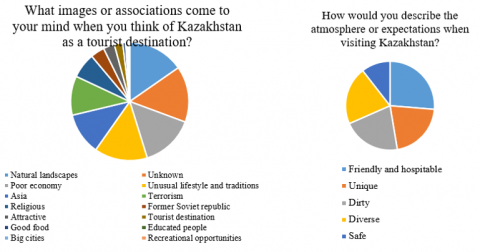
The results are presented by the number of respondents. However, the number of respondents who chose certain attributes is not a priority. Their responses and how they explain a particular word association are more important. Respondents were allowed to give multiple answers for each question (Figure 1).
Figure 1. Answers of respondents by the word association method
The word association analysis combined with the collage method helped identify key stereotypical characteristics of Kazakhstan as a destination in functional-psychological, attribute-universal, and general-unique dimensions. As Figure 1 shows, almost all respondents view Kazakhstan as a country of natural landscapes, an unknown country with a poor economy, unusual customs, and way of life. Attributes such as educated people, large cities, recreational opportunities, and a safe place were not selected. Only a few respondents showed some awareness of Kazakhstan, while most showed limited knowledge of the country. Also, answering the question “What type of tourism do you think Kazakhstan has?” respondents identified nature tourism as the primary type of tourism associated with Kazakhstan.
The selection of factors is presented in Table 2.
Table 2. PEST analysis
|
Designation |
Factors |
Influence (+/-) |
Factor Manifestation |
Business Reaction |
|
1 |
2 |
3 |
4 |
5 |
|
Political factors |
||||
|
P1 |
The unstable economic and political situation increases the risks of investment in rural tourism projects |
– |
The rural tourism model focused strictly on a specific type of client and a narrow set of tourism services is the most vulnerable to the risks of economic and legal instability |
It is necessary to rely on network business models that involve diversification |
|
Economic factors |
||||
|
Е1 |
The trend of inflation reduction in Kazakhstan [20] |
+ |
Reduction of inflation reduces investment risks, which is a positive factor |
The financial model of rural tourism business should consider the temporary change in the value of money |
|
Е2 |
High interest rates of commercial credits affect the profitability of business |
– |
The profitability of business decreases |
It is necessary to involve the state as a guarantor of tax benefits and soft loans |
|
Е3 |
Favorable recreational opportunities of Kazakhstan |
+ |
Favorable factor for the development of rural tourism |
This advantage should be used and promoted |
|
Social factors |
||||
|
S1 |
Strengthening of migration processes: outflow of qualified personnel to cities |
– |
The factor makes companies in the rural tourism industry seek opportunities to create competitive labor conditions |
It is necessary to pay attention to staff incentives |
|
S2 |
A significant number of the rural population (about 45%) [19] |
– |
The factor creates difficulties for rural tourism as it is focused on urban residents and foreigners |
It is necessary to use territorial advantages |
|
Technological factors |
||||
|
T1 |
Development of information and communications technologies |
+ |
A favorable factor for the development of marketing |
The use of information and communications technologies in marketing and communications strategies of management |
|
T2 |
Penetration of technology and scientific achievements in rural tourism management |
+ |
A positive factor. Management does not need to reinvent the wheel |
Managers need to follow scientific publications and maintain contacts with the scientific community |
Note: Based on the results of the expert group discussion
None of the Kazakh tour operators has succeeded in domestic tourism. They are not interested in teaching the basics of tourism to rural residents who are prone to let down their partners and do not comply with agreements.
It is necessary to improve the legal acts that hinder the development of rural tourism by stimulating the activities of specialized tour operators and creating conditions for the development of network interaction among small businesses.
Table 3 demonstrates the average data on five experts.
Table 3. The results of the PEST analysis
|
Environmental Factor |
Evaluation (Threats/Opportunities, -/+) |
Factor Weight (Pi) (0…1) |
Influence of the Factor (Ai) (0…5) |
Weighted Score, Pi × Ai |
|
P1 |
– |
0.13 |
3.80 |
-0.49 |
|
Е1 |
+ |
0.13 |
4.20 |
0.55 |
|
Е2 |
– |
0.13 |
3.90 |
-0.51 |
|
Е3 |
+ |
0.12 |
3.65 |
0.44 |
|
S1 |
– |
0.12 |
3.75 |
-0.45 |
|
S2 |
– |
0.11 |
3.85 |
-0.42 |
|
T1 |
+ |
0.12 |
4.05 |
0.49 |
|
T2 |
+ |
0.14 |
4.50 |
0.63 |
|
Total |
х |
1.00 |
31.70 |
0.23 |
|
Weighted average |
х |
0.13 |
2.50 |
0.31 |
The PEST analysis identified both opportunities and threats in the external environment of rural tourism. The weighted score for each factor was calculated by multiplying these values, allowing for a comparative ranking of macroeconomic influences.
The consistency of expert evaluations is determined using the coefficient of variation [18]. Since the coefficient of variation remained within acceptable limits in all cases (less than 0.25), the consistency of expert opinions is considered sufficient.
Our analysis of macro-environment factors showed that the distant external environment is generally favorable for business, with a final weighted score of +0.23.
The greatest threat to companies comes from social factors. The fact that Kazakhstan is an agrarian country, while rural tourism businesses primarily target urban residents and international visitors, necessitates finding competitive advantages, such as proximity to major cities. The migration of skilled personnel from rural areas creates challenges in workforce management.
Rural tourism promotes responsible land use by encouraging the preservation of rural landscapes, open spaces, and biodiversity. This can help protect agricultural land from urbanization and contribute to the conservation of natural resources [19].
Political and legal factors have a negative impact. Under conditions of uncertainty, investments in rural tourism businesses remain risky. It is essential to incorporate risk mitigation strategies into business models.
A key strategy is building strong networks and partnerships among stakeholders in rural tourism, such as government entities, local communities, the tourism industry, and educational or research institutions. Effective collaboration facilitates knowledge exchange, resource sharing, financial support, and the promotion of best practices for the sustainable development of rural tourism [18].
Technological factors indicate the ongoing development of modern technologies in the digitalization of society and marketing management (e.g., the Internet and marketing tools).
Economic factors also play a significant role, including inflation, the recreational potential of territories, and high commercial loan interest rates.
A sustainable development strategy for agritourism involves increasing added value through the diversification of products and services [21].
Those factors whose weighted average score exceeds the absolute value of 0.28 are considered threats or opportunities.
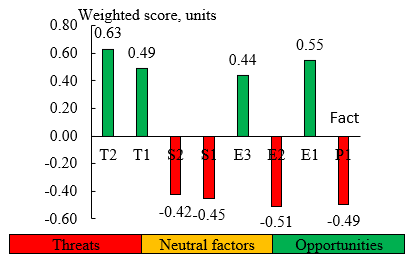
Based on the PEST analysis, we created a diagram to visually present the influence of factors (Figure 2).
Figure 2 highlights opportunities and threats, with no neutral factors identified.
Opportunities identified through the PEST analysis are as follows:
E1 is the trend of declining inflation in Kazakhstan;
E3 is favorable recreational opportunities in Kazakhstan;
T1 is the development of information and communications technologies;
T2 is the adoption of technology and scientific advancements in rural tourism management.
Threats identified through the PEST analysis are as follows:
P1 is an unstable economic and political situation that increases investment risks for rural tourism projects;
E2 is high commercial loan interest rates that negatively impact business profitability;
S1 is the intensified migration processes leading to an outflow of skilled personnel to cities;
S2 is a significant proportion of the rural population (approximately 45%).
Figure 2. Profile of the external distant environment
Note: According to expert assessments
4.1 Stakeholder analysis
The expert group discussion highlights the specific factors of the near environment (Table 4).
Similarly to PEST, opportunities and threats were identified using the quantitative method (Table 5).
Table 4. Stakeholder analysis
|
Designation |
Factors |
Influence (+/-) |
Factor Manifestation |
Business Reaction |
|
1 |
2 |
3 |
4 |
5 |
|
Managers of rural tourism business |
||||
|
P1 |
Have their own needs |
+ |
Have the opportunity to realize their needs in rural tourism |
It is necessary to include human resource management activities in rural tourism management |
|
Owners of rural tourism business |
||||
|
P2 |
Link to agriculture. Entrepreneurs often have parallel business in agriculture |
+ |
Combination of business activities |
Possibility to create agro-cultural tourist complexes |
|
State |
||||
|
P3 |
Declared priority and support for rural tourism |
+ |
Tax incentives, preferential lending |
It is necessary to use state support |
|
Municipal authorities in the area where rural tourism businesses are present |
||||
|
P4 |
Interest in rural development |
+ |
Expected support from local authorities, akimats (municipalities) |
Assistance in infrastructure development |
|
Clients, tourists |
||||
|
P5 |
Increasing social inquiries of potential customers |
– |
Using the Internet, customers can compare the price-quality ratio of different rural tourism service operators |
It is necessary to pay attention to the management of publicity, business reputation, and brand image |
|
P6 |
The interest of domestic customers in low prices |
+ |
Opportunities for differentiation strategies |
Price management mechanisms need to be incorporated into the business model |
|
P7 |
Demand changes and seasonal fluctuations. Dependence on other markets |
– |
Uncertainty factor |
It is necessary to diversify activities by combining tourism and agriculture |
|
P8 |
Potential clients are interested in cost savings (survey results) |
+ |
Factor determining pricing policy |
Necessity to adhere to average pricing policy |
|
P9 |
Potential clients are interested in quality services (survey results) |
+ |
Factor determining the quality management policy |
It is necessary to maintain a high level of price/quality at all times |
|
P10 |
Potential clients are interested in the territorial proximity of ethnic auls/mountain villages (survey results) |
+ |
Factor determining the territorial location |
It is necessary to consider the prospects of the settlements closest to large cities |
|
P11 |
Significance of regular customers |
– |
30% of potential customers have already planned regular visits to the ethno-village |
There should be a loyalty program |
|
P12 |
Customers’ willingness to recommend the service to their friends |
+ |
55% of potential customers would recommend the service to their friends (survey results) |
It is reasonable to develop the sales channel through recommendations |
|
Partners |
||||
|
P13 |
Rural tourism association in Kazakhstan |
+ |
Expected business support from the association |
Involvement of the association in business support |
|
Other participants in the tourism industry |
||||
|
P14 |
Increased competition in the rural tourism market |
– |
Increased vulnerability of single (non-networking) companies |
It is necessary to focus on the network business model |
|
P15 |
Competition with other types of tourism |
– |
Beach, outbound, and other types of tourism constitute the competition of rural tourism |
It is necessary to promote rural tourism |
|
P16 |
Risk of unfair behavior of competitors (poaching key employees, spreading negative rumors, etc.) |
– |
Loss of key employees, loss of business reputation |
Business reputation and brand image management |
|
P17 |
A potential employee always has a choice in the labor market |
– |
The company is always at risk of dismissal of an employee |
It is necessary to monitor market labor conditions and comply with them |
Note: Based on the results of the expert group discussion
Table 5. Quantitative assessment of the immediate environmental factors
|
Environmental Factor |
Evaluation (Threats/Opportunities, -/+) |
Factor Weight (Pi) (0…1) |
Influence of the Factor (Ai) (0…5) |
Weighted Score, Ai × Pi |
|
P1 |
+ |
0.05 |
2.15 |
0.11 |
|
P2 |
+ |
0.07 |
4.00 |
0.28 |
|
P3 |
+ |
0.07 |
3.90 |
0.27 |
|
P4 |
+ |
0.06 |
3.70 |
0.22 |
|
P5 |
– |
0.05 |
2.10 |
-0.11 |
|
P6 |
+ |
0.06 |
3.80 |
0.23 |
|
P7 |
– |
0.07 |
4.00 |
-0.28 |
|
P8 |
+ |
0.05 |
3.90 |
0.20 |
|
P9 |
+ |
0.05 |
3.95 |
0.20 |
|
P10 |
+ |
0.07 |
4.00 |
0.28 |
|
P11 |
+ |
0.06 |
3.75 |
0.23 |
|
P12 |
+ |
0.05 |
3.80 |
0.19 |
|
P13 |
+ |
0.05 |
3.65 |
0.18 |
|
P14 |
– |
0.06 |
3.80 |
-0.23 |
|
P15 |
– |
0.06 |
3.75 |
-0.23 |
|
P16 |
– |
0.06 |
3.75 |
-0.23 |
|
P17 |
– |
0.06 |
3.80 |
-0.23 |
|
Total |
х |
1.00 |
61.80 |
1.09 |
|
Weighted average |
х |
0.06 |
2.50 |
0.15 |
Note: The source is the results of expert assessments
The consistency of expert assessments was determined similarly to the PEST analysis. The external environment is generally favorable to rural tourism development (the final weighted score +1.09). The most favorable factors are P2 “Connection with agriculture. Entrepreneurs often have parallel business in the field of agriculture” and P10 “Potential customers are interested in the territorial proximity of the ethno-village (survey results)”. The most unfavorable factor is P7 “Demand changes and seasonal fluctuations. Dependence on other markets”. All threats and opportunities should be considered by the business model.
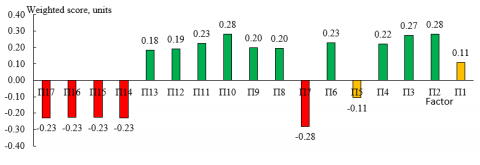
Based on the data of stakeholder analysis, a profile of the influence of the near environment is formed (Figure 3).
Figure 3. Profile of the external immediate environment
Note: According to expert assessments
For this purpose, the most significant factors are highlighted (modulus weighted score is greater than the average, i.e., 0.15 units).
Opportunities are as follows:
P2 is a link to agriculture. Entrepreneurs often have parallel business in agriculture;
P3 is declared priority and support for rural tourism;
P4 is interest in rural development;
P6 is the interest of domestic customers in low price;
P8 is potential customers interested in saving money (survey results);
P9 is potential clients interested in quality services (survey results);
P10 is potential customers interested in the territorial proximity of ethno-villages (survey results);
P11 is the importance of regular customers;
P12 is customers’ willingness to recommend the service to their acquaintances;
P13 is the rural tourism association in Kazakhstan.
Threats are as follows:
P5 is an increase in the social demands of potential customers;
P7 is demand changes and seasonal fluctuations. Dependence on other markets;
P14 is the growth of competition in the market of rural tourism;
P15 is the competition with other types of tourism;
P16 is a risk of unfair behavior of competitors (poaching key employees, spreading negative rumors, etc.);
P17 is a potential employee who always has a choice in the labor market.
4.2 The SNW analysis
The results of the SNW analysis are presented in Table 6.
The SNW analysis focused on internal business factors, with weighted scores used to classify elements as strengths or weaknesses based on their relative influence. Similar to the PEST analysis, a quantitative evaluation of internal factors was conducted using expert assessments. The results are presented in Table 7 (Ai × Pi). The following notations are used: Ai is an expert evaluation of the factor’s weight (importance) (ranging from 0 to 1); Pi is an expert evaluation of the factor’s influence (ranging from 0 to 5).
Table 6. The SNW analysis (internal business factors)
|
Designation |
Factors |
Evaluation (+/-) |
Factor Manifestation |
Business Reaction |
|
1 |
2 |
3 |
4 |
5 |
|
Environmental principle |
||||
|
В1 |
Incorporating conservation into the company’s mission |
+ |
Positive impact on brand image and business reputation |
Participation in nature conservation activities. Promotion of environmental cleanliness |
|
Principle of sustainable development |
||||
|
В2 |
Business organization within the framework of state and municipal programs of regional development |
+ |
Use of state and regional assistance in business |
It is necessary to study these programs and apply for participation in them |
|
В3 |
Businesses subject to seasonal fluctuations. Dependence on other markets |
– |
Uncertainty factor |
Use of agro-cultural tourist complexes |
|
В4 |
Relationships with partners are not established |
– |
Risks of partner dishonesty |
Need to find partners on favorable terms |
|
В5 |
Business is socially important |
+ |
Support in the region |
Appeal to local authorities for support |
|
Principle of efficiency |
||||
|
В6 |
Business planning |
+ |
Decisions are made based on the criterion of economic and social efficiency |
Inclusion of possible risks and uncertainties in the business development model |
|
В7 |
Lack of customer base |
– |
Additional costs for attracting customers |
Need to engage in branding and advertising |
|
В8 |
Low publicity |
– |
Risks of failure to fulfill business goals and objectives |
It is necessary to engage in branding and advertising |
|
В9 |
Orientation on the medium/high price/quality ratio, which is in demand but not common in the market |
+ |
Market demand |
Alignment with this price category |
|
В10 |
Significant dependence of efficiency on staff engagement and quality |
+ |
Opportunities to improve efficiency through staff management |
Consideration of HR management policies in the business model |
|
Principle of the partnership of government, business, and local community |
||||
|
В11 |
Small businesses lacking their own funds |
– |
Limitations in business implementation and development |
Need to attract investment or credit funds |
|
В12 |
Employment in agriculture distracts from tourism activities |
– |
Limitations in business implementation and development |
Inclusion of the interaction mechanism between agricultural and tourism activities in the business model |
Note: Based on expert assessments
Table 7. Quantitative assessment of SNW factors
|
Environmental Factor |
Evaluation (Weak/Strong, -/+) |
Factor Weight (Pi) (0…1) |
Influence of the Factor (Ai) (0…5) |
Weighted Score, Ai * pi |
|
В1 |
+ |
0.06 |
2.15 |
0.13 |
|
В2 |
+ |
0.08 |
3.75 |
0.30 |
|
В3 |
– |
0.10 |
4.20 |
-0.42 |
|
В4 |
– |
0.06 |
2.20 |
-0.13 |
|
В5 |
+ |
0.10 |
4.40 |
0.44 |
|
В6 |
+ |
0.09 |
3.95 |
0.36 |
|
В7 |
– |
0.08 |
3.90 |
-0.31 |
|
В8 |
– |
0.09 |
3.85 |
-0.35 |
|
В9 |
+ |
0.09 |
3.85 |
0.35 |
|
В10 |
+ |
0.09 |
3.75 |
0.34 |
|
В11 |
– |
0.08 |
3.75 |
-0.30 |
|
В12 |
– |
0.08 |
3.80 |
-0.30 |
|
Total |
х |
1.00 |
43.55 |
0.09 |
|
Weighted average |
х |
0.08 |
2.50 |
0.21 |
Note: Based on expert assessments
The consistency of experts was determined by the coefficient of variation [22, 23]. Since the coefficient of variation was within the norm in all cases (less than 0.25 units), the consistency of experts is recognized as sufficient.
Having analyzed these factors, we can conclude that the internal environment is generally favorable, although the influence of weak factors is expressed (the final weighted assessment has a positive value of +0.09). This means that the strategy should be aimed at building on the strengths and eliminating the influence of weak factors.
The strongest factor is B5 “Business is socially important”, and the weakest factor is B3 “Business subject to seasonal fluctuations”.
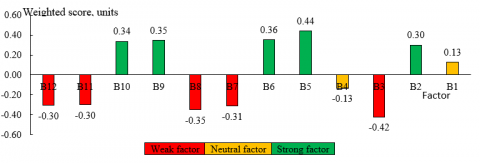
Based on the SNW analysis, a profile of the internal business environment was created (Figure 4).
Figure 4. Profile of the internal environment of rural tourism business
Note: According to expert assessments
For this purpose, the most significant factors are highlighted (modulus weighted score is greater than the average (0.21 units).
Strengths are as follows:
B2 is the business organization within the framework of state and municipal programs of regional development;
B5 is business that is socially important;
B6 is business that is planned;
B9 is the orientation to the “price/quality” ratio of the “medium/high” type, which is in demand but not widespread in the market;
B10 is a significant dependence of performance on staff engagement and quality.
Weaknesses are as follows:
B3 is business subject to seasonal fluctuations. Dependence on other markets;
B7 is lack of customer base;
B8 is low publicity;
B11 is lack of equity in small business;
B12 is employment in agriculture detracting from tourism activities.
Thus, the analysis of rural tourism management at macro, meso, and micro levels allowed to identify the most significant factors for rural tourism business: threats and opportunities, weaknesses and strengths, which should be considered in the model of effective rural tourism management.
The development of rural tourism in Kazakhstan is heavily influenced by government policies, which can either facilitate or hinder growth in the sector. Following the framework established in other countries, we observe that in China, the central government plays a steering role in guiding rural tourism towards desired directions, and the local government plays a serving role by directly managing tourism practices and coordinating with businesses and residents to provide services and solve problems. This cooperative effort is essential to stimulate rapid development in rural tourism [24]. The Kazakhstan government has already made substantial efforts to support rural tourism through the establishment of the Kazakh Tourism "National Company" JSC and the committee of tourism, which are focused on stimulating the development of a competitive tourist complex in the country, promoting and maintaining international standards, and creating conditions for development, but this is not substantial as a holistic, integrated approach should be adopted where local governments play a more proactive role in enabling rural tourism through subsidies, tax incentives, and the establishment of public-private partnerships (PPP) as seen in other nations [25]. Ainakanova et al. [26] proposed the need to adopt an integration of agriculture and tourism as a means of fostering rural tourism. A sustainable rural tourism model requires the alignment of various factors, including economic, environmental, and social considerations. First and foremost, the government should focus on offering targeted financial incentives to small rural tourism businesses. These could include low-interest loans, tax exemptions, and funding for infrastructure development. Iskakova et al. [27] highlighted the need for state-sponsored innovative entrepreneurship in Kazakhstan as a means of improving rural tourism. These policies should go beyond the boundaries of just improving rural tourism but should also encourage the diversification of rural tourism products, moving beyond traditional sightseeing to include agritourism, ecotourism, and cultural tourism.
For further clarification on the roles of government interventions in rural tourism, it is essential to observe other transition economies that have successfully integrated rural tourism into their economic models. A study by Dašić et al. [28] highlights the impacts of rural tourism in Croatia, Serbia, Kenya, and Namibia. This study shows a positive increase in national earnings, improved image, and economic benefits.
Capacity building within rural communities is essential for rural tourism developments, as most rural communities lack the necessary skills and knowledge to manage tourism effectively. The government, in collaboration with educational institutions, should offer specialized training programs for local communities to build their hospitality, marketing, and business management skills. Significantly, environmental sustainability should be at the core of rural tourism policies in Kazakhstan, as the government should implement regulations that ensure the preservation of rural landscapes and biodiversity. By ensuring that tourism growth does not come at the expense of the environment, the government can safeguard the long-term viability of rural tourism.
We analyzed the perceptions of rural tourism in Kazakhstan by stakeholders. Their key needs and expectations were determined using a questionnaire survey. The analysis allowed us to determine the fundamental importance of the network model for the organization of rural tourism business in Kazakhstan.
We generalized factors affecting rural tourism management in the format of PEST, stakeholder, and SNW analysis. All levels of the business environment favorably affect rural tourism, despite certain threats and weaknesses. These threats and weaknesses should be addressed in the model of effective rural tourism management.
Findings suggest that policy interventions should prioritize infrastructure investment, financial incentives, and workforce development to enhance rural tourism’s viability. Businesses should focus on diversification strategies, digital marketing, and partnerships with agricultural enterprises to mitigate seasonal dependency and strengthen customer engagement. Additionally, the integration of network-based business models could improve resource sharing and resilience among rural tourism operators.
Despite its contributions, this study has limitation that the sample size for qualitative data collection was relatively small, particularly in the tourist perception survey, which was limited to 20 respondents from European universities. While this provided valuable insights, future studies should incorporate a larger and more diverse sample to obtain a more representative understanding of international tourist perceptions.
Future studies should explore investigate how rural tourism initiatives in Kazakhstan influence job creation, income levels, and rural-urban migration trends over time. Future research should explore how digital marketing, smart tourism platforms, and virtual experiences can enhance rural tourism accessibility and attract tech-savvy travelers.
This study provides a foundation for evidence-based policymaking and business innovation, aiming to transform rural tourism into a sustainable and competitive sector within Kazakhstan’s broader economic landscape.
[1] Bakanova, A.A. (2006). Formation and implementation of a system for the development of rural tourism in the region (as exemplified by the Leningrad region). Abstract of thesis for a Candidate Degree in Economic Sciences. Moscow. https://www.dissercat.com/content/formirovanie-i-realizatsiya-sistemy-razvitiya-selskogo-turizma-v-regione-na-primere-leningra.
[2] Pavić, L., Pažek, K., Pavlovič, M. (2019). Agritourism between agriculture and tourism: A review. In the 3rd International Thematic Monograph: Modern Management Tools and Economy of Tourism Sector in Present Era, Balkana, pp. 243-257.
[3] Oborin, M.S. (2020). Features of creating favorable conditions for the development of rural tourism in the regions of Russia. Service in Russia and Abroad, 14(1): 117-126. https://doi.org/10.24411/1995-042X-2020-10110
[4] Jin, X., Wu, H., Zhang, J., He, G. (2021). Agritourism development in the USA: The strategy of the State of Michigan. Sustainability, 13(20): 11360. https://doi.org/10.3390/su132011360
[5] Kaz'mina, E.B. (2012). Development of rural tourism services in Russian regions. Candidate of Economics Dissertation: Author's Abstract. Moscow.
[6] Volkova, T., Golubyatnikova, E., Mamonova, A., Ivlieva, O., Anisimova, V., Rovovaya, T. (2024). Unified methodological foundations for sustainable recreational environmental management: A framework for tourism and natural resource conservation. International Journal of Ecosystems and Ecology Science (IJEES), 14(4): 231-242. https://doi.org/10.31407/ijees14.4
[7] Yusuf, E.S., Wulandari, S. (2023). Agritourism development: Designing an effective model for sustainable growth. In BIO Web of Conferences, Yogyakarta, Indonesia, p. 04023. https://doi.org/10.1051/bioconf/20236904023
[8] Masir, A.M.R.S. (2017). Development of competitive business strategies for integrated interactions in the tourism industry (in Russian). PhD thesis, Economic Sciences. Moscow. https://www.dissercat.com/content/razvitie-konkurentnykh-biznes-strategii-integratsionnykh-vzaimodeistvii-v-industrii-turizma.
[9] Ariyani, N., Fauzi, A. (2023). Pathways toward the transformation of sustainable rural tourism management in central Java, Indonesia. Sustainability, 15(3): 2592. https://doi.org/10.3390/su15032592
[10] Mikhaylova, A.A., Wendt, J.A., Hvaley, D.V., Bógdał-Brzezińska, A., Mikhaylov, A.S. (2022). Impact of cross-border tourism on the sustainable development of rural areas in the Russian–Polish and Russian–Kazakh borderlands. Sustainability, 14(4): 2409. https://doi.org/10.3390/su14042409
[11] Sergeyeva, A.M., Omirzakova, M.Z., Saparov, K.T., Nurgazina, A.S. (2023). The resource potential and scenarios for the rural tourism development in Aktobe oblast of the Republic of Kazakhstan. Journal of Geology, Geography and Geoecology, 32(3): 609-619. https://doi.org/10.15421/112354
[12] Karshalova, A., Akpanov, A., Tleubayeva, S., Belgibayev, A., Makhmudov, A., Atchabarova, A., Zholayeva, M. (2025). Development of entrepreneurial activity using the integration of human capital and green technologies to optimize the sustainable development of the territories. Qubahan Academic Journal, 4(4): 306-317. https://doi.org/10.48161/qaj.v4n4a1022
[13] Akhmetshin, E., Abdullayev, I., Kurikov, V., Khadasevich, N., Shichiyakh, R., Severyanova, M. (2024). Opportunities for socio-economic development in Russia: Integration of education, science, and business through the "University 4.0" model. Revista Relações Internacionais do Mundo Atual, 4(46): 639-656. https://doi.org/10.21902/Revrima.v4i46.7575
[14] Kulanina, A., Dashin, A., Khorolskaya, T., Karabalaeva, S., Yakushina, A., Fozilova, S. (2025). Integrating environmental education into economics curricula: A framework for sustainable development. International Journal of Ecosystems and Ecology Science (IJEES), 15(1): 283-290. https://doi.org/10.31407/ijees15.1
[15] Kazakova, N.A. (2018). Modern Strategic Analysis: Textbook and Practical Course for Master’s Degree. Moscow: Izdatelstvo Yurait. https://urait.ru/bcode/560469.
[16] Porter, M.E. (2008). The five competitive forces that shape strategy. Harvard Business Review, 86(1): 78.
[17] Wang, N., Pan, H., Feng, Y., Du, S. (2024). How do ESG practices create value for businesses? Research review and prospects. Sustainability Accounting, Management and Policy Journal, 15(5): 1155-1177. https://doi.org/10.1108/SAMPJ-12-2021-0515
[18] Joyner, L., Kline, C., Oliver, J., Kariko, D. (2018). Exploring emotional response to images used in agritourism destination marketing. Journal of Destination Marketing & Management, 9: 44-55. https://doi.org/10.1016/j.jdmm.2017.10.004
[19] Ammirato, S., Felicetti, A.M., Raso, C., Pansera, B.A., Violi, A. (2020). Agritourism and sustainability: What we can learn from a systematic literature review. Sustainability, 12(22): 9575. https://doi.org/10.3390/su12229575
[20] Ryazantsev, M.I., Morozov, A.V. (2014). Methodology for the coordination of expert assessments obtained through individual questionnaires using the method of hierarchy analysis. Engineering Bulletin, 2: 3-9. https://ecofin-isuct.ru/article/download/2170/1216/.
[21] Akhmadi, H., Yekti, A. (2021). Impact of agrotourism development on increasing value added of agricultural products and farmers' income levels (a study in Karangtengah, Bantul, Yogyakarta. In E3S Web of Conferences, Yogyakarta, Indonesia, p. 02013. https://doi.org/10.1051/e3sconf/202123202013
[22] Exchange Rate Chart. (2020). https://ru.exchange-rates.org/history/KZT/USD/G/180.
[23] Population of Kazakhstan. (2020). https://countrymeters.info/ru/Kazakhstan.
[24] Liu, C., Dou, X., Li, J., Cai, L.A. (2020). Analyzing government role in rural tourism development: An empirical investigation from China. Journal of Rural Studies, 79: 177-188. https://doi.org/10.1016/j.jrurstud.2020.08.046
[25] Lipkova, L., Madiyarova, A., Blembayeva, A. (2020). Importance of state regulation of the tourism industry in the Republic of Kazakhstan. In E3S Web of Conferences, Almaty, Kazakhstan, p. 04007. https://doi.org/10.1051/e3sconf/202015904007
[26] Ainakanova, B., Nukesheva, A., Sundetuly, Z., Kazkenova, A., Omarkhanova, Z., Yernazarovat, A. (2023). Kazakhstan tourism industry in promoting sustainable agriculture development. Journal of Environmental Management & Tourism, 14(2): 552-562.
[27] Iskakova, M.S., Abenova, M.K., Dzhanmuldaeva, L.N., Zeinullina, A.Z., Tolysbaeva, M.S., Salzhanova, Z.A., Zhansagimova, A. (2021). Methods of state support of innovative entrepreneurship: The example of rural tourism. Journal of Environmental Management & Tourism, 12(2): 466-472. https://doi.org/10.14505/jemt.12.2(50).14
[28] Dašić, D., Živković, D., Vujić, T. (2020). Rural tourism in development function of rural areas in Serbia. Економика Пољопривреде, 67(3): 719-733. https://doi.org/10.5937/ekoPolj2003719D