Ahmed Mohammed Al-Shammari* | Kareem Hasan Alwan
© 2025 The authors. This article is published by IIETA and is licensed under the CC BY 4.0 license (http://creativecommons.org/licenses/by/4.0/).
OPEN ACCESS
The research aims to study the role of the spatial development gap in allocating investments in the educational buildings services sector due to the importance of the spatial development gap, which shows the extent of the needs of each administrative unit in Babylon Governorate and its suitability to achieve spatial development for all development sectors, and here comes the role of the development gap in determining investments in school buildings projects according to the need that is determined according to planning criteria. It addressed the school buildings (kindergarten, primary, secondary, and vocational) for each administrative unit in the governorate and the actual need for 2023. The research problem is a gap in educational services (buildings) at the administrative unit level in the Babylon governorate. It hypothesizes that considering the spatial development gap in the distribution of financial allocations for educational services will lead to achieving equity in spatial distribution. It adopted the descriptive-analytical approach to study the reality of development and the inductive approach to analyze the data to achieve a balanced distribution of regional development program allocations. To determine the level of development, its priorities, and the size of financial allocations in the buildings sector for educational services, the weighted proportional distribution method (WPDM), one of the basic methods of multi-criteria decision analysis (MCDM), was used. It takes into account the population and development gap, according to specific weights according to the relative importance of development goals to achieve spatial justice and regional development. The research concluded that there is a development gap in educational building services between administrative units, despite the inclusion of projects under construction as a fixed balance for school buildings, which necessitated the redistribution of investment allocations for the regional development Program for educational services according to the method used.
basic services development, educational services, investment planning, regional development, spatial development gap
Education is one of the most important pillars of development and is pivotal in improving the standard of living and human capabilities. However, there is a development gap in educational services at various levels.
The spatial development gap of educational services in Babylon Governorate represents a major challenge in achieving development. It negatively affects the quality of life of the population and hinders the achievement of sustainable development. It highlights the clear imbalance in education services compared to the growing needs of the population.
The research dealt with research concepts, knowledge and field study of the study area. In the practical aspect, it dealt with the magnitude of educational needs, financial allocations, and the method used to prioritise investment in educational services.
The research aims to study the spatial development gap for educational services and its role in distributing investments in a way that promotes efficiency and spatial justice, proposal to reallocate the projects of the area development Program for educational services by administrative units and provide recommendations to improve the educational sector in Babylon Governorate.
The study of the spatial development gap has been and continues to be an important area of focus in both local and international research. This section aims to synthesise existing literature on similar topics, highlighting the most important innovative aspects of this study and its theoretical and practical relevance.
2.1 Local research
In Babylon Governorate/Iraq, regional development investment programs have been introduced to enhance spatial planning through the development of several regional strategies to improve living standards and provide services to the population. Several studies have analyzed spatial development gaps, including the Spatial Development Plan, the Spatial Development Gap Study, and the Regional Structural Plan Strategies for Babylon Governorate, all of which aim to reduce the development gap and improve spatial planning, but disparities in development pose a great challenge, and for this reason, this study was prepared to formulate a new mechanism in the distribution of development investments for the education sector in Babylon Governorate that takes into account the population size and spatial development gap (education) for each administrative unit.
2.2 International research
At the international level, many studies are interested in achieving spatial justice and reducing the gap between different settlements, for example, the work of Harvey, who focused his ideas on spatial justice and believes that justice cannot be understood or achieved without a spatial perspective, stressing that patterns of access to services such as education, health care, transport, and housing are unevenly distributed between regions, and are often linked to factors such as social class, ethnicity, and geographical location. This requires rethinking regional planning in terms of the population's right to fair and equal access to opportunities and resources, not just their provision in aggregate [1].
Therefore, he argues that assessing the distribution of services at the regional level should not be limited to technical or economic criteria only, but should take into account the extent to which this distribution fulfills the principle of regional spatial justice.
The work of Indian philosopher “Amartya Sen” [2] is one of the most prominent thinkers who reformulated the concept of development from a humanitarian and human rights perspective, away from a single focus on economic growth indicators. His work, especially his book "Development as Freedom", contributed to the establishment of what is known as the Capability Approach, which is considered one of the most important conceptual tools for understanding development and spatial gaps, including the inequitable distribution of educational infrastructure.
Capability theory is based on the fundamental idea that true development is not measured by the amount of resources or income, but by the extent to which individuals can achieve a life they choose and value. Thus, the age of poverty is defined not only as an absence of income, but also as a deprivation of basic opportunities and capabilities such as education, health, and community participation, all of which lead to deepening developmental disparities between regions and a lack of spatial distributional justice.
2.2.1 Innovative aspects of the study
The study is characterized by the integration of local and international perspectives, highlighting its innovative approach to proposing effective mechanisms to allocate resources and capabilities. In order to identify the gaps in the spatial development of educational services and their role in the redistribution of investments for education services in Babylon Governorate, and to propose practical solutions from the distribution of financial forms for services in a balanced manner, by employing the analytical descriptive method and using spatial development indicators for the education and investment sector.
2.2.2 Theoretical and practical importance
The theoretical significance of this study lies in contributing to the understanding of the dynamics of investment allocations and their impact on reducing the spatial development gap to minimise regional disparities. By integrating local and international research perspectives, the study provides a comprehensive analysis of the development reality and proposes appropriate solutions.
In practical terms, the study provides practical recommendations for policymakers to enhance planning decision-making mechanisms and resource allocation. From reducing the development gap for educational services for each administrative unit to ensuring more equitable and effective development outcomes to achieving regional spatial justice to enhance the socio-economic stability of Babylon Governorate.
The spatial development gap is defined from the developmental point of view as the gap that defines the difference between the actual development requirements of the economy and society on the one side and the other side, the balance achieved from the declared development projects [3], that is, the development gap constitutes the distance between the potential, capabilities and resources available in the economy on the one hand, and on the other hand the needs and life aspirations of all members of society according to the standards [4, 5], so the wider the development gap, the less the performance of the agencies concerned with harnessing and employing the available capabilities and resources in order to meet the developmental needs and demands on the other side [6, 7].
The disparity in the distribution of basic services such as health, education, transport and infrastructure between urban and rural areas or developed and poor areas has been continuously widening, which leads to the widening of the development gap and therefore requires a study of the reality of this gap and ways to address it [8]. The services gap is an essential part of the development gap [9] and the process of measuring the level of development. Then, the development gap is a necessity stemming from the concept and objectives of the development process itself, according to the different intellectual perspectives that defined it [10]. Whether this measurement is to evaluate results, set policies, formulate plans and objectives, or identify development priorities for a particular place or sector [11]. The spatial equity of events is measured by the actual opportunities that development produces for the population in the design of regional services that respond to the spatial reality to achieve justice and appropriate real function and ensure that no group is marginalised in the integrated development process from planning to the actual effects of development [12].
Planning investment projects is one of the most effective means of changing the economic, urban and rural structure [13], so the process of anticipating these projects requires a scientific method and methods to achieve the returns assigned to them to bring about development, the adoption of the spatial and sectoral development gap will contribute to the neutralisation of investment projects [14]. The benefits of using the development gap to achieve balanced regional development by directing resources, planning efforts towards regions and sectors that suffer from underdevelopment. To achieve balanced regional development by directing resources and planning efforts towards regions, sectors that suffer from underdevelopment [15], the distribution of resources and services in urban or regional space is not neutral, but rather a reflection of power and authority relations within society. Consequently, space itself is reproduced through market mechanisms, public policies, and planning models, often reinforcing rather than addressing spatial inequalities [1]. One of the benefits of using the development gap to prioritise development through:
Therefore, the spatial development gap is an important tool in the development process at various local, regional, national levels and the coordination of their efforts, which are based on planning and regulatory considerations to set priorities, investment Programs based on development and regulation, especially for less developed areas or sectors that suffer from a spatial development gap to achieve balanced spatial development.
5.1 Location areal
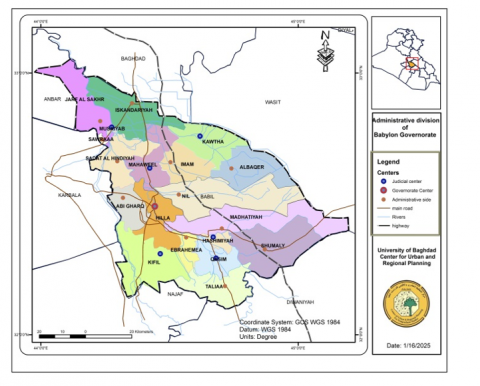
Babylon Governorate extends between the (44˚ 00′ 00′′) and (45˚ 13′ 00′′) circles of latitude (32˚ 5′ 00′′) and (33˚ 3′ 00′′) (Figure 1). The governorate’s distinguished location in the heart of the Middle Euphrates region and its sharing of administrative borders with six governorates, namely the capital Baghdad, Wasit, Diwan, Najaf, Karbala and Anbar, which gave it a vital role in linking the southern provinces of Iraq with Baghdad, and the eastern provinces of Iraq with the western provinces [18].
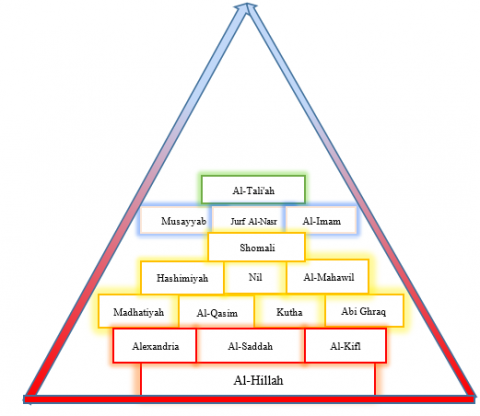
Babylon governorate consists of 7 districts distributed over 19. A district with a total area estimated at 5308 km2, representing 1.2% of Iraq’s area of 435052 km2.
Figure 1. Map of the administrative units of Babylon Governorate
Source: Using the ARC GIS 10.8 software.
5.2 Educational services
Service is defined as ‘the material or moral benefit provided to society and represents activities to achieve material and non-material benefit to the population in order to improve their standard of living’ [19] The educational sector is considered one of the sectors with a great impact on the various segments of society, as the educational sector is no longer a service sector but is considered a productive sector because this sector provides other sectors with competencies , skills and provides society with minds and abilities , creates competent and effective personalities [20].
To determine the efficiency of the distribution of educational services spatially the nature of their performance by comparing their indicators with local planning standards [21] adopted in the Directorate of Education of Babylon determined 25 students per class for kindergarten education and 35 students per class for primary, secondary and vocational education, based on the number of registered students. Based on the planning criteria adopted by the Iraqi Ministry of Education and the Iraqi Ministry of Planning to identify the gap (deficit and surplus) for school buildings (kindergarten, primary, secondary and vocational) as well as taking into account ongoing projects (under construction) in each of the projects (regional development programmes, ministerial programmes and international loans) in the process of calculating the net gap in order to accurately determine the priority of the service to ensure fair distribution of future investments for educational services as shown in the Table 1.
Table 1. Spatial distribution of educational services according to planning standards for the year 2023
|
Administrative Unit |
Number of Kindergartens |
Standard |
Under Construction |
Elementary |
Standard |
Under Construction |
High School |
Standard |
Under Construction |
Professional |
The Standard |
|
Al-Hillah |
13 |
104 |
1 |
108 |
184 |
21 |
64 |
92 |
28 |
5 |
46 |
|
Abi Ghraq |
1 |
6 |
0 |
33 |
36 |
8 |
11 |
18 |
1 |
2 |
9 |
|
Al-Kifl |
1 |
5 |
0 |
60 |
46 |
2 |
9 |
23 |
3 |
0 |
12 |
|
Al-Mahawil |
2 |
7 |
0 |
35 |
38 |
13 |
12 |
19 |
6 |
1 |
10 |
|
Al-Imam |
2 |
3 |
0 |
18 |
12 |
1 |
4 |
6 |
2 |
0 |
3 |
|
Al-Nil |
1 |
2 |
1 |
26 |
19 |
4 |
1 |
10 |
0 |
0 |
5 |
|
Kutha |
2 |
9 |
0 |
60 |
42 |
9 |
7 |
21 |
3 |
0 |
10 |
|
Hashimiyah |
1 |
8 |
0 |
10 |
12 |
5 |
3 |
6 |
1 |
0 |
3 |
|
Madhatiyah |
1 |
14 |
0 |
62 |
45 |
7 |
10 |
22 |
3 |
3 |
11 |
|
Al-Shomali |
2 |
4 |
0 |
57 |
29 |
11 |
9 |
14 |
0 |
0 |
7 |
|
Al-Qasim |
2 |
19 |
0 |
57 |
52 |
13 |
13 |
26 |
6 |
0 |
13 |
|
Al-Tali'ah |
1 |
2 |
1 |
22 |
13 |
5 |
6 |
6 |
0 |
0 |
3 |
|
Musayyab |
4 |
13 |
0 |
14 |
18 |
12 |
8 |
9 |
3 |
0 |
5 |
|
Al-Saddah |
2 |
8 |
1 |
22 |
38 |
5 |
7 |
19 |
3 |
0 |
10 |
|
Alexandria |
4 |
23 |
0 |
39 |
52 |
6 |
12 |
26 |
6 |
1 |
13 |
|
Jurf Al-Nasr |
1 |
1 |
0 |
42 |
16 |
1 |
6 |
8 |
1 |
0 |
4 |
|
Total |
40 |
227 |
4 |
665 |
652 |
123 |
182 |
326 |
66 |
12 |
163 |
Source: The authors based on the Babylon Education Directorate Regional Development Department / Ministry of Planning, Planning, Public Policy Directorate / Babylon Governorate for the year 2024.
Figure 2. Spatial distribution of educational buildings in Babylon Governorate for the year 2023
Source: Using the ARC GIS 10.8 software.
The financial allocations for education services amounted to 459,429 million dinars, where the percentage of (general) allocations at the governorate level amounted to 32.1% of the allocations, as shown in Table 2, while the percentage of allocations amounted to 67.9% distributed at the level of administrative units 297,268 million dinars. as shown in Table 2.
Table 2 represents the spatial distribution of the percentage of project costs by administrative units where it is observed that Hilla centre occupies the largest percentage (20.7%). which is natural because it is the most populous administrative unit as well as the administrative capital of Babylon Governorate, so it will need more services to meet the growing needs of the population and the pressure of services, then Kutha center (10.1%) and Abu Ghargh (8.9%) of the cost of projects, while the lowest allocations were Jurf al-Nasr (1.1%) and Al-Imam district (1.7%) of the cost of allocations.
It is necessary to redistribute the financial allocations for education services because most of its administrative units suffer from a gap in school buildings, some of which have a surplus of services to achieve fairness in spatial distribution and to ensure that everyone has access to services.
Table 2. Spatial distribution of population and financial allocations for the cost of education services for the year 2023
|
Administrative Unit |
Population |
Population % |
Cost (million dinars) |
Cost % |
|
Al-Hillah |
661,433 |
0.28 |
61,512 |
20.7 |
|
Abi Ghraq |
128,597 |
0.05 |
26,542 |
8.9 |
|
Al-Kifl |
165,989 |
0.07 |
20,270 |
6.8 |
|
Al-Mahawil |
138,371 |
0.06 |
25,514 |
8.6 |
|
Al-Imam |
43,658 |
0.02 |
4,946 |
1.7 |
|
Al-Nil |
69,661 |
0.03 |
5,353 |
1.8 |
|
Kutha |
150,714 |
0.06 |
30,007 |
10.1 |
|
Hashimiyah |
42,357 |
0.02 |
8,765 |
2.9 |
|
Madhatiyah |
160,817 |
0.07 |
17,473 |
5.9 |
|
Al-Shomali |
103,254 |
0.04 |
18,549 |
6.2 |
|
Al-Qasim |
188,545 |
0.08 |
25,488 |
8.6 |
|
Al-Tali'ah |
46,099 |
0.02 |
10,039 |
3.4 |
|
Al-Musayyab |
65,156 |
0.03 |
12,300 |
4.1 |
|
Al-Saddah |
137,586 |
0.06 |
14,236 |
4.8 |
|
Alexandria |
188,582 |
0.08 |
13,017 |
4.4 |
|
Jurf Al-Nasr |
55,883 |
0.02 |
3,256 |
1.1 |
|
Administrative units |
2,346,702 |
1 |
29,7268 |
100 |
|
general |
162,161 |
32.1 |
||
|
the total |
459,434 |
100 |
||
Source: The authors based on the Regional Development Plan for Babylon Governorate 2024.
To redistribute the investment allocations of the regional development program for breeding projects, the research adopted the Weighted Sum Model (WSM), which is one of the basic methods of multi-criteria decision analysis (MCDM). It is used to allocate resources or investments between regions or sectors based on a set of factors with different relative weights to categorize and rank alternatives based on multiple criteria. It aims to achieve fairness and efficiency in the distribution of resources so that each factor is given a weight that reflects its importance to the development goals.
To calculate the investment priority for education services (buildings), we perform the following steps:
First: Calculate the net gap for the education indicators as in Table 3.
Table 3. Spatial distribution of the educational services gap index at the level of Babylon Governorate for 2023
|
Administrative Unit |
Kindergarten Gap % |
Primary Gap % |
High School Gap % |
Professional Gap % |
|
Al-Hillah |
8.9 |
3.9 |
0.0 |
5.8 |
|
Abi Ghraq |
8.6 |
-2.0 |
7.5 |
5.1 |
|
Al-Kifl |
8.4 |
-4.5 |
10.9 |
6.6 |
|
Al-Mahawil |
7.5 |
-3.3 |
1.4 |
5.9 |
|
Al-Imam |
3.3 |
-7.5 |
0.2 |
6.6 |
|
Al-Nil |
-2.7 |
-7.2 |
20.4 |
6.6 |
|
Kutha |
8.0 |
-8.5 |
11.8 |
6.6 |
|
Al-Hashimiyah |
9.1 |
-3.5 |
7.3 |
6.6 |
|
Al-Madhatiyah |
9.6 |
-7.1 |
9.5 |
4.8 |
|
Al-Shomali |
5.4 |
-18.0 |
8.4 |
6.6 |
|
Al-Qasim |
9.2 |
-4.5 |
6.1 |
6.6 |
|
Al-Tali'ah |
-0.2 |
-14.6 |
1.4 |
6.6 |
|
Al-Musayyab |
8.9 |
-5.8 |
-5.0 |
6.6 |
|
Al-Saddah |
8.6 |
3.8 |
10.9 |
6.6 |
|
Alexandria |
8.4 |
1.8 |
7.0 |
6.0 |
|
Jurf Al-Nasr |
7.5 |
-23.2 |
2.3 |
6.6 |
|
|
100 |
100 |
100 |
100 |
Source: The authors based on Table 1
* Note: (-) indicates a surplus in service.
To accurately determine the weights of educational services, a questionnaire was prepared for 50 experts according to the five-point Likert scale on determining the relative importance of educational buildings to prioritize investment projects for education services, and the results were as shown in Tables 4-5.
Table 5 shows the educational gap based on the relative importance of school buildings, resulting in a net educational gap for the administrative units of the Babylon Governorate. We note that the highest development gap is in Al-Saddah, Alexandria, Al-Nil, Abi Ghraq, and Al-Hashimiya, while some administrative units have a medium gap, as in Hilla, Kutha, Al-Qasim, Al-Madhatiyah and Al-Mahawil, and some administrative units have a surplus of service for the net gap, although they suffer from the gap of some of their educational services in Shomali, Al- Al-Musayyab, Al-Tali'ah and Jurf Al-Nasr, which does not mean depriving them of development because the development gap is part of the investment priorities.
Thus, the development categories can be defined into three levels: high priority category from 1 to 6, medium priority category from 7 to 12, and very low priority category from 13 to 16, as shown in Figure 3.
Figure 3. Developmental categories of education services for Babylon Governorate
Source: Using the ARC GIS 10.8 software
Table 4. Intentional questionnaire to determine the relative importance of education
|
Materiality Scale |
Kindergarte % |
Primary % |
Secondary % |
Vocational % |
|
Unnecessary |
0 |
0 |
0 |
2 |
|
Low priority |
34 |
2 |
2 |
22 |
|
Medium priority |
28 |
12 |
12 |
24 |
|
High priority |
30 |
34 |
44 |
42 |
|
Very High Priority |
8 |
52 |
42 |
10 |
|
Total |
100 |
100 |
100 |
100 |
|
Relative Importance Index |
20.7 |
28.9 |
28.2 |
22.3 |
Source: The authors based on Questionnaire form.
Table 5. Ranking the administrative units according to the net development gap (Education)
|
Ranking |
Administrative Unit |
Net Gap % |
|
1 |
Al-Saddah |
7.0 |
|
2 |
Alexandria |
5.7 |
|
3 |
Al-Kifl |
5.1 |
|
4 |
Al-Nil |
4.6 |
|
5 |
Abi Ghraq |
4.6 |
|
6 |
Al-Hashimiyah |
4.5 |
|
7 |
Al-Hillah |
4.3 |
|
8 |
Kutha |
4.1 |
|
9 |
Al-Qasim |
3.9 |
|
10 |
Al-Madhatiyah |
3.9 |
|
11 |
Al-Mahawil |
2.4 |
|
12 |
Al-Imam |
0.1 |
|
13 |
Al-Shomali |
-0.1 |
|
14 |
Al-Musayyab |
-0.1 |
|
15 |
Al-Tali'ah |
-2.4 |
|
16 |
Jurf Al-Nasr |
-3.9 |
Source: The authors based on Table 3.
These classifications will help planning decision-makers to identify the development gap and identify development needs to achieve spatial equity in the distribution of investments and ensure universal access to education.
Second: Distribution of investment allocations.
To ensure the fairness of the spatial distribution of education sector investments in Babylon Governorate, two main dimensions were relied upon in determining the priorities of investment distribution by administrative units to achieve social justice and spatial development in setting priorities and reducing the development gap for each administrative unit. The first dimension (spatial development gap) and the second dimension (population) relied on the relative weight between the two dimensions from the questionnaire (for specialists) in determining them, as the relative weight of the development gap (52%) and the relative weight of the population (48%) as in the Table 6.
Table 7 shows the levels of development according to the priority of the administrative units of Babylon Governorate, where Hilla district received priority (18%) based on the application of population indicators and the educational buildings gap because it has the largest population and within the second development category, then Sadah (10%) and Alexandria (9.76%) and then Al-Kafeel (7.39%) according to the calculated weights. At the same time, the least prioritized was at the top because it had the lowest population and did not have a gap because it had a surplus of educational buildings. As shown in Figure 4.
Table 6. Questionnaire responses for investment prioritization
|
Materiality Scale |
Population % |
Development Gap % |
|
Unnecessary |
0 |
0 |
|
Low priority |
2 |
2 |
|
Medium priority |
8 |
2 |
|
High priority |
52 |
32 |
|
Very High Priority |
38 |
64 |
|
Total |
100 |
100 |
|
Relative Importance Index |
48 |
52 |
Source: The authors based on Questionnaire form.
Table 7. Spatial distribution of investment priorities for education projects according to the weighted proportional distribution method
|
Administrative Unit |
Population (48%) |
Net Gap (52%) |
Administrative Unit weight% |
|
Relative weight% |
Relative weight% |
||
|
Al-Hillah |
28.19 |
8.58 |
18.0 |
|
Abi Ghraq |
5.48 |
9.13 |
7.4 |
|
Al-Kifl |
7.07 |
10.20 |
8.7 |
|
Al-Mahawil |
5.90 |
4.69 |
5.3 |
|
Al-Imam |
1.86 |
0.11 |
1.0 |
|
Al-Nil |
2.97 |
9.20 |
6.2 |
|
Kutha |
6.42 |
8.25 |
7.4 |
|
Al-Hashimiyah |
1.80 |
8.95 |
5.5 |
|
Al-Madhatiyah |
6.85 |
7.76 |
7.3 |
|
Al-Shomali |
4.40 |
0.00 |
2.1 |
|
Al-Qasim |
8.03 |
7.82 |
7.9 |
|
Al-Tali'ah |
1.96 |
0.00 |
0.9 |
|
Al-Musayyab |
2.78 |
0.00 |
1.3 |
|
Al-Saddah |
5.86 |
13.92 |
10.1 |
|
Alexandria |
8.04 |
11.39 |
9.8 |
|
Jurf Al-Nasr |
2.38 |
0.00 |
1.1 |
|
Total |
100 |
100 |
100 |
Source: The authors.
* Note: The value of (-) has been replaced with (0) to ensure that the administrative unit is not completely deprived of financial allocations
Figure 4. Spatial distribution of the percentage of investment priorities for education services
Source: Table 7.
This method is of great importance in assisting decision-makers in distributing investments and regional development programs and other programs based on the development gap in decision-making practically and thoughtfully that takes into account the social, economic, service dimensions in the localization of investment and service projects. As shown in the priority scale in Figure 5, the financial allocations were also redistributed according to the weights of the administrative units to know the amount of disparity between the previous and proposed costs in Table 8. Redistribution of allocations according to the planning priority based on the weighted allocation method.
Table 8. Differences between the actual and planned distribution of financial allocations (million) for 2023
|
Administrative Unit |
Amounts After Application Weights (chart) |
Current Allocations (actual) |
The Difference |
|
Al-Hillah |
82,655 |
61,512 |
21,143 |
|
Abi Ghraq |
33,907 |
26,542 |
7,365 |
|
Al-Kifl |
39,956 |
20,270 |
19,686 |
|
Al-Mahawil |
24,213 |
25,514 |
(1,301) |
|
Al-Imam |
4,367 |
4,946 |
(579) |
|
Al-Nil |
28,537 |
5,353 |
23,184 |
|
Kutha |
33,869 |
30,007 |
3,862 |
|
Al-Hashimiyah |
25,351 |
8,765 |
16,586 |
|
Al-Madhatiyah |
33,649 |
17,473 |
16,176 |
|
Al-Shomali |
9,703 |
18,549 |
(8,846) |
|
Al-Qasim |
36,407 |
25,488 |
10,919 |
|
Al-Tali’ah |
4,332 |
10,039 |
(5,707) |
|
Al-Musayyab |
6,123 |
12,300 |
(6,177) |
|
Al-Saddah |
46,181 |
14,236 |
31,945 |
|
Alexandria |
44,933 |
13,017 |
31,916 |
|
Jurf Al-Nasr |
5,251 |
3,256 |
1,995 |
|
Administrative units |
459,434 |
297,267 |
459,434 |
|
general |
0 |
162,167 |
0 |
|
the total |
459,434 |
459,434 |
459,434 |
Source: The authors.
* Note: () means that there are more allocations than the planned entitlement.
Figure 5. Development priorities for educational building services by administrative units in Babylon Governorate
Source: The Authors.
Figure 6. Differences between the actual and planned distribution of regional development allocations for education services (million)
Source: Table 8.
It is clear from Table 5 that there is a disparity in the process of distribution of education allocations for investment projects for regional development programs in Babylon Governorate, as shown in Figure 6, where there is a disparity between the actual and planned distribution of financial allocations (the difference between actual and planned) in the distribution of allocations (million) and the highest administrative units reached the need for these amounts are Al-Sada, Alexandria, Nile and Hilla to reach the ideal state of distribution. Some administrative units have a surplus of the planned situation in Shomali, Al-Imam, Al-Tali'ah, and Al-Maseeb, which affected the rest of the administrative units and resulted in a gap in services and educational buildings.
Despite the large allocations to this group of administrative units, they suffer from a gap in their educational services because the regional development programme needs more allocations to fill the need in educational services as well as complete the projects that have been allocated to them, which are ongoing and stalled, facing issues in implementation and referral.
This mechanism helps to identify the spatial development gap and know the shortage of services to direct development efforts towards the areas and sectors most in need of development and helps decision-makers in determining investment priorities, whether in the projects of regional development programs or other programs in the ease of distribution and take the appropriate decision to achieve the expected gains and to achieve spatial justice and ensure everyone in the development process.
To bridge the development gap, it requires the participation of various development programs in the development process, which requires more allocations at various levels.
This study presented the mechanism for the distribution of investment allocations to the education sector according to the regional development programs in Babylon Governorate based on investment indicators for financial allocations to projects and indicators of the educational and population spatial development gap:
Based on the results of the study on the impact of the development gap on the distribution of investment allocations to the education sector, the study proposes several recommendations aimed at improving the development reality and achieving spatial justice for the distribution of investments in Babylon Governorate:
[1] Harvey, D. (2012). Rebel cities: From the right to the city to the urban revolution. Journal of Planning Education and Research, 34(4): 483-485. https://doi.org/10.1177/0739456X14550377
[2] Sen, A. (1999). Development as Freedom. Oxford University Press. https://doi.org/10.1017/S0892679400008728
[3] AL-Faihan, H.H.H., Alwan, K.H. (2024). The impact of climate on the quality of water in Hilla, Iraq. E3S Web of Conferences, 583: 02011. https://doi.org/10.1051/e3sconf/202458302011
[4] Alwan, K.H., Dhahir, Y.M. (2023). The role of land is used in achieving the characteristics of the creative city (Tikrit city). AIP Conference Proceedings, 2793(1): 040002. https://doi.org/10.1063/5.0163558
[5] Mohamed, T.A. (2020). The role of local broadcast media in achieving sustainable development: The Algerian Broadcast as a model. The Journal of El-Ryssala for Media Studies, 8(1): 195-205. https://asjp.cerist.dz/en/article/244770.
[6] Hwaidi, M.A., Al-Rawe, M.K. (2025). The level of spatial justice in the distribution of social services for the Regional Development Program in Wasit province for the period (2011–2022). Journal of Planning and Development, 30(1): 43-63. https://jpd.uobaghdad.edu.iq/index.php/jpd/article/view/530.
[7] Jedi, Z.A.J., Al-Jawari, S.M. (2023). Prediction of formal transformations in city structure (Kufa as a Model) based on the cellular automation model and Markov chains. International Journal of Sustainable Development & Planning, 18(5): 1417-1424. https://doi.org/10.18280/ijsdp.180512
[8] Al-Shadidi, H.A. (2012). Spatial development disparity in Iraq with proposed developmental measures and means of confronting it. Journal of Planning and Development, (26): 216-238. https://jpd.uobaghdad.edu.iq/index.php/jpd/article/view/126.
[9] Hasach Albasri, N.A.R., Shakir, H.S., Al-Jawari, S.M. (2023). Monitoring and prediction functional change of land uses toward urban sustainability. International Journal of Sustainable Development and Planning, 18(7): 2015-2023. https://doi.org/10.18280/ijsdp.180703
[10] Al-Razouqi, S. (2008) Notes on regional development policies. Journal of Planning and Development, University of Baghdad, Centre for Urban and Regional Planning, (18): 86-111. https://jpd.uobaghdad.edu.iq/index.php/jpd/article/view/194/156.
[11] Almansuri, D.S., Alkinani, A.S. (2024). The role of competitive advantage in investing spatial identity. Journal of Planning and Development, 29(3): 21-47. https://jpd.uobaghdad.edu.iq/index.php/jpd/article/view/474/322.
[12] Kadhim, S.H., Al-Jawari, S.M., Razak Hasach, N.A. (2024). Analyzing earth’s surface temperatures with relationship to land urban land cover (LULC) to enhance sustainability. International Journal of Sustainable Development & Planning, 19(1): 123-130. https://doi.org/10.18280/ijsdp.190110
[13] Al-Shadidi, H.A.S., Al Kaabi, M.M.F. (2024). Impact of investment projects in changing master plan of Najef Holy City. Pakistan Journal of Life and Social Sciences 22(2): 491-505. http://doi.org/10.57239/PJLSS-2024-22.2.0036
[14] Alshadidi, H.A.S., Aldabiwee, N.S.H. (2022). Development importance of the regional development program (comparative study between Babylon and Maysan provinces for 2019). IOP Conference Series: Earth and Environmental Science, 961(1): 012097. https://doi.org/10.1088/1755-1315/961/1/012097
[15] Mutlaq, J.B. (2022). An analytical study on national housing finance policies and implementation strategies. Journal of Planning and Development, 27(1): 19-44. https://jpd.uobaghdad.edu.iq/index.php/jpd/article/view/337.
[16] Bukodi, E., Goldthorpe, J.H. (2019). Social Mobility in Britain: Research, Politics and Policy. Cambridge University Press.
[17] Sachs, J., Schmidt-Traub, G., Kroll, C., Lafortune, G., Fuller, G., Woelm, F. (2020). The sustainable development goals and COVID-19. Sustainable Development Report 2020. Cambridge: Cambridge University Press. https://s3.amazonaws.com/sustainabledevelopment.report/2020/2020_sustainable_development_report.pdf.
[18] Republic of Turkey Prime Ministry, State Planning Organisation, General Directorate of Regional Development and Structural Adjustment. (2007). The new regional development policies and implementations. https://www.sbb.gov.tr/wp-content/uploads/2018/11/The_New_Regional_Development_Policies_and_Implementations.pdf.
[19] Alwan, K.H., Al-Jawari, S.M., Al-Rikabi, N.K. (2024). Evaluation the sustainability of urban settlement of the purified water supply service. AIP Conference Proceedings, 3249(1): 070001. https://doi.org/10.1063/5.0236266
[20] Al-Rawi, M. K., & Hamil, A. K. (2018). The spatial planning for the educational services and the scarcity of urban land: Study area: Al-Sadder City. In Postmodern Urban and Regional Planning in Iraq. Knowledge E, pp. 270-291. https://media.neliti.com/media/publications/504717-the-spatial-planning-for-the-educational-7d5ee91c.pdf.
[21] Alrazaq, N.K.A., Yousif, N.E. (2007). The efficiency of the distribution for educational services in Al-Athamiyah area. Journal of Planning and Development, (16): 32-53. https://jpd.uobaghdad.edu.iq/index.php/jpd/article/view/203.