Huong Ho* | Thi-Hong-Diep Pham
© 2025 The authors. This article is published by IIETA and is licensed under the CC BY 4.0 license (http://creativecommons.org/licenses/by/4.0/).
OPEN ACCESS
This study aims to systematically examine the theoretical framework and empirical findings pertaining to the determinants of the night-time economy's expansion within the context of improving sustainable tourism. By using a sample of 325 businesses, the study evaluates the factors influencing night-time economy development in rural by using the regression model. Besides, the study also uses quantile regression to find the impact at different points of district management variable in the conditional distribution of night-time economy development in rural like Ninh Binh, Vietnam. The findings indicate that district management (0.543), infrastructure (0.604), policy (0.134), vulnerability (0.199) and associations and support services (0.026) exhibit a positive impact on the growth of night-time economy in rural Ninh Binh. Against the aforementioned background, this research proposes strategies to promote the expansion of the night-time economy in response to the sustainable tourism strategy.
night-time economy, rural Ninh Binh, district management, NTE development, sustainable tourism
The night-time economy contributes to developing the economy, creating jobs and income for labors as well as making the useage of local resources to attract tourists, creating new motivation for sustainable tourism economic development. In general, catering, culture, entertainment, arts, festivals, events, sports, nightlife, tourism, and transportation services are all components of the night-time economy (NTE), which is becoming a significant force in rural economic development. In addition to supporting sustainable economic development, providing employment opportunities, expanding consumption, and enhancing the competitiveness and attractiveness of cities, the NTE performs a multitude of other tasks [1]. The night-time economy makes an negative impact on the environment and local culture, while contributing to sustainable development by helping to generate future employment for local people.
Some studies have examined factors influencing NTE development by using a mean regression approach. VNAT [2] shows that night-time economy development is related to culture, health, and tourism with nocturnal electrical supply, public transportation, urban safety, and environmental protection. The development of the economy at night is also based on the maintenance and enhancement of public lighting, the availability of commercial and public infrastructure, the character of relevant policies, and economic success [3]. In addition, the NTE development depends on infrastructure enhancements, economic services late at night, city plans, management agencies, and changes in technological, economic, environmental, political, social, and commercial factors [4-6]. In Viet Nam, Tuong [7] has examined Da Nang data to determine which factors have influenced the development of NTE there. The focus of the researchers is on evaluating NTE's progress. To the best of our knowledge, no study examining the effects of NTE development, district management, or vulnerability in rural has utilized quantile regression. Besides, in light of sustainable tourism trend, it is necessary to re-evaluate the role of district management in the development of NTEs in rural and rural like Ninh Binh, Viet Nam, one of the most potential provinces in NTE development according to sustainable development.
To do so, the study concentrates on examining the factors influencing NTE development in rural Ninh Binh in the context of improvement sustainable tourism by using the regression model with the variables including infrastructure, safety, association and support services, policy, customer satisfaction, resource and nature, vulnerability and district management. Parallel to that, the study also uses quantile regression to find the impact at different points of district management variable in the conditional distribution of NTE’s development in rural Ninh Binh, Viet Nam.
2.1 Definition and role of the night-time economy
Although the term “night-time economy” (NTE) was coined in the 1970s in Britain, its origins can be attributed to a series of cultural events organized by the Rome City Council between 1977 and 1985 [8]. When the manufacturing-based daytime economy in the heart of British cities began to decline due to de-industrialization, the NTE concept was created to characterize its revival through the inclusion of night-time operating hours [9]. Since then, the NTE has been used as a metric to characterize the administration and commerce of post-industrial British cities. The expansion of NTE has a significant impact on the development and vitality of cities. The NTE has been shown to increase employment opportunities (by keeping businesses open later) and nocturnal use of urban public and commercial facilities [8]. Second, the expansion of NTEs promotes the success of the service sector and increases consumer expenditure. With the assistance of the NTE, businesses in the hospitality, transportation, and retail industries can expand in tandem with the success of the NTE. The third advantage of NTE expansion is that it makes cities more attractive and competitive. Authorities frequently employ "re-imagining" and "place marketing" to increase the attractiveness of a city, which in turn attracts external investors, skilled residents, and professionals, and stimulates the local economy [10]. In addition, the NTE offers tourists a variety of purchasing alternatives, which enhances their vacations and boosts their satisfaction. If a visitor or business investor has a positive and memorable experience in a city, they are likely to return. Similar to how locals are more apt to participate in after-work entertainment if they value the beauty and appeal of urban nightlife [11].
The majority of research on NTE has focused on implementing effective strategies, policies, and plans for urban governance and security. Few systematic studies have examined the financial and social effects of the urban expansion of NTEs. Quantitative measurements are also urgently required to support the policy planning and decision-making processes of government and corporate stakeholders. Related to the development of NTE in rural, Landry and Bianchini [8] emphasize the social and economic interactions that thrive during night hours in various sectors such as nightlife venues and transportation services. Montgomery [12] shows that the development of NTE in rural can be adapted to rural economies, where unique assets like eco-tourism, local crafts, and farm-to-table experiences are central. Some studies also confirm the NTE development in rural relate to the ability of the night economy to meet the conditions relating to facilities, safety for tourists and society, support services, policies, meeting customer expectations, management, and ability to respond to changes [4, 7, 11].
2.2 Determinants of the night-time economy development
Taking into account the national policy context, Anning County's integration with the metropolitan area, and advancements in the subdistrict's matching degree, Wang et al. [13] assert that the night-time economy is crucial to the formulation of a sustainable development strategy for the county. Policies must also determine the orientation of Anning County's nocturnal economic development from the perspective of rural revitalization and urban-rural integration. To determine the county's objectives for night-time economic development, the county should consider the development requirements of rural regeneration and urban-rural integration, with culture, health, and tourism serving as the proposed development's central axis. Therefore, it is essential to cultivate the nocturnal economy sector with vigor, cohesion, ease, and equilibrium. Additionally, the county can promote its cultural identity in order to attract tourists. Restaurants, nightclubs, parks, and other late-night recreational areas need government permission to remain open without disturbing residential neighborhoods [14]. To ensure the expansion of NTE, government management and regulations are necessary for nocturnal electrical supply, public transportation, urban safety, and environmental protection.
Moreno-Gené et al. [15] have investigated the effects of NTE on the social requirements and life quality of neighborhood residents. Others have conducted rigorous scientific research on the environmental advantages of addressing the light pollution problem and the social repercussions it has on public safety in the night-time economy. It is evident that most recent studies of the Western world's night-time economy have focused on invisible economic issues, such as the security of cities at night and the prevalence of urban crime [16]. The growth of the economy at night is contingent on a variety of factors, including the maintenance and enhancement of public lighting. Several empirical studies have demonstrated a correlation between the intensity of a region's night-time lighting and its rate of economic development. The growth of the night-time economy is contingent on a number of factors, such as the availability of commercial and public infrastructure, the character of relevant policies, and economic success [17].
The development of NTE necessitates a well-lit, secure environment. If the NTE is to flourish, lighting infrastructure enhancements should be an ongoing priority. When businesses have access to adequate illumination, darkness no longer signifies the end of business but rather the beginning of a new economic trend. Night-time illumination can do more than keep businesses open; it can also make people feel secure and make streets safer [6]. Son et al. [18] confirm using a regression model that safety parameters influence the progression of NTEs. With a Cronbach's alpha greater than 0.90, this model demonstrates that the reliability of using economic services (AT) late at night is high. The paper concludes that utilizing economic services (AT) at night is extremely secure.
In addition, Baum [1] accounted for the expansion of economic activities into the evening and exhorted city planners, licensing experts, environmental management agencies, and chambers of commerce to develop strategies for enhancing city life after dark. Historically, the term "night -economy" only referred to the "chaos economy" of late-night partying and imbibing. Festivals and cultural projects that entice people to return to the city, the creation of new commercial and residential spaces, and the streamlining of existing ones are all components of the NTE expansion plan. To promote the city as a prospering cultural habitat, the city's nightlife, an area for enjoyment, socializing and gathering at night, and the activities of cultural center facilities are highlighted. Given the high concentration of foot traffic, modes of transportation, noise, cultural practices, and infrastructure in the area, the district council must manage conflict to ensure visitors' secure access to and departure from the nightlife district. In addition, Zmyslony and Pawlusinski [4] discussed the shifting dynamics between tourism and the nocturnal economy as a result of changes in technological, economic, environmental, political, social, and commercial factors.
In addition, the Internet's cutting-edge business infrastructure can be utilized to create a platform and mechanism for a country’s nocturnal economic management. The government must oversee and administer the county's nocturnal economic development policy to ensure its smooth operation. The tourism and goods industries can benefit from government support on a firm basis. Due to their respective strengths and responsibilities in rural tourism development, governments, businesses, and communities can operate in a manner that benefits all parties [19]. A public-private partnership platform for the region's night-time economy can be constructed to encourage large and medium-sized enterprises to locate in rural areas. The government can establish a risk prediction threshold and an emergency response mechanism in advance to achieve an eco-friendly, safe, and secure urban night-time management service. In the end, the county administration, the people, and society as a whole will all prosper. Seijas and Gelders [5] provide models for managing NTE advisory bodies such as Night Committees or Club Committees, and more cooperative cities; night mayors who are subordinate to or strongly associated with the structure of municipal authorities such as Nightlife and Culture Offices.
Son et al. [18] demonstrated that promotion and sharing, infrastructure and safety, institutions and environment, and nature and resources have a positive impact on Hanoi's nocturnal economic development. Profitability and expansion can be enhanced by concentrating on customer satisfaction, which is a fundamental demand-side qualitative indicator that is essential for understanding customers' preferences, experiences, and propensity to repurchase. If both locals and tourists have a negative experience with NTEs, the industry will fail. In other words, the satisfaction of citizens and tourists is crucial when assessing the future expansion potential of the NTE. When tourists enjoy themselves in a city, they are more likely to return, and when locals enjoy themselves at night, they are more likely to go out with their families. People will travel to the city to spend the evening there as a result of the free and extensive advertising provided by satisfied customers' recommendations. An understanding of destination competitiveness requires an understanding of productivity and comparative advantages [20]. Guizzardi and Mariani [21] developed a Dynamic Destination Satisfaction Matrix to monitor visitor satisfaction at the national level over time (i.e. longitudinally). This matrix illustrated how a positive visitor experience could increase a destination's allure to prospective tourists.
Overall, studies show that NTE development in rural areas refers to the range of economic activities that occur during the evening and night, typically between 6 p.m. and 6 a.m., aimed at stimulating local economic growth and community engagement. In a rural context, this can encompass a variety of sectors, including hospitality, entertainment, cultural tourism, and retail. In general, the night-time economy development is related to culture, health, and tourism with nocturnal electrical supply, public transportation, urban safety, and environmental protection. The development of the economy at night is also based on the maintenance and enhancement of public lighting, the availability of commercial and public infrastructure, the character of relevant policies, and economic success [13, 17]. In addition, the NTE development depends on economic services late at night, management agencies, and changes in technological, economic, environmental, political, social, and commercial factors [4-6]. Furthermore, some studies also have examined factors influencing NTE development by using a mean regression approach [7, 13]. However, only a few studies examining the effects of district management, or vulnerability on NTE development in rural has utilized quantile regression. So our research was motivated by the need to bridge this gap in the existing literature. The study concentrates on examining the factors influencing NTE development in rural Ninh Binh in the context of improvement sustainable tourism by using the regression model with the variables including infrastructure, safety, association and support services, policy, customer satisfaction, resource and nature, vulnerability and district management. Besides, quantile regression is used to find the impact at different points of district management variable in the conditional distribution of NTE’s development in rural Ninh Binh, Vietnam.
Ninh Binh, Viet Nam is ideally situated for the expansion of all types of tourism, particularly NTE. Ninh Binh is a region with great potential and advantages in tourism development, which can create unique, competitive tourism products and create its own brand for Ninh Binh tourism. Ninh Binh is not only favored by the Creator, bestowed with many rich, unique and attractive natural landscapes such as Trang An, Tam Coc - Bich Dong, Cuc Phuong National Park, and Van Long flooded... but also has many especially important historical and cultural relics, marking important historical events of the Vietnamese people such as relics, historical and cultural sites of Hoa Lu Ancient Capital, imprints of Vu Lam Palace, Thai Vi Temple, Bai Dinh Pagoda, Phat Diem Stone Church... Besides, Ninh Binh also has many unique intangible cultural heritages with folk festivals, unique traditional crafts and arts, rich cuisine... With 1,821 relics, of which there are 298 provincial-level relics and 81 national-level relics including 3 special national-level relics. Since 2022, tourism in Ninh Binh province has flourished due to efficient provincial administration with sustainable tourism development strategy.
The primary source of data for our analysis was derived from three distinct categories of enterprises located in the peripheral regions of Ninh Binh's four principal cities, namely Gia Vien, Hoa Lu, Kim Son, and Nho Quan. The selection of these provinces was based on their representation as exemplars of a developed NTE in rural Vietnam.
Firstly, an initial step involved compiling a comprehensive list of local businesses within each region provided form local authorities. A list with 325 business establishments by local authorities, it is an official and public list. The business selection process was primarily focused on revenue in order to obtain a representative local business sample. They are the group of potential businesses with the highest revenues.
In the second step, a questionnaire was used to collect data from the business establishments. With the assistance of authorities, interviews with those business establishments were also set up. Face-to-face interviews were conducted with 325 business establishments including 216 business establishments in rural Ninh Binh to collect information on factors affecting nigh-time economic development in Ninh Binh including NTE development, infrastructure, ensuring safety, association and support services, policy, customer satisfaction, resource and nature, district management, vulnerability and some recommendations for improving NTE development in rural Ninh Binh. We concentrated on a discussion about evaluating how factors such as infrastructure, safety, association and support services, policy, customer satisfaction, resource, management, and vulnerability affect the development of NTE in rural Ninh Binh. Besides, we also had a discussion with the group of potential customers using NTE service frequently to ask some questions related to their satisfaction with the company's products, services, and overall customer experience meet customer expectations since then recommend some useful solution to enhances NTE businesses to develop. These are customers from other areas who use day trips in Ninh Bình and participate in experiencing night tourism products including 120 tourists with an average age of 33 years old, an income of above 30 million VND/month, most of whom have a university degree or higher and have traveled frequently.
There have been numerous previous studies on the factors that influence NTE, the majority of which follow the mean regression or correlation approach [8, 18]. Building on the foundation of previous research, we also employ a regression model to examine the factors influencing NTE in rural Ninh Binh. The regression model is a statistical technique that uses several explanatory variables to predict the outcome of a response variable. The goal of the regression model is to model the linear relationship between the explanatory (independent) variables and the response (dependent) variables. Formula and calculation of multiple linear regression:
Yi=β0+β1xi1+β2xi2+...+βpxip+ϵ
where, for i=n observations: Yi=dependent variable (night-time economy development); xi=explanatory variables (infrastructure, safety, association and support services, policy, customer satisfaction, resource, management, vulnerability); β0= y-intercept (constant term); βp=slope coefficients for each explanatory variable; ϵ=the model’s error term (also known as the residuals).
The regression model is a function that allows an analyst or statistician to make predictions about one variable based on the information that is known about another variable.
Nevertheless, this study is novel in that it employs the quantile regression model to examine potential variations in the effects of district management. We use quantile regression to find the relationship at different points of district management variable in the conditional distribution to NTE’s development [22]. In other words, using quantile analysis, we can answer the question of whether the impact of the district management on the development of NTE is heterogeneous across all considered percentiles of employment distribution [3]:
$\mathrm{y}_{\mathrm{i}}=\mathrm{x}_{\mathrm{i}}^{\prime} \beta_\theta+\mathrm{u}_{\theta \mathrm{i}}$
Quantile $_\theta\left(\mathrm{y}_{\mathrm{i}} \mid \mathrm{x}_{\mathrm{i}}\right) \equiv \inf \left\{\mathbf{y}: \mathrm{F}_{\mathrm{i}}(\mathrm{y} \mid \mathrm{x}) \theta\right\}=\mathrm{x}_{\mathrm{i}}^{\prime} \beta_\theta$
Assumption : Quantile $_\theta\left(\mathrm{u}_{\theta \mathrm{i}} \mid \mathrm{x}_{\mathrm{i}}\right)=0$
where, Quantile (y/x): θi, i is the regression of the (0;1) percentile of the dependent variable yi; percentage change θ (0;1) Î will reflect the entire distribution of the variable yi. We use the quantile model to evaluate the effects of district management on the development of NTE in rural Ninh Binh. Quantile regression enabled us to examine the relationship at different points in the conditional distribution of NTE development. The goal of quantile regression differentially weights the differences between the observed values and the values predicted by the regression line, then tries to minimise the weighted differences [3]. Several studies found a public governance heterogeneous effect across levels of development [23, 24]. In addition, a quantile regression estimator is more robust to non-normal errors and outliers, whereas a linear regression estimator can suffer from inefficiency if the errors are highly abnormal. Thus, we employed a fixed-effects quantile regression estimator (P50, P70, P90) to test whether the effect of district management differs with varying levels of NTE development. In general, the quantile estimator also provides a richer characterisation of the data, allowing to study the effect of district management on the entire distribution of NTE development. Thus, the quantile regression analysis would bring better information for policy‐makers regarding the development of NTE in rural Ninh Binh [24].
The selected independent variables include infrastructure, safety, association and support services, policy, customer satisfaction, resource and nature, district management, and vulnerability. The definition of evaluating the dependent variables and independent variables can be further seen in Table 1.
Table 1. The definition of the dependent variable and independent variable
|
Criteria |
Definition |
Source |
|
NTE development |
The ability of the night economy to meet the conditions relating to facilities, safety for tourists and society, support services, policies, meeting customer expectations, management, and ability to respond to changes. |
[4, 7, 11] |
|
Infrastructure |
The basic physical and organizational structures and facilities (e.g. buildings, roads, Illumination, parks, squares, camera.) needed for the operation of NTE |
[4-6, 13, 18] |
|
Safety |
Ensure safety for tourists and society: taking public transport at night; activities in bars, pubs, discos, and karaoke bars; going out, visiting crowded areas such as night markets, walking streets; handling incidents, problems of order, security, environment… |
[4, 6, 13, 16, 18] |
|
Association and support services |
Support services for NTE: Installation of security cameras, official cameras, services to support guests using alcoholic beverages such as car driving services, taxi services, room services, medical services, security services in the area, organization work, environmental sanitation at night destinations... |
[1, 6, 13, 16, 25] |
|
Policy |
Policies for NTE (financial policy, credit policy, tax policy, promotion policy, promotion of night economic activities, human resource training policy, science and technology application policy…) |
[4, 17] |
|
Customer satisfaction |
Customer satisfaction is a measure of how well a company's products, services, and overall customer experience meet customer expectations. |
[6, 26] |
|
Resource and Nature |
Geomorphological (landforms), geological (minerals, rocks, and fossils), hydrological (rivers, lakes, and seas), and biological (animals and plants…) |
[5, 19] |
|
District management |
Business improvement districts; Community Development Organizations, Main streets |
[7, 13] |
|
Vulnerability |
Ability to respond to changes |
[7, 27] |
Source: Author's synthesis (2024)
Table 2. Descriptive statistics
|
Variables |
Definition |
Mean/Share |
Std. Dev |
|
Age |
Respondent’s actual age (years) |
32.50 |
7.34 |
|
Education |
Actual schooling years |
13.23 |
2.07 |
|
Gender-female |
Male |
0.35 |
0.47 |
|
Job lever |
1= APS level 2 = Executive level |
1.73 |
0.44 |
|
NTE’s types |
1= Shopping services (supermarkets, walking streets, ...) 2= Bar, dance floor, karaoke services 3= Sightseeing services, experiencing night tours in the tourist area |
2.82 |
1.40 |
|
Region/Location |
1 = the Mekong Delta region 2 = the Central region 3 = the Cuu Long Delta region |
1.95 |
1.42 |
|
Working years |
Number of years from the time the business was established |
12.27 |
6.68 |
|
Number of tourists |
Number of customers using the business's services for per month |
365.21 |
8.41 |
|
Revenue |
Monthly revenue (million VND) 1 = > 100 million VND 2 = from 100 to 500 million VND 3= 500 – 1000 million 4= < 1000 million |
1.66 |
1.08 |
Source: Author’s survey (2024)
Besides, the study uses a 5-point Likert scale with ratings from 1-5, in which 1 is the lowest rating and 5 is the highest rating for the questions related to the evaluation of the impact of these variables on NTE development in Ninh Binh. The questionnaire was test and validated for reliability. In Table 2, the responses evaluate criteria at about 3-point Likert scale for the questions related to the evaluation of the impact of these variables on NTE development in Ninh Binh. In statistics, the mean is one of the measures of central tendency. The mean is nothing but the average of the given set of values. It denotes the equal distribution of values for a given data set. Mean is the average of the given numbers and is calculated by dividing the sum of given numbers by the total number of numbers.
Key informants’ interviews and focus group discussions were then conducted. Of the total of respondents, the rate of males accounts for 35 %, and the rest is the rate of females, the average schooling years is 15.23 and the average age of all respondents is 32.5 years old (Table 1). Besides, NTEs exhibit an average monthly revenue of approximately 300 million VND. Women representatives from the majority within the sampled CBTEs, with an average age of 34 years. The establishment of most CBTEs dates back approximately 12.27 years, focusing primarily on Sightseeing services, experiencing night tours at the tourist area. The average schooling duration among the sampled representatives for NTEs exceeds 13.23 years.
4.1 Determinants of NTE development in rural Ninh Binh
According to Ninh Binh Department of Tourism (2022), before the outbreak of covid, the number of tourists visiting Ninh Binh province in the period of 2010-2019 grew very fast, with an average growth rate of 12.19%/year, of which the average growth rate of international visitors reached 4.07%/year, domestic tourists reached 12.69%/year. In 2019, the number of tourists to the province reached 7.65 million, tourism revenue reached 3,671 billion VND. However, during the covid outbreak, in 2020 and 2021, revenue decreased sharply with 20,661 billion VND in 2019, 14,561 billion VND in 2020 and 2,596 billion VND in 2021 (Figure 1). In 2021, Ninh Binh welcomed only 1,325,000 visitors, with revenue of 935 billion VND. As of December 2022, the whole province has 689 accommodation establishments with 8,508 rooms, of which 39 are 1-4 star hotels.
Figure 1. Tourism revenue form 2015-2023 in Ninh Binh
Source: Ninh Binh statistical yearbook (2023)
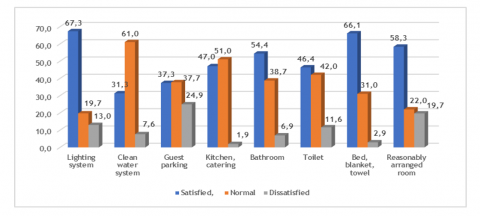
The type of NTE services like shopping services (supermarkets, walking streets, ...) has an average service income of 30,000,000 VND/night; bar, dance floor, and karaoke services reaching 70,000,000 VND/night; night tour and tourism experience services reaching 150,000,000 VND/night. The number of lights in public places serving tourists has increased, ensuring the standard ratio of 2 lights per street and 56,420 visitors at Tourist Support Stations and supported 69,100 visitors via hotline numbers and email boxes have directly supported. Along with that, to ensure security for tourists, 94% of accommodation establishments in the province were declared temporary residences via ASM software in the VneID app. The survey results show that most tourists are satisfied with the facilities, with the highest level of satisfaction being the lighting system with 67.3% (Figure 2).
Figure 2. Tourists’ evaluation of the facilities in NTEs in rural Ninh Binh
Source: Author’s survey (2024)
Table 3 presents the results of the regression model on NTE development in Ninh Binh. The variables, which are district management, infrastructure, association and support services, policy, customer satisfaction, and vulnerability, have a positive impact on the development of NTE in rural Ninh Binh for all models. In Table 3, test F of the regressive is significant (p < 0.05), which shows that there is no error in selection.
Table 3. Determinants of NTE development in rural Ninh Bình
|
Variables |
Model 1 Ninh Binh |
Model 2 Rural Ninh Binh |
||
|
Coef. |
Std.Err |
Coef. |
Std.Err |
|
|
District management |
0.732*** |
0.241 |
0.543** |
0.042 |
|
Infrastructure |
0.463*** |
0.062 |
0.604*** |
0.063 |
|
Safety |
-0.041* |
0.062 |
0.129** |
0.062 |
|
Association and support services |
0.122* |
0.065 |
0.026* |
0.065 |
|
Policy |
0.208** |
0.078 |
0.134*** |
0.079 |
|
Customer satisfaction |
0.137** |
0.072 |
-0.130** |
0.073 |
|
Resource and nature |
0.120** |
0.061 |
-0.035** |
0.063 |
|
Vulnerability |
0.201*** |
0.059 |
0.199** |
0.059 |
|
Constant |
0.111 |
0.094 |
0.125 |
0.095 |
|
Observation |
325 |
216 |
||
Note: Robust standard errors in parentheses. *** p<0.01, ** p<0.05, * p<0.1
Source: Author’s survey (2024)
The results of estimation affirm that the impact of district management on NTE development is given in Table 3. In all models, the coefficients on education variables are highly statistically significant and positive with 0.732 in model 1 and 0.543 in model 2. Similarly, infrastructure also has a significant impact on NTE development in rural Ninh Binh with 0.463 and 0.604 in model 1 and model 2 respectively. The development of NTE in rural necessitates infrastructure enhancements should be an ongoing priority. A well-lit, secure environment, internet's cutting-edge business infrastructure can also make people feel secure and make streets safer. So, is one of the most important for NTE development in rural. Son et al. [18] have the same conclusions. Parallel to that, vulnerability also has a significant impact on NTE development in rural Ninh Binh (0.201, model 1; 0.199, model 2). Momani et al (2021) also have similar results. Furthermore, district management plays a big role in NTE development (0.731, model 1; 0.543, model 2). Ninh Binh has many advantages in NTE, in order to develop, rural Ninh Binh needs other factors such as management, district management, association and support services, infrastructure, policy, etc. [18].
The other factors that affect the development of NTE include association and support services, customer satisfaction and safety. Association and support services has a positive impact on the NTE development with 0.12 (Model 1) and 0.026 (Model 2). Wang et al. [13] also conclude that an orderly county night-time economic development environment requires relevant departments and governments can build a good platform for cooperation between the tourism and product industries through association and support services. The government can establish a risk prediction level and an emergency response mechanism in advance to achieve an environmentally friendly, safe, and secure urban night-time management service. Notably, for customer satisfaction and safety, the impact of these parameters exhibits contrasting effects in the two models. In the first model, a positive effect is observed, however, in the second model, a negative effect is observed on the development of the night-time economy. Furthermore, according to the results of model estimation, the increase in safety factor will lead to an increase of 0.129 units of NTE development in model 2. However, the coefficient corresponding to the factor is positive in model 2 but negative in model 1 (-0.041). This shows that NTE activities in rural Ninh Binh always ensure safety, and district management does not care about this. Besides, customer satisfaction is a cornerstone for the successful development of the night-time economy. It drives customer retention, increases spending, boosts reputation, and supports long-term business growth and regional economic prosperity. Ensuring a positive customer experience is key for any business or region aiming to grow its night-time activities. So, the factor has a positive impact on NTE development in model 1 with 0.137, but in the model 2, this factor has a negative on NTE development with -0.130. In our group discussions, the interviewees also show that the role’s customer satisfaction in driving the development of the night-time economy in rural areas may be constrained by factors such as a small customer base, economic limitations, lack of infrastructure, cultural habits, and seasonal challenges. These issues can limit the extent to which satisfied customers translate into significant economic growth, meaning that other factors like investment, infrastructure development, and cultural engagement are often more critical for the success of night-time economies in rural settings.
4.2 The effects of district management on the NTE development of rural Ninh Binh
The regression model in Table 4 confirms that ensuring safety and customer satisfaction does not encourage increasing NTE development, but ensuring infrastructure is found to increase NTE development by 0.287 times in rural Ninh Binh regions. Notably, the estimates from quantile regression in Table 4 reveal that resource and natural resources tend to decrease with district management quantiles in rural Ninh Binh, while association and support services, policy, and vulnerability tend to increase with manager quantiles.
Especially, Table 4 shows that the higher level of the district management, the higher level of NTE development in Ninh Binh. District management impacts on the NTE development with 0.252 (model 1), 0.361 (model 2) and 0.658 (model 2). Tuong [7] also gives the same result about the role of district management in NTE. According to these authors, tax exemption and reduction policies for tourism businesses should be adopted. Furthermore, they suggest implementing a pricing system for power use in restaurants and tourist accommodation services based on the unit price of electricity production, as opposed to the current practice of utilizing service rates. The district management should prioritize supporting tourism businesses through the implementation of financial support policies, such as exemptions, tax breaks, and reduced fees for companies. Additionally, they should establish training support policies by organizing training programs and fostering human resources to enhance the quality of resource supply for the tourism industry. Furthermore, policies aimed at facilitating logistics associated with tourism should also be implemented. Hence, the ethical conduct exhibited by district management serves as a constructive model, thereby enhancing the quality of development in the Ninh Binh province for quantile models.
Table 4. Quantile effects of district management on the NTE development in rural Ninh Binh
|
Variables |
The 50th Quantile |
The 70th Quantile |
The 90th Quantile |
|||
|
Coefficient |
SE |
Coefficient |
SE |
Coefficient |
SE |
|
|
District management |
0.252** |
0.016 |
0.361** |
0.421 |
0.658** |
0.132 |
|
Infrastructure |
0.401*** |
0.010 |
0.401** |
0.390 |
0.287*** |
0.147 |
|
Safety |
0.125** |
0.012 |
1.940** |
0.308 |
-0.188** |
0.146 |
|
Association and support services |
0.021** |
0.010 |
0.216** |
0.404 |
0.004** |
0.153 |
|
Policy |
0.242*** |
0.118 |
0.021** |
0.489 |
0.282** |
0.182 |
|
Customer satisfaction |
0.443** |
0.119 |
0.403** |
0.447 |
- 0.282** |
0.169 |
|
Resource and Nature |
0.231** |
0.098 |
-0.213*** |
0.384 |
0.321** |
0.145 |
|
Vulnerability |
0.121** |
0.155 |
1.390** |
0.370 |
0.074*** |
0.139 |
|
Constant term |
0.105 |
0.154** |
2.780 |
0.058** |
0.252 |
0.221** |
|
Pseudo R2 |
0.753 |
|
0.794 |
|
0.645 |
|
Note: *** p < 0.01, ** p < 0.05, * p < 0.1
Source: Author’s survey (2024)
This paper examined the impact of factors on the development of NTE in rural Ninh Binh with 325 respondents in Ninh Binh, including 216 respondents in rural Ninh Binh. To understand the influence of these factors, we used the regression model and quantile model to evaluate factors that impact NTE development in the context of sustainable tourism development. Our empirical results showed that infrastructure, district management and vulnerability have the most positive impact on NTE development in the two models. However, safety has a negative impact on district management in model 1, customers, and resources and nature have a positive impact on NTE development in model 2. As a result, in the next few years, there are some solutions that need to be created to promote district management in NTE in rural Ninh Binh, including:
Firstly, the government should formulate scientifically sound NTE development policies and planning strategies. Initially, it is necessary to disclose the basis for the development of the night-time economy and the distinct characteristics of the spatial matching of all elements. In addition, the government should concentrate on enhancing infrastructure, public transportation, and expanding night-time leisure and entertainment venues. This contributes to the enhancement of the crowd’s vitality, thereby fostering the growth of rural Ninh Binh's night-time economic spatial patterns.
Secondly, focusing on the night-time economic format distribution, comprehensive traffic distribution, and night-crowd vitality in the county with a clear spatial relationship is also essential when proposing a sustainable development strategy for the country based on its spatial characteristics. The nation's nocturnal economy benefits from all three of these attributes. In addition, it is necessary to establish regulations regarding the province's night-time use (such as curfews, restaurant closure times, and light pollution regulations). This will protect residents from night-time perils and enhance their quality of life.
Thirdly, the government should also make an effort to provide public services including a reliable night-time transportation network, police and fire protection, and easy access to medical care. In addition, the district management policy should center on the city's competitive advantages while being internally governed, with a specified development path and well-defined functional and temporal boundaries.
This study is not without limitations. Our study concentrates primarily on determining the effect of factors on the development of NTEs in rural Ninh Binh. So in the future, the next research directions can will be concentrated for examining the influence of factors on the development of NTEs in other regions.
Part I. Demographics
1. Gender
2. Age
3. Schooling years
4. Working years
5. Current job position
6. Number of customers
7. Revenue
Part II. List of interview questions
1. Question for NTEs
Could you evaluate the level according to Likert scale from 1 to 5 including:
·NTE development relates to the ability of the night economy to meet the conditions relating to facilities, safety for tourists and society, support services, policies, meeting customer expectations, management, and ability to respond to changes)
·Infrastructure relates to the basic physical and organizational structures and facilities needed for the operation of NTE
·Safety for tourists and society: taking public transport at night; activities in bars, pubs, discos, and karaoke bars; going out, visiting crowded areas such as night markets, walking streets; handling incidents, problems of order, security, environment…
·Association and support services for NTE: installation of security cameras, official cameras, services to support guests using alcoholic beverages such as car driving services, taxi services, room services, medical services, security services in the area, organization work, environmental sanitation at night destinations...
·Policies for NTEs (financial policy, credit policy, tax policy, promotion policy, promotion of night economic activities, human resource training policy, science and technology application policy)…
·Customer satisfaction with company's products, services, and overall customer experience meet customer expectations.
·Resource and Nature for NTEs including geomorphological (landforms), geological (minerals, rocks, and fossils), hydrological (rivers, lakes, and seas), and biological (animals and plants)…
·District management for business improvement districts; community development organizations, main streets
·Vulnerability of NTEs with the ability to respond to changes
2. Question for tourists
Could you evaluate the satisfaction level (satisfied, normal, dissatisfied) for facilities of NTEs: lighting system, clean water system, guest parking, kitchen, catering, bathroom, toilet, bed, blanket, towel, reasonably arranged room.
[1] Baum, T. (2018). Sustainable human resource management as a driver in tourism policy and planning: A serious sin of omission? Journal of Sustainable Tourism, 26(6): 873-889. https://doi.org/10.1080/09669582.2017.1423318
[2] VNAT. (2022). Final Report 2022. Viet Nam General Administration of Tourism. https://www.scribd.com/document/673952774/Vietnam-Tourism-Report-Q4-2022.
[3] Koenker, R. (2005). Quantile Regression. Cambridge: Cambridge University Press.
[4] Zmyslony, P., Pawlusiński, R. (2020). Tourism and the night-time economy: The perspective article. Tourism Review, 75(1): 194-197. https://doi.org/10.1108/TR-05-2019-0158
[5] Seijas, A., Gelders, M.M. (2021). Governing the night-time city: The rise of night mayors as a new form of urban governance after dark. Urban Studies, 58(2): 316-334. https://doi.org/10.1177/0042098019895224
[6] Zhang, J., Zhang, Y. (2023). Does tourism contribute to the nighttime economy? Evidence from China. Current Issues in Tourism, 26(8): 1295-1310. https://doi.org/10.1080/13683500.2022.2053073
[7] Tuong, N.T. (2022). Developing night-time economy: International experience and policy implications for Da Nang City, Vietnam. Journal of Language and Linguistic Studies, 18(1): 1157-1180.
[8] Landry, C., Bianchini, F. (1995). The Creative City. Demos, London.
[9] Chatterton, P., Hollands, R. (2002). Theorising urban playscapes: producing, regulating and consuming youthful nightlife city spaces. Urban Studies, 39(1): 95-116. https://doi.org/10.1080/00420980220099096
[10] Hobbs, D. (2003). Bouncers: Violence and governance in the night-time economy. Clarendon Studies in Criminolo.
[11] Grazian, D. (2009). Urban nightlife, social capital, and the public life of cities. Sociological Forum, 24(4): 908-917. https://doi.org/10.1111/j.1573-7861.2009.01143.x
[12] Montgomery, J. (1994). The evening economy of cities. Town and Country Planning, 63: 302-307.
[13] Wang, X., Li, Z., Feng, Z. (2022). Classification of shrinking cities in China based on self-organizing feature map. Land, 11(9): 1525. https://doi.org/10.3390/land11091525
[14] Roberts, M., Eldridge, A. (2009). Planning the Night-Time City. Routledge.
[15] Moreno-Gené, J., Sánchez-Pulido, L., Cristobal-Fransi, E., Daries, N. (2018). The economic sustainability of snow tourism: The case of ski resorts in Austria, France, and Italy. Sustainability, 10(9): 3012. https://doi.org/10.3390/su10093012
[16] Muhammad, M., Ibrahim, S.A., Yarube, I.U., Bello, B. (2021). A review on emerging pathogenesis of COVID-19 and points of concern for research communities in Nigeria. African Journal of Infectious Diseases, 15(2): 36-43.
[17] Ashton, K., Roderick, J., Parry Williams, L., Green, L. (2018). Developing a framework for managing the night-time economy in Wales: A Health Impact Assessment approach. Impact Assessment and Project Appraisal, 36(1): 81-89. https://doi.org/10.1080/14615517.2017.1364024
[18] Son, N.N., Thu, N.T.P., Dung, N.Q., Huyen, B.T.T., Xuan, V.N. (2023). Determinants of the sustained development of the night-time economy: The case of Hanoi, capital of Vietnam. Journal of Risk and Financial Management, 16(8): 351. https://doi.org/10.3390/jrfm16080351
[19] Li, T., Liu, J., Zhu, H., Zhang, S. (2018). Business characteristics and efficiency of rural tourism enterprises: an empirical study from China. Asia Pacific Journal of Tourism Research, 23(6): 549-559. https://doi.org/10.1080/10941665.2018.1483957
[20] Crouch, G.I., Ritchie, J.B. (1999). Tourism, competitiveness, and societal prosperity. Journal of Business Research, 44(3): 137-152. https://doi.org/10.1016/S0148-2963(97)00196-3
[21] Guizzardi, A., Mariani, M.M. (2021). Introducing the dynamic destination satisfaction method: An analytical tool to track tourism destination satisfaction trends with repeated cross-sectional data. Journal of Travel Research, 60(5): 965-980. https://doi.org/10.1177/0047287520958205
[22] Koenker, R., Hallock, K.F. (2001). Quantile regression. The Journal of Economic Perspectives, 15(4): 143-156. https://doi.org/10.1257/jep.15.4.143
[23] Dollar, D., Kraay, A. (2002). Growth is good for the poor. Journal of Economic Growth, 7(3): 195-225. https://doi.org/10.1023/A:1020139631000
[24] Tran, T.Q., Doan, T.T., Van Vu, H., Nguyen, H.T. (2019). Heterogeneous impacts of provincial governance on household welfare in Vietnam. International Journal of Social Welfare, 28(2): 229-240. https://doi.org/10.1111/ijsw.12337
[25] Sequera, J., Nofre, J. (2018). Shaken, not stirred: New debates on touristification and the limits of gentrification. City, 22(5-6): 843-855. https://doi.org/10.1080/13604813.2018.1548819
[26] Pramono, R., Sondakh, L.W., Bernarto, I., Juliana, J., Purwanto, A. (2021). Determinants of the small and medium enterprises progress: A case study of SME entrepreneurs in Manado, Indonesia. The Journal of Asian Finance, Economics and Business, 8(1): 881-889. https://doi.org/10.13106/jafeb.2021.vol8.no1.881
[27] Röglinger, M., Plattfaut, R., Borghoff, V., Kerpedzhiev, G., Becker, J., Beverungen, D., vom Brocke, J., Looy, A.V., del-Río-Ortega, A., Rinderle-Ma, S., Rosemann, M., Santoro, F.M., Trkman, P. (2022). Exogenous shocks and business process management: A scholars’ perspective on challenges and opportunities. Business & Information Systems Engineering, 64(5): 669-687. https://doi.org/10.1007/s12599-021-00740-w