Malillane Lillane* | Khomotso Semenya
© 2025 The authors. This article is published by IIETA and is licensed under the CC BY 4.0 license (http://creativecommons.org/licenses/by/4.0/).
OPEN ACCESS
The Maseru City Council uses a former quarry as a landfill for municipal waste disposal, creating environmental and health concerns. To address these, the Council aims to establish a new, sanitary landfill at the Ts’oeneng site in Rothe, Maseru. Recognising methane emissions as a potential energy source, this study assesses methane emissions and energy potential from 2025 to 2045, assuming all Maseru waste is directed to Ts’oeneng. Methane generation is projected to start in 2026, with an estimated annual energy potential of 2.9 MWh in the first year. The peak of methane production is expected between 2043 and 2045, with the highest annual energy potential reaching 44.1 MWh in 2045. The study was conducted using LandGEM which used waste composition and decay rates as key parameters. The projected energy output would contribute only 0.0045% of Lesotho’s annual energy consumption of 976 GWh, the initiative offers a sustainable waste management solution and enhances energy diversification. However, financial feasibility and regulatory constraints may pose challenges. The findings could inform policy on landfill gas utilisation, contributing to Lesotho’s energy resources and reducing reliance on conventional energy resources.
energy, LandGEM, landfill gas, methane, T’soeneng landfill, T’sosane landfill
Urbanisation and industrialisation have increased municipal solid waste generation, contributing to environmental and health challenges. Inadequate waste management practices result in greenhouse gas emissions, particularly methane, exacerbating climate change [1].
Lesotho, like many developing nations, struggles with inefficient waste management systems. Open dumpsites such as Ha Ts’osane and Ha Nyenye serve as primary waste disposal sites, leading to uncontrolled methane emissions, spontaneous combustion, and contamination of water sources [2]. Approximately 78% of Maseru’s municipal solid waste is disposed of in unauthorised locations, highlighting the need for sustainable waste management solutions [3]. The lack of formal landfill infrastructure highlights the urgent need for sustainable waste management solutions. Figure 1 illustrates the open waste dump lifecycle characteristic of Lesotho [4].
Lesotho embarks upon its trajectory of industrialisation in pursuit of enhanced economic development, and there exists a concomitant escalation in the national demand for electrical power [5]. The relationship between economic expansion and electricity generation in Lesotho is deeply intertwined, as economic advancement propels a heightened demand for electrical power, whereas an adequate supply of electricity is essential for the perpetuation of growth [6].
The national electrification rate has attained a level of 41% across households, thereby necessitating an augmented commitment toward electrification initiatives aimed at accommodating the remaining 59% of households, predominantly situated in the country's rural locales. Currently, a mere 10% of rural households are connected to the electrical grid, in stark contrast to approximately 80% of urban households enjoying such connectivity [5].
The 2024 peak electricity demand for Lesotho is valued at 203 MW with the electricity consumption at 970 GWh. 532 GWh of the electricity consumption comes from local generation while 438 GWh is from imported electricity [7]. A comprehensive analysis was undertaken to assess the projected electricity demand for the nation of Lesotho from the years 2010 to 2030. The findings indicated that by the year 2030, Lesotho is anticipated to realise a national electrification rate of 54.2%, with urban households achieving a rate of 95% and rural households attaining a rate of 14%, reflecting significant increases from the baseline values of 19.4%, 54.1%, and 1.8%, respectively [5].
Furthermore, during the same temporal framework, the projections for the most probable scenario reveal the following outcomes: the peak demand is projected to escalate to 211 MW; the annual average energy consumption per household is expected to decline to 1,009 kWh/household from an initial 1,998 kWh/household; and the aggregate consumption is forecasted to rise to 1,128,284 MWh from 614,868 MWh [5]. This evidence underscores the ongoing necessity for the implementation of additional energy interventions such as landfill gas to energy to facilitate the attainment of energy self-sufficiency for the nation.
Figure 1. Open waste dump life cycle in Lesotho
Landfill Gas-to-Energy (LFGTE) technology offers a promising solution to waste management and energy generation. As waste decomposes, it produces methane, which can be captured and converted into a renewable energy source, reducing environmental harm while contributing to the energy supply [8]. Municipal solid waste landfills are among the largest anthropogenic methane sources but also present an opportunity for thermal energy, electricity generation, and alternative fuel production [9].
Despite its potential, Lesotho has not yet adopted LFGTE due to several key barriers, including high initial investment costs, limited technical expertise, regulatory gaps, and inadequate infrastructure for landfill gas collection and utilisation [10]. While LFGTE has been successfully implemented in other countries, little research has been conducted on its feasibility in Lesotho.
This study explores the feasibility of LFGTE at the proposed Ts’oeneng landfill in Maseru, addressing the reduction of greenhouse gas emissions and energy poverty which aligns with the National Climate Change Policy and National Strategic Development II for Lesotho [11]. The aim is to fill this gap by assessing the potential for electricity generation from methane emissions at the proposed Ts’oeneng landfill in Maseru. Using the LandGEM model, methane production will be estimated to determine its viability as an energy source. The findings will provide policymakers with data-driven insights to facilitate the adoption of LFGTE in Lesotho, addressing both waste management inefficiencies and energy shortages. By integrating waste-to-energy solutions into Lesotho’s energy strategy, this study highlights the importance of sustainable resource utilisation, environmental conservation, and economic development through renewable energy initiatives.
2.1 Study area
Lesotho is entirely encircled by South Africa, positioned at a latitude of 29°30' South and a longitude of 28°30' East, with an estimated population of approximately 2.2 million individuals [12]. The anticipated population growth rate in Lesotho is approximately 1.31%. The principal urban centre of Lesotho, Maseru, possesses a population nearing 519,186 individuals [13].
Maseru lacked a designated sanitary landfill before 2006, leading to the disposal of waste in an antiquated quarry where it was incinerated, thereby causing significant health risks related to air contamination. Additionally, hazardous chemicals leached from the waste disposal site into the city’s water supply, exacerbating public health concerns. The United Nations Development Programme commenced a project in Lesotho from 2009 to 2012 aimed at fostering the establishment of innovative public-private partnerships designed to enhance the provision of fundamental solid waste management services. Nevertheless, the issue of waste management in Lesotho continues to pose substantial difficulties, with the prevalent practice of indiscriminate waste disposal occurring along roadways, in marketplaces, and various other communal spaces [12].
The government of Lesotho has proposed to transfer the T’sosane landfill site to the Ts’oeneng landfill site located in Rothe. Ts’oeneng landfill site is designated as a sanitary landfill intended to manage all refuse generated within the city of Maseru. According to the integrated solid waste management plan established for the city of Maseru, it was stipulated that by the year 2010, a sanitary landfill site should become operational in Tšoeneng, thereby redirecting waste disposal from the current practice of formal dumping at Ha Tšosane [14].
This relocation has yet to be realised. In May 2024, the Minister of Local Government, Chieftainship, Home Affairs, and Police articulated that the Tsósane Dumping Site is poised for relocation to Ts’oeneng, albeit without specifying a definitive timeline. Furthermore, there exist two active tenders; one proposal addresses the excavation of holes to improve drainage for site rehabilitation, while the other focuses on the extraction of gas and the generation of electricity at the proposed landfill site, T’soeneng [15].
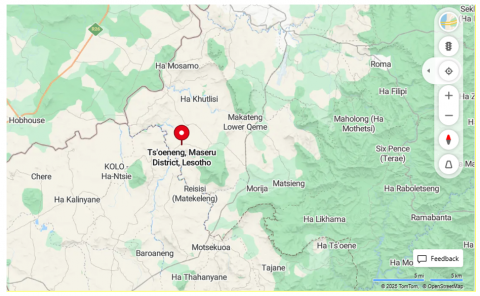
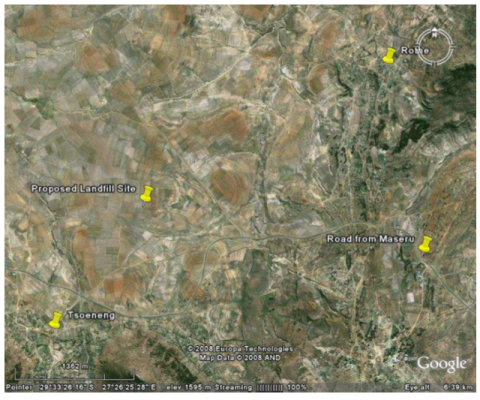
Ha Ts’osane dumpsite and the Ts’oeneng sanitary landfill are situated in Maseru, the capital city of Lesotho [16]. Figure 2 and Figure 3 provide insight on the location of the Ts’oeneng sanitary landfill. The responsibility for this dumpsite resides with the Maseru City Council [17]. The Maseru City Council (MCC)is tasked with ensuring proper sanitation and public health within the city of Maseru. The MCC is responsible for the management of solid waste originating from both residential and commercial sectors. The methodologies for waste collection from these sectors diverge.
Figure 2. Map of Lesotho showing the Ts’oeneng sanitary landfill [2]
Figure 3. Ts'oeneng landfill site [2]
Household waste collection is conducted by the MCC in conjunction with Community-Based Organisations (CBOs), which are not universally present across all communities, as some areas rely on informal waste pickers [17]. Waste management currently lacks a treatment phase, with only collection from roadsides and households followed by deposition at the Ha Ts’osane dumpsite. The CBOs collect waste utilising a van, while the MCC employs a fleet of three vehicles: a trailer designated for solid waste collection, a 60-litre or 1-ton half truck, a tractor, and a Rear Loader Compactor truck with a capacity of 330 litres or 4 tons [17].
2.2 Determination of waste generation
Population size serves as a critical determinant for quantifying the volume of waste that may be generated. It is feasible to derive estimates of population size by utilising the prevailing demographic data from Lesotho. The population forecasts for Lesotho as delineated in the 2016 Census were instrumental in estimating the volume of waste anticipated to be produced from 2025 to 2045. Given that the typical operational lifespan of a LFGTE project is approximately 20 years, this investigation is concentrated on the period spanning from 2025 to 2045. The World Bank has projected this figure to approximate 0.8 kg/capita/day in 2025, which was the metric employed in the calculations about waste generation. The total annual waste generation potential, denoted as Wg, can be ascertained utilising Eq. (1) [18].
$\mathrm{W}_{\mathrm{g}}=\mathrm{P} \times \mathrm{w}_{\mathrm{pc}} \times 365$ days $(\mathrm{t} / \mathrm{yr})$ (1)
However, in nations characterised by developmental challenges, the entirety of waste generated does not reach the designated areas. Generally, the efficiency of waste collection in the majority of African nations is conventionally regarded as 75%. Consequently, the aggregate quantity of municipal solid waste that is successfully transported to the dumpsite can be quantified as Eq. (2). In the estimation of waste generation for the city of Maseru, it was posited that 75% of the waste produced is collected and conveyed to the landfill site. Thus, Eq. (2) would be employed to approximate the total volume of waste deposited in the Ts’oeneng landfill during the period from 2025 to 2045 [18].
$\mathrm{W}_{\mathrm{D}}=0.75 \times \mathrm{W}_{\mathrm{g}}(\mathrm{t} / \mathrm{yr})$ (2)
2.3 LandGEM analysis
This research utilises the LandGEM model for the quantification of methane emissions, as it offers extensive insight into the prospective biogas generation. A particular investigation applied the LandGEM framework to assess methane output from the Oum Azza landfill site. It forecasted that the peak methane production would attain a volume of 64.3 million cubic meters by the year 2028 [19]. The LandGEM (version 3.02) emission methodology can be described mathematically using the Eq. (3) [18].
$\mathrm{Q}_{\mathrm{CH}_4}=\sum_{\mathrm{i}=1}^{\mathrm{n}} \sum_{\mathrm{j}-0.1}^1 \mathrm{KL}_0\left(\frac{\mathrm{M}_{\mathrm{i}}}{1}\right)\left(\mathrm{e}^{\mathrm{Kt}_{\mathrm{tf}}}\right)$ (3)
According to the equation, the required inputs for the amount estimation of generated methane are the design capacity of the landfill site, the annual acceptance rate, the methane generation constant K, the methane generation potential L0 and the years of waste acceptance. Default values from the landfills inventory of the Clean Air Act were used in this study. The electrical energy that could be obtained from the methane content of collected landfill gas is estimated using Eq. (4) [20].
$\mathrm{E}_{\text {LFTGE }}=\frac{\text { LHVmethane } \times 0.9 \times \mathrm{Q}_{\mathrm{CH}_4} \times \lambda \times \mathrm{\eta}}{3.6}$ (4)
The potential for waste generation at the Ts’oeneng landfill was assessed utilising population projections derived from the Bureau of Statistics [13]. The estimation of methane emissions was conducted based on the potential waste generated by the city of Maseru and subsequently disposed of at the Ts’oeneng sanitary landfill for the temporal span of 2025-2045, as delineated in Table 1. The estimation of waste generation, derived from population projections, was executed employing Eq. (1) and Eq. (2). The total mass of methane produced from the dumpsite was determined following the LandGEM methodology, which incorporates Eq. (3). It is evident that the decomposition of organic waste within the dumpsites results in the production of methane, which is subsequently emitted into the atmosphere, thereby contributing to climate change; however, this methane possesses the potential for utilisation in energy generation [21].
The findings indicated that the volume of municipal solid waste escalates concomitantly with population growth as indicated in Table 1. The research forecasts that by the year 2026, methane emissions derived from MSW will amount to 1,119,275 m³, continuing to increase until 2045, reaching a peak of 17,257,175 m³, after which a gradual decline is anticipated. The estimations were conducted utilising the LandGEM model (version 3.02). The year 2045 is projected as the closure year for the landfill; therefore, even in the absence of incoming waste, methane production persists.
Table 1. Population projections waste increase per year
|
Year |
Population Projection |
Municipal Solid Waste (tons/year) |
|
2025 |
605,183 |
176,713 |
|
2026 |
614,701 |
179,492 |
|
2027 |
624,413 |
182,328 |
|
2028 |
634,287 |
185,211 |
|
2029 |
644,304 |
188,136 |
|
2030 |
654,441 |
191,096 |
|
2031 |
664,668 |
194,083 |
|
2032 |
674,995 |
197,098 |
|
2033 |
685,391 |
200,134 |
|
2034 |
695,833 |
203,183 |
|
2035 |
706,302 |
206,240 |
|
2036 |
716,773 |
209,297 |
|
2037 |
727,399 |
212,400 |
|
2038 |
738,183 |
215,549 |
|
2039 |
749,126 |
218,744 |
|
2040 |
760,232 |
221,987 |
|
2041 |
771,503 |
225,278 |
|
2042 |
782,940 |
228,618 |
|
2043 |
794,547 |
232,007 |
|
2044 |
806,327 |
235,447 |
|
2045 |
818,281 |
238,938 |
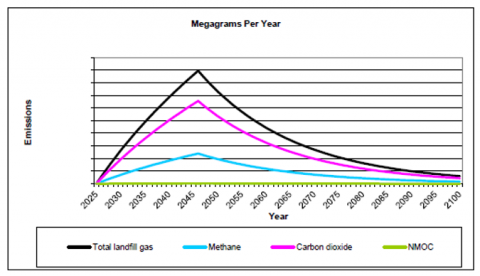
The outcomes derived from the LandGEM model as indicated in Figure 4 illustrate a progressive escalation in methane production, commencing from a comparatively modest quantity during the preliminary years. As the organic refuse within the landfill perpetuates its anaerobic decomposition, there is a marked increase in methane emissions, culminating in a zenith between the years 2043 and 2045. This apex coincides with the juncture at which the predominant portion of the organic constituents within the landfill has completed its decomposition, and methane production reaches its maximum capacity. Additionally, the graph delineates a reduction in methane emissions subsequent to this apex, as the supply of degradable organic matter wanes and the landfill nears its post-decomposition phase.
Figure 4. Estimate methane emission from Ts’oeneng landfill site in megagrams/year
LandGEM employs Eq. (3), and thus the parameters for the methane generation constant (K) and the methane generation potential (L0) utilised in this analysis were the default values, given that this is a simulation and the T’soeneng sanitary landfill has yet to commence receiving waste from Maseru. Following the guidelines established by the United States Environmental Protection Agency, the default values assigned to K and L0 are 0.5 per year and 170 m³ per ton, respectively [22].
3.1 Estimation of electrical energy generation potential
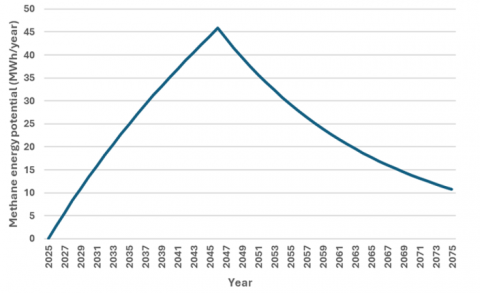
In this section, an evaluation of the methane energy potential derived from municipal solid waste (MSW) for the period spanning from 2025 to 2045 is presented. The quantification of methane production, as established through the LandGEM model, facilitated the assessment of the potential for electricity generation. The potential for methane energy (measured in MWh/year) derivable from the methane content is illustrated in Figure 5. The estimated electrical energy that can be harnessed from the methane content of the collected landfill gas is calculated and represented in Table 2. The estimation of the energy yield from the anticipated methane was conducted employing Eq. (4).
Figure 5. Methane energy potential
Table 2. Methane production and electrical energy potential
|
Year |
Methane |
Electrical Energy Potential (MWh/year) |
|
|
(Mg/year) |
(m3/year) |
||
|
2025 |
0 |
0 |
0 |
|
2026 |
746.7 |
1119275 |
2.9 |
|
2027 |
1468.8 |
2201565 |
5.6 |
|
2028 |
2167.6 |
3249034 |
8.3 |
|
2029 |
2844.5 |
4263678 |
10.9 |
|
2030 |
3500.8 |
5247365 |
13.4 |
|
2031 |
4137.5 |
6201824 |
15.9 |
|
2032 |
4755.9 |
7128649 |
18.2 |
|
2033 |
5356.8 |
8029371 |
20.5 |
|
2034 |
5941.2 |
8905392 |
22.8 |
|
2035 |
6510.1 |
9758001 |
24.9 |
|
2036 |
7064.0 |
10588390 |
27.1 |
|
2037 |
7603.9 |
11397646 |
29.1 |
|
2038 |
8130.6 |
12187088 |
31.2 |
|
2039 |
8644.9 |
12957972 |
33.1 |
|
2040 |
9147.6 |
13711500 |
35.1 |
|
2041 |
9639.5 |
14448818 |
36.9 |
|
2042 |
10121.3 |
15171022 |
38.8 |
|
2043 |
10593.7 |
15879156 |
40.6 |
|
2044 |
11057.5 |
16574222 |
42.4 |
|
2045 |
11513.1 |
17257175 |
44.1 |
The electrical energy anticipated to be accessible, commencing in 2026 at the Ts’oeneng landfill, is projected to yield 2.9 MWh, escalating to 44.1 MWh by 2045, followed by a gradual decline thereafter. The initial output of 2.9 MWh in 2026 would diminish the volume of electricity imported into Lesotho and simultaneously enhance the diversification of the nation’s energy portfolio. According to the findings of Mpholo et al. [5], the energy demand within Lesotho is projected to reach 211 MW by 2030 [5], with an estimated 6% of this energy requirement potentially being satisfied through landfill gas-to-energy (LFGE) technology.
The electricity generation dynamics observed at the Ts’oeneng landfill as observed in Figure 5 are consistent with the conventional lifecycle of landfill gas energy production which is characterised by the initial phase (lag phase), active decomposition (methanogenic phase), peak production (optimal gas generation phase) and lastly the decline phase (post-closure phase) [8]. Initially, in the year 2026, it is anticipated that the electricity output will be approximately 2.8 MWh, which corresponds to the low-output phase, during which the decomposition of waste is still in its nascent stages and methane production remains minimal. As the volume of waste increases and microbial activity intensifies, it is projected that electricity generation will experience a consistent upward trajectory, culminating in an output of 44.1 MWh by the year 2045, indicating the apex of generation which will then be followed by a decline.
The peak implies that the landfill has achieved optimal gas generation, facilitated by the augmented input of waste, enhanced LFG capture techniques, and effective power conversion processes. After 2045, a gradual decline phase is anticipated as organic waste becomes depleted and methane output diminishes, which will result in a reduction in electricity generation. This pattern follows the typical trajectory of landfill energy production characterized by a slow increase, rapid expansion, peak, and subsequent decline, thereby underscoring the imperative for sustainable waste management practices and the potential integration of alternative energy sources.
The uncertainty could occur in multiple aspects of evaluation, making it valuable to examine the robustness of the obtained outcomes with sensitivity analysis evaluating key parameters on methane generation and energy output. Variations in the methane generation rate (k) showed that increasing k from 0.5 to 0.6 year-1 accelerated peak methane production but shortened the gas generation phase, whereas lowering the k to 0.4 year-1 delayed peak production while extending methane availability. Adjusting the methane potential (Lo) from 170m3/ton to 200m3/ton increased the total methane output boosting energy generation by approximately 15% over the landfill's lifetime. Additionally, a decrease in landfill gas collection efficiency (λ) from 75% to 60% reduced methane recovery by 20%, limiting the energy potential and increasing the emissions. These results highlight the significance of enhancing landfill management practices, gas capture infrastructure, and waste composition to maximize methane recovery and energy generation.
Waste management is crucial for Lesotho to mitigate environmental degradation, public health risks, and climate change impacts. Relocating the Ha Ts’osane dumpsite to the Ts’oeneng sanitary landfill could safeguard communities, reduce water contamination from leachate, and address air pollution. Additionally, methane from landfills presents an opportunity for renewable energy production, helping to alleviate energy poverty while reducing dependence on fossil fuels. This study estimates methane generation at Ts’oeneng to begin in 2026, with a peak energy potential of 44.1 MWh by 2045, highlighting the feasibility of landfill gas-to-energy (LFGTE) as a sustainable solution. Implementing LFGTE aligns with Lesotho’s policy goals and the United Nations’ SDGs, particularly SDG 7 (affordable and reliable energy) and SDG 11 (sustainable cities and communities). The LandGEM model, used to assess methane generation, offers reliable projections essential for planning, but technical challenges such as infrastructure development and expertise must be addressed. Policymakers should integrate LFGTE into national energy strategies to enhance waste management, improve energy security, and drive economic growth.
|
I |
1-year time increment |
|
K |
methane generation rate (/year) |
|
L0 |
potential methane generation capacity (m3/ton) |
|
Mi |
mass of waste accepted in the 1st year (ton) |
|
Methane LHV |
lower heating value of methane and is given as 37.2 MJ/m3 |
|
n |
(year of the calculation) – (initial year of waste acceptance) |
|
P |
expected population |
|
QCH4 |
annual methane generation in the year of the calculation (m3/year) |
|
tij |
age of the jth section of waste mass |
|
Wpc |
per capita waste generation (0.8 kg/cap/day in 2025) |
|
λ |
collection efficiency (75%) |
|
η |
electrical conversion efficiency for internal combustion engines given as 33% |
[1] Dixit, A., Singh, D. (2022). Significance of landfills on climate change: Challenges and opportunities. Water and Energy International, 65(9): 15-21.
[2] Bulane, I. (2009). The selection of transfer locations for Maseru Municipality. University of the Witwatersrand, Johannesburg (South Africa). ProQuest Dissertations & Theses, pp. 1-19.
[3] United Nations Framework Convention on Climate Change. (2021). The Kingdom of Lesotho’s first Biennial Report 2021. https://unfccc.int/sites/default/files/resource/NAI_BUR1.pdf.
[4] Motaung, M., Roberts, H., Makhoahle, P. (2024). Environmental and health implications of waste disposal sites in the Lesotho Lowlands. Innovation Journal of Social Sciences and Economic Review, 6(2): 56-69. https://doi.org/10.36923/Ijsser.v6i2.270
[5] Mpholo, M., Mothala, M., Mohasoa, L., Eager, D., Thamae, R., Molapo, T., Jardine, T. (2021). Lesotho electricity demand profile from 2010 to 2030. Journal of Energy in Southern Africa, 32(1): 41-57. https://doi.org/10.17159/2413-3051/2021/v32i1a7792
[6] Sekantsi, L.P., Thamae, R.I. (2016). Electricity consumption and economic growth in Lesotho. Energy Sources, Part B: Economics, Planning, and Policy, 11(10): 969-973. https://doi.org/10.1080/15567249.2013.876125
[7] GET. transform. (2024). Lesotho Country Window: Energy System Transformation Outlook (ESTO). https://www.get-transform.eu/wp-content/uploads/2024/08/GET.transform-Lesotho-ESTO-Aug-2024.pdf.
[8] Un, C. (2023). A Sustainable approach to the conversion of waste into energy: Landfill gas-to-fuel technology. Sustainability, 15(20): 14782. https://doi.org/10.3390/su152014782
[9] Fei, F., Wen, Z., De Clercq, D. (2019). Spatio-temporal estimation of landfill gas energy potential: A case study in China. Renewable and Sustainable Energy Reviews, 103: 217-226. https://doi.org/10.1016/j.rser.2018.12.036
[10] Budiarto, R., Gozan, M., Novitasari, D., Wahyuni, N.S., Naimah, D.Y.N. (2021). Sustainability challenges of the landfill gas power plants in Indonesia. IOP Conference Series: Earth and Environmental Science, 940: 012028. https://doi.org/10.1088/1755-1315/940/1/012028
[11] The Lesotho National Climate Change Policy 2017-2027. (2017). https://www.gov.ls/download/national-climate-change-policy/.
[12] Senekane, M.F., Makhene, A., Oelofse, S. (2022). A critical analysis of indigenous systems and practices of solid waste management in rural communities: The case of Maseru in Lesotho. International Journal of Environmental Research and Public Health, 19(18): 11654. https://doi.org/10.3390/ijerph191811654
[13] Bureau of Statistics. (2016). Kingdom of Lesotho 2016 Lesotho Population and Housing Census Volume VI: Population Projections. https://www.bos.gov.ls/New%20Folder/Copy%20of%20Demography/Lesotho_Population_Projections_Report_2016_2036.pdf.
[14] Government of Lesotho, UNEP, University of Cape Town, & Enviro Tech Environmental Consultants. (2007). Integrated Solid Waste Management Plan (ISWMP) for the City of Maseru. https://www.knowwaste.net/Documents/IS_3_3_ISWMP.pdf.
[15] Lesotho News Agency. (2024). Tsosane dumping to be relocated to Ts’oeneng. https://www.lena.gov.ls/tsosane-dumping-to-be-relocated-to-tsoeneng-lephema/.
[16] Nhlapo, L.A. (2017). Temperature variability and change at various altitudes across lesotho and adjoining areas: Implications for agriculture. University of the Witwatersrand, Johannesburg (South Africa).
[17] Moremi, M. (2022). Municipal solid-waste collection and disposal management using geospatial techniques in Maseru City, Lesotho. University of Cape Town. https://open.uct.ac.za/handle/11427/37646.
[18] Sechoala, T., Popoola, O., Ayodele, T. (2023). Economic and environmental assessment of electricity generation using biogas and heat energy from municipal solid waste: A case study of Lesotho. AIMS Energy, 11(2): 337-357. https://www.aimspress.com/aimspress-data/aimse/2023/2/PDF/energy-11-02-018.pdf.
[19] Bouyakhsass, R., Souabi, S., Bouaouda, S., Taleb, A., Kurniawan, T.A., Liang, X., Goh, H.H., Anouzla, A. (2023). Adding value to unused landfill gas for renewable energy on-site at Oum Azza landfill (Morocco): Environmental feasibility and cost-effectiveness. Trends in Food Science & Technology, 142: 104168. https://doi.org/10.1016/j.tifs.2023.104168
[20] Rodrigue, K.A., Essi, K., Cyril, K.M., Albert, T. (2018). Estimation of methane emission from Kossihouen sanitary landfill and its electricity generation potential (Côte d’Ivoire). Journal of Power and Energy Engineering, 6(7): 22-31. https://doi.org/10.4236/jpee.2018.67002
[21] Dimishkovska, B., Berisha, A., Lisichkov, K. (2019). Estimation of methane emissions from Mirash municipal solid waste sanitary landfill, differences between IPPC 2006 and LandGEM method. Journal of Ecological Engineering, 20(5): 35-41. http://doi.org/10.12911/22998993/105332
[22] USEPA. (2005). Landfill Gas Emissions Model (LandGEM) Version 3.02 User’s Guide. https://www3.epa.gov/ttncatc1/dir1/landgem-v302-guide.pdf.