Ala Alkhawaldeh* | Basel Al-Shaer | Eman Ibrahim Alwreikat | Ziad Mohammad Al Wahshat
© 2025 The authors. This article is published by IIETA and is licensed under the CC BY 4.0 license (http://creativecommons.org/licenses/by/4.0/).
OPEN ACCESS
The aim of this paper is to investigate, from 2002 to 2022, how good governance affects economic growth in Jordan. The study adopted a quantitative approach, and the effect of institutional variables, including voice and accountability (VA), political stability (PS), rule of law (RL), and regulatory quality (RQ) on economic performance was evaluated using the ordinary least squares (OLS) model. The results showed that government efficiency and the RL have favorable and major effects on Jordan's economic development, as developments in these areas improve economic stability and draw investments. On the other hand, the study revealed that throughout the investigated time PS and RQ had little effect on economic progress. The results of the statistical tests showed that the model is free from autocorrelation and normal distribution problems in the residuals, therefore improving the credibility of the conclusions. The paper argues that as fundamental components to promote sustainable economic development in Jordan, government efficiency and the RL should be improved.
good governance, economic growth, Jordan, political stability (PS), rule of law (RL), regulatory quality (RQ), voice and accountability (VA)
Effective governance is one key factor for success in all economies, including that of Jordan. Almost all sectors of the economy operate within a stable environment to attain the best results. Much of these goals can be achieved through adherence to specific rules and restrictions that regulate how the economic operations in the state should be conducted. Governance increases the investment climate, inspires confidence in political institutions, and makes effective use of financial resources into the system. Sustainable development and favorable economic results are possible only with good governance. It further enhances social equitability, reduces discrimination, and increases sensitivity and transparency. Much research that can be conducted on the linkage between economic development and governance can prove quite meaningful and constructive to the situation in which the political and economic Jordanian lands find themselves [1].
Government is integral to successful markets all over the world, and more specifically, within Jordan. Companies depend largely on achieving optimal results through business in an environment of certainty, and that objective may be achieved through adherence to well-laid rules and boundaries that govern the behavior of financial processes in a country. Governance proves to be an essential part of an economic engine as it helps build confidence in political systems, better the investment environment, maximize capital allocation productivity. Good governance is fundamental to viable financial results and sustainable development in addition to promoting social justice, reducing discrimination, and enhancing transparency and responsiveness towards the needs of a country. The research delivers value and importance due to the current political and economic context of Jordan concerning its exploration of the relationship between governance and economic development [2].
The economic problems Jordan has faced in the last few years was a high unemployment rate, high government debt, and no foreign investment. Inflation was high because of political instability in neighboring countries and Jordan has opened its borders to support as refugees. Despite all odds, the Government of Jordan is perceived to be capable of ensuring governance, transparency, and accountability efforts in many areas to strengthen the economy and establish long-term financial stability. The perpetual divide between economic aspirations and barriers underscores the requirement of more research toward how governance affects economic growth in Jordan [3].
Transparency and accountability are integral parts of governance and play an essential role in shaping the business and investment environment of a nation. Private shared companies depend on clear and transparent decisions from government organizations as they need a steady legal and regulatory framework in which to operate. Openness and accountability in governance create an enabling environment for the private sector to flourish, a condition precedent to increasing both local and foreign investment, employment opportunities, and overall economic development. Besides, corruption remains one of the major constraints to economic progress. The evidence suggests that countries with good governance are characterized by higher economic growth rates because better governance rules out the prospect of corruption and enhances the effectiveness of economic ventures [4].
Attracting investors and enhancing the business climate depend on political stability (PS). Jordan's higher degree of PS has lately helped it to be successful in attracting certain international investments, compared to some of the neighbors. Nonetheless, the government encounters obstacles to continuing development in this industry mostly related to administrative infrastructure in some regions. This is a crucial aspect to underline since PS alone does not promote economic development; it has to coexist with the application of good governance principles. Therefore, a study of the interaction between PS, governance, and economic growth is crucial in determining how governance may help Jordan to develop economically [5].
Using econometrically researched easily available quantitative economic data, the study therefore focuses on the effect of governance on economic development in Jordan from 2002 to 2022. It examines a collection of global governance metrics including openness, accountability, and the rule of law (RL); more especially, it looks at how these factors either determined or otherwise affected Jordan's GDP development over the past two decades. The study will also show changes in Jordan's governance metrics during this period and how such changes could have affected the national economic performance of that nation overall.
The period of 2002–2022 was chosen because of the availability of consistent quantitative data, which allowed a comprehensive econometric analysis of the impact of governance on Jordanian economic development. This age was appropriate for analyzing the impact of transparency, responsibility, and the RL on economic development as it saw significant changes in governance methods including these ones. Extreme political and economic issues include the 2008 global financial crisis, the 2011 Arab Spring, and the 2020 COVID-19 epidemic—which significantly impacted the Jordanian economy—defined this decade. This offers an opportunity to investigate in the framework of economic changes the impact of government. Many economic reform initiatives were carried out during this period, which resulted in a convoluted scene for assessing the relationship between government and economic progress in Jordan.
Since they provide consistent evaluations of government institutions' openness, accountability, and decision-making efficacy among other traits that influence the business environment, the World Bank indicators are a valuable tool for evaluating governance in every country. By use of these indicators, Jordan's economic development may be precisely evaluated under either direct investment or better government performance and public sector efficiency. Moreover, the study will examine the challenges that can arise during the application of good governance in Jordan, including political and financial ones, and how to overcome them so as to provide a more sustainable economic environment [6].
In order to foster sustainable economic growth in Jordan, this research will advise policymakers on how to improve the country's political and economic governance. As part of these suggestions, the government should undertake the following: establish economic policies that attract investment from both within and beyond the country; emphasize the significance of institutional development; and improve the quality of regulations, the RL, and transparency.
This research can help answer the fundamental questions related to governance on the one hand and economic growth on the other hand in Jordan. Does governance have a clear and tangible impact on economic development in Jordan? What are the main constraints that limit the effectiveness of governance in achieving long-term growth? Is it possible to improve the business environment in Jordan using the principles of good governance?
This research area will review the literature on how governance contributes to Jordan's economic development. We will be able to create hypotheses and the required equations for the pertinent variables with the aid of this investigation. The study will concentrate on the connections among "IV", "Voice and Accountability (VA)", "PS", "RL", and "RQ" and how they affect the dependent variable, economic growth.
2.1 Literature on the relationship between VA and economic growth
Costantiello and Leogrande [7] evaluated the importance through "VA" in a study that employed "World Bank" data on issues like The Environment and Governance (EG) issues. Between 2011 and 2021, the researchers examined data from 193 countries using various analytical approaches, such as fixed effects panel data, random effects panel data, and pooled ordinary least squares (OLS) methodologies. The study showed a strong correlation between VA and two variables: maximum 5-day rainfall and under-5 mortality rate. In contrast, "Adjusted Savings: Natural Resources Depletion" and "Annualized Average Growth Rate in Per Capita Real Survey Mean Consumption or Income" negatively correlated with VA. In addition, the k-means clustering approach was used. However, it proved ineffectual due to the variable's slight variance among nations [7].
Rahman's [8] study explores the links between accountability, transparency, and GDP growth across countries. It highlights the significance of the Current Account Balance (CAB), Net Capital Account (NCA), and Net Financial Account (NFA). The findings show that a positive CAB correlates with higher GDP growth, while a negative NFA is linked to negative GDP effects due to capital outflows. Although the CPIA Transparency Rating and VA are important for governance, they do not directly impact GDP growth.
Bird et al. [9] suggest in their paper that the traditional tax effort model requires expansion. They underline that, while supply considerations are crucial, demand variables like as accountability, community involvement, and corruption have a substantial impact on tax efforts. The fundamental value of this study is to show that these demand factors should be addressed while evaluating tax effort.
Maun [10] uses an econometric model to explore the connection between strong Corporate governance and its impact on economic growth in Zimbabwe, a developing country. The study uses ols to examine this relationship. The study indicates that “VA” has little impact on economic progress in Zimbabwe. Nadeem et al. [11] analyzed their findings, showing that terrorism and inadequate voice accountability harm innovation in the short and long run. These issues also hurt the Pakistani economy.
Orayo and Mose [12] reported that the purpose of this study was to look at the relationship between good governance and economic growth in the countries that comprise the East Africa Community (EAC). Both the Random Effect Model (REM) and the OLS estimate technique were applied. The study found that three key governance characteristics were PS, high-quality regulation, and corruption control. The first two measures showed a negative link with the economic growth rate, whereas the latter showed a positive correlation. Although the importance of the RL was only demonstrated in Kenya, Tanzania was also significantly impacted by the caliber of regulation.
H1: Voice and responsibility have a detrimental impact on economic progress.
2.2 Literature about PS on economic growth
Issa's [13] research looks at the variables that have helped to keep the Jordanian political system stable over the last century, despite regional obstacles. It claims that this stability stems from the regime's legitimacy, which is based on a consensual agreement between the leadership and the populace. Loyalty, national identity, the RL, and constitutional respect are all essential components. The study indicates that the regime's legitimacy, links to the Hashemite family, national unity, and the leadership-people relationship have all played important roles in Jordan's PS and progress.
In their analysis of two competing hypotheses in the Developing Eight Muslim States, Shabbir et al. [14] elucidated the role of PS. The importance of the conditional relationship between corruption and PS is also examined. Economic growth is strongly correlated with population, investment, and PS, according to empirical research. Because it encourages investment, enhances the economy, and reduces political instability and social unrest, PS is a growth promoter.
Qamruzzaman et al. [15] looked on the connection between African countries' economic development and PS. We investigate the relationship between PS and investment in determining economic growth by using data from 48 nations between 2000 and 2020. According to our research, economic growth depends on PS, and investment is essential for fostering growth in politically stable settings.
The study by Alrawabdeh [16] highlights how important investing is as a major economic activity in many nations. The researchers used primary data and quantitative techniques to assess a sample of 116 investment businesses using stratified random sampling. According to the survey, the primary driving force for investment was the desire to raise income; its impact on raising living standards was viewed as less important. Furthermore, the researchers determined that the most significant obstacle to investment was administrative complexity, whereas the least significant component was the monopolization of investment prospects.
Alkhawaldeh et al. [17] use Turkey as a case study to investigate the influence of governance in economic growth between 2002 and 2022. A multivariate linear regression model is used in the investigation. The findings show a statistically significant correlation between PS, government efficacy, and VA in connection to Turkey's economic development. Nevertheless, there is no statistically significant correlation between economic progress and corruption control. Two key elements that affect state success are VA. However, other problems like terrorism, taxes, government expenditure, and infrastructure might also have a detrimental effect on these parameters.
Chletsos and Sintos [18] studied how important PS is to a nation. According to their examination of 123 nations between 1980 and 2017, financial progress is greatly aided by greater PS. This relationship is most pronounced in nations with democratic political systems, efficient governance, and financial liberalization initiatives. According to the findings, putting PS first not only improves development prospects but also creates a secure atmosphere in which economic actors may participate in financial markets.
Teslenko [19] investigates whether authoritarian or democratic regimes promote economic growth and examines the relationship between PS and economic development in Singapore. To assess this relationship, it uses descriptive, methodical, and comparative techniques. Singapore is seen as an exception to the rule that authoritarian governments are often effective. The study comes to the conclusion that PS is not the only element that leads to sustainable growth. Cultural, historical, geographical, and human factors are important components. In the end, Singapore's PS and consistent long-term policies, together with efficient planning, are the main drivers of its economic success.
Corovei and Socol [20] discovered a favourable relationship between PS and economic growth. However, Phul et al.’s [21] research found that, in the near run, PS had little effect on GDP. In the short term, however, Gross Fixed Capital Formation (GFCF), Trade and Labour Force (TLF), and Inflation (INF) all contributed considerably to Pakistan's GDP.
As Cotte Poveda and Martinez Carvajal [22] have noted, sociopolitical instability is a substantial impediment to a country's economic and social development. Political violence is a prominent feature of this instability, which stifles progress by posing economic problems, reducing private and public investment, and causing damage to the national infrastructure. According to the PS model, characteristics such as total production per capita, health coverage, arrest rates, and educational levels all have a negative influence on political violence. Unemployment rates, the Gini coefficient, illicit drug usage, and population relocation all have a favourable impact on violent crime.
Sweidan [23] addresses the connection between economic expansion and political unrest in Jordan, a lower-middle-income nation in the center of the Middle East. This area has a history of long-lasting wars, conflicts, bloodshed, and terrorist acts. By influencing government expenditure, we may anticipate that these occurrences will have an influence on economic growth. The study analyzes data from 1967 to 2009 and using two econometric techniques: the Kalman filter (ML) and the ARDL (OLS) model. We discover that both actual government spending and economic growth are negatively impacted by political instability in a statistically meaningful way.
H2: PS significantly impacts on economic growth.
2.3 Literature about RL on economic growth
No nation is complete without the RL, which has been described as an essential component of democracies, prosperous societies, and equitable distribution of wealth [24]. This research study explores the several relationships that exist or may be claimed to exist between economic growth and the RL. The study employs a mixed-method approach, combining qualitative and quantitative methods, to ascertain the connection between the regulatory framework, the appropriate institutions for enforcing it, and the economic environment. Interviews with lawyers, economists, and politicians made up the qualitative part of the study, which helped to uncover some of the obstacles to efficient law enforcement and its effects on boosting economic activity. Using secondary data from the World Bank index and transparency international through correlation matrices, this quantitative study used a correlation research design to determine the relationship between RL and other important economic parameters such as GDP growth, FDI inflow, and the GCI.
The expansion of national economies has long been considered an essential goal of global macroeconomic policy [25]. A sustainable and functioning RL is another non-economic goal for society's well-being, although it could have some connection to the economy. Hence, this paper's stated goal is to investigate 107 nations with varying degrees of economic development and various quality of RL to determine the nature of the link between the two. The study found a statistically significant association between the level of RL and economic development in these nations. It used a quantitative scientific technique, namely econometric analysis.
Cunha [26] was notified that a nation's economic growth is impacted by the presence of well-functioning markets. Also, for markets to work well, there must be an efficient justice system. So, it stands to reason that a country's level of legal compliance is positively correlated with its per capita income. Here, data from 110 nations in 2016 provide credence to this theory. The findings also reveal that Brazil's RL isn't very strong, which means that reforms aimed at strengthening the country's courts might lead to economic development.
Aside from that, Alghazzawi's [4] study on Botswana identified effective government expenditure as a significant factor in economic growth. All of these studies demonstrate that there is a link between economic development and government competency.
H3: RL has a positive impact on growth in the economy.
2.4 Literature about RQ on economic growth
Several studies show that in many cases encouraging economic development depends on RQ. Complicating investment, technological advancement, and sustainable development, the relationship between RQ and economic growth is multifarious.
These are basic components that highlight this link. Particularly in Nigeria, where developments in governance are linked with enhanced economic performance, RQ and investment development show a clear positive linkage [27].
Particularly in Albania and North Macedonia, where Greenfield Investments (GFIs) are impacted by regulatory improvements [28].
RQ in the Western Balkans has been shown to boost development. Environmental standards have been found to promote high-quality economic development in China, implying that regulatory frameworks may enable sustainable development while addressing environmental problems. Attaining sustainable economic growth in sub-Saharan Africa depends on RQ and technological innovation, which clearly show their interconnectedness [29].
H4: RQ has a positive impact on economic development.
According to prior studies, economic growth and the four governance components may have a favorable or unfavorable correlation. This study is distinct since it focuses on the precise relationship between economic development and the four governance metrics. The study uses a quantitative approach, using OLS EViews.
This paper investigates the effect of good governance on economic development in Jordan between the years 2002 and 2022 using the quantitative analytical technique. Since it lets one analyze quantitative data and estimate the direct and indirect effects of governance variables on economic development, this method is regarded as the most suitable for investigating the causal links between several variables. Since the Ordinary Linear Regression (OLS) model may offer objective and efficient estimates when the fundamental hypotheses are satisfied, it was applied to evaluate the connection between the independent variables and the dependent variable in order to attain this.
To guarantee accuracy and objectivity in the study, trustworthy secondary sources' data were gathered from. Measuring the four elements of governance PS, VA, RL, and RQ the study drew on the World Bank's Worldwide Governance Indicators (WGI). Based on precise statistical approaches combining data from several sources, these indicators offer yearly assessments of governance levels in many nations. Measuring by the Real GDP Growth rate as a goal and all-encompassing indicator of economic success, economic growth statistics were taken from World Bank and International Monetary Fund publications.
Four basic aspects of governance constitute the independent variables for this study. The capacity of the political system to prevent disputes and violence, therefore influencing the investment and economic climate, is known as PS. Transparency is improved and economic development is promoted by voice and responsibility reflecting the degree to which the political system welcomes citizen involvement, freedom of expression, and media institution independence. The degree to which rules are observed and their efficient implementation to all players defines the RL and guarantees a stable economic environment by thereby boosting investor confidence. At last, the RQ Index gauges the government's capacity to create and carry out regulatory policies favoring the free market and thus lower bureaucratic barriers influencing economic production. These four aspects capture the core of effective government and provide the analytical foundation to investigate how it affects economic performance.
Measuring the yearly real GDP growth rate, economic development is the dependent variable in this study. Widely employed in economic research to evaluate national overall performance, this statistic measures the degree of economic activity. The study aims to expose the degree to which effective governance influences or impedes economic growth in Jordan by means of an analysis of the link between the four governance characteristics and economic growth.
Statistical analyses were carried out using Eviews program in order to guarantee the correctness of the study and the dependability of the findings. The fundamental statistical tests consisted of the R² and Adjusted R² tests to evaluate the general explanatory power of the model and the F-test to evaluate the significance of the model as a whole. To confirm the independence of mistakes and prevent estimate bias, the Durbin-Watson test was also carried out to find the existence of autocorrelation in the residuals. Furthermore used to check for heteroscedasticity which lets one investigate the stability of the variance in mistakes over the sample was the Breusch-Pagan test. A fundamental assumption for guaranteeing the validity of the OLS model's results is that the residuals follow a normal distribution; hence, the LM test was also performed to identify first-order autocorrelation and the Jarque-Bera test to guarantee this. The research spans 2002 to 2022, which gives enough time to examine changes in governance characteristics and how they affect economic development over time. By means of this approach, the quantitative study is expected to help to clarify the nature of the link between good governance and economic development in Jordan and guide legislators to make evidence-based decisions supporting institutional and economic reforms.
The selection of the OLS model and the quantitative method improves the objectivity of the research and helps the generalizable result extraction. This study offers a detailed examination of the influence of governance on economic growth by using official and trustworthy data and statistically evaluating them according on acknowledged standard techniques, therefore opening the path for additional future research in this important topic.
The model we'll be using, represented by in this instance, αi is a normal random variable with zero mean. The random-effects model works better for unbalanced time series, whereas the fixed-effects approach works better for balanced time series. To choose between the fixed-effects and random-effects models, the following assumptions are examined as part of a Hausman test [30]:
In conclusion, we develop the following model by enhancing the basic time series model to incorporate all the variables in our analysis:
$\begin{gathered}\text { DGDPit }=\alpha+\beta 1 \text { VAit }+\beta 2 \text { PSit }+\beta 3 \text { RLit } \\ +\beta 4 \text { RQit }+\varepsilon i t\end{gathered}$
This equation consists of economic growth plus PS, VA, RL and RQ.
Data and test of unit root are commonly employed in statistical analysis to ascertain if the data exhibit a stationary process. Co-integration analysis can be used to determine the connections among two or more time series data sets [31].
Table 1 below contains a list of the sources used to collect the study's data. The table shows the independent and dependent variables of the study along with the data sources from which they were collected. The dependent variable's GDP (economic growth) data came from World Bank statistics. VA, PS, RL, and RQ were the independent variables for which data were collected using the World Bank's section on global governance indicators.
Table 1. World Bank's Worldwide Governance Indicators
|
Variable |
Definition |
Data Source |
Independent/Dependent Variable |
|
GDP |
Real GDP |
World Bank |
Dependent |
|
VA |
Voice and accountability |
WGI |
Independent |
|
PS |
Political stability |
WGI |
Independent |
|
RL |
Rule in law |
WGI |
Independent |
|
RQ |
Regulatory quality |
WGI |
Independent |
Source: by author
5.1 Jarque-Bera test
By evaluating its skewness and whether the data follow a normal distribution or not as well as whether the null hypothesis is accepted or not, the Jarque-Bera test is a statistical instrument used to examine the normalality of a data set Originally developed in 1987, it is now a main tool for economic analysis [32].
The results of Jarque-Bera in Table 2 show that every variable has p-values higher than the standard threshold of 0.05, therefore indicating that the data for these variables do not statistically differ from a normal distribution. The results confirm the application of parametric statistical techniques, which assume normal distribution, such as variance testing or regression analysis, to increase the confidence in obtained conclusions from the data.
Table 2. Jarque-Bera test
|
Variable |
Probability |
|
GDP |
0.58 |
|
VA |
0.06 |
|
RL |
0.49 |
|
PS |
0.64 |
|
RQ |
0.85 |
Source: by researcher, EViews, unit root test
5.2 Unit root test
Crucially used statistical tools to determine whether a time series is non-stationary and has a unit root are unit root tests. Recent developments in this area have resulted in numerous methods that increase the accuracy and effectiveness of these tests. The next parts show notable developments in unit root testing.
Especially in the domains of econometrics and finance, the Augmented Dickey-Fuller (ADF) test is a widely used statistical method for assessing the stationarity of time series data. It addresses autocorrelation by include lagged components of the dependent variable, hence improving the simple Dickey-Fuller test. Recent studies on many applications and enhancements of the ADF test show its relevance in many contexts [1, 2, 5-8, 10-15, 18-23, 25-27, 29-60].
Commonly used unit root test for evaluating stationarity of time series data is the Phillips-Perron (PP) test. Its semi-parametric approach, which helps it to solve particular kinds of serial correlation and heteroskedasticity in the error terms, is notably well-known. Several elements can influence the effectiveness of the PP test, including cointegration among variables and the presence of persistent cycles. The next parts discuss these aspects [6, 8, 10-12, 14, 15, 21, 23, 27, 29-31, 46-49, 51-55, 61].
Table 3. "ADF" and "PP", unit root test results Jordan
|
Variable |
ADF |
|
|
Level |
1st Difference |
|
|
Prop |
Prop |
|
|
GDP |
0.45 |
0.00 |
|
VA |
0.31 |
0.008 |
|
PS |
0.51 |
0.00 |
|
RL |
0.07 |
0.002 |
|
RQ |
0.04 |
0000 |
|
Variable |
PP |
|
|
Level |
1st Difference |
|
|
Prop |
Prop |
|
|
GDP |
0.50 |
0.002 |
|
VA |
0.09 |
0.001 |
|
PS |
0.04 |
0000 |
|
RL |
0.07 |
0.001 |
|
RQ |
0.02 |
0000 |
Source: by researcher, EViews 12
Table 3's reported unit root test results show the stationarity evaluation of the time series variables.
Whereas the values in the second column show the stability of the variables after the first difference (1st difference), the probability values (Prop) in the first column of every test indicate the significance level at the original level (Level). The findings show that all variables have probability values exceeding 0.05 at the original level; consequently, the unit root hypothesis cannot be discounted; hence, the time series are non-stationary at this level. The initial difference causes the probability values to drop to below 0.05 for all variables, therefore indicating their stability upon application.
The results show the first-order integration property (1) for every variable, meaning that although the variables are non-stationary at their starting values, they reach stability by means of the first difference. Therefore, long-term regression models and other economic models depending on these factors have to include cointegration testing to prevent the problem of false correlation in the research.
5.3 Cointegration analysis
Through cointegration analysis, time series study reveals long-term linkages in non-stationary data. This approach is adopted in the financial, industrial, and economic spheres [35]. Often used method for evaluating cointegration in multivariate time series, Johansen Test helps estimate several cointegration connections [50].
Table 4 shows that the effect statistic for three hypotheses none, at most 1, at most 3, at most 4 exceeds the critical values, therefore rejecting the null hypothesis in favor of cointegration among the variables at these levels. Under the null hypothesis (Non), for example, the effect statistic is 94.0, exceeding the critical threshold of 69.8 and hence indicating the presence of at least one cointegration connection.
The hypotheses "At most 1," "At most 3," and "At most 4" are disproved; this suggests the presence of at least four cointegration vectors; the hypothesis "At most 2" is not refuted, implying that four is the optimal number of cointegration equations.
These findings support the idea of an equilibrium relationship among the variables, therefore enabling the use of models such as the OLS model to examine their dynamic interaction.
Table 4. Johansson cointegration test
|
Trace Statistic |
Critical Value Sig Level=0.05 |
Hypothesized No. of CE(s) |
|
94.0 |
69.8 |
Non* |
|
50.4 |
47.8 |
At most 1* |
|
26.6 |
29.7 |
At most 2 |
|
15.7 |
15.4 |
At most 3* |
|
5.26 |
3.84 |
At most 4* |
|
"Denotes rejection of the hypothesis at the 0.05 level" |
||
After using the "OLS" method to estimate the parameters of the standard model in "EViews12", the results were obtained in Table 5:
Table 5. OLS results
|
Variable |
Coefficient |
S.E |
T-Statistics |
P-Value |
|
Constant |
-60.6 |
14.7 |
-4.10 |
0.0008 |
|
VA |
1.31 |
0.42 |
3.07 |
0.007 |
|
PS |
-0.25 |
0.13 |
-1.9 |
0.06 |
|
RL |
0.66 |
0.24 |
2.71 |
0.01 |
|
RQ |
-0.03 |
0.18 |
-0.16 |
0.8 |
|
"R-Squared=0.60, Adj R-Squared=0.50, Prop=0.003, At the Level of 5%" |
||||
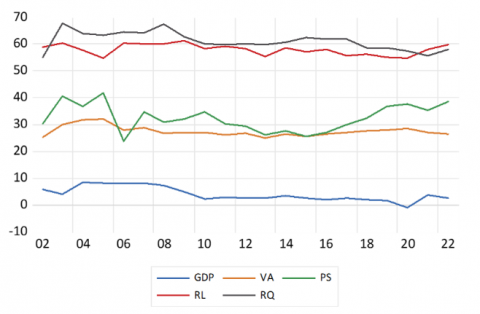
From 2002 to 2022, the graph shows how GDP and numerous governance metrics correlate in Jordan. The several lines refer to measures of government including VA, PS, RL, and RQ. Among the indicators, the RQ indicator has always been the greatest and has been very constant; the PS indicator has shown rather erratic fluctuations. On the other hand, the GDP appears to have followed a quite steady course with little variations throughout the years. These trends indicate the link between government and economic growth as changes in governance indices are found to affect economic performance.
Table 5 shows the results of the OLS model, so enabling the analysis of the relationship between the dependent variable and the independent variables using the least squares approach, whereby the estimated values show the effect of every independent variable on the dependent variable.
Whereas the adjusted coefficient (adjusted R-squared = 0.50) shows the model's robustness after considering the number of independent variables, the coefficient of determination (R-squared = 0.60) indicates that 60% of the variance in the dependent variable is accounted for by the independent variables in the model. With a 5% significance threshold, the model's total probability p = 0.003 showcases statistical relevance.
With a result of 2.14, the Durbin-Watson test indicated that the residuals lacked autocorrelation—that is, close to 2, suggesting so. As such, the theory claiming the independence of errors over time is maintained, thereby strengthening the dependability of the model.
Examining Independent Variables
Improvements in VA correlate with a notable increase in the dependent variable; the correlation for VA is positive (1.31) and statistically significant at the 1% level (p = 0.007). This outcome is consistent with previous study [7] and refutes the theory that voice and responsibility are harmful for economic development.
At the 5% level (p = 0.06), PS has a modest negative impact (-0.25) and is statistically insignificant, suggesting that this variable may lack a strong or durable influence over time. This outcome is consistent with earlier research [20] and runs against the hypothesis that PS favorably influences economic development.
With a significant coefficient of 0.66 at the 5% level (p = 0.01), the RL has a positive impact on the dependent variable, therefore stressing the need of improving the RL to gain good economic or social effects. This outcome is consistent with previous studies [4, 24, 25] and with the hypothesis that the RL favorably influences economic growth.
With a minimal coefficient (-0.03) and a statistical insignificance (p = 0.8), RQ shows that this variable has no obvious effect on the dependent variable. This outcome runs against the hypothesis that RQ promotes economic development.
The results show that although PS and RQ had a minor statistical influence, VA and RL are the two elements most clearly influencing the dependent variable. By showing the lack of autocorrelation, the Durbin- Watson test value (2.14) supports the dependability of the data and thus strengthens the validity of the conclusions obtained from the model. Therefore, depending on the circumstances under analysis, increasing governmental efficiency and extending the RL are argued as essential components to support economic development or social stability.
Table 6 shows that the model is free from autocorrelation problems, the residuals follow a normal distribution, and heteroscedasticity is lacking. This indicates that the model shows statistical fit concerning independence and suitable residual distribution, thereby increasing the reliability of the analytical results.
Table 6. Model quality results
|
|
LM |
Normality Test |
Breusch-Pagan |
|
Prop |
0.3 |
0.7 |
0.9 |
This paper aims to investigate the institutional elements supporting or hindering economic development in Jordan from 2002 to 2022 as well as the impact of good governance on this development. The results of the OLS regression model show that in Jordan government efficiency and the RL have somewhat positive effects on economic development. According to the studies, improving government efficiency and increasing openness and responsibility in public institutions can help to create the business climate and draw investments, so promoting economic development. The study shows that PS and RQ have no appreciable effect on economic growth in Jordan during this period, implying that these fields need additional adjustments to start their positive effects on the national economy.
Based on the results of the study, a set of suggestions might be made to increase the importance of good government in realizing sustainable economic development in Jordan:
The government has to step up its efforts to increase openness and responsibility inside its institutions. Reform programs meant to strengthen the institutional framework and increase the government's capacity to provide high-quality services would help to build faith of investors and people in the governmental system by thus strengthening the institutional framework and enhancing the capacity of the government to provide such services.
Strengthening the RL: The autonomy of the court must be strengthened, and laws must be enforced fairly and efficiently, so fostering a stable legal environment that supports both domestic and foreign investments while ensuring that people and institutions receive their rights inside a reliable legal framework.
Reforms in PS: Although the research did not show a significant significant impact, PS is still very important for promoting economic development. Consequently, the Jordanian government has to increase national political dialogue and implement measures promoting political and social stability, thereby improving the political environment of the country and hence impacting the economic situation.
Improving RQ requires reforms that streamline administrative processes and reduce bureaucracy thereby optimizing the business environment. To draw both local and international investments, the regulatory structure has to be improved to conform with global standards.
Further studies using advanced analytical frameworks, including dynamic models, are proposed to evaluate the impact of efficient governance on continuous economic growth and to analyze the interaction between these factors under many conditions.
To achieve thorough and lasting economic development, improving good governance in Jordan is ultimately very vital. Adopting the suggested changes will improve the business environment, increase confidence in institutions, and help to enable future economic development.
[1] Harb, A., Alhammad, F.A., Almajali, T.A., Freewan, A., Shkokani, H.M., Slehat, M. (2025). Promoting tourism sustainability in Jordan: Policy effectiveness and stakeholders perspectives. Contemporary Review of the Middle East, 23477989251319625. https://doi.org/10.1177/23477989251319625
[2] Guo, L., Tang, M., Wu, Y., Bao, S., Wu, Q. (2025). Government-led regional integration and economic growth: Evidence from a quasi-natural experiment of urban agglomeration development planning policies in China. Cities, 156: 105482. https://doi.org/10.1016/j.cities.2024.105482
[3] Ananzeh, H. (2025). The Influence of top-management remuneration on cash-based charitable contributions of nonfinancial companies in Jordan. In Technological Horizons. Emerald Publishing Limited, pp. 139-156. https://doi.org/10.1108/978-1-83662-364-920251006
[4] Alghazzawi, R. (2025). The mediating role of regulations in the effectiveness of XBRL in emerging markets: The case of Jordan. Discover Sustainability, 6(1): 6. https://doi.org/10.1007/s43621-025-00800-1
[5] Faras, R., AlShammari, N. (2021). Does Political Regime Matter in Assessing the Impact of Political Stability on Economic Performance across MENA Region? Journal of Arts & Social Sciences (JASS), 12(3): 5-19. http://doi.org/10.53542/jass.v12i3.5068
[6] Munajat, M.E., Irawati, I. (2025). Digital sociocracy: Navigating governance challenges in Southeast Asia. Policy & Governance Review, 9(1): 93-105. https://doi.org/10.30589/pgr.v9i1.1220
[7] Costantiello, A., Leogrande, A. (2023). The Impact of Voice and Accountability in the ESG Framework in a Global Perspective. https://doi.org/10.2139/ssrn.4398483
[8] Rahman, A.A. (2024). Impact of account, transparency, and accountability indicators on economic growth: Evidence from South Asian countries. Journal of Ekonomi, 6(2): 96-105. https://doi.org/10.58251/ekonomi.1514374
[9] Bird, R.M., Martinez-Vazquez, J., Torgler, B. (2007). Tax effort: The impact of corruption, voice and accountability (No. 2007-13). CREMA Working Paper. https://hdl.handle.net/10419/214387
[10] Maune, A. (2017). The strength of sound corporate governance on economic growth in an emerging market context. International Journal of Economics and Financial Issues, 7(5): 6-13.
[11] Nadeem, M.A., Jiao, Z., Nawaz, K., Younis, A. (2020). Impacts of voice and accountability upon innovation in Pakistan: Evidence from ARDL and Maki Cointegration approaches. Mathematical Problems in Engineering, 2020(1): 6540837. https://doi.org/10.1155/2020/6540837
[12] Orayo, J.A., Mose, G.N. (2016). A comparative study on contribution of governance on economic growth countries in the East African community. https://ideas.repec.org/a/mth/ijrd88/v3y2016i2p89.html.
[13] Issa, M.S.B. (2023). Factors of stability and sustainable development in Jordan in its first centenary 1921–2021 (An analytical descriptive study). Heliyon, 9(11). https://doi.org/10.2139/ssrn.3936321
[14] Shabbir, G., Anwar, M., Adil, S. (2016). Corruption, political stability and economic growth. The Pakistan Development Review, 55(4): 689-702. http://doi.org/10.30541/v55i4I-IIpp.689-702
[15] Qamruzzaman, M., Karim, S., Jahan, I. (2022). Nexus between economic policy uncertainty, foreign direct investment, government debt and renewable energy consumption in 13 top oil importing nations: Evidence from the symmetric and asymmetric investigation. Renewable Energy, 195: 121-136. https://doi.org/10.1016/j.renene.2022.05.168
[16] Alrawabdeh, W. (2022). Factors affecting the growth of investment in achieving economic development in Jordan-An empirical study. In Explore Business, Technology Opportunities and Challenges After the Covid-19 Pandemic. Springer, Cham. https://doi.org/10.1007/978-3-031-08954-1_115
[17] Alkhawaldeh, A., Halim, M., Abueliwa, H.M.S., Wahshat, Z.M.A., Darawsheh, S.R. (2025). The role of governance on economic growth: A case study of Turkey 2002-2022. International Journal of Sustainable Development & Planning, 20(1): 401-409. https://doi.org/10.18280/ijsdp.200136
[18] Chletsos, M., Sintos, A. (2024). Political stability and financial development: An empirical investigation. The Quarterly Review of Economics and Finance, 94: 252-266. https://doi.org/10.1016/j.qref.2024.02.003
[19] Teslenko, S. (2021). Political stability and economic development of the state: Example of Singapore. Baltic Journal of Legal and Social Sciences, (2): 143-149. https://doi.org/10.30525/2592-8813-2021-2-18
[20] Corovei, E.A., Socol, A. (2019). The impact of political stability on economic growth in European Union. Ovidius University Annals, Economic Sciences Series, 19(1): 8-14. https://ibn.idsi.md/sites/default/files/j_nr_file/Full-Vol.-XIX-Issue-1-1.pdf#page=21.
[21] Phul, M.H., Rahpoto, M.S., Mangnejo, G.M. (2020). Political stability and its impact on economic growth of Pakistan (1988-2018): A time series analysis. Journal of Accounting and Finance in Emerging Economies, 6(1): 273-282. https://doi.org/10.26710/jafee.v6i1.1087
[22] Cotte Poveda, A., Martinez Carvajal, J. (2019). Economic development, political violence and socio-political instability in Colombia: An econometric analysis using panel data. European Research Studies Journal, 22(1): 237-253 https://www.um.edu.mt/library/oar/handle/123456789/41232.
[23] Sweidan, O.D. (2016). Political instability and economic growth: Evidence from Jordan. Review of Middle East Economics and Finance, 12(3): 279-300. https://doi.org/10.1515/rmeef-2015-0025
[24] Bano, N., Bukhtiar, A., Zaheer, B., Sultan, B. (2024). The role of rule of law in enhancing economic growth through effective social justice and regulatory frameworks. The Critical Review of Social Sciences Studies, 2(2): 1546-1562. https://doi.org/10.59075/c5kb6s31
[25] Hajdari, A., Hadzimustafa, S. (2023). The relationship between rule of law level and economic growth. In Economic Recovery, Consolidation, and Sustainable Growth. Springer, Cham. https://doi.org/10.1007/978-3-031-42511-0_11
[26] Cunha, A.B. (2021). Economic growth, markets and the rule of law: Brief considerations on the Brazilian case. Brazilian Business Review, 18(2): 196-216. https://doi.org/10.15728/bbr.2021.18.2.5
[27] Manasseh, C.O., Logan, C.S., Ede, K.K. (2024). Rule of law, regulatory quality and investment growth in Nigeria: An impact analysis. Journal of Economics, Management and Trade, 30(10): 38-57. https://doi.org/10.9734/jemt/2024/v30i101247
[28] Branković, A., Sarajčić, S. (2024). Causality between greenfield investments, regulatory quality, and economic growth: Is the Western Balkans different? Economic Analysis, 57(1): 61-70. http://doi.org/10.28934/ea.24.57.1.pp61-70
[29] Shen, J., Liu, R., Lin, Y., Ibrahim, R.L. (2023). Technological advancement and regulatory quality. African Development Review, 35(4): 336-350. https://doi.org/10.1111/1467-8268.12713
[30] Stock, J.H., Watson, M.W. (2015). Introduction to Econometrics. Pearson Education. Inc.: Beijing, China.
[31] Ryan, O., Haslbeck, J., Waldorp, L. (2023). Non-stationarity in time-series analysis: Modeling stochastic and deterministic trends. PsyArXiv. https://doi.org/10.31234/osf.io/z7ja2
[32] Da, G.B.O., Gning, G., Ngom, M. (2023). Explicit fourth order generalized Jarque-Bera tests and applications to recent laws. Afrika Statistika, 18(3): 3551-3566. https://doi.org/10.16929/as/2023.3551.318.sFEP
[33] Çelik, A., Ulu, Ç. (2023). Testing the price bubbles in cryptocurrencies using sequential augmented Dickey-Fuller (SADF) test procedures: A comparison for before and after COVID-19. Scientific Annals of Economics and Business, 70(1): 1-15. https://doi.org/10.47743/saeb-2023-0005
[34] Cox, G.W., Weingast, B.R. (2018). Executive constraint, political stability, and economic growth. Comparative Political Studies, 51(3): 279-303. https://doi.org/10.1177/0010414017710254
[35] Das, R.C., Chatterjee, A. (2023). Depression rate, GDP growth rate, health expenditure, and voice and accountability: Are there co-movements? In Research Anthology on Macroeconomics and the Achievement of Global Stability. IGI Global, pp. 1831-1847. https://doi.org/10.4018/978-1-6684-7460-0.ch096
[36] Drebee, H.A., Abdul-Razak, N.A., Shaybth, R.T. (2020). The impact of governance indicators on corruption in Arab countries. Contemporary Economics, 14(3): 354-365. https://doi.org/10.5709/ce.1897-9254.409
[37] Esen, B., Gumuscu, S. (2021). Why did Turkish democracy collapse. A political economy account of AKP’s. Party Politics, 27(6): 1075-1091. https://doi.org/10.1177/1354068820923722
[38] Faisol, F., Dwi, B.S., Arif, H. (2020). Does the effectiveness of the government expenditure accelerate economic growth? In Proceedings of the 23rd Asian Forum of Business Education (AFBE 2019), Atlantis Press, pp. 7-14.
[39] Feil, F., Feijó, C. (2021). Development banks as an arm of economic policy–promoting sustainable structural change. International Journal of Political Economy, 50(1): 44-59. https://doi.org/10.1080/08911916.2021.1894827
[40] Dang Thi Thu Hang, N.P.L. (2022). Effects of monetary policy and government effectiveness on economic growth: Evidence from 49 countries worldwide. Journal of Hunan University Natural Sciences, 49(8): https://doi.org/10.55463/issn.1674-2974.49.8.6
[41] Husain, S., Baig, I.A., Asif, M., Gupta, Y. (2023). Does twin deficit hypothesis exist in India? A structural break co-integration analysis. Millennial Asia. https://doi.org/10.1177/09763996231169136
[42] Hussein, A.M., Ali, D.A. (2022). The role of international trade and agricultural production on economic growth in Somalia: Johansson cointegration approach. African Journal of Business and Economic Research, 17(4): 123. https://hdl.handle.net/10520/ejc-aa_ajber_v17_n4_a6.
[43] Karim, M., Simoh, M., El Baraka, H., El Yazidi, M., Mouhil, I. (2024). A spatial exploration of political stability, investment, and economic prosperity in Africa. International Journal of Economics and Financial Issues, 14(4): 34-43. https://doi.org/10.32479/ijefi.15936
[44] Khalid, U., Habimana, O. (2021). Military spending and economic growth in Turkey: A wavelet approach. Defence and Peace Economics, 32(3): 362-376. https://doi.org/10.1080/10242694.2019.1664865
[45] Koçak, D., Özer, M.A. (2022). Comparing the quality of governance across the European Union member countries: A grey relational analysis approach. Policy Studies, 43(5): 1135-1155. https://doi.org/10.1080/01442872.2021.1994135
[46] Lee, C., Shie, F.S. (2004). Fractional integration and the Phillips-Perron test. Academia Economic Papers, 32(2): 273-312. https://doi.org/10.29628/AEP.200406.0001
[47] Lin, M.W., Yu, C. (2014). Can corruption be measured? Comparing global versus local perceptions of corruption in East and Southeast Asia. Journal of Comparative Policy Analysis: Research and Practice, 16(2): 140-157. https://doi.org/10.1080/13876988.2013.870115
[48] Moises Jr, C. (2020). Online data collection as adaptation in conducting quantitative and qualitative research during the COVID-19 pandemic. European Journal of Education Studies, 7(11): http://doi.org/10.46827/ejes.v7i11.3336
[49] Oliinyk, A., Sierova, L., Huliaieva, L. (2023). Assessment of the impact of corruption on economic growth in the context of the EU's anti-corruption policy. Economics & Education, 8(1): 60-67. https://doi.org/10.30525/2500-946X/2023-1-8
[50] Onatski, A., Wang, C. (2018). Alternative asymptotics for cointegration tests in large VARs. Econometrica, 86(4): 1465-1478. https://doi.org/10.3982/ECTA14649
[51] Ozek, Y. (2020). Political stability and economic growth relation: The case of Turkey and Turkic Republics. Journal of Economics Finance and Accounting, 7(3): 263-273. https://doi.org/10.17261/Pressacademia.2020.1293
[52] Rothe, C., Sibbertsen, P. (2006). Phillips-Perron-type unit root tests in the nonlinear ESTAR framework. Allgemeines Statistisches Archiv, 90: 439-456. https://doi.org/10.1007/s10182-006-0244-y
[53] Saint Akadiri, S., Eluwole, K.K., Akadiri, A.C., Avci, T. (2020). Does causality between geopolitical risk, tourism and economic growth matter? Evidence from Turkey. Journal of Hospitality and Tourism Management, 43: 273-277. https://doi.org/10.1016/j.jhtm.2019.09.002
[54] Struthmann, P., Walle, Y.M., Herwartz, H. (2024). Corruption control, financial development, and growth volatility: Cross‐country evidence. Journal of Money, Credit and Banking, 56(7): 1833-1860. https://doi.org/10.1111/jmcb.13051
[55] Taneja, S., Bhatnagar, M., Kumar, P., Grima, S. (2023). A panel analysis of the effectiveness of the asset management in Indian agricultural companies. International Journal of Sustainable Development and Planning, 18(3): 653-660. https://doi.org/10.18280/ijsdp.180301
[56] Turkmen, S. (2023). Stabilization of the Turkish economy in the early 2000s and the urgent action plan. ESI Preprints, 14: 472-472. https://doi.org/10.19044/esj.2023.v19n10p64
[57] Vian, T. (2020). Anti-corruption, transparency and accountability in health: Concepts, frameworks, and approaches. Global Health Action, 13(1): 1694744. https://doi.org/10.1080/16549716.2019.1694744
[58] Wahyudi, H., Husain, F.R., Palupi, W.A. (2023). The impact of control of corruption, human development index, and macroeconomics on economic growth rates in low-middle income countries. Wseas Transactions on Business and Economics, 20: 1030-1041. https://doi.org/10.37394/23207.2023.20.94
[59] Yang, B., Liu, X., Long, W., Peng, L. (2023). A unified unit root test regardless of intercept. Econometric Reviews, 42(6): 540-555. https://doi.org/10.1080/07474938.2023.2217077
[60] Zghidi, N. (2017). Do political stability and democracy increase national growth? Evidence from African countries using the GMM method. Journal of Global Economics, 5(1): 242. https://doi.org/10.4172/2375-4389.1000242
[61] Mirdehghan Ashkezari, S.A., Makiyan, S.N., Hajamini, M. (2024). The effect of non-renewable natural resources on regulatory quality and economic growth in Iran. Quarterly Journal of Fiscal and Economic Policies, 11(44): 151-187. http://qjfep.ir/article-1-1491-en.html.