Jeyagopi Raman | Muhammad Izzat Nor Ma'arof | Girma Tadesse Chala | Manoj Kumar Kar | Imhade Princess Okokpujie*
© 2026 The authors. This article is published by IIETA and is licensed under the CC BY 4.0 license (http://creativecommons.org/licenses/by/4.0/).
OPEN ACCESS
Engine thermal management is a critical challenge for high-performance motorcycles, particularly under hot and humid operating conditions. This study proposes a novel motorcycle body panel concept incorporating a passive, self-regulating thermo-mechanical valve system based on a shape memory alloy (SMA). The system enables adaptive opening and closing of a fairing channel in response to temperature variations, thereby enhancing convective heat dissipation when required while preserving aerodynamic performance under normal operating conditions. Computational Fluid Dynamics (CFD) was employed to evaluate the heat transfer characteristics of the proposed design. The results indicate that a 45° channel opening configuration yields the highest convective heat transfer enhancement, attributed to improved airflow penetration and accelerated heat removal from the heated surface. It is acknowledged that the present study is limited to numerical simulation under controlled conditions. Therefore, future work will focus on experimental validation using scaled physical models to better represent real-world operating environments. Overall, this study establishes a proof-of-concept for a passive, thermally adaptive cooling mechanism for motorcycle applications.
convection heat transfer, body panel, R&D investment, product innovation
High-performance motorcycles have been observed to be operating at high engine revolutions per minute (RPM) - either during idle or especially during usage. In cold climates such as in Europe [1], this might not be an issue since the external environment will aid in reducing the engine’s temperature. However, the following problem statement is found for other climates:
Firstly, for hot and humid climates such as in Malaysia or the Middle East, the external temperature (e.g., within the range of 30 to 45 degrees Celsius) only adds to the engine’s heat stress. Hence, in addition to the engine’s temperature, the hot and humid climate does not facilitate convection heat transfer as opposed to colder regions (e.g., below 17 degrees Celsius).
Secondly, it is observed that it is a rather common phenomenon where motorcycles will run at above 110 degrees Celsius during urban motorcycling. This will increase the risk of electronic shut-off of the engine as a fail-safe countermeasure. Finally, increased engine temperature will increase wear and tear of the engine components, introduce oil leaks, loss of power, and increased fuel consumption. Hence, these respective problem statements provide a research gap that gives opportunity for further research in the engine’s temperature management by external means [2].
The aim of this study is to develop a new body panel concept for motorcycles which is integrated with a self-regulating thermo-mechanical valve system with (i) zero electronics, (ii) without sensors or actuators, and (iii) purely material-driven intelligence. From an engineering standpoint, this hits three strong novelty pillars: (i) passive thermal control using smart materials, (ii) adaptive aerodynamics (conditional geometry) and (iii) application in motorcycle fairing (very underexplored niche). This invention is to promote better convection heat transfer for motorcycles, which are integrated with bodywork (or fairing) once the motorcycle (i.e., the engine) has reached a high operating temperature (beyond 100 degrees Celsius). The motorcycle body panel is operated by heat-induced shape memory alloy (SMA). A heat-induced SMA is a material that can be “trained” to varies it shape in accordance with designated temperatures. The SMAs have the ability to memorize the original or previous states such as size or shape, when applied to certain processes. In the case of this study, at high operating temperature, the heat-induced SMA will open up the body panels, thus enabling greater convection heat transfer from the engine bay to the environment [3]. This will be beneficial at low-speed urban motorcycling or idling at the traffic light - two (2) examples of motorcycling conditions which shall result in undesirably high operating temperature. When the motorcycle is moving at a greater speed of travel, the heat-induced SMA shall retract the body panels to facilitate streamlining. The windblast could facilitate heat transfer in this mobile operating condition; hence, the body panel could now be retracted. In short, this study should promote better convection heat transfer for motorcycles with bodywork. The only engineering solutions that are practiced by the manufacturers today are limited to better cooling systems such as the use of (i) radiator, (ii) liquid-cooled, and (ii) oil-cooled systems. Even so, with modern motorcycles operating at higher compression ratios and this coupled with high ambient (environment) temperatures, the existing cooling system will be under greater stress. Thus, this invention shall complement the existing cooling system.
Heat transfer is known to be the phenomenon where heat is exchanged between two physical systems; the three types of heat transfer that occur are conduction, convection, and radiation. In the study of heat transfer, heat will flow from a high-temperature environment to a low-temperature environment [4, 5].
Heat transfer gives an advantage to motor vehicles to dissipate the heat from the engine to the open environment [6]. Given this advantage, the angle of door opening, which influences the area of air space between different temperature deviations, enables the components in the motor engine to dissipate the heat which produce from the engine during the working environment [7].
The heat transfer rate equation will be used to measure the amount of heat transfer, which is stated as:
$Q~=~hAT$ (1)
where, h is the convection heat transfer coefficient, A is the exposed surface area of the object, and $T$ is the temperature difference between the fluid temperature and the surface temperature of the object.
Commonly, convection heat transfer is designed by means of the vehicle’s engine. For example, the authors focused on the integration of permeable fins onto the engine cylinder for better heat exchange [3]. The study found that permeable fins improved the average heat transfer rate by about 5.63% and the average heat transfer coefficient by 42.3% as compared to solid fins, with a reduction in the cost of the material by 30%. This is indeed a very good finding and could be implemented in the engine design for motorcycles. It should be noted that this study was experimental-based and indeed a good reference for convection heat transfer-related studies for motorcycle engines [8].
Alternatively, a simulation-based study had been conducted in examining convection heat transfer, as shown in the previous study [4], a similar approach for the same topic of interest. The authors utilized computational fluid dynamics (CFD) to identify the geometrical shape of the fin that will dissipate more amount of heat by varying the geometry, material, and thickness of cylinder fins via ANSYS Workbench. Similarly, the study by the author also focuses on the CFD application to simulate fluid flow, heat transfer, and combustion in a four-stroke single-cylinder engine [7].
In this study, CFD was chosen as the data collection method of interest. This is indeed due to the advantages presented by simulation-based studies, especially being more cost-effective in terms of both the apparatus and experimental activities. Nonetheless, for future assessment and publication, this study shall conduct the heat convection experiment to better validate and analyze the heat exchange while in a real-world setup.
Such an approach is like what was found where experiments and modelling were conducted in studying the unsteady in-cylinder heat transfer in a spark ignition engine [8]. This is because there was very poor agreement between experimental and simulation-based data. It is noted that the discrepancies were attributed to assumptions in the law of the wall and Reynolds analogy in that the energy equation was solved within the boundary layer. The one-dimensional energy conservation equation has been linearized, normalized, and solved in the gas-side boundary layer for a motored case. Therefore, it is highly recommended that both experimental and modelling studies are conducted to best determine the outcome of any study, though dependent on the scope and limitations of said study.
The simulation setup for this study will be on forced convection heat transfer. This is because, even at a standstill, the movement of air during real-world applications will be noted as dynamic since it is an open system. This is not an issue for liquid-cooled motorcycles, where they are well-equipped with radiators and cooling fans. Thus, this study only focuses on air-cooled motorcycles and shall simulate the convection heat transfer as close as possible to the real-world situation. Indeed, for the automotive industry, it could be seen that electronics had been a great advantage in the form of an Engine Control Unit (ECU) [9]. This is achieved as the ECU takes control of the air fuel mixture ratio depending on the inputs provided in the means of controlling the fuel injectors operations while ensuring the necessary performance is achieved at various conditions. Besides being beneficial in terms of performance and efficiency it was learned that incorporation of electronics to the traditional braking system by having the Hydraulic Control Unit being linked to the ECU to develop the Anti-Lock Braking System has resulted in significant safety improvement in vehicles. Conclusively, it is safe to say that including electronic controlled components will result in greater benefits compared to purely mechanical components.
The 3D solid model was created using Autodesk Inventor. The completed design of the model was then exported to ANSYS Workbench to set up the simulation and initiate the simulation. The first setup in the ANSYS Workbench is to use the design modeler to sketch the shape of the boundary between the space environment and the 3D solid model; after sketching was extruded and turned into a 3D space. This space was then used to simulate the heat flow from the 3D solid model’s coil to the space [10].
The next stage was the ANSYS Mechanical modelling. During this stage, the 3D solid model and the space were meshed to define the shape of the object. The face of the space was defined with names for the inlet wall and outlet wall, as “inlet” and “outlet”, respectively. While the other was named “wall”. Then, the mesh was generated and updated in the Workbench. A mesh sensitivity analysis has been conducted by comparing results across multiple grid densities to ensure solution independence. The results showed negligible variation in key parameters, indicating acceptable numerical stability. Additional clarification on boundary conditions and solver settings has been included to improve reproducibility. Given the proof-of-concept nature of this study, the focus was placed on demonstrating feasibility. However, this limitation has now been explicitly stated in the revised manuscript, and future work will incorporate grid independence studies, numerical error quantification, and sensitivity analyses to strengthen the robustness of the findings.
Next, in the ANSYS Fluent stage, the simulation was set to transient and based on a pressure-based solver. In the setup, the coil was set to 373.15 K while the space was set to 300 K, and the coil heat transfer coefficient was set to 2391 W/m2 -k because it was based on aluminum material. Next, the inlet speed was set to 2 km/h. The limitation of evaluating a single wind speed (2 km/h), fixed ambient temperature (26 ℃), and coil temperature (100 ℃). Future work will include parametric studies across varying airflow velocities, temperature conditions, and experimental validation. The wall of the space was set to a moving wall that moved with the same speed as the fluid flow to simulate that the model was experiencing a straight-line road. Initialization was initiated with the initial values of 0 km/h, 0 km/h, and 100 km/h for the x-axis, y-axis, and z-axis, respectively, while the initial temperature was set to 300 K and computed from all zones. Hence, the simulation will run and get the data on how the fluid flow from the 3D solid model coil to the space environment [11].
In the final stage, ANSYS Mechanical Transient Thermal was used to simulate the heat transfer rate of the heat moving from the coil to the space environment over a period of 5 seconds. Initially, the model will need to be meshed, and then the temperature of the coil will be set to 100 ℃ (T0), while the environment was set to 26 ℃ (T∞). In the solution, the temperature was inserted into the coil to investigate the temperature change.
Finally, the data was recorded and exported to an Excel file, and a screenshot will be taken of the flow of the fluid in the ANSYS Fluent simulation. The details of the parameters are as shown in Tables 1 and 2.
For the simulation, the fluid flow direction was set up as parallel to the z-axis, and it was moving toward the -z axis direction, or, with respect to the x-axis, it is moving from the left to the right direction. In relation to the forced convection, the fluid flow speed was set to 2 km/h, while the coil temperature was set to 373.15 K. The purpose of this simulation is to show that the heat dissipated through convection can be manipulated by manipulating the door angle of opening to observe how it affected the effectiveness of heat convection transfer. The Design of Experiments (DOE) for the data collection was as follows.
Table 1. Parameters for simulation study
|
Constant Variable (CV) |
Manipulated Variable (MV) |
Responding Variable (RV) |
|
Ambient temperature |
Angle of body panel to the main body |
Temperature (coil) |
|
Ambient air flow |
||
|
Temperature (coil) |
Table 2. Data collection for convection heat transfer coefficient
|
Manipulated Variable: Angle of Body Panel to the Main Body [°, Degrees] |
Responding Variable Coil Temperature [℃] |
|||
|
Open |
T0 |
Tf |
T0- Tf |
Tf-T∞ |
|
45 |
100 |
70.35 |
15.56 |
43.34 |
|
90 |
100 |
73.66 |
13.32 |
46.68 |
|
180 |
100 |
74.52 |
12.68 |
47.62 |
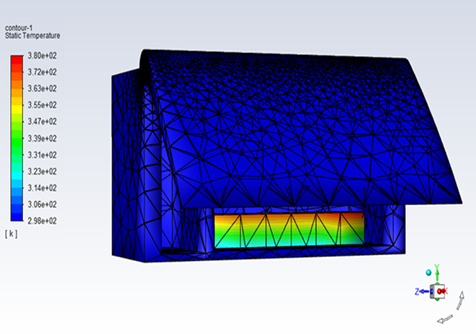
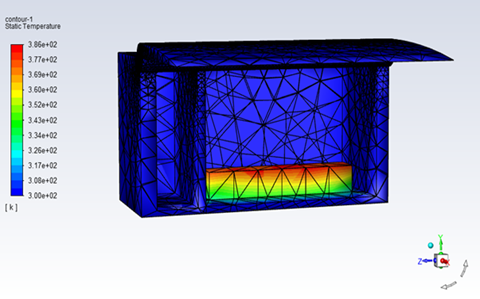
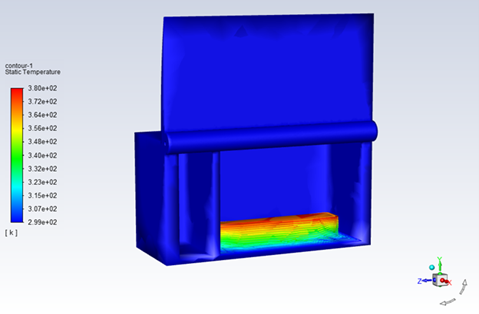
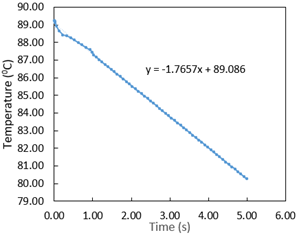
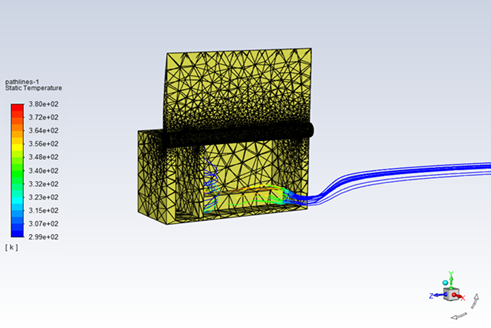
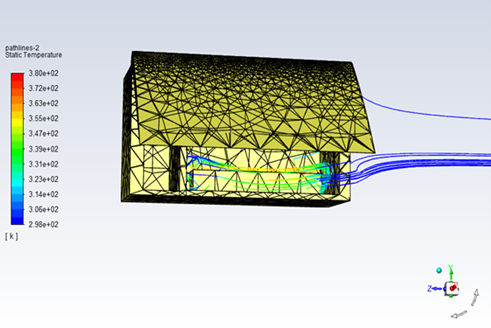
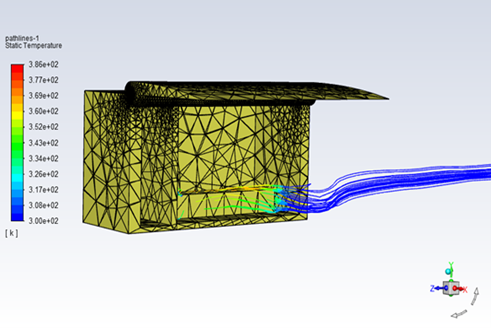
From the results, the simulation has shown the pattern of forced heat convection as expected. At all open positions, forced convection heat transfer was successfully achieved, as shown in Figures 1 to 3. The forced convection heat transfer has resulted in the coil temperature dropping rapidly over a short time span of just 5 seconds, as shown in Figures 4 to 6, at the inlet speed of 2 km/h, which is the selected wind that replicates stop-and-go traffic in an urban area.
In a real-world situation, this could be replicated via the use of radiator fans (which are usually present in modern liquid/oil-cooled motorcycles that are equipped with radiators) [12]. Thus, the result is not entirely impossible to achieve during real-world riding conditions. The factory-installed radiator fans will usually be operational once the motorcycle’s engine has reached a pre-determined temperature by the manufacturer. This pre-determined temperature usually varies among manufacturers. For instance, for a motorcycle which commonly operates at 85 ℃, the radiator fans might only be operational once the temperature has reached 100 ℃ [13]. The temperature exhibited by the motorcycle is, of course, dependent on various parameters such as engine architecture, cooling system, and riding conditions [14].
Figure 1. Static temperature in contour view (45-degree open positioning)
Figure 2. Static temperature in contour view (90-degree open positioning)
Figure 3. Static temperature in contour view (180-degree open positioning)
Figure 4. Result for forced convection heat transfer: 45-degree open position
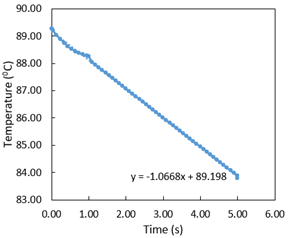
Figure 5. Result for forced convection heat transfer: 90-degree open position
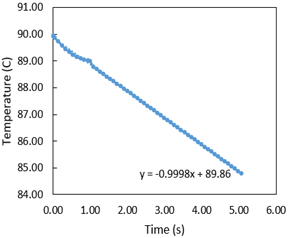
Figure 6. Result for forced convection heat transfer: 180-degree open position
The objective of this study was to develop a new body panel concept for a motorcycle that is integrated with a self-regulating thermo-mechanical valve system. The purpose of this new body panel is to have the capacity to promote convection heat transfer once the motorcycle (i.e., the engine) has reached a high operating temperature (beyond 100 degrees Celsius). At high operating temperature, the heat-induced SMA will open up the body panels, thus enabling greater convection heat transfer from the engine bay to the environment [15-17].
Even so, solely based on the simulation conducted, the active body panel design architecture is indeed proven to have the capacity to better regulate the motorcycle’s operating temperature [18]. Nonetheless, further studies are indeed advised. Especially, in relation to the key findings, i.e., the variation in forced heat convection heat transfer in relation to the angle at which the open position is designated.
From Table 3, the comparison of these simulations and the information retrieved from the contour view of the simulation. It is observed that for the open positioning (the body panel is erected), the coil dissipated heat the most in the 45-degree positioning in comparison to both the 90-degree and 180- degree [19, 20]. At the end of the simulation period, the final temperature readings for the 45-, 90-, and 180-degree open positioning are 80.24 ℃, 83.78 ℃, and 84.78 ℃, respectively [21]. This is contradictory to the forecasted or pre-simulation expected data. It is expected that a fully open body channel, i.e., at 180-degree open positioning, shall provide the lowest final temperature value since the fully open positioning shall provide the maximum area of heat convection [22].
However, upon observation of the streamline image between the 45-degree and 180-degree open positioning shown in Figures 7 and 8, it is observed that at the 45-degree open positioning, the body panel causes air to flow faster between the Body and the door area as the volume is getting smaller [23]. Hence, fluid (air) will dissipate the heat from the coil effectively.
Table 3. Summary of forced convection heat transfer for three (3) body panels at open positioning
|
Manipulated Variable Angle of Body Panel to the Main Body [°, Degrees] |
Responding Variable Coil Temperature [℃] |
|||
|
Open |
T0 |
Tf |
T0-Tf |
Tf-T∞ |
|
45 |
100 |
80.24 |
19.76 |
54.24 |
|
90 |
100 |
83.78 |
16.22 |
57.78 |
|
180 |
100 |
84.72 |
15.28 |
58.72 |
Figure 7. Static temperature air flow (door open at 180-degree)
Figure 8. Static temperature air flow (door open at 45-degree)
Figure 9. Static temperature air flow (door open at 90-degree)
Comparatively, the 90-degree open positioning exhibits the heat convection characteristics, which is allocated between the performance of the 45- and 180-degree open positioning (see Figure 9). Therefore, it could be noted that the 90-degree open positioning provides the balance of convection heat transfer between the 45- and 180-degree open positioning. This information is vital if other factors are considered in addition to the forced convection heat transfer properties, such as the consideration of aerodynamics [24].
At high speeds of travel, the consideration of forced convection heat transfer is no longer prominent. This is because the windblast from moving forward shall immediately facilitate heat exchange. It is not a normal occurrence for a motorcycle to exhibit high operating temperatures while on the move. Such incidences will mostly be likely to occur from mechanical discrepancies or even failure involving the engine cooling system (e.g., liquid and/or oil-cooled cooling system, radiator-fan failure, or radiator leakage). At high speeds of travel, one of the key prominent engineering concerns of a motorcycle will be on the aerodynamics [25]. Two (2) key aspects of aerodynamics which are the utmost concern are: (i) lift, and (ii) drag.
Firstly, aerodynamic lift is not a major concern for motorcycles being ridden in an urban environment. As the scope of this research suggests, the speed being tested in this paper is not fast enough to create enough lift and compromise the overall traction of the motorcycle tyres. However, lift or frontal lift is totally undesirable, and motorcycle manufacturers do opt for various engineering designs and interventions (electronics and non-electronics) to minimize frontal lift.
Secondly, drag or skin friction. Though dependent on design factors such as the availability of bodywork or fairing, by default, any vehicle shall focus on the minimization of drag or skin friction. A high level of drag will result in various adverse issues such as reduced fuel efficiency and top speed. Thus, a vehicle is generally designed to exhibit minimal drag [26].
In relating the two (2) aerodynamics considerations to the outcome of this study, it is highly emphasized that the design for the body panel must not facilitate frontal lift and must not exhibit high levels of drag while operational, especially when the body panel is in open position. The aerodynamics study will ensure that the body panel does not facilitate frontal lift and does not exhibit high levels of drag while operational. Future aerodynamic analysis should also determine the vehicle speed at which the incoming airflow alone provides sufficient convective cooling, allowing the active body panel to return to its closed position [27]. Related heat-rejection studies have shown that cooling performance depends on the combined effects of air velocity, duct geometry, radiator configuration, and aerodynamic resistance [28]. Once sufficient airflow is available, the panel could automatically return to the 0° closed position, thereby minimizing its contribution to aerodynamic lift and drag. At that speed, the body panel could be automatically closed (at 0-degree position), hence, no longer be a prominent parameter that contributes towards lift and drag. Nonetheless, if the body panel actually facilitates downforce while it is in operational mode, well, that will be an interesting finding. Anti-lift or downforce at the frontal section of the motorcycle is indeed desirable since it shall increase stability and traction.
Conclusively, the aim of this study is to develop a new body panel concept for motorcycles which is integrated with a self-regulating thermo-mechanical valve system. While the present study remains a proof-of-concept, these additions better position the work within the context of applied heat transfer. Future work will extend this by developing empirical correlations and conducting detailed parametric analysis.
As an overview, the “open” body panel configuration has indicated a measure of double the effectiveness of convection heat transfer in comparison to the enclosed body panel positioning. This was considered for both temperature decrement (in units of Celsius) and the duration taken for a similar temperature decrement (in units of seconds). The findings of this study will be beneficial for both motorcycle manufacturers and aftermarket product developers. The global motorcycle manufacturers could utilize the findings for potential integration of a self-regulating thermo-mechanical valve system motorcycle body panel on their future model line-up. Whilst the aftermarket product developers could generate new products for both existing and future motorcycle models for all manufacturers. However, it should be noted that an “open” body panel as configured in this study is theoretically expected to have an adverse effect on the streamlining of the motorcycle. Thus, affecting the motorcycle’s aerodynamic properties. This study proposes that the “open” body panel positioning is only configured for the working condition in which the motorcycle is at rest, for instance, during stop-and-go traffic conditions. Consequently, the following is proposed for further studies:
The performance of the adaptive mechanism can be enhanced through optimization of the SMA properties, including activation temperature, response time, and fatigue resistance. Future research may explore different alloy compositions, actuation geometries, and hysteresis behavior to ensure reliable and repeatable operation under real-world thermal cycling conditions.
The authors would like to thank INTI International University for the support provided.
[1] Niccolai, A. (2025). Design of electric motorcycles using right-sizing criteria and framework definition for analysis and synthesis of driving cycles. https://hdl.handle.net/2158/1437174.
[2] Marshall, G.J., Mahony, C.P., Rhodes, M.J., Daniewicz, S.R., Tsolas, N., Thompson, S.M. (2019). Thermal management of vehicle cabins, external surfaces, and onboard electronics: An overview. Engineering, 5(5): 954-969. https://doi.org/10.1016/j.eng.2019.02.009
[3] Swetha, T.M., Gireesha, B.J., Venkatesh, P. (2026). Numerical analysis of fully wetted cylindrical porous fins with temperature-dependent thermal conductivity, surface emissivity and heat transfer coefficient under natural convection and radiation. Transport in Porous Media, 153(2): 23. https://doi.org/10.1007/s11242-025-02278-x
[4] Ma’Arof, M.I.N., Chala, G.T., Husain, H., Mohamed, M.S. (2019). Influence of fins designs, geometries and conditions on the performance of a plate-fin heat exchanger-experimental perspective. Journal of Mechanical Engineering and Sciences, 13(1): 4368-4379. https://doi.org/10.15282/jmes.13.1.2019.02.0372
[5] Ma’arof, M.I.N., Rhu, T.P., Nasir, R.E.M., Husain, H., Chala, G.T. (2019). A study on slot design of motorcycle windshield to improve aerodynamics features. INTI Journal, 2019. https://iuojs.intimal.edu.my/index.php/intijournal/article/view/281.
[6] Ma’arof, M.I.N., Chala, G.T., Suresh, S., Suresh, S. (2020). The development of an aftermarket intercooler spray for turbocharged vehicles using ethylene glycol and hyaluronic acid. IOP Conference Series: Materials Science and Engineering, 863(1): 012066. https://doi.org/10.1088/1757-899X/863/1/012066
[7] Gupta, N., Tiwari, S., Gaikwad, S.D., Sharma, P. (2026). On-road driving performance analysis of a fuel cell-hybrid electric scooter integrated with metal hydride hydrogen storage system. International Journal of Hydrogen Energy, 207: 153511. https://doi.org/10.1016/j.ijhydene.2026.153511
[8] Oktar, H.E., Özkan, M., Hürpekli, M. (2026). Experimental and thermodynamic analysis of hydrogen and gasoline in a spark-ignition engine. International Journal of Hydrogen Energy, 203: 153154. https://doi.org/10.1016/j.ijhydene.2025.153154
[9] Lu, C.Y., Hsu, H.Y., Chen, B.S., Huang, W.L., Ho, W.S. (2025). Development and validation of an explainable hybrid deep learning model for multiple-fault diagnosis in intelligent automotive electronic systems. Electronics, 14(22): 4488. https://doi.org/10.3390/electronics14224488
[10] Alsharea, A., Lavasani, E.J., Stamatin, I., Diac, C., Balan, A. (2025). Designing geometries in SolidWorks for heat transfer simulations in ANSYS. Romanian Reports in Physics, 77(1): 1-16. https://doi.org/10.59277/RomRepPhys.2025.77.902
[11] Nghia, N.T., Khoa, N.X. (2025). Comparative analysis of gasoline and biofuel impacts on the performance, emissions, and wear of motorcycle engines over long-term operating conditions. Engineering, Technology & Applied Science Research, 15(3): 23330-23334. https://doi.org/10.48084/etasr.9324
[12] Kurniawan, A., Setiadi, R., Sumbodo, W., Naryanto, R.F. (2025). Design and development of body electrical system and controller temperature control system for electric motorcycles. Jurnal Inovasi Mesin, 7(1): 40-51. https://doi.org/10.15294/jim.v7i1.21246
[13] Li, K., Zheng, Y., Zhu, J., Huang, Y., Qin, C., Yang, T. (2026). Investigating the high-temperature oxidation behavior of Ti-5Sn-x Er and Ti-6.5 Ni-x Er alloys using multi-scale convolutional neural networks. Journal of Materials Engineering and Performance, 35: 22746-22767. https://doi.org/10.1007/s11665-026-13225-2
[14] Libin, T., Yuejin, Y. (2025). Numerical simulation and cooling performance improvement on cooling system of two type motorcycles and its comprehensive thermal management test. Thermal Science and Engineering Progress, 104413. https://doi.org/10.1016/j.tsep.2025.104413
[15] Zhu, T., Kirca, M., Zhou, S., Dinh, T., McGordon, A. (2025). Thermal management for electric motorcycles—multi-scale modelling and battery thermal design evaluation. Applied Sciences, 15(5): 2713. https://doi.org/10.3390/app15052713
[16] Zhang, X., Yang, Y., Yang, Z., Ma, R., Aimaijiang, M., Xu, J., Zhou, Y. (2023). Four-dimensional printing and shape memory materials in bone tissue engineering. International Journal of Molecular Sciences, 24(1): 814. https://doi.org/10.3390/ijms24010814
[17] Jena, A., Samal, B.B., Kumar, C.S., Varshney, S.K. (2021). Analysis of electro-thermo-mechanical behavior of thin film Ni50-Ti50 and Ni40-Ti50-Cu10 shape memory alloys for application in thermal actuators. Materials Today: Proceedings, 47: 4578-4583. https://doi.org/10.1016/j.matpr.2021.05.448
[18] Marupalli, B.C., Behera, A., Aich, S. (2021). A critical review on nickel-titanium thin-film shape memory alloy fabricated by magnetron sputtering and influence of process parameters. Transactions of the Indian Institute of Metals, 74(10): 2521-2540. https://doi.org/10.1007/s12666-021-02418-z
[19] Sabir, R., Khan, M.M., Sheikh, N.A., Imran, M., Shahzad, M.W. (2025). Thermal-hydraulic performance enhancement of ellipsoidal dimpled U-tubes with different bend curvatures. International Communications in Heat and Mass Transfer, 164: 108814. https://doi.org/10.1016/j.icheatmasstransfer.2025.108814
[20] Yuan, X., Ji, Y., Yuan, W., Huai, Q., Hao, Z., Dongye, Z. (2025). A method for sensing the internal current distribution state of press-pack IGBT devices based on Hall sensors. Electronics, 14(3): 590. https://doi.org/10.3390/electronics14030590
[21] Mishra, G.K., Pandey, A.K., Gupta, O.H. (2026). Efficient PWM-based motor control for educational robotic arm prototypes. Engineering Research Express, 8(2): 025314. https://doi.org/10.1088/2631-8695/ae3709
[22] Hasany, M., Kohestanian, M., Najafi Tireh Shabankareh, A., Nezhad‐Mokhtari, P., Mehrali, M. (2025). Ultra-stretchable, super‐tough, and highly stable ion-doped hydrogel for advanced robotic applications and human motion sensing. InfoMat, 7(5): e12655. https://doi.org/10.1002/inf2.12655
[23] Kuehl, N.W., Johnson, C.E. (2025). Method to measure blast overpressure exposure on military personnel using orthogonal sensor orientations. Scientific Reports, 15(1): 38974. https://doi.org/10.1038/s41598-025-22826-1
[24] Zhang, K., Wu, Y., Lu, J., Liu, Y., Zhang, C., Li, J., Luo, J. (2025). Biocompatible salt-enhanced thin porous humidity sensor for human interaction sensing. Sensors and Actuators B: Chemical, 425: 136907. https://doi.org/10.1016/j.snb.2024.136907
[25] Cildir, A., Tahir, F.A., Farooq, M., Zahid, A., Imran, M., Abbasi, Q.H. (2025). A highly efficient and broadband metasurface for linear-to-linear and linear-to-circular polarization conversion in reflection mode. Photonics and Nanostructures-Fundamentals and Applications, 64: 101382. https://doi.org/10.1016/j.photonics.2025.101382
[26] Spaven, F., Liu, Y., Baghdadi, M. (2025). Experimental analysis of alternative rider postures for low drag motorcycle design. Transportation Research Interdisciplinary Perspectives, 32: 101533. https://doi.org/10.1016/j.trip.2025.101533
[27] Avignone, A., Chiusano, S., Peroni, L. (2025). Mine4Race: A user-friendly toolset for enhancing racing telemetry analysis and visualization. Results in Engineering, 29: 108865. https://doi.org/10.1016/j.rineng.2025.108865
[28] Piancastelli, L. (2023). An innovative heat rejection system for high altitude unmanned aerial vehicles. Power Engineering and Engineering Thermophysics, 2(2): 110-119. https://doi.org/10.56578/peet020205