Zainab Kh. Majeed | Ehsan F. Abbas* | Iesam J. Hasan
© 2026 The authors. This article is published by IIETA and is licensed under the CC BY 4.0 license (http://creativecommons.org/licenses/by/4.0/).
OPEN ACCESS
This study experimentally investigated the effects of low-frequency mechanical vibration on natural convection heat transfer from a horizontally heated plate immersed in stagnant water. Experiments were performed at three constant heat-flux levels of 740, 1320, and 2060 W/m² using vibration frequencies of 10, 15, and 20 Hz with measured vibration amplitudes ranging from 0.16 to 0.19 mm. Heat-transfer performance was evaluated in terms of the Nusselt number (Nu), the modified Rayleigh number (Re), and the enhancement factor (EF) relative to the static natural-convection condition. Under static conditions, the Nusselt number increased with the modified Rayleigh number, indicating that buoyancy-driven heat transfer became stronger as the applied heat flux increased. Under vibrating conditions, the thermal response was distinctly non-monotonic and depended on the combined effects of heat flux, vibration frequency, and amplitude. At the intermediate heat-flux level, the 10 Hz condition produced the highest frequency-based Nu of 110.63. At the lowest heat-flux level, EF was 10.17, 10.26, and 10.64 at 10, 15, and 20 Hz, respectively. The EF values at the lowest heat-flux level exceeded those at the intermediate and highest heat-flux levels, while the static Nu was also lowest at the lowest heat-flux level. Overall, heat-transfer enhancement in water depended on the selected heat flux, vibration frequency, and amplitude. The reported findings apply to the investigated low-frequency and micro-amplitude operating conditions.
buoyancy-driven convection, heat-transfer enhancement, horizontal heated plate, Nusselt number, stagnant water, vibration frequency
Natural convection heat transfer from heated surfaces plays a fundamental role in a wide range of thermal systems, including passive cooling devices, solar thermal units, compact heat exchangers, and electronic equipment. Because natural-convection heat transfer is often limited by thermal boundary-layer development, numerous active enhancement techniques have been investigated to disrupt the boundary layer and increase the heat-transfer rate. Among these techniques, mechanical vibration has attracted considerable attention as an active heat-transfer enhancement method. By introducing external excitation, it can modify buoyancy-driven flow, promote near-wall fluid renewal, and alter the structure of thermal plumes, thereby enhancing convective heat transfer [1-4]. Recent studies have demonstrated that appropriately applied mechanical vibration can enhance natural-convection heat transfer by periodically disrupting the thermal boundary layer, promoting near-wall fluid mixing, and increasing fluid renewal adjacent to the heated surface [5]. The thermal influence of vibration, however, is inherently complex and cannot be interpreted as universally beneficial. Previous investigations have shown that the response of convective heat transfer to oscillatory forcing depends on several coupled parameters, including vibration frequency, amplitude, heating intensity, and fluid properties [6-11]. Depending on the operating conditions, vibration may improve thermal performance by thinning the boundary layer and enhancing fluid mixing. Conversely, it may weaken the natural plume structure or provide only limited enhancement [12-16]. These findings indicate that vibration-assisted convection is not uniformly beneficial and that its performance depends on the operating window defined by the imposed vibration conditions.
Water was selected to investigate the effects of external oscillation on boundary-layer development, plume behavior, and heat-transfer rate because its thermal conductivity, heat capacity, and buoyancy-driven transport characteristics directly influence these phenomena. Furthermore, the response of water to vibration can be non-monotonic. This behavior suggests that the interaction between frequency and amplitude may produce different heat-transfer responses within a limited operating range rather than a linear improvement [15-17].
Previous studies have reported that mechanical vibration can enhance convective heat transfer; however, the observed heat-transfer response depends strongly on the tested geometry, fluid, vibration mode, and frequency range [14, 17-19]. Earlier investigations examined vibrating cylinders, vertical plates, fins, channels, annular spaces, cavities, heat exchangers, and other flow-based configurations [5, 11, 14-19]. However, the cited studies did not jointly examine a horizontally heated plate immersed in stagnant water under low-frequency, micro-amplitude vibration while evaluating the effects of heat flux, vibration frequency, and measured amplitude relative to a static natural-convection baseline.
To address this gap, the present study experimentally investigates vibration-assisted natural-convection heat transfer from a horizontally heated plate immersed in stagnant water. It examines the effects of vibration frequency and amplitude at different heat-flux levels. The study evaluates heat-transfer performance using the Nusselt number (Nu), the modified Rayleigh number (Re), and the enhancement factor (EF) relative to the static condition. The study provides a controlled experimental assessment of the combined effects of heat flux, vibration frequency, and measured micro-amplitude relative to a static natural-convection baseline.
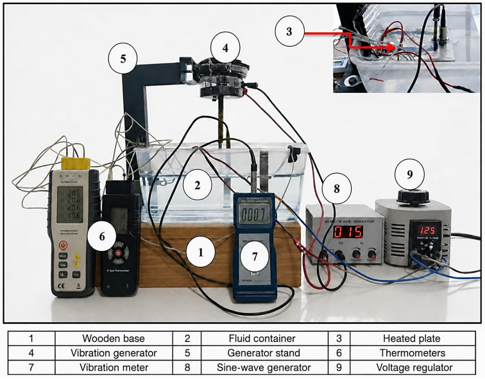
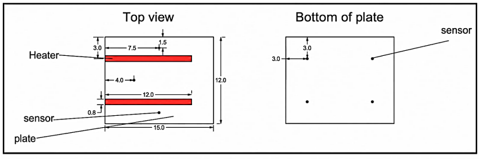
A dedicated experimental facility was developed to investigate vibration-assisted natural convection heat transfer from a horizontally heated plate immersed in stagnant water. The main heated element was an aluminum plate with dimensions of (15 × 12 × 1) cm. Two cartridge heaters were embedded in the plate to provide the required thermal input. Each heater was 100 mm long, 10 mm in diameter, and rated at 200 W. The heated plate was mounted horizontally inside a transparent test container and supported in a cantilever configuration on a wooden base. Mechanical excitation was generated by a vibration generator attached to the supporting frame. The temperature distribution within the test section was monitored using eight K-type thermocouples. Seven thermocouples were attached to the plate surface to track its temperature distribution, while one thermocouple was positioned in the surrounding water to measure the bulk-water temperature. The electrical input to the heaters was monitored using a voltmeter and an ammeter. The vibration amplitude was measured using a vibration meter. A sine-wave generator and a variac were used to regulate the vibration signal and the electrical heating input, respectively. The main components of the experimental apparatus and the locations of the thermocouples are shown in Figures 1 and 2, respectively.
Figure 1. Schematic diagram of the experimental setup
Figure 2. Schematic of the heated plate showing heater and thermocouple locations
2.1 Measuring instruments and accuracy
The accuracy and resolution of the measuring instruments were obtained from the manufacturers' specifications and incorporated into the uncertainty analysis. Thermocouple measurements, voltage and current measurements, plate dimensions, and vibration amplitude measurements were identified as the primary sources of experimental uncertainty. Uncertainties associated with the thermophysical properties of water, evaluated at the film temperature, were also considered. The accuracy, resolution, and relevant specifications of the main measuring and control instruments are summarized in Table 1.
Table 1. Accuracy and resolution of the measuring instruments
|
Instrument |
Measured/Controlled Parameter |
Accuracy/Specification |
Resolution |
|
K-type thermocouples |
Plate and water temperatures |
±(0.015% of reading + 1 ℃) |
0.01 ℃ |
|
Digital caliper |
Plate dimensions |
±0.02 mm |
0.01 mm |
|
Voltmeter |
Input voltage |
±(0.8% of reading + 5 digits) |
0.01 V |
|
Ammeter |
Input current |
±(2.0% of reading + 5 digits) |
0.01 A |
|
Vibration meter |
Vibration amplitude |
±(5% of reading + 2 digits) |
0.001 mm |
|
Vibration meter |
Frequency range |
10 Hz–1 kHz for displacement mode |
Not specified |
|
Sine-wave signal generator |
Vibration frequency control |
Frequency range: 1–400 Hz |
1 Hz |
|
Variac |
Heating input control |
Output voltage range: 0–250 V |
Not specified |
The experiments were conducted according to a systematic procedure to ensure consistent thermal response of the heated plate immersed in stagnant water. Before each experimental run, the experimental apparatus and measuring instruments were inspected to verify proper operation and stable readings. The test container was filled with water to a level sufficient to ensure complete submergence of the heated plate and stable boundary conditions throughout the test section.
For each operating case, the electrical input supplied to the cartridge heaters was adjusted using the variac to obtain the required heat-flux level. Voltage and current were measured using the voltmeter and ammeter and subsequently used in the data-reduction calculations. The plate was first heated under static conditions until the thermal response approached steady state. In the present study, steady-state condition was considered achieved when neither the mean surface temperature of the heated plate nor the bulk water temperature exhibited a continuous increase or decrease during the final recording period. For all test cases, data acquisition began after thermal stabilization, which typically occurred at approximately 5000 s.
After steady state was reached, the surface temperatures of the heated plate and the bulk water temperature were recorded to characterize the static natural-convection condition. This static case served as the baseline for evaluating the vibration-induced enhancement. The mechanical vibration was then applied using the vibration generator at the selected frequencies of 10, 15, and 20 Hz. For each frequency, the corresponding vibration amplitude was measured with the vibration meter. Once the temperature readings stabilized under each vibration condition, the plate and bulk-water temperatures were recorded. The voltage, current, vibration frequency, and amplitude were also recorded. The same procedure was repeated at each selected heat-flux level. The resulting experimental data set was used to calculate the heat-transfer coefficient Nu, the modified Rayleigh number, and EF.
For each static and vibrating case, each measurement was recorded three times after thermal stabilization. The arithmetic mean of the three readings was used in the subsequent data-reduction calculations to reduce random measurement variability and improve the reliability of the experimental results.
Table 2. Experimental matrix and Nusselt number (Nu) for the first heat flux level, $q_1^{\prime \prime}$ = 740 W/m2
|
Operating Case |
$f$ (Hz) |
$a$ (mm) |
$T_s$ (℃) |
Nu |
|
Static |
0 |
0 |
51.614 |
6.5873 |
|
1 |
10 |
0.16 |
40.071 |
87.747 |
|
2 |
10 |
0.17 |
37.957 |
85.278 |
|
3 |
10 |
0.18 |
36.657 |
155.929 |
|
4 |
10 |
0.19 |
35.5 |
75.912 |
|
5 |
15 |
0.16 |
33.929 |
102.524 |
|
6 |
15 |
0.17 |
33.586 |
121.247 |
|
7 |
15 |
0.18 |
33.457 |
51.288 |
|
8 |
15 |
0.19 |
33.143 |
65.5 |
|
9 |
20 |
0.16 |
32.3 |
50 |
|
10 |
20 |
0.17 |
31.92 |
136.58 |
|
11 |
20 |
0.18 |
31.914 |
78.663 |
|
12 |
20 |
0.19 |
31.657 |
61.505 |
Table 3. Experimental matrix and Nusselt number (Nu) for the second heat flux level, $q_2^{\prime \prime}$ = 1320 W/m2
|
Operating Case |
$f$ (Hz) |
$a$ (mm) |
$T_s$ (℃) |
Nu |
|
Static |
0 |
0 |
52.9 |
65.416 |
|
1 |
10 |
0.16 |
40.729 |
65.014 |
|
2 |
10 |
0.17 |
39.757 |
63.391 |
|
3 |
10 |
0.18 |
38.929 |
106.721 |
|
4 |
10 |
0.19 |
38.271 |
57.378 |
|
5 |
15 |
0.16 |
36.786 |
68.384 |
|
6 |
15 |
0.17 |
36.243 |
124.237 |
|
7 |
15 |
0.18 |
36.157 |
58.337 |
|
8 |
15 |
0.19 |
35.943 |
80.083 |
|
9 |
20 |
0.16 |
35.5 |
67.578 |
|
10 |
20 |
0.17 |
35.471 |
69.567 |
|
11 |
20 |
0.18 |
35.414 |
37.283 |
|
12 |
20 |
0.19 |
35.386 |
52.586 |
Tables 2–4 summarize the tested amplitude cases and their corresponding mean plate surface temperatures and Nu values, while Section 4 describes the procedures used to calculate Nu and EF. Because four vibration amplitudes were investigated at each vibration frequency, each row represents a specific combination of heat flux, frequency, and amplitude.
Table 4. Experimental matrix and Nusselt number (Nu) for the third heat flux level, $q_3^{\prime \prime}$ = 2060 W/m2
|
Operating Case |
$f$ (Hz) |
$a$ (mm) |
$T_s$ (℃) |
Nu |
|
Static |
0 |
0 |
51.329 |
99.603 |
|
1 |
10 |
0.16 |
45.357 |
71.094 |
|
2 |
10 |
0.17 |
41.371 |
97.404 |
|
3 |
10 |
0.18 |
40.386 |
133.053 |
|
4 |
10 |
0.19 |
39.2 |
80.645 |
|
5 |
15 |
0.16 |
38.814 |
65.015 |
|
6 |
15 |
0.17 |
38.571 |
101.255 |
|
7 |
15 |
0.18 |
38.443 |
84.47 |
|
8 |
15 |
0.19 |
38.729 |
57.423 |
|
9 |
20 |
0.16 |
38.186 |
62.351 |
|
10 |
20 |
0.17 |
38.557 |
72.053 |
|
11 |
20 |
0.18 |
38.314 |
61.291 |
|
12 |
20 |
0.19 |
38.443 |
54.08 |
Note for endash Tables 2–4: $f$ denotes the vibration frequency, $a$ denotes the vibration amplitude, and $T_s$ represents the mean plate surface temperature calculated from the seven thermocouple readings. For the static case, $f$ = 0 Hz and $a$ = 0 mm.
For the enhancement-factor analysis, a representative mean surface temperature of the heated plate was determined at each vibration frequency and heat-flux level. The corresponding frequency-based Nusselt number was then computed using this temperature. Accordingly, Table 5 lists the frequency-based Nu values used for comparison with the static baseline and for EF calculation, whereas Tables 2–4 list the amplitude-resolved Nu values for the individual amplitude conditions. In Table 5, $N u_{\text {static}}$ and $N u_{\text {vib}}$ denote the Nusselt numbers under static and vibrating conditions, respectively.
Table 5. Frequency-based enhancement factors (EFs) calculated using mean plate surface temperatures
|
$q^{\prime \prime}$ (W/m2) |
$f$ (Hz) |
$N u_{\text {static}}$ |
$N u_{\text {vib}}$ |
EF |
|
740 |
10 |
6.587 |
66.967 |
10.166 |
|
740 |
15 |
6.587 |
67.567 |
10.257 |
|
740 |
20 |
6.587 |
70.1 |
10.64 |
|
1320 |
10 |
65.416 |
110.629 |
1.691 |
|
1320 |
15 |
65.416 |
97.958 |
1.497 |
|
1320 |
20 |
65.416 |
64.493 |
0.986 |
|
2060 |
10 |
99.603 |
78.008 |
0.783 |
|
2060 |
15 |
99.603 |
65.423 |
0.6568 |
|
2060 |
20 |
99.603 |
65.292 |
0.656 |
The measured electrical and thermal data were processed to evaluate the natural convection heat-transfer characteristics of the horizontally heated plate under static and vibrating conditions. The data-reduction procedure was based on standard definitions of heat transfer and natural convection [20, 21]. The mean plate surface temperature was obtained by averaging the readings of the seven thermocouples attached to the plate surface as follows:
$T_s=\frac{1}{7} \sum_{i=1}^7 T_{s, i}$ (1)
where, $T_s$ is the mean plate surface temperature, and $T_{s, i}$ is the temperature measured by the i-th thermocouple attached to the plate surface.
The electrical power supplied to the cartridge heaters is calculated from the measured voltage and current [22]:
$P=V \times I$ (2)
where, P is the electrical input power, V is the measured voltage, and I is the measured current.
The corresponding nominal heat flux applied to the heated plate is given by [21]:
$q^{\prime \prime}=\frac{P}{A}$ (3)
where, $q^{\prime \prime}$ is the applied heat flux, and A is the effective heated surface area of the plate.
The experimental setup was meticulously designed to minimize heat losses through the supporting structure and adjacent components. Because conductive and radiative heat losses from the non-active surfaces were not measured individually, the electrical input was considered to be the nominal heat input, and no direct correction for heat losses was applied. The potential influence of the residual heat losses was accounted for in the uncertainty margins associated with the heat-flux and heat-transfer calculations.
The average convective heat-transfer coefficient was calculated from the applied heat flux and the temperature difference between the mean surface temperature of the heated plate and the surrounding water [20, 21]:
$h=\frac{q^{\prime \prime}}{\left(T_s-T_{\infty}\right)}$ (4)
where, h is the average convective heat-transfer coefficient, $T_s$ is the mean plate surface temperature, and $T_{\infty}$ is the bulk-water temperature.
The thermophysical properties of water were evaluated at the film temperature for each operating condition [21]:
$T_f=\frac{\left(T_s+T_{\infty}\right)}{2}$ (5)
where, $T_f$ is the film temperature.
The Nusselt number (Nu) was calculated using its standard definition [20, 21]:
$N u=\frac{h L_c}{k}$ (6)
where, $N u$ is the Nusselt number, $L_c$ is the characteristic length of the heated plate, and k is the thermal conductivity of water evaluated at the film temperature.
For the present horizontal heated plate, the characteristic length was defined as the ratio of the heated surface area to the perimeter of the heated plate [23]:
$L_c=\frac{A}{{Per}}$ (7)
where, Per is the perimeter of the heated surface.
Under constant-heat-flux natural-convection conditions, the modified Grashof number was used to characterize the buoyancy effect [20, 21]:
$G r_L^*=\frac{g \beta q^{\prime \prime} L_c^4}{k v^2}$ (8)
where, $G r_L^*$ is the modified Grashof number and $g$ is the gravitational acceleration. The symbols $\beta$ and $v$ denote the thermal expansion coefficient and kinematic viscosity of water, respectively. The symbols $q^{\prime \prime}, L_c$, and $k$ represent the applied heat flux, characteristic length, and thermal conductivity of water, respectively.
The corresponding modified Rayleigh number was calculated as follows [20, 21]:
$R a_L^*=G r_L^* \cdot P r$ (9)
where, RaL* is the modified Rayleigh number, and Pr is the Prandtl number of water evaluated at the film temperature.
To better understand how mechanical vibration affects heat transfer, we introduce the EF, which measures the relative change in performance:
$E F=\frac{N u_{\text {vib}}}{N u_{\text {static}}}$ (10)
where, EF denotes the enhancement factor. The terms $N u_{\text {vib}}$ and $N u_{\text {static}}$ represent the Nusselt numbers under vibrating and static conditions, respectively. For each enhancement-factor calculation, $N u_{\text {vib}}$ and $N u_{\text {static}}$ were evaluated at the same applied heat-flux level. The calculated Nusselt number and enhancement-factor values were subsequently used to evaluate the effects of heat flux, vibration frequency, and vibration amplitude on natural-convection heat transfer in water.
4.1 Uncertainty analysis
An uncertainty analysis was applied to quantify the uncertainties associated with the measured variables and the derived heat-transfer parameters used in the present experimental study. The analysis was performed using the root-sum-square (RSS) propagation method at a 95% confidence level, following standard procedures for experimental measurements [24, 25]. The analysis included the measurement uncertainties described in Section 2.1, together with the thermophysical properties of water evaluated at the film temperature.
For a calculated parameter R that depends on a set of independent variables x1, x2,…, xn, the combined uncertainty was estimated as:
$\begin{gathered}U_R={\left[\left(\frac{\partial R}{\partial x_1} U_{x_1}\right)^2+\left(\frac{\partial R}{\partial x_2} U_{x_2}\right)^2+\cdots+\left(\frac{\partial R}{\partial x_n} U_{x_n}\right)^2\right]^{1 / 2}}\end{gathered}$ (11)
where, $U_R$ is the combined uncertainty associated with the calculated parameter $R$, and $U_{x_1}, U_{x_2}, \ldots, U_{x_n}$ are the uncertainties associated with the independent variables. The relative uncertainty is expressed as:
$\frac{U_R}{R}=\frac{U_R}{R} \times 100 \%$ (12)
The uncertainty in the electrical input power was obtained by propagating the uncertainties in the measured voltage and current:
$\frac{U_P}{P}=\left[\left(\frac{U_V}{V}\right)^2+\left(\frac{U_I}{I}\right)^2\right]^{1 / 2}$ (13)
where, $U_P / P, U_V / V$, and $U_I / I$ are the relative uncertainties associated with the electrical power, voltage, and current, respectively. The uncertainty in the applied heat flux was then determined from the uncertainties associated with the electrical power and the heated surface area, as follows:
$\frac{U_{q^{\prime \prime}}}{q^{\prime \prime}}=\left[\left(\frac{U_P}{P}\right)^2+\left(\frac{U_A}{A}\right)^2\right]^{1 / 2}$ (14)
The uncertainty in the average heat-transfer coefficient was estimated by considering the uncertainties in the heat flux and the temperature difference between the mean plate surface temperature and the bulk-water temperature:
$\begin{gathered}\frac{U_h}{h}=\left[\left(\frac{U_{q^{\prime}}}{q^{\prime \prime}}\right)^2+\left(\frac{U_{\Delta r}}{\Delta T}\right)^2\right]^{1 / 2} \\ \Delta T=T_s-T_{\infty}\end{gathered}$ (15)
where, $U_h / h$ is the relative uncertainty of the heat-transfer coefficient, and ΔT is the temperature difference between the mean plate surface temperature and the bulk-water temperature.
The uncertainty in Nu was obtained by propagating the uncertainties in the heat-transfer coefficient, characteristic length, and thermal conductivity of water:
$\frac{U_{N_u}}{N u}=\left[\left(\frac{U_h}{h}\right)^2+\left(\frac{U_{L_c}}{L_c}\right)^2+\left(\frac{U_k}{k}\right)^2\right]^{1 / 2}$ (16)
where, $U_{N u} / N u$ denotes the relative uncertainty of the Nusselt number. The terms $U_{L C} / L_C$ and $U_k / k$ represent the relative uncertainties of the characteristic length and the thermal conductivity of water, respectively.
Using the EF definition in Eq. (10), its uncertainty was calculated from the uncertainties in Nu under vibrating and static conditions:
$\frac{U_{F F}}{E F}=\left[\left(\frac{U_{N u_w, v i b}}{N u_{v i b}}\right)^2+\left(\frac{U_{N u_u, \text {static}}}{N u_{\text {stalic}}}\right)^2\right]^{1 / 2}$ (17)
where, $U_{E F} / E F$ denotes the relative uncertainty of the EF. The terms $U_{N u, v i b} / N u_{v i b}$ and $U_{N u, \text {static}} / N u_{\text {static}}$ represent the relative uncertainties of the Nusselt numbers under vibrating and static conditions, respectively.
The average uncertainties were ±1.385% for the applied heat flux and ±7.62% for Nu. Propagation of the uncertainties in the vibrating and static Nu values yielded an average EF uncertainty of approximately ±10.78%. Tables 6 and 7 summarize the average uncertainties of the main independent and calculated parameters.
Table 6. Average uncertainty of independent parameters and thermophysical properties
|
Parameter |
Percentage Uncertainty |
|
$U_A / A$ |
±0.54% |
|
$U_T / T$ |
±2.68% |
|
$U_V / V$ |
±0.0656% |
|
$U_I / I$ |
±1.3305% |
|
$U_P / P$ |
±1.332% |
|
$U_k / k$ |
±6.572% |
|
$U_v / v$ |
±13.6% |
Table 7. Average uncertainty of calculated parameters
|
Calculated Parameter |
Percentage Uncertainty |
|
$U_{q^{\prime \prime}} / q^{\prime \prime}$ |
±1.385% |
|
$U_{P r} / P r$ |
±1.332% |
|
$U_{R a_L^*} / R a_L^*$ |
±15.65% |
|
$U_{N u} / N u$ |
±7.62% |
|
$U_{E F} / E F$ |
±10.78% |
This section presents the thermal response of stagnant water to low-frequency mechanical vibration under different heat-flux levels, vibration frequencies, and vibration amplitudes. The analysis first examines the establishment of steady-state conditions and the static natural-convection behavior of water. It then evaluates the effects of vibration amplitude and frequency using Nu.
Finally, the analysis assesses the relative change produced by vibration using EF. For clarity, the applied heat-flux levels of 740, 1320, and 2060 W/m² are hereafter denoted as $q_1^{\prime \prime}$, $q_2^{\prime \prime}$, and $q_3^{\prime \prime}$, respectively. Tables 2–4 summarize the tested vibration amplitudes, the corresponding mean plate surface temperatures, and the calculated Nusselt numbers at each heat-flux level, thereby enabling direct comparison between the vibration-assisted and static natural-convection conditions.
The following discussion is limited to the experimentally observed trends within the tested operating range. Accordingly, "higher response" refers to a higher measured Nu, whereas "highest-response condition" denotes the tested condition that produced the highest Nu. These terms apply only to the investigated heat-flux levels, vibration frequencies, and amplitudes and do not imply a general optimum for vibration-assisted natural-convection systems.
5.1 Steady-state establishment
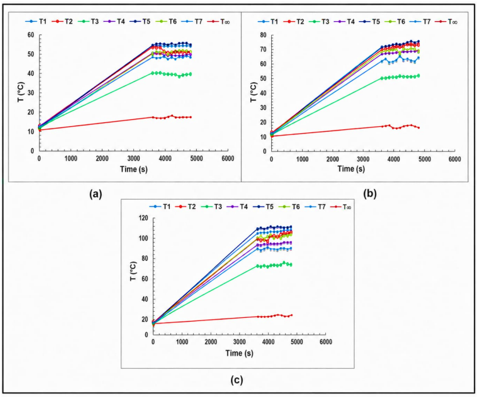
Before investigating the effects of mechanical vibration on natural convection heat transfer in water, the heated plate was confirmed to have reached a steady state. Figure 3 presents the temporal evolution of the measured temperatures from the beginning of each test at the three applied heat-flux levels; $T_1-T_7$ denote the temperatures measured by the seven plate-surface thermocouples, whereas $T_{\infty}$ denotes the bulk-water temperature. In all cases, the plate temperature increased rapidly during the initial heating period. The rate of temperature increase then decreased gradually as the system approached steady state.
Figure 3. Plate surface temperature versus time until steady state at: (a) $q_1^{\prime \prime}$; (b) $q_2^{\prime \prime}$; and (c) $q_3^{\prime \prime}$
The system exhibited a similar transient response at $q_1^{\prime \prime}$, $q_2^{\prime \prime}$, and $q_3^{\prime \prime}$. However, the absolute temperature levels increased with increasing heat flux. The temperature curves began to approach steady state after approximately 3000 s. Steady-state conditions were reached after approximately 5000 s. Accordingly, all experimental data used in the subsequent calculations were recorded only after the measured temperatures had stabilized.
5.2 Static heat transfer behavior in water
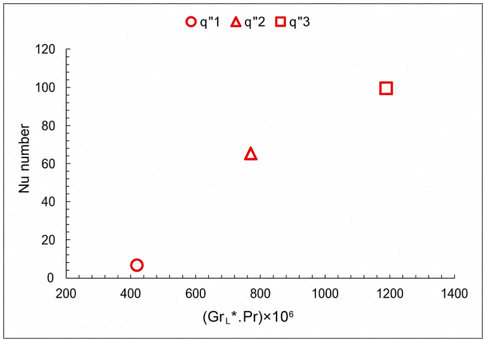
The experiments conducted under static conditions established the baseline natural convection behavior of the horizontally heated plate in stagnant water before the application of mechanical vibration. Under these conditions, the variation of $N u$ with the modified Rayleigh number represents the inherent buoyancy-driven heat transfer response of water. Figure 4 shows that Nu increased with $G r_L^* \operatorname{Pr}$, which is equivalent to the modified Rayleigh number $R a_L^*$. This trend indicated that increased buoyancy forces at higher applied heat fluxes enhanced convective heat transfer from the heated surface to the surrounding water.
Figure 4. Nusselt number (Nu) versus $G r_L^* P r$ at three heat-flux levels under static conditions
Physically, increasing the imposed heat flux produced a larger plate-to-water temperature difference. This larger temperature difference was consistent with stronger buoyancy-driven plume development and fluid circulation near the heated plate. The observed increase in Nu was consistent with buoyancy-driven transport in water and with the influence of its thermal conductivity and heat capacity.
The present study did not include direct flow visualization, infrared thermography, or velocity-field measurements. Therefore, the discussion of boundary-layer development and plume behavior represents a physical interpretation of the measured temperature and heat-transfer trends rather than a direct observation of the flow structure.
5.2.1 Baseline comparison of static natural convection
To validate the measurements of static natural convection, the experimental Nusselt numbers were compared with a widely used correlation for natural convection from a horizontal plate. For the present range of $R a_L^*$, the correlationbased Nusselt number ($N u_{\text {corr}}$) was estimated as:
$N u_{\text {corr }}=0.15\left(R a_L^*\right)^{1 / 3}$ (18)
Table 8 compares the experimental static Nusselt number ($N u_{\text {static,exp}}$) with the correlation-based Nusselt number $\left(N u_{\text {corr}}\right)$.
Table 8. Baseline comparison of static natural convection with a horizontal-plate correlation
|
$q^{\prime \prime}$ (W/m2) |
$R a_L^*$ × 10⁶ |
$N u_{\text {static,exp}}$ |
$N u_{\text {corr}}$ |
Deviation (%) |
|
740 |
419.69 |
6.587 |
112.31 |
94.13 |
|
1320 |
771.62 |
65.416 |
137.58 |
52.45 |
|
2060 |
1187.62 |
99.603 |
158.85 |
37.30 |
Table 8 shows that both the measured static Nu values and the correlation-based Nu values increased with the modified Rayleigh number. However, the experimental Nusselt numbers were consistently lower than those predicted by the correlation, particularly at the lowest heat-flux level. This discrepancy arose because the reference correlation was developed for idealized natural convection from an unconfined horizontal plate. In contrast, the present experiments were conducted with a 15 × 12 cm heated plate immersed in a confined water container.
The largest deviation occurred at $q_1^{\prime \prime}$ = 740 W/m2. In this case, the mean plate surface temperature was $T_s$ = 51.614 ℃, while the bulk-water temperature was $T_{\infty}$ = 46 ℃. The resulting temperature difference was relatively small, with $\Delta T$ = 5.614 ℃. Under such a small temperature difference, the calculated heat-transfer coefficient and Nu became highly sensitive to small uncertainties in the temperature measurements. Therefore, even small measurement variations in the mean plate surface temperature or bulk-water temperature can produce a noticeable deviation in the calculated static Nu.
In addition, the confined geometry of the container may have restricted the natural development of the buoyancy-driven flow compared with the ideal unconfined horizontal-plate condition assumed in the reference correlation. Residual heat losses through the supporting structure, container walls, and non-active surfaces may also have reduced the effective heat transferred to the surrounding water. The influence of residual heat losses may have been more pronounced at $q_1^{\prime \prime}$ = 740 W/m2, where the plate-to-water temperature difference was only 5.614 ℃. As described in Section 4, these losses were not measured separately, and their potential effects were included in the experimental uncertainty analysis.
Accordingly, Table 8 serves as a consistency check for the measured trend rather than as a strict validation of the absolute Nu values against an ideal correlation. The absolute deviations likely resulted from the combined effects of the confined geometry, the small temperature difference, and uncorrected residual heat losses.
5.3 Effect of vibration amplitude on the Nusselt number in water
Figure 5 presents the effect of vibration amplitude on Nu, and Tables 2–4 list the corresponding values. For each heat-flux level, four vibration amplitudes were tested at frequencies of 10, 15, and 20 Hz. The results showed that Nu varied non-monotonically with amplitude for all nine heat-flux–frequency combinations. Increasing the amplitude from 0.16 to 0.19 mm did not produce a continuous increase in Nu in any of these combinations. This non-monotonic behavior indicated that the effect of amplitude depended on both the vibration frequency and the applied heat flux.
Figure 5. Nusselt number (Nu) versus vibration amplitude at three heat-flux levels
At $q_1^{\prime \prime}$, the static Nu was 6.587, and all 12 tested amplitude–frequency combinations produced higher Nu values, ranging from 50.000 to 155.929. This indicated that the relative effect of vibration was greater when the static Nusselt number was low. The increase in the Nusselt number under these conditions may have been associated with enhanced near-wall fluid motion and the renewal of water adjacent to the heated surface. However, as discussed in Section 5.2, the underlying enhancement mechanism could not be directly confirmed by the present measurements. This explanation was inferred from the heat-transfer data rather than from flow visualization.
At $q_2^{\prime \prime}$, the static Nu was 65.416. Six of the 12 tested amplitude–frequency combinations produced Nu values above the static value, whereas the remaining six produced lower values. Enhancement occurred at (10 Hz, 0.18 mm), (15 Hz, 0.16, 0.17, and 0.19 mm), and (20 Hz, 0.16 and 0.17 mm). The highest Nu values did not consistently occur at the largest amplitude. This finding suggested that amplitude alone did not control the thermal response within the tested range.
At $q_3^{\prime \prime}$, the static Nu was 99.603. Ten of the 12 tested amplitude–frequency combinations produced Nu values below the static value; only the combinations (10 Hz, 0.18 mm) and (15 Hz, 0.17 mm) produced higher values of 133.053 and 101.255, respectively. This behavior suggested that buoyancy-driven motion was already well developed at the higher heat flux.
Across the tested heat-flux levels, the vibration amplitude varied from 0.16 to 0.19 mm in increments of 0.01 mm, whereas Nu ranged from 37.283 to 155.929. Because the Nusselt number was calculated using the temperature difference between the mean plate surface and the bulk water, measurement uncertainties may have affected the calculated heat-transfer coefficient and Nusselt number, particularly at low temperature differences. In addition to measurement sensitivity, the imposed vibration may have interacted differently with the buoyancy-driven flow at each frequency and heat-flux level. This interaction could have produced non-uniform near-wall fluid renewal and a non-monotonic thermal response. Therefore, the observed variations likely resulted from the combined influence of measurement sensitivity, thermal-response stability, and the interaction between oscillatory forcing and natural convection rather than from amplitude alone.
Overall, the results indicated that amplitude alone did not predict an increase in Nu; its effect depended on vibration frequency and heat-flux level.
5.4 Effect of vibration frequency on Nu
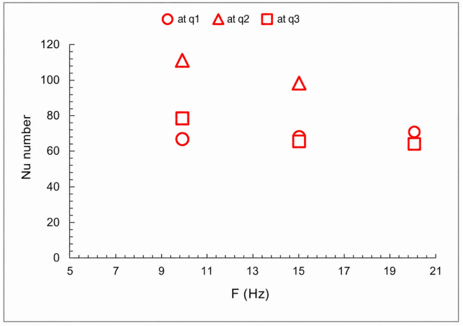
Figure 6 shows the effect of vibration frequency on $N u$ at the three heat-flux levels. The results showed that vibration frequency affected Nu non-monotonically and differently across the tested heat-flux levels. At $q_1^{\prime \prime}$, the frequency-based Nu increased from 66.97 at 10 Hz to 67.57 at 15 Hz and 70.10 at 20 Hz, corresponding to an overall increase of approximately 4.7% between 10 and 20 Hz.
Figure 6. Effect of vibration frequency on the Nusselt number (Nu) at different heat-flux levels
By contrast, at $q_2^{\prime \prime}$, the maximum Nusselt number within the tested frequency range occurred at 10 Hz. Increasing the vibration frequency from 10 to 20 Hz reduced the Nusselt number from 110.63 to 97.96 and then to 64.49 at 15 and 20 Hz, respectively. The reduction in the Nusselt number at higher frequencies may have been due to reduced near-wall fluid renewal or excessive disturbance of the buoyancy-driven flow structure. However, this interpretation remains speculative because the flow field was not measured directly.
At $q_3^{\prime \prime}$, the frequency-based Nu decreased from 78.01 at 10 Hz to 65.42 at 15 Hz and 65.29 at 20 Hz, corresponding to an overall reduction of approximately 16.3%. The change between 15 and 20 Hz was approximately 0.2%, compared with an overall reduction of approximately 41.7% between 10 and 20 Hz at $q_2^{\prime \prime}$. This behavior suggested that buoyancy-driven convection was already well established under the static condition at the highest heat-flux level.
Overall, the frequency response depended on the heat-flux level rather than following a common monotonic trend.
5.5 Enhancement factor analysis
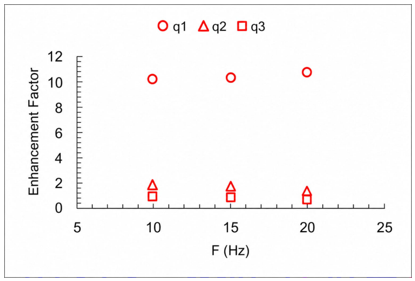
Following the separate amplitude and frequency analyses, EF was used to quantify the change in heat-transfer performance under mechanical vibration relative to the corresponding static condition at the same heat-flux level. Table 5 lists the calculated EF values, and Figure 7 plots them against vibration frequency. EF values greater than unity indicate improved heat-transfer performance relative to the static condition. In contrast, EF values below unity indicate that vibration did not enhance heat-transfer performance relative to the static baseline.
At $q_1^{\prime \prime}$, the EF was 10.17, 10.26, and 10.64 at 10, 15, and 20 Hz, respectively, indicating that the vibration-assisted Nusselt number was approximately 10.17–10.64 times greater than the corresponding static value.
At $q_2^{\prime \prime}$, the EF decreased from 1.691 at 10 Hz to 1.497 at 15 Hz and 0.986 at 20 Hz. These results indicated that vibration enhanced heat transfer at 10 and 15 Hz, whereas at 20 Hz the vibration-assisted Nusselt number was approximately 1.4% lower than the corresponding static value.
At $q_3^{\prime \prime}$, EF was approximately 0.783, 0.657, and 0.656 at 10, 15, and 20 Hz, respectively. These EF values corresponded to reductions in the frequency-based Nu of approximately 21.7%, 34.3%, and 34.4% relative to the corresponding static Nu.
Overall, EF decreased as the heat-flux level increased from $q_1^{\prime \prime}$ to $q_3^{\prime \prime}$. However, this trend applies only to the investigated low-frequency and micro-amplitude range.
Figure 7. Variation of enhancement factor (EF) with vibration frequency at three heat-flux levels
This experimental study evaluated the effect of low-frequency mechanical vibration on natural-convection heat transfer from a horizontal heated plate immersed in stagnant water. The principal findings within the investigated range are:
1. Under static conditions, Nu increased with the modified Rayleigh number. This trend indicated that increasing the heat flux strengthened buoyancy-driven natural-convection heat transfer from the heated plate to the surrounding water.
2. Under vibrating conditions, Nu responded non-monotonically to amplitude, indicating that the thermal response depended on the combined effects of heat flux, frequency, and amplitude rather than on amplitude alone.
3. The effect of vibration frequency depended on the heat-flux level. At the intermediate heat-flux level, the 10 Hz condition produced the highest frequency-based Nu within the tested range, whereas higher frequencies produced lower frequency-based Nu values.
4. EF decreased as the heat-flux level increased. It was highest at $q_1^{\prime \prime}$ and remained below unity at $q_3^{\prime \prime}$, indicating that vibration reduced Nu relative to the static condition at the highest heat-flux level.
5. Overall, the results indicated that Nu under vibration depended on the static Nu, vibration frequency, and amplitude. These findings are limited to stagnant water, the tested heat-flux levels, vibration frequencies of 10–20 Hz, and micro-amplitudes of 0.16–0.19 mm.
Conceptualization, Z.K.M., E.F.A. and I.J.H.; methodology, Z.K.M., E.F.A. and I.J.H.; validation, E.F.A. and I.J.H.; formal analysis, Z.K.M.; investigation, Z.K.M.; resources, Z.K.M.; data curation, Z.K.M.; writing—original draft preparation, Z.K.M.; writing—review and editing, E.F.A. and I.J.H.; visualization, Z.K.M.; supervision, E.F.A. and I.J.H.; project administration, E.F.A. All authors have read and agreed to the published version of the manuscript.
|
$A$ |
area, m2 |
|
$a$ |
vibration amplitude, mm |
|
$E F$ |
enhancement factor |
|
$f$ |
vibration frequency, Hz |
|
$G r_L^*$ |
modified Grashof number |
|
$g$ |
gravitational acceleration, m·s-2 |
|
$h$ |
heat transfer coefficient, W·m-2·℃-1 |
|
$I$ |
current, A |
|
$k$ |
thermal conductivity, W·m-1·℃-1 |
|
$L_C$ |
characteristic length, m |
|
$N u$ |
Nusselt number |
|
$N u_{\text {corr}}$ |
correlation-based Nusselt number |
|
$N u_{\text {static}}$ |
static Nusselt number |
|
$N u_{\text {static,exp}}$ |
experimental static Nusselt number |
|
$N u_{\text {vib}}$ |
Nusselt number under vibrating conditions |
|
$P$ |
power, W |
|
Per |
perimeter, m |
|
${Pr}$ |
Prandtl number |
|
$q^{\prime \prime}$ |
heat flux, W·m-2 |
|
$R a_L^*$ |
modified Rayleigh number |
|
$T_f$ |
film temperature, ℃ |
|
$T_s$ |
mean plate surface temperature, ℃ |
|
$T_{s, i}$ |
temperature measured by the $i$-th surface thermocouple, ℃ |
|
$T_{\infty}$ |
bulk-water temperature, ℃ |
|
ΔT |
temperature difference, ℃ |
|
$V$ |
potential difference, V |
|
Greek symbols |
|
|
$\beta$ |
thermal expansion coefficient, K-1 |
|
$v$ |
kinematic viscosity, m2·s-1 |
|
Subscripts |
|
|
corr |
correlation |
|
exp |
experimental |
|
$f$ |
film |
|
$i$ |
thermocouple index |
|
$s$ |
surface |
|
static |
static |
|
vib |
vibrating |
[1] Sreenivasan, K., Ramachandran, A. (1961). Effect of vibration on heat transfer from a horizontal cylinder to a normal air stream. International Journal of Heat and Mass Transfer, 3(1): 60-67. https://doi.org/10.1016/0017-9310(61)90006-0
[2] Klaczak, A. (1997). Report from experiments on heat transfer by forced vibrations of exchangers. Heat and Mass Transfer, 32(6): 477-480. https://doi.org/10.1007/s002310050148
[3] Murphy, K.D., Lambert Jr, T.A. (2000). Modal effects on the local heat transfer characteristics of a vibrating body. ASME Journal of Heat and Mass Transfer, 122(2): 233-239. https://doi.org/10.1115/1.521462
[4] Bronfenbrener, L., Grinis, L., Korin, E. (2001). Experimental study of heat transfer intensification under vibration condition. Chemical Engineering & Technology: Industrial Chemistry-Plant Equipment-Process Engineering-Biotechnology, 24(4): 367-371. https://doi.org/10.1002/1521-4125(200104)24:4%3C367::AID-CEAT367%3E3.0.CO;2-P
[5] Wang, Y., Sun, X., Li, L., et al. (2025). Vibration-induced heat transfer enhancement in additively manufactured Kelvin metal foam. Applied Thermal Engineering, 274: 126767. https://doi.org/10.1016/j.applthermaleng.2025.126767
[6] Gomaa, H., Al Taweel, A.M. (2005). Effect of oscillatory motion on heat transfer at vertical flat surfaces. International Journal of Heat and Mass Transfer, 48(8): 1494-1504. https://doi.org/10.1016/j.ijheatmasstransfer.2004.10.017
[7] Fu, W.S., Huang, C.P. (2006). Effects of a vibrational heat surface on natural convection in a vertical channel flow. International Journal of Heat and Mass Transfer, 49(7-8): 1340-1349. https://doi.org/10.1016/j.ijheatmasstransfer.2005.10.028
[8] Kim, H.J., Jeong, J.H. (2006). Numerical analysis of experimental observations for heat transfer augmentation by ultrasonic vibration. Heat Transfer Engineering, 27(2): 14-22. https://doi.org/10.1080/01457630500397161
[9] Eid, E.I., Gomaa, M.E. (2009). Influence of vibration in enhancement of heat transfer rates from thin plannar fins. Heat and Mass Transfer, 45(6): 713-726. https://doi.org/10.1007/s00231-008-0470-9
[10] Cheng, L., Luan, T., Du, W., Xu, M. (2009). Heat transfer enhancement by flow-induced vibration in heat exchangers. International Journal of Heat and Mass Transfer, 52(3-4): 1053-1057. https://doi.org/10.1016/j.ijheatmasstransfer.2008.05.037
[11] Park, K.T., Lee, J.W., Lee, M.G., Kim, H.J., Kim, D.K. (2014). Nusselt number correlation for vibration-assisted convection from vertically oriented plate fins. International Journal of Heat and Mass Transfer, 78: 522-526. https://doi.org/10.1016/j.ijheatmasstransfer.2014.07.015
[12] Akcay, S., Akdag, U., Palancioglu, H. (2020). Experimental investigation of mixed convection on an oscillating vertical flat plate. International Communications in Heat and Mass Transfer, 113: 104528. https://doi.org/10.1016/j.icheatmasstransfer.2020.104528
[13] Akcay, S., Akdag, U. (2021). Mixed convection heat transfer from a vertical flat plate subjected to periodic oscillations. Journal of Thermal Engineering, 7(6): 1377-1391. https://doi.org/10.18186/thermal.990687
[14] Idan, M.F., Ramadhan, A.A. (2023). An experimental study to show the effect of forced vertical vibrations on the thermal heat transfer coefficient of a flat plate. Beni-Suef University Journal of Basic and Applied Sciences, 12(1): 55. https://doi.org/10.1186/s43088-023-00394-5
[15] Khudhair, B.K., Saleh, A.M., Ekaid, A.L. (2023). An experimental study of forced vibration on natural convection between closed ended concentric and eccentric annular of horizontal cylinder. Diagnostyka, 24(2): 2023112. https://doi.org/10.29354/diag/165931
[16] Abedallh, A.S., Alomar, O.R., Yasin, N.J. (2024). Numerical and experimental investigation on mixed convection heat transfer inside cavity heated from below with reciprocating moving upper surface. International Communications in Heat and Mass Transfer, 159: 108242. https://doi.org/10.1016/j.icheatmasstransfer.2024.108242
[17] Bhattacharyya, S., Bhatt, T., Vishwakarma, D.K., Benim, A.C., Abraham, J. (2025). Effect of mechanical vibration and its influence on thermal performance of a nanofluid heat exchanger. Numerical Heat Transfer, Part A: Applications, 86(16): 5492-5515. https://doi.org/10.1080/10407782.2024.2331589
[18] Fu, Y., Liu, W., Wang, J., et al. (2024). Experimental investigation on heat transfer enhancement of supercritical pressure aviation kerosene in tubular laminar flow by vibration. Applied Thermal Engineering, 257: 124206. https://doi.org/10.1016/j.applthermaleng.2024.124206
[19] Agag, N.M., Ali, Y.H., Yousif, Q.A. (2025). Experimental study of effect vertical vibration on heat transfer of vehicle radiator. International Journal of Computational Methods and Experimental Measurements, 13(4): 1032-1047. https://doi.org/10.56578/ijcmem130419
[20] Bergman, T.L., Lavine, A.S., Incropera, F.P., DeWitt, D.P. (2018). Fundamentals of Heat and Mass Transfer (8th ed.). Wiley.
[21] Çengel, Y.A., Ghajar, A.J. (2015). Heat and Mass Transfer: Fundamentals and Applications (5th ed.). McGraw-Hill Education.
[22] Serway, R.A., Jewett, J.W. (2014). Physics for Scientists and Engineers with Modern Physics (9th ed.). Cengage Learning.
[23] Kozanoglu, B., Rubio, F. (2014). The characteristic length on natural convection from a horizontal heated plate facing downwards. Thermal Science, 18(2): 555-561. https://doi.org/10.2298/TSCI110127087K
[24] Holman, J.P. (2012). Experimental Methods for Engineers (8th ed.). McGraw-Hill.
[25] Figliola, R.S., Beasley, D.E. (2011). Theory and Design for Mechanical Measurements (5th ed.). Wiley.