Djamal Embarek* | Djamel Chaouch
© 2026 The authors. This article is published by IIETA and is licensed under the CC BY 4.0 license (http://creativecommons.org/licenses/by/4.0/).
OPEN ACCESS
This study presents a comprehensive experimental investigation of the influence of heat treatments on the tensile mechanical properties of 42CrMo4 steel, a chromium-molybdenum alloy widely used in engineering applications requiring high strength and optimal toughness. Despite extensive prior work on this alloy, the quantitative strength–ductility trade-off across a systematic tempering range remains insufficiently documented. The specimens were subjected to oil quenching at 850 ℃ followed by tempering at different temperatures (200 ℃, 400 ℃, 500 ℃ and 600 ℃), in accordance with ISO 6892-1 standard. The mechanical properties were evaluated by tensile tests on normalized cylindrical specimens, enabling the extraction of yield strength, ultimate tensile strength, elongation at fracture, and reduction of area. Stress-strain curves reveal significant variations in strength and ductility with tempering temperature. A correlation between microstructural mechanisms and tensile properties is established to identify optimal conditions for different high-performance industrial applications.
42CrMo4 steel, ductility, heat treatment, mechanical strength, stress-strain curve, tensile test
42CrMo4 steel, a low-alloy chromium-molybdenum steel, equivalent to AISI 4140, is widely utilized in engineering applications requiring high strength, toughness, and resistance to wear, such as shafts, gears, crankshafts, and structural components. The mechanical and structural properties of this steel are profoundly affected by thermomechanical processing, which can optimize its performance under elevated temperatures and strain rates [1]. In drive technology, high-strength tempered 42CrMo4 steel has been explored for its suitability in shafts, demonstrating that lower tempering temperatures (around 400 ℃) can significantly increase fatigue strength by up to 51% compared to conventional standard assumptions, albeit with reduced impact toughness [2]. Beyond these traditional applications, structural steel is also increasingly considered in thermal engineering systems, such as water-cooled heat sinks, where its mechanical strength and corrosion resistance are evaluated in comparison with aluminum [3].
The relationship between heat treatment parameters and tensile properties of 42CrMo4 steel has been extensively investigated in recent years. Zhang et al. [4] systematically examined the effect of tempering temperature on microstructure and mechanical properties, confirming that low-temperature tempering (200 ℃) preserves a fine-needle martensitic structure with submicroscopic ε-carbide particles, while higher temperatures lead to coarser cementite formation and progressive softening. Ji et al. [5] provided detailed Scanning Electron Microscopy (SEM) and Electron Backscatter Diffraction (EBSD) evidence of martensite decomposition across the tempering range 550–590 ℃, demonstrating that dislocation density decreases and grain boundary character evolves from low-angle to high-angle boundaries as tempering temperature increases. Liang et al. [6] investigated secondary tempering effects on 42CrMo4M steel using optical microscopy, SEM, and Transmission Electron Microscopy (TEM), revealing that carbide spheroidization proceeds in two distinct stages—first length reduction (300–600 nm to 150–200 nm), then width coarsening—which directly governs the strength-ductility balance. Szala et al. [7] employed SEM/Energy-Dispersive X-ray Spectroscopy (EDS) and X-ray Diffraction (XRD) analysis to characterize the microstructural evolution of annealed 42CrMo4 steel, establishing quantitative links between carbide morphology and hardness variation. These trends are corroborated by complementary studies: Simunovic et al. [8] reported a strong correlation between hardness and microstructural evolution across a comparable quenching-tempering sequence, Thakare et al. [9] observed similar mechanical property improvements in 42CrMo4 steel through a related thermomechanical processing route, and Ivković et al. [10] found an analogous tempering-temperature dependence of strength and ductility in the related G42CrMo4 cast steel grade. More broadly, Murugesan et al. [11] examined the influence of hardening and tempering temperatures on the mechanical behavior of alloy steels in general, consistent with the trends observed here. This pursuit of enhanced mechanical performance through alloy design also extends to more recent alloy classes, such as high-entropy alloys, where compositional and microstructural optimization strategies have been shown to substantially improve strength and other performance metrics [12].
Despite this substantial body of research, several gaps remain in the current understanding of 42CrMo4 steel behavior under tensile loading. First, most existing studies have focused on relatively broad tempering temperature ranges (e.g., 450–600 ℃ or 570–720 ℃) with limited intermediate points, leaving the transition regimes—particularly around 400 ℃ and 500 ℃—less characterized. Second, while individual studies report hardness or tensile data, the quantitative correlation between hardness evolution and tensile property variation across the full tempering spectrum has not been systematically established for this steel grade. Third, the specific tempering conditions that optimize the strength-ductility balance for different industrial applications remain to be precisely defined, particularly in relation to the secondary hardening phenomenon observed around 200 ℃. Fourth, many recent publications have emphasized hydrogen embrittlement [13] or fatigue behavior [14, 15] rather than conventional tensile response after standard quenching and tempering, creating a relative shortage of comprehensive tensile data for design purposes.
The present study addresses these gaps by conducting a systematic experimental investigation of the tensile behavior of 42CrMo4 steel subjected to oil quenching at 850 ℃ followed by tempering at four distinct temperatures: 200 ℃, 400 ℃, 500 ℃, and 600 ℃. This selection covers the full spectrum from low-temperature tempering (preserving high hardness with secondary hardening effects) through medium-temperature tempering (producing troostite with optimal strength-ductility balance) to high-temperature tempering (yielding sorbitic structures with enhanced ductility). A control group in the as-received ferritic-pearlitic state is included for baseline comparison. The specific contributions of this work relative to existing literature are threefold: (i) it provides detailed stress-strain curves and mechanical property data at tempering temperatures (400 ℃ and 500 ℃) that bracket the reported optimum for fatigue resistance [2], enabling direct comparison with published industrial standards; (ii) it establishes a quantitative hardness–tensile strength correlation across all tested conditions, supported by statistical analysis of three replicate tests per condition; and (iii) it offers practical, evidence-based recommendations for selecting tempering parameters according to specific industrial requirements, grounded directly in the experimental results rather than general metallurgical principles. The findings are expected to inform rational material selection and heat treatment optimization for high-performance mechanical components.
2.1 Material and specimen preparation
The steel used in this study is 42CrMo4 steel according to AFNOR NF EN 10083-1 standard. The chemical composition of the material is presented in Table 1.
The tensile specimens were taken from cylindrical bars of 20 mm diameter by machining. The specimen geometry corresponds to the standardized form defined by the ISO 6892-1 standard, with a gauge length of 50 mm and a diameter of 10 mm in the calibrated section. This geometry ensures uniform stress distribution in the deformation zone and enables obtaining reproducible and comparable results.
Table 1. Chemical composition of 42CrMo4 steel (weight percentage)
|
Element |
C |
Si |
Mn |
P |
S |
Cr |
Mo |
Cu |
|
Min (%) |
0.38 |
0.15 |
0.50 |
- |
- |
0.90 |
0.15 |
- |
|
Max (%) |
0.45 |
0.30 |
0.80 |
0.035 |
0.035 |
1.20 |
0.30 |
0.30 |
2.2 Heat treatment protocol
The heat treatment was carried out according to a rigorous protocol to ensure reproducibility of results. Quenching consisted of heating at 850 ℃ for 30 minutes to ensure complete austenitization of the steel, followed by rapid cooling in an oil bath at room temperature. This process enables obtaining a homogeneous martensitic structure throughout the specimen section. The cooling rate was controlled to avoid the formation of intermediate structures such as bainite, which could modify the mechanical properties.
After quenching, the specimens were divided into five groups to undergo different tempering treatments. The selected tempering temperatures are: 200 ℃, 400 ℃, 500 ℃, and 600 ℃. Each tempering was maintained for 30 minutes, followed by air cooling. This protocol enables studying the evolution of tensile properties as a function of tempering temperature and determining optimal conditions for different industrial applications. A control group was kept in the as-received state (without heat treatment) to serve as reference.
2.3 Tensile testing protocol
The tensile tests were performed on a hydraulic universal testing machine with a capacity of 600 kN.
Table 2. Mechanical properties extracted from tensile tests (Rm: maximum strength, A: elongation at fracture)
|
Heat Treatment |
Rm (MPa) |
A (%) |
Re (MPa) |
Z (%) |
Observations |
|
As-received |
1123 ± 12 |
20.5 ± 0.8 |
685 ± 15 |
52 ± 2 |
Yield plateau |
|
Quenched 850 ℃ |
1248 ± 18 |
11.2 ± 0.5 |
1050 ± 20 |
38 ± 3 |
No plateau, brittle |
|
Tempered 200 ℃ |
1405 ± 22 |
15.9 ± 0.6 |
1250 ± 25 |
45 ± 2 |
Secondary hardening |
|
Tempered 400 ℃ |
1497 ± 15 |
16.9 ± 0.7 |
1320 ± 18 |
48 ± 2 |
Optimum strength-ductility |
|
Tempered 500 ℃ |
1249 ± 14 |
20.0 ± 0.9 |
1100 ± 16 |
55 ± 2 |
Sorbitic structure |
|
Tempered 600 ℃ |
1076 ± 16 |
19.3 ± 0.8 |
950 ± 15 |
58 ± 2 |
High ductility |
For each heat treatment condition, three tests were conducted to verify result reproducibility. The mean values and standard deviations of yield strength (Re), ultimate tensile strength (Rm), elongation at fracture (A), and reduction of area (Z) are reported in Table 2. Stress-strain curves were plotted using raw data acquired by the acquisition system. Stress was calculated by dividing the force by the initial cross-section of the specimen, while strain was obtained by dividing the elongation by the initial gauge length. The extracted mechanical parameters include: yield strength (Re), ultimate tensile strength (Rm), elongation at fracture (A), and reduction of area (Z).
3.1 Analysis of stress-strain curves
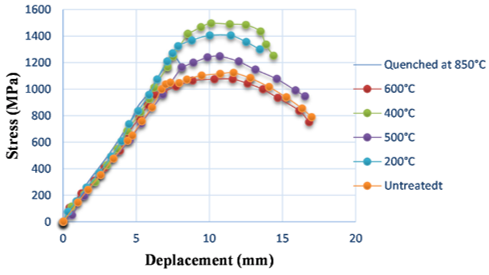
The stress-strain curves obtained for the different heat treatment conditions are presented in Figure 1. Comparative analysis of these curves reveals significant differences in the mechanical behavior of the steel according to the treatment undergone. These differences reflect the microstructural modifications induced by quenching and tempering, and enable the identification of optimal conditions for each type of industrial application.
The as-received specimen exhibits a curve characteristic of a ferritic-pearlitic steel with classical elastoplastic behavior. A well-defined linear elastic zone is observed, followed by a yield plateau corresponding to the transition between elastic and plastic domains. This plateau, typical of mild and medium-hard steels, results from the release of dislocations trapped by carbon and nitrogen atoms. After the plateau, the curve shows progressive work hardening up to maximum stress, followed by localized necking and fracture. The total elongation at fracture reaches 20.5%, reflecting good ductility of the steel in its delivery state.
Figure 1. Stress-strain curves for different heat treatments applied to 42CrMo4 steel
After quenching at 850 ℃, the tensile behavior is radically modified. The curve no longer shows a yield plateau, which is characteristic of martensitic structures. The initial slope of the curve is steeper, indicating a higher apparent Young's modulus. However, the plastic domain is considerably reduced, with elongation at fracture of only 11.2%. This brittleness results from high internal stresses generated by the martensitic transformation and the deformed tetragonal structure of martensite. The maximum strength reaches approximately 1248 MPa, which represents a significant improvement compared to the as-received state, but at the cost of reduced ductility.
3.2 Influence of tempering temperature on tensile behavior
Tempering progressively modifies the tensile behavior of quenched steel. At 200 ℃, a slight improvement in ductility is observed compared to the quenched state, with elongation increasing from 11.2% to approximately 16%. This improvement results from partial relaxation of internal stresses and the beginning of martensite decomposition. The maximum strength remains high (approximately 1405 MPa), indicating that secondary hardening by fine carbide precipitation partially compensates for matrix softening.
At 400 ℃, the material presents the best compromise between strength and ductility. The maximum strength reaches 1497 MPa, the highest value among all tested conditions, while elongation is maintained at 16.9%. This condition corresponds to an optimum for many industrial applications requiring both good mechanical strength and sufficient toughness. The microstructure at this stage is composed of troostite, a mixture of ferrite and fine carbides, which combines the advantages of martensite (strength) and ferrite (ductility).
3.3 Deformation mechanisms and microstructure-properties correlation
Interpretation of tensile curves requires understanding of deformation mechanisms at the microstructural scale. In the as-received state, the ferritic-pearlitic structure presents zones of ductile ferrite and more resistant pearlite lamellae. Plastic deformation initiates in ferrite, then progressively propagates to pearlitic zones. The observed yield plateau corresponds to dislocation unlocking from interstitial atom clouds (carbon, nitrogen) that trap them due to their elastic stress fields.
In the quenched state, the martensitic structure is characterized by a very high dislocation density and high internal stresses resulting from the diffusionless transformation of austenite to martensite. These internal stresses, as well as the carbon supersaturation of martensite, considerably limit dislocation mobility, explaining the low ductility observed. The absence of a yield plateau is due to the fact that dislocations are already strongly constrained and cannot move cooperatively.
Tempering enables progressive relaxation of these internal stresses and controlled precipitation of carbides. At low temperature (200 ℃), the observed secondary hardening results from precipitation of fine molybdenum (Mo₂C) and chromium carbides that reinforce the matrix by the Orowan effect. At higher temperatures (400–600 ℃), carbide coalescence and matrix recovery lead to progressive softening but improved ductility. These microstructural transformations explain the experimentally observed evolution of tensile properties.
It should be noted that the microstructural interpretations presented above are based on established metallurgical literature [16, 17] and are consistent with the microstructural observations reported for 42CrMo4 steel subjected to various heat-treatment conditions [18], as well as with the general metallurgical knowledge of quenched-and-tempered low-alloy steels. Direct microstructural characterization (optical microscopy, SEM, or TEM) was not performed in this study. Future work should include such characterization to experimentally validate the proposed mechanisms.
3.4 Correlation between hardness and tensile properties
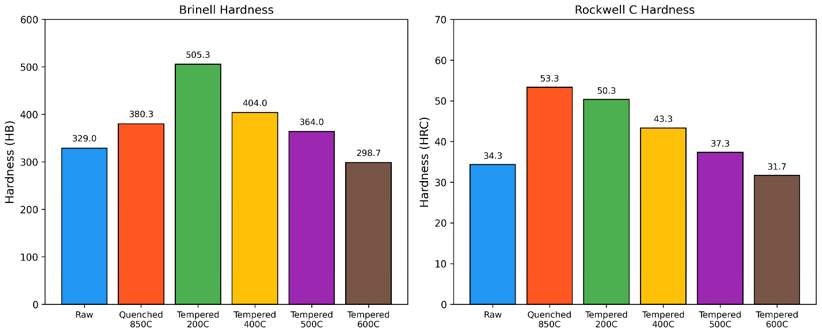
Hardness measurements usefully complement tensile tests. Figure 2 presents the evolution of hardness as a function of heat treatment. A good correlation between hardness and tensile strength is observed, as shown by comparing Tables 2 and 3. This correlation is explained by the fact that both quantities depend on resistance to dislocation glide, itself governed by microstructure.
Figure 2. Evolution of Brinell: (a) and Rockwell C, (b) hardness as a function of heat treatment
Table 3. Brinell hardness (HB) measurement results for different heat treatments
|
Treatment |
Test 01 |
Test 02 |
Test 03 |
Mean HB |
|
As-received |
329 |
329 |
329 |
329.00 |
|
Quenched 850 ℃ |
383 |
383 |
375 |
380.33 |
|
Tempered 200 ℃ |
507 |
507 |
502 |
505.33 |
|
Tempered 400 ℃ |
404 |
404 |
404 |
404.00 |
|
Tempered 500 ℃ |
363 |
363 |
366 |
364.00 |
|
Tempered 600 ℃ |
298 |
298 |
300 |
298.66 |
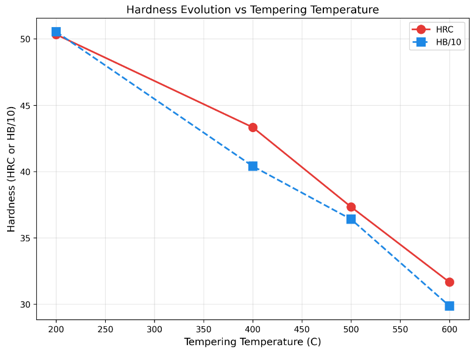
Figure 3 presents more specifically the evolution of hardness as a function of tempering temperature, showing a progressive decrease in hardness with increasing tempering temperature.
Figure 3. Evolution of hardness as a function of tempering temperature
3.5 Quantitative hardness–tensile strength correlation
To move beyond the qualitative observation in Section 3.4, a linear regression was performed on the mean hardness (HB) and ultimate tensile strength (Rm) data from Tables 2 and 3. The fitted relationship, excluding the 200 ℃ condition where secondary hardening by fine carbide precipitation disproportionately increases hardness relative to tensile strength, is:
Rm (MPa) = 3.608 × HB − 42.9 (R² = 0.8502, p = 0.026)
This correlation is consistent with the general trend reported for quenched-and-tempered low-alloy steels, where tensile strength scales approximately linearly with Brinell hardness in the range 250–550 HB [16]. The coefficient of determination (R² = 0.8502) confirms that hardness can serve as a reliable proxy for tensile strength in quality-control applications, provided the secondary hardening regime is treated separately. The 200 ℃ condition (Rm = 1405 MPa, HB = 505) deviates from this trend because fine Mo₂C and Cr-carbide precipitation increases hardness more than tensile strength, a well-documented phenomenon in low-alloy steels [5, 6].
3.6 Comparison with published literature data
Table 4 compares the present tensile results with published data for 42CrMo4 steel under comparable heat treatment conditions. The values obtained in this study fall within the ranges reported by Çalık et al. [19] (quenched at 860 ℃, tempered 480–570 ℃) and by EN 10083-3 for QT condition (Rm = 900–1200 MPa, depending on section size) [20], with a closely converging range also compiled by Xia [21] in an independent engineering materials database. The as-quenched strength (1248 MPa) and the 400 ℃ tempered peak (1497 MPa) are slightly above the standard ranges, which can be attributed to the smaller specimen diameter (10 mm) and shorter tempering time (30 min) used here.
Table 4. Comparison of tensile properties with literature data for 42CrMo4 steel under comparable heat treatment conditions
|
Condition |
This Study Rm (MPa) |
Çalık et al. [19] Rm (MPa) |
EN 10083-3 (Thyssenkrupp) Rm (MPa) |
Rapid-Protos 2025 Rm (MPa) |
|
As-received |
1123 |
940 (untreated) |
800–950 (Ø >100 mm) |
800–950 (normalized) |
|
Quenched |
1248 |
1194 (oil quenched) |
>1200 (Ø ≤16 mm) |
>1200 (martensite, oil quenched) |
|
Tempered 400–500 ℃ |
1249–1497 |
1157 (480 ℃), 1147 (500 ℃) |
1100–1250 (Ø ≤16 mm) |
1100–1250 (tempered 500–550 ℃) |
|
Tempered 500–600 ℃ |
1076–1249 |
1116 (530 ℃), 1115 (550 ℃), 1113 (570 ℃) |
900–1100 (Ø 40–100 mm) |
950–1100 (tempered 550–600 ℃) |
|
Tempered 600 ℃ |
1076 |
— |
750–900 (Ø 160–250 mm) |
850–950 (tempered 600–650 ℃) |
This study characterized the tensile behavior of 42CrMo4 steel across six heat treatment conditions. The main findings are:
(1) Oil quenching at 850 ℃ eliminates the yield plateau and reduces elongation from 20.5% to 11.2%, while raising hardness from 329 HB to 380 HB.
(2) Tempering at 200 ℃ produces secondary hardening (Rm = 1405 MPa, HB = 505) through fine carbide precipitation.
(3) The 400 ℃ tempering condition offers the best strength–ductility compromise (Rm = 1497 MPa, A = 16.9%), corresponding to a troostitic microstructure.
(4) At 500–600 ℃, carbide coalescence and matrix recovery reduce strength (Rm = 1076 MPa at 600 ℃) but restore high ductility (A = 19.3–20.0%).
(5) A linear correlation Rm = 3.608 × HB − 42.9 (R² = 0.8502) was established for the non-secondary-hardening regime, enabling hardness-based strength estimation for quality control.
These results provide quantitative data for selecting heat treatment protocols according to specific mechanical requirements. Components requiring maximum strength should be tempered at 400 ℃. Those needing higher toughness may use 500–600 ℃ tempering. Future work should include direct microstructural characterization (OM, SEM, TEM) to validate the proposed deformation mechanisms, as well as fatigue and fracture toughness testing under the same heat treatment conditions. Numerical approaches such as finite element simulation coupled with stochastic optimization could also usefully complement experimental characterization by predicting the influence of heat treatment parameters prior to testing.
|
A |
elongation at fracture, % |
|
HB |
Brinell hardness |
|
HRC |
Rockwell C hardness |
|
Re |
yield strength, MPa |
|
Rm |
ultimate tensile strength (maximum strength), MPa |
|
Z |
reduction of area, % |
[1] Pop, M., Sas-Boca, I.M., Frunză, D., Popa, F., Neag, A. (2024). Influence of hot deformation on mechanical and structural properties of 42CrMo4 steel. Metals, 14(6): 647. https://doi.org/10.3390/met14060647
[2] Ulrich, C., Günther, S., Becker, N., et al. (2025). High strength tempered 42CrMo4 for shafts in drive technology. Forschung im Ingenieurwesen, 89: 59. https://doi.org/10.1007/s10010-025-00818-x
[3] Hanan, D.F., Lazuardi, G.M., Trisnoaji, Y., et al. (2024). Thermal and hydrodynamic performance analysis of water-cooled heat sinks using aluminum and structural steel materials. Power Engineering and Engineering Thermophysics, 3(3): 176-188. https://doi.org/10.56578/peet030303
[4] Zhang, Y., Zhao, H., Liu, P.K., Wei, M.H., Lu, Y., Liu, Z.Q. (2023). Effect of tempering temperature on the microstructure and mechanical properties of 42CrMo4 steel. Journal of Physics: Conference Series, 2459: 012044. https://doi.org/10.1088/1742-6596/2459/1/012044
[5] Ji, M., Weng, H., Zhu, X., Lu, X., Wang, J. (2026). Effect of tempering temperature on microstructure and mechanical properties of 42CrMo steel. Heat Treatment of Metals, 51(1): 214-220. http://www.jsrcl.net/CN/Y2026/V51/I1/214.
[6] Liang, Y.X., Cai, X., Zheng, L.G., Hu, X.Q., Li, D.Z. (2023). Effect of secondary tempering on microstructure and properties of 42CrMo4M steel. Transactions of Materials and Heat Treatment, 44(8): 106-114.
[7] Szala, M., Winiarski, G., Wójcik, Ł., Bulzak, T. (2020). Effect of annealing time and temperature parameters on the microstructure, hardness, and strain-hardening coefficients of 42CrMo4 steel. Materials, 13(9): 2022. https://doi.org/10.3390/ma13092022
[8] Simunovic, S., Milinović, A., Kladarić, I., Mijic, J. (2024). The influence of quenching and tempering on the hardness and microstructure of 42CrMo4 steel. MM Science Journal, 7950-7955. https://doi.org/10.17973/MMSJ.2024_12_2024131
[9] Thakare, A.S., Butee, S.P., Kamble, K.R. (2020). Improvement in mechanical properties of 42CrMo4 steel through novel thermomechanical processing treatment. Metallography, Microstructure, and Analysis, 9: 759-773. https://doi.org/10.1007/s13632-020-00684-9
[10] Ivković, Đ., Arsić, D., Mitrović, A., et al. (2024). Influence of tempering temperature on mechanical properties of G42CrMo4 cast steel. In 11th International Scientific Conference on Defensive Technologies - OTEH 2024, Tara, Serbia, pp. 452-456. https://doi.org/10.5937/OTEH24081I
[11] Murugesan, V., Ganesan, D., Tarigonda, H. (2025). Effect of hardening and tempering temperatures on mechanical behavior of alloy steel. In Advances in Design, Materials, Manufacturing and Surface Engineering for Mobility (ADMMS’25), Chennai, India. https://doi.org/10.4271/2025-28-0027
[12] Wang, X., Luo, J., Ma, R., Wang, K. (2024). Progress in high-entropy alloy performance enhancement. Power Engineering and Engineering Thermophysics, 3(1): 10-27. https://doi.org/10.56578/peet030102
[13] Imdad, A., Arniella, V., Zafra, A., Belzunce, J. (2024). Tensile behaviour of 42CrMo4 steel submitted to annealed, normalized, and quench and tempering heat treatments with in-situ hydrogen charging. International Journal of Hydrogen Energy, 50(Pt A): 270-280. https://doi.org/10.1016/j.ijhydene.2023.10.082
[14] Schmiedel, A., Kirste, T., Morgenstern, R., Weidner, A., Biermann, H. (2024). Fatigue lives and damage mechanisms at elevated temperatures of steel 42CrMo4 in the HCF and VHCF regime. In Multifunctional Ceramic Filter Systems for Metal Melt Filtration. Springer Series in Materials Science, Springer, Cham, pp. 853-878. https://doi.org/10.1007/978-3-031-40930-1_34
[15] Delova, I., Borisov, T., Mirchev, Y., Raychev, R. (2025). Numerical modeling and analysis of fatigue failure in 42CrMo4 steel pivot bolts at different heat treatments. Engineering Proceedings, 100(1): 52. https://doi.org/10.3390/engproc2025100052
[16] Tabor, D. (2000). The Hardness of Metals. Oxford University Press, Oxford, UK. https://doi.org/10.1093/oso/9780198507765.001.0001
[17] Atay, G.Y., Bilgiç, N. (2023). Investigation of the microstructure and mechanical properties of heat-treated 42CrMoS4 steel. Journal of Materials Engineering and Performance, 33: 13265-13273. https://doi.org/10.1007/s11665-023-08908-z
[18] Çeltik, C., Yürektürk, Y. (2022). Microstructure and wear properties of 42CrMo4 steel prepared by various heat treatment methods. In 31st International Conference on Metallurgy and Materials, Orea Congress Hotel Brno, Czech Republic, EU, pp. 388-394. https://doi.org/10.37904/metal.2022.4404
[19] Çalık, A., Dokuzlar, O., Uçar, N. (2020). The effect of heat treatment on mechanical properties of 42CrMo4 steel. Journal of Achievements in Materials and Manufacturing Engineering, 98(1): 5-10. https://doi.org/10.5604/01.3001.0014.0811
[20] Thyssenkrupp Materials. (2021). 42CrMo4 / 1.7225 Technical datasheet according to EN 10083-3. Thyssenkrupp Materials Schweiz, May 2021.
[21] Xia G. (2025). 1.7225 Steel (42CrMo4): Comprehensive Engineering Guide to Properties, Heat Treatment, and Applications. Rapid-Protos Materials Database, Nov. 2025.