Hanan K. Kadhim | Sarmad A. Ali* | Dhay S. Naji
© 2026 The authors. This article is published by IIETA and is licensed under the CC BY 4.0 license (http://creativecommons.org/licenses/by/4.0/).
OPEN ACCESS
Natural convection heat transfer in closed cavities is an important phenomenon in many engineering applications, notably electronic cooling and thermal insulation systems. Regardless of the heat source, the heat transfer and flow patterns inside these cavities are highly dependent upon the heat transfer surfaces, their geometries, as well as the internal flow conditions. This work presents a numerical study on natural convection heat transfer along a closed square cavity of (L = H = 1 m) with chamfered sides. In the middle, it has an inner cylinder with different geometric shapes like square, circular, ellipse, and rhombus, keeping the same hydraulic diameter for all shapes. Two-dimensional numerical simulations were conducted in ANSYS Fluent with (k–ω) model turbulent flow in high Ra (109 ≤ Ra ≤ 1012) conditions. The objective of the analysis is to investigate the influence of both the shape of the inner cylinder and different Rayleigh values on the heat transfer coefficient represented by the Nusselt number. Changes in geometry were correlated with the resulting flow patterns and thermal properties in the cavity by analyzing thermal distribution, pressure distribution, and streamlines in the cavity. The results indicate that the geometric shape of the cylinder strongly influences the heat transfer enhancement and that certain shapes outperform the rest in convective heat transfer performance, suggesting that the internal flow pattern and thermal field played an important role.
finite volume method, heated cylinder, computational fluid dynamics, hybrid nanofluid, thermal energy storage units, solar energy systems, Rayleigh number, Nusselt number
Natural convective heat transfer is an essential physical phenomenon that is involved in a myriad of engineering and natural applications since it arises from the temperature difference, which results in generating natural motion of fluids without external sources to activate motion. Such a type of convection is of utmost importance when dealing with closure systems like different engineering cavities, because it has a significant influence on device and electronics heat removal, solar energy systems, and thermal reactors. Over the past few years, hybrid nanofluids, which are basic fluids reinforced with nanoparticles of different types, have shown much higher effectiveness as heat transfer fluids due to their superior thermal properties, which are characterized by high thermal conductivity and changed viscosity. The flow characteristics and heat transfer characteristics of these fluids passed into cavitation in various geometric shapes are affected by several parameters, such as The Geometric Shape of the cavity, the nano-fluid properties, and the direction of heating. Hence, investigating the interaction of hybrid nanofluid flow with natural load within such environments is an important milestone to design thermal systems that are more efficient and sustainable [1-6]. Several researchers have conducted previous studies on natural convection heat transfer inside cavities filled with nanomaterials, as these researchers have shown that the addition of nanoparticles to basic liquids leads to a clear improvement in thermal performance. Studies have focused on the influence of particle type, concentration, and different cavity shapes on heat transfer rates, contributing to the construction of an important knowledge base to support advanced thermal applications. In the research of Bhuiyana et al. [7], a numerical study of natural convection heat transfer was conducted within a square cavity filled with a nanofluid and partially heated from below, while the other walls remained cold. The study used the finite element method (Galerkin method) with various types of nanoparticles, Rayleigh numbers between 103 and 106, and particle volume ratios up to 0.2. The results showed a significant improvement in heat transfer with increasing particle concentration, with a clear dependence on the type of nanofluid used. Qasem et al. [8] investigated the effect of thermal radiation on free convection inside a differentially heated cavity containing a square solid mass in the center, using a copper-water nanofluid. The mass, momentum, and energy equations were solved using the finite-difference method, with the internal surfaces considered as emitting and reflecting radiation. The influence of the Rayleigh number (from 103 to 106), the nanoparticle fraction (up to 0.04), and the radiation coefficient (from 0 to 10) was studied. The results showed that the local and average Nusselt values increased with increasing Rayleigh number and volume fraction, and that temperatures also increased with increasing radiation flux. Sharifpur et al. [9] conducted an experimental study of natural convection heat transfer using a deionized zinc oxide (ZnO) nanofluid in a rectangular cavity. The stability of the fluid was tested using spectroscopy and zeta potential measurements, and the analysis was performed within the Rayleigh number range of 7.45 × 10⁷ to 9.20 × 10⁸. The results showed that a 0.10% by volume ZnO concentration enhanced the heat transfer coefficient by 9.14% compared to pure water, while increasing the concentration degraded the thermal performance. Sheikhzadeh et al. [10] conducted a numerical study to analyze the effect of SiO₂ nanoparticle shape and concentration on natural convection heat transfer within a square partitioned cavity using a water–SiO₂ nanofluid. Various particle shapes (e.g., spherical, cylindrical, and plate-shaped) were studied at concentrations between 2% and 4%, with Rayleigh numbers between 105 and 107 and different partition heights. The results showed that the Rayleigh number and partition height significantly affect the streamlines and temperature distribution, and that the average Nusselt number increases with increasing Rayleigh number regardless of particle shape. Alipanah et al. [11] studied entropy generation in a square cavity using an Al₂O₃-water nanofluid under natural convection and sidewall temperature variations. The study covered Rayleigh numbers between 104 and 107 and nanofluid concentrations down to 0.05. The results showed that the nanofluid generated greater entropy and heat transfer than the pure fluid, with the lowest entropy and Nusselt number values recorded for the pure fluid. Khalili et al. [12] conducted an experimental study to investigate the inhomogeneous distribution of nanoparticles within a square cavity during natural convection heat transfer using an Al₂O₃-water nanofluid. The particle concentration was fixed at 1%, and the effect of different Rayleigh numbers was studied. The results showed clear differences in the particle distribution, increasing with increasing Rayleigh number. Fluid motion played a major role in this variation, confirming the inhomogeneity of the distribution within the cavity. Solomon et al. [13] studied the effect of the dimensional ratio of a rectangular cavity on heat transfer by natural convection using Al2O3 nanofluids-water and deionized water. The results showed that the dimensional ratio significantly affects the heat transfer coefficient and the Nusselt number, and the optimal concentration of nanoparticles varies depending on The Shape of the cavity, with a pronounced effect also of the Rayleigh number on thermal performance and buoyancy. In the context of developing thermal cooling technologies and improving the efficiency of natural convection heat transfer, previous studies have demonstrated the effectiveness of using nanofluids within closed or inclined cavities, whether filled with fluid alone or with porous layers. Experiments have shown that adding nanoparticles such as ZnO, Al₂O₃, Cu, and SiO₂ at low volume fractions significantly improves thermal performance, especially at low Rayleigh numbers. The results also revealed that the shape and location of the heat source, the presence of porous layers, and varying particle properties all affect the intensity of convection and the direction of fluid flow. Various numerical methods, such as the volumetric method and the finite element method, have been used to analyze the thermal and kinetic patterns within these cavities. Most studies have concluded that there is an optimal limit for nanoparticle concentrations that achieves the highest heat transfer efficiency without disrupting fluid stability or causing increased entropy generation [14-21]. However, hybrid nanofluids have been attracted for better heat transfer by natural convection inside closed square cavities, because of its high potential to improve the thermal properties of the fluid, such studies recently revealed that a mixture of the Al2O3-Cu nanoparticles in the base Water has considerable ability to increase the Nusselt number, especially at high Rayleigh numbers which increase the efficiency of passive cooling systems relying on natural convection [22, 23]. Gul et al. [24] performed the numerical analysis of natural convection heat transfer in a permeable chamber containing a Cu + Al₂O₃/H₂O hybrid nanofluid under the influence of a magnetic field using the finite volume method. The focus was on the effects of the nanoparticle ratio, Rayleigh number, Hartmann number, and porosity coefficient on improving the heat flow and transfer within the chamber. The results showed that increasing the nanoparticle concentration enhances convective heat transfer within the chamber, and that higher Rayleigh and Darcy numbers improve the thermal performance of the system, while the effect of porosity was limited. It was also shown that clockwise flow rotation contributes to better heat distribution and that hybrid nanofluids outperform conventional fluids in improving overall thermal properties.
The purpose of this study is to investigate the behavior of natural convection heat transfer and hybrid nanofluid (SWCNT + MgO / Water) flow distribution inside a closed square cavity that has three different geometrically shaped heated inner cylinders, while considering the effect of a moving upper wall with a constant velocity. This is of interest in the sense of studying the influence of the cylinder's geometric shape on the fluid flow structure and shape of flow lines (in terms of the following cylinder geometries: square, rectangular, circular, ellipse, and rhombus). Investigate the temperature distribution within the cavity and its impact on the thermal conductivity performance. A hybrid nanofluid for enhanced thermal systems, thermal performance measurement, and analysis in a closed geometry. It also helps in the better design of thermal structures for cooling systems, electronic devices, or heat exchangers.
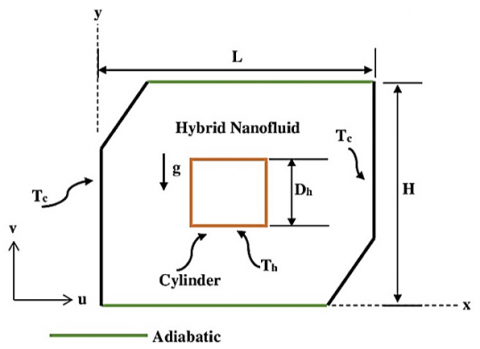
Figure 1 shows a numerical model for studying the heat transfer by natural convection and the flow of a hybrid nanofluid (Mg + SWCNT / Water) inside a closed chamber square cavity (L = H = 1 m) filled with this fluid. The left and right walls of the cavity are exposed to a cold temperature (Tc = 300 K), while the upper and lower walls are thermally insulated, which prevents heat transfer through them. A cylinder is inserted into the center of the cavity, and this cylinder can take various shapes, such as square, circular, oval, or rhombus, and be heated with constant heat, that is, its inner walls are considered a source of heat. The downward direction of gravity g affects the fluid flow inside the cavity, creating natural convection currents that depend on the thermal differences between the heated cylinder and the cooled walls. In this model, the thermal distribution is analyzed, and flow lines are formed to study the efficiency of heat transfer using a hybrid nanofluid.
2.1 Thermophysical properties of hybrid nanofluid
A set of mathematical equations used to calculate the thermophysical properties of components of nanomaterials (MgO + SWCNT) mixed with pure water at a temperature of 298 K includes volumetric fractions, density, dynamic viscosity, thermal conductivity, and thermal diffusivity, and applied at volumetric fractions (0.4%) for both nanoparticles. It is noted that water has a lower thermal conductivity compared to the nanomaterials, while SWCNT exhibits the highest thermal conductivity, making it more efficient at enhancing heat transfer when added to the base fluid.
Figure 1. Numerical model of natural convection in a square cavity containing a heated cylinder and a hybrid nanofluid
$\emptyset_{\text {hybrid-nanofluid }}=\emptyset_{\text {nanoparticle 1 }}+\emptyset_{\text {nanoparticle 2 }}$ (1)
$\rho_{h n f}=\rho_{n p 1} \emptyset_{n p 1}+\rho_{n p 2} \emptyset_{n p 2}+\left(1-\emptyset_{h n f}\right) \rho_{b f}$ (2)
$C p_{h m f}=\frac{\emptyset_{n p 1} \rho_{n p 1} C p_{n p 1}}{\rho_{h n f}}+\frac{\emptyset_{n p 2} \rho_{n p 2} C p_{n p 2}}{\rho_{h m f}}+\frac{\left(1-\emptyset_{h n f}\right) \rho_{b f} C p_{b f}}{\rho_{h n f}}$ (3)
$\mu_{h n f}=\frac{\mu_{b f}}{\left(1-\emptyset_{n p 1}-\emptyset_{n p 2}\right)^{2.5}}$ (4)
$\lambda_{m n f}=\lambda_{b f} \frac{\left(\frac{\emptyset_{n p_1} \lambda_{n p_1}+\emptyset_{n p_2} \lambda_{n p_2}}{\emptyset_{\text {total }}}\right)+2 \lambda_{\text {bf }}+2\left(\emptyset_{n p_1} \lambda_{n p_1}+\emptyset_{n p_2} \lambda_{n p_2}\right)-2\left(\emptyset_{\text {total }} \lambda_{\text {bf }}\right)}{\left(\frac{\emptyset_{n p_1} \lambda_{n p_1}+\emptyset_{n p_2} \lambda_{n p_2}}{\emptyset_{\text {total }}}\right)+2 \lambda_{\text {bf }}-\left(\emptyset_{n p_1} \lambda_{n p_1}+\emptyset_{n p_2} \lambda_{n p_2}\right)+\left(\emptyset_{\text {total }} \lambda_{b f}\right)}$ (5)
Table 1 shows the thermophysical properties of the hybrid nanofluid (SWCNT + MgO / water) at a volume concentration of 0.4%, which were obtained after applying the mathematical equations for calculating the equivalent properties. The values indicate that adding nanoparticles to water increased the thermal conductivity of the fluid, enhancing its heat transfer efficiency compared to the pure base fluid.
Table 1. Hybrid nanofluid (SWCNT + MgO / Water) thermophysical properties
|
Ø |
ρ (kg‧m-3) |
λ (W‧m-1‧K-1) |
Cp (J‧kg-1‧K-1) |
|
0.4 % |
1005.4316 |
0.622 |
4136.753 |
2.2 Fluid governing equations and boundary conditions
Based on Figure 1, which represents a closed square cavity filled with a hybrid nanofluid, with a heated inner cylinder of various shapes (square, round, oval, or rhombus), the side walls are cooled (Tc), the upper and lower walls are thermally insulated, in addition, the upper wall moves at a constant velocity (u = 0.2 m/s). The boundary conditions applied to the numerical model of a closed square cavity with a heated inner cylinder and a movable upper wall can be illustrated as in Table 2. The governing equations and physical context can be described based on the following assumptions:
Table 2. Base fluid at the temperature of (298 K) and Nanomaterials thermophysical properties [25, 26]
|
|
ρ (kg‧m-3) |
λ (W‧m-1‧K-1) |
Cp (J‧kg-1‧K-1) |
µ (Pa‧s) |
|
Water |
997.1 |
0.594 |
4183 |
0.00089 |
|
SWCNT |
2600 |
6600 |
425 |
-------- |
|
MgO |
3560 |
45 |
955 |
-------- |
The governing equations of the Navier-Stokes and energy equations are written as [27-29]:
$\frac{\partial u}{\partial x}+\frac{\partial v}{\partial y}=0$ (6)
$u \frac{\partial u}{\partial x}+v \frac{\partial u}{\partial y}=-\frac{1}{\rho} \frac{\partial p}{\partial x}+v\left(\frac{\partial^2 u}{\partial x^2}+\frac{\partial^2 v}{\partial y^2}\right)$ (7)
$u \frac{\partial v}{\partial x}+v \frac{\partial v}{\partial y}=-\frac{1}{\rho} \frac{\partial p}{\partial y} +v\left(\frac{\partial^2 v}{\partial x^2}+\frac{\partial^2 v}{\partial y^2}\right)+g \beta\left(T-T_o\right)$ (8)
The last term of the above equation represents the buoyancy force as a result of the change in density with temperature (the effect of natural convection).
$u \frac{\partial T}{\partial x}+v \frac{\partial T}{\partial y}=\alpha\left(\frac{\partial^2 T}{\partial x^2}+\frac{\partial^2 T}{\partial y^2}\right)$ (9)
In the case of a fluid flowing inside a closed square cavity when there is a disturbance, the turbulence model can be used (k-ꞷ), which is one of the most famous models adopted in computational fluid dynamics, especially in cases that contain solid and close walls (such as closed cavities of all kinds). The model (k-ꞷ) is based on solving two additional perturbation equations as follows:
$\frac{\partial(\rho k)}{\partial t}+\frac{\partial\left(\rho u_j k\right)}{\partial x_j}=P_k -\beta^* \rho k \omega+\frac{\partial}{\partial x_j}\left[\left(\mu+\sigma_k \mu_t\right) \frac{\partial k}{\partial x_j}\right]$ (10)
$\frac{\partial(\rho \omega)}{\partial t}+\frac{\partial\left(\rho u_j \omega\right)}{\partial x_j}=\alpha \frac{\omega}{k} P_k -\beta \rho \omega^2+\frac{\partial}{\partial x_i}\left[\left(\mu+\sigma_\omega \mu_t\right) \frac{\partial \omega}{\partial x_j}\right]$ (11)
$P_k=\mu_t\left(\frac{\partial u_i}{\partial x_i}+\frac{\partial u_j}{\partial x_i}\right) \frac{\partial u_i}{\partial x_i}$ (12)
Table 3. All boundary conditions are applied to the walls of a closed chamber, a square cavity, and an inner cylinder
|
Wall Location |
Velocity Vector (m/s) |
Temperature (K) |
Physical Type |
|
Left |
u = v = 0 |
T = Tc |
Fixed the cooler wall |
|
Right |
u = v = 0 |
T = Tc |
Fixed the cooler wall |
|
Top |
u = 0.2 m/s |
∂T/∂y = 0 |
Thermally insulated movable wall |
|
v = 0 |
|||
|
Bottom |
u = v = 0 |
∂T/∂y = 0 |
Thermally insulated fixed wall |
|
Inner Cylinder |
u = v = 0 |
T = Th |
fixed heated surface |
$\mu_t=\frac{\rho k}{\omega}$ (13)
The mathematical equations related to the Rayleigh, Grashof, Prandtl, and Nusselt numbers and heat flux, which are usually used in the analysis of heat transfer by natural convection inside cavities or surfaces, can be expressed as follows [30, 31]:
$G r=\frac{g \beta\left(T_h-T_c\right) L_{c a}^3}{v^2}$ (14)
$\alpha=\frac{\lambda}{\rho \times C_p}$ (15)
$\operatorname{Pr}=\frac{v}{\alpha}=\frac{\mu C_p}{\lambda}$ (16)
$R a=G r \times \operatorname{Pr}=\frac{g \beta\left(T_h-T_c\right) L_{c a}^3}{\alpha v}$ (17)
$\beta=\frac{1}{K}$ (18)
$T_h=\frac{R a \times \alpha \times v}{g \times \beta \times L_{c a}^3}+T_c$ (19)
$q^{\prime \prime}=h\left(T_h-T_c\right)$ (20)
$N u=\frac{h \times L_{c a}}{\lambda}$ (21)
$q^{\prime \prime}=\frac{N u \times \lambda}{L_{c a}}\left(T_h-T_c\right)$ (22)
$C_f=\frac{\tau_w}{\frac{1}{2} \rho U_{r e f}^2}$ (23)
$\tau_w=\mu\left(\frac{\partial u}{\partial y}\right)_{\text {wallre }}$ (24)
Table 3 shows the boundary conditions applied to the edges of the numerical model, which is a closed square cavity containing an internal cylinder of various shapes. All side walls, the base, and the internal cylinder are in the adhesion condition (u = v = 0), where the left and right walls are set at a constant temperature T = Tc and the internal cylinder at T = Tc. The upper surface moves horizontally at a constant velocity u = 0.2 m/s (lid-driven) with a zero vertical component v = 0, and the upper and lower surfaces are thermally insulated (∂T/∂y = 0). These conditions fully determine the velocity and heat exchange used in the numerical solution of the problem.
3.1 Creating mesh and independence test
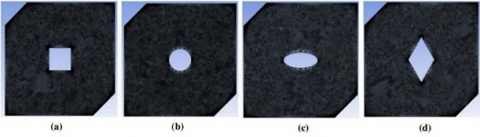
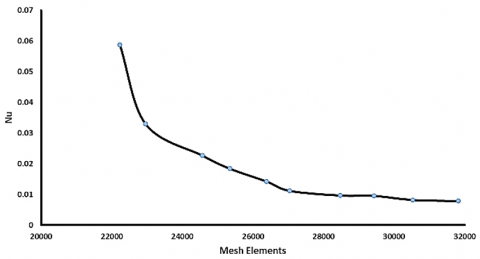
The numerical model of the cavity was built using the ANSYS Workbench program, where the numerical mesh was generated using the ANSYS Meshing tool. The model consists of a chamfered square enclosure, inside which there is an internal body representing a cylinder of various geometric shapes. Four-cylinder shapes have been studied, namely: square, circular, horizontal ellipse, and rhombus, as shown in Figure 2. An irregular numerical mesh (unstructured mesh) consisting of triangular and quadrilateral elements, with a pronounced thickening of the mesh around the inner shape, was used to increase the accuracy of calculations in areas where sharp changes in flux or heat transfer are expected. The distribution of the mesh is also gradually improved from the boundaries of the inner shape towards the walls of the outer cavity, providing an effective numerical representation while maintaining the stability of numerical solutions. For objects with sharp angles (such as square and rhombus shapes), the cells were additionally reduced in size around the corners to reduce the possible numerical error caused by the concentration of thermal or fluid voltage. In the case of the round and oval shapes, a symmetrical and smooth mesh has been generated around the curved border to facilitate the representation of flow and flowability. This variety of geometric shapes is aimed at studying the influence of the internal shape of the cylinder on the temperature distribution and the behavior of the flow inside the cavity, which enhances the understanding of physical phenomena associated with heat transfer by natural or forced convection. Figure 3 illustrates the mesh independence test for the numerical solution used in this study. It can be observed that the Nusselt number (Nu) clearly decreases with an increase in the number of mesh elements. A significant change in values is evident at low numbers of elements, after which the values gradually stabilize when the number of elements exceeds approximately 27,000. This behavior indicates that the numerical solution becomes independent of the mesh size beyond this point, demonstrating the efficiency of the chosen mesh resolution in representing the physical domain without an unnecessary increase in the number of computational elements.
Figure 2. Mesh generation of the model for various configurations: (a) Square, (b) Circular, (c) Ellipse, and (d) Rhombus
Figure 3. Test of the mesh independence of the numerical simulation model
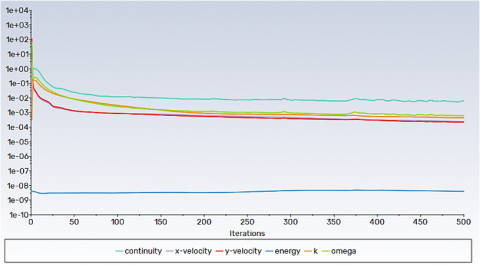
Figure 4. Analysis of the convergence of the numerical solution of turbulent flow in a square cavity containing an internal cylinder
3.2 Convergence of numerical solution
Figure 4 represents the evolution of the residual values of the governing equations during several iterations up to 500 steps, which reflects the closeness and stability of the numerical solution in the turbulent normal load model inside a square cavity containing a cylinder of various geometric shapes. The k-omega model was used to calculate the turbulence in the flow, and operating conditions were adopted at high Rayleigh numbers, which shows the influence of normal load strongly on the fluid flow. It can be noted that all the remaining values decrease significantly during the first 100 repetitions, which indicates a rapid response of the numerical system towards equilibrium. As the iterations continue, the values begin to stabilize at low levels, with most of them stabilizing in the range between 10-3 to 10-5, which is acceptable in turbulent flow studies. The velocity equation in the x-direction shows good convergence until it reaches the limits of 10-9, which indicates a high accuracy in solving the velocity components. The fact that the residuals remain within the limits of stability without significant fluctuations indicates that the numerical solution has reached the stage of stability and numerical convergence, which is a prerequisite for ensuring the reliability of the results extracted from the study.
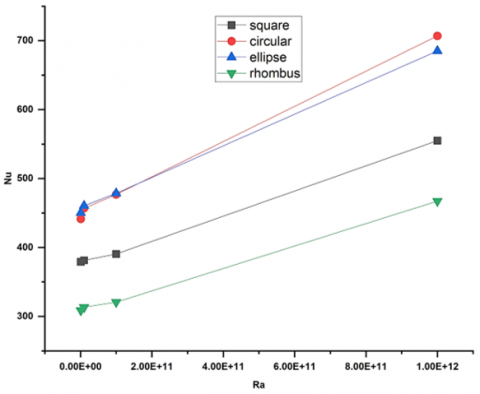
Figure 5 represents the relation of the Nusselt number (Nu) to the Rayleigh number (Ra) of four different shapes of cylinders (square, circular, ellipse, rhombus) placed inside a closed square cavity. It can be seen that the Nusselt number increases with an increase in the Rayleigh number for all forms, reflecting the improvement of heat transfer by natural convection with increasing convection forces. It can be seen that a circular cylinder achieves the highest values of the Nusselt number at all Rayleigh values, followed by an ellipse, then a square, and finally a rhombus that achieves the lowest thermal performance. These results can be explained by the effect of the cylinder shape on the air flow inside the cavity, where the circular cylinder allows a smoother flow of fluid around it, which leads to enhanced heat transfer and reduced flow resistance, thereby increasing the number of Nusselt. The elliptical cylinder, although flattened, retains an acceptable flowability, which allows good heat transfer, albeit less than the round cylinder. As well as a square cylinder, it has sharp corners that cause a disturbance in the air flow and localized stagnation, which relatively impairs heat transfer. Finally, the rhomboid cylinder (diamond-shaped) leads to maximum turbulence of the flow and the formation of large stagnation zones, which reduces the efficiency of heat transfer and leads to the lowest values of the Nusselt number. Thus, an increase in the Rayleigh number means an increase in the convection effect, and the more streamlined the shape of the cylinder (like a circle), the better this effect can be exploited, which leads to an increase in the Nusselt number and improved thermal performance.
Figure 5. Variation of Nusselt number with Rayleigh numbers for different cylindrical shapes inside a closed square cavity
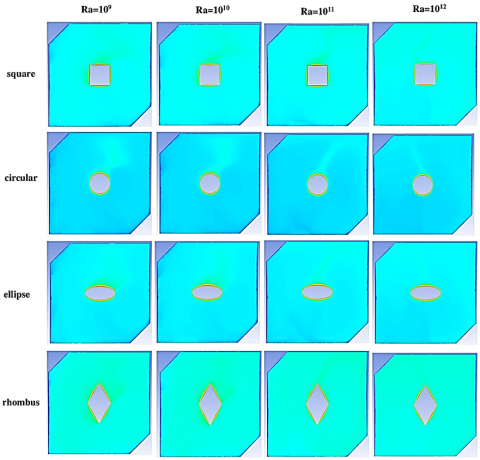
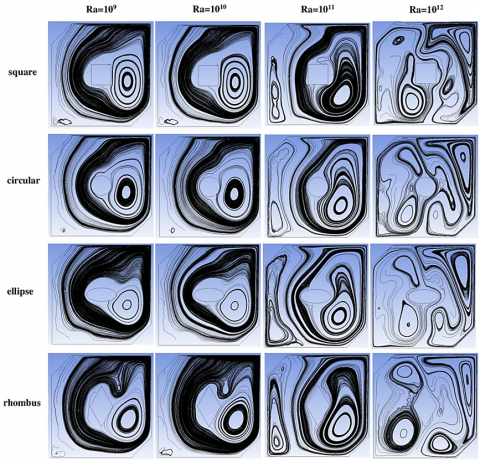
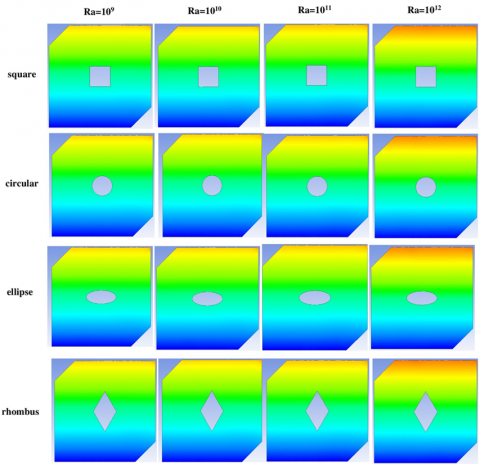
Figures 6–8 represent the temperature distribution, streamlines, and pressure distribution inside a closed square cavity containing various cylindrical shapes (square, circular, oval, and rhombic), at different Rayleigh numbers (Ra = 109 to 1012). We can see from the temperature maps (Figure 6) that heat transfer by natural convection increases with increasing Rayleigh number. The temperature gradient changes from a linear distribution at Ra = 109 to a more complex, nonlinear distribution at Ra = 1012, indicating a transition from uniform natural convection to turbulent natural convection. Rhombic and elliptical objects exhibit steeper temperature gradients at higher numbers, indicating that they contribute more to convection than other shapes, especially the rhombic shape at Ra = 1012. The streamlines (Figure 7) demonstrate the development of vortices within the cavity as the Rayleigh number increases. At Ra = 109, the streamlines are relatively simple and symmetrical. However, at Ra = 1012, several secondary vortices and complex flow regions appear, particularly around sharp-angled objects such as diamonds, demonstrating the effect of shape on internal flow redistribution. The circular shape exhibits less turbulent streamlines than other shapes, indicating less flow resistance. Finally, the pressure map (Figure 8) shows that pressure differences within the cavity increase with Rayleigh number, with high- and low-pressure regions increasing, particularly at the upper and lower walls. The effect of shape is very clear. For example, the square and diamond shapes exhibit a more asymmetric and high-pressure distribution at Ra = 1012, indicating stronger driving forces affecting convection currents within the cavity. Accordingly, the geometric shape of the internal body within the cavity greatly affects the natural convection characteristics, as sharp corners (as in the rhomboid shape) enhance internal vortices and increase heat transfer, especially at large Rayleigh numbers, providing an important engineering guide to improve the efficiency of natural convection cooling systems using appropriate internal shapes.
Figure 6. Contours of temperatures for the chamber square cavity at various cylinder shapes
Figure 7. Patterns of streamlines flow for the chamber square cavity at various cylinder shapes
Figure 8. Contours of pressure for the chamber square cavity at various cylinder shapes
This numerical study analyzes natural convection heat transfer within a closed square cavity with chamfered corners. The cavity contains a symmetrical inner body with a constant hydraulic diameter but with different geometric shapes (square, circle, ellipse, and rhombus). A hybrid nanofluid (Mg+ SWCNT / Water) was used to enhance the heat transfer, and simulations were performed over a wide range of Rayleigh numbers (Ra = 10⁹ to 10¹²) using a turbulent flow model. The study focuses on the effect of the inner cylinder geometry on the thermal performance, temperature distribution, and streamlines within the cavity. The results showed clear differences in heat transfer efficiency depending on the inner body shape, as follows:
As a suggestion for future studies, the study could be expanded to include a three-dimensional simulation to capture out-of-plane flow effects not reflected in the current two-dimensional model. Additionally, thermal radiation effects could be incorporated into the analysis to gain a more comprehensive understanding of heat transfer in complexly shaped cavities, especially in high-temperature applications.
|
Cf |
skin friction |
|
|
Cp |
heat capacity at constant pressure, J‧kg-1‧K-1 |
|
|
H |
height of enclosure, m |
|
|
k |
turbulence of kinetic energy |
|
|
L |
length of enclosure, m |
|
|
Nu |
Nusselt number |
|
|
P |
turbulence power generation rate |
|
|
p |
pressure, Pa |
|
|
Ra |
Rayleigh number |
|
|
Dh |
hydraulic diameter of cylinder, m |
|
|
T |
temperature, K |
|
|
Greek symbols |
||
|
$\omega$ |
specific dissipation rate |
|
|
$\mu$ |
dynamics viscosity, Pa‧s |
|
|
$\varnothing$ |
volume fraction |
|
|
$\alpha$ |
thermal diffusivity, m2‧s-1 |
|
|
$\beta$ |
coefficient of thermal expansion, 1‧K-1 |
|
|
$\lambda$ |
thermal conductivity, W‧m-1‧K-1 |
|
|
$\rho$ |
density, kg‧m-3 |
|
|
$\tau_{{W}}$ |
shear stress of the wall |
|
|
$\upsilon$ |
kinematics viscosity, m2‧s-1 |
|
|
Greek symbols |
||
|
CFD |
computational fluid dynamics |
|
|
FVM |
finite volume method |
|
|
HNF |
hybrid nanofluid |
|
|
MgO |
magnesium oxide |
|
|
SWCNT |
single-walled carbon nanotube |
|
|
Subscripts |
||
|
bf |
base fluid |
|
|
c |
cold |
|
|
ca |
characteristic |
|
|
f |
friction |
|
|
h |
hot |
|
|
hnf |
hybrid nanofluid |
|
|
j |
velocity component |
|
|
np |
nanoparticle |
|
|
t |
turbulence |
|
|
w |
wall |
|
[1] Li, S., Lv, L., Liao, M. (2025). Numerical simulation of heat transfer and entropy generation due to the nanofluid natural convection with viscous dissipation in an inclined square cavity. Numerical Heat Transfer, Part A: Applications, 86(14): 4956-4986. https://doi.org/10.1080/10407782.2024.2325121
[2] Safi, S., Berrahil, F., Filali, A., Benissaad, S. (2025). Numerical analysis of Al2O3/water nano-fluid natural convection in a square cavity filled with an anisotropic porous medium under a magnetic field. Archives of Mechanics, 77(2): 153-175.
[3] Alshayji, A., Alzuabi, M.K., Aljuwayhel, N.F. (2025). Numerical investigation of nanofluid free convection in a rectangular cavity using variable properties. Journal of Thermal Analysis and Calorimetry, pp. 1-20. https://doi.org/10.1007/s10973-025-14197-6
[4] Chelia, W., Laouer, A., Mezaache, E.H., Atia, A., Teggar, M. (2025). Effect of convective boundary conditions and enclosure orientation on natural convection heat transfer of nanofluids using the Lattice Boltzmann method. Journal of Advanced Research in Fluid Mechanics and Thermal Sciences, 131(2): 198-220. https://doi.org/10.37934/arfmts.131.2.198220
[5] Miadzvedzeva, M., Fedotov, A.S., Zur, I., Fedotova, J. (2025). Heat transfer and flow dynamics for natural convection in Fe3O4/H2O Nanofluid. Energies, 18(11): 2767. https://doi.org/10.3390/en18112767
[6] Moshiri, A., Ghasemiasl, R., Armaghani, T., Nazarahari, M. (2025). Effects of different shapes of the porous cavity on natural convective heat transfer of hybrid nanofluids: Experimental study. Applications of Hybrid Nanofluids in Science and Engineering, pp. 89-110.
[7] Bhuiyana, A.H., Alam, M.S., Alim, M.A. (2017). Natural convection of water-based nanofluids in a square cavity with partially heated of the bottom wall. Procedia Engineering, 194: 435-441. https://doi.org/10.1016/j.proeng.2017.08.168
[8] Qasem, S.A., Sivasankaran, S., Siri, Z., Othman, W.A. (2021). Effect of thermal radiation on natural conviction of a nanofluid in a square cavity with a solid body. Thermal Science, 25(3 Part A): 1949-1961. https://doi.org/10.2298/TSCI191003182Q
[9] Sharifpur, M., Giwa, S.O., Lee, K.Y., Ghodsinezhad, H., Meyer, J.P. (2021). Experimental investigation into natural convection of zinc oxide/water nanofluids in a square cavity. Heat Transfer Engineering, 42(19-20): 1675-1687. https://doi.org/10.1080/01457632.2020.1818384
[10] Sheikhzadeh, G.A., Aghaei, A., Soleimani, S. (2018). Effect of nanoparticle shape on natural convection heat transfer in a square cavity with partitions using water-SiO2 nanofluid. Challenges in Nano and Micro Scale Science and Technology, 6(1): 27-38. https://doi.org/10.22111/tpnms.2018.3520
[11] Alipanah, M., Ranjbar, A.A., Farnad, E., Alipanah, F. (2015). Entropy generation of natural convection heat transfer in a square cavity using Al2O3-water nanofluid. Heat Transfer-Asian Research, 44(7): 641-656. https://doi.org/10.1002/htj.21141
[12] Khalili, E., Saboonchi, A., Saghafian, M. (2017). Experimental study of nanoparticles distribution in natural convection of Al2O3-water nanofluid in a square cavity. International Journal of Thermal Sciences, 112: 82-91. https://doi.org/10.1016/j.ijthermalsci.2016.09.031
[13] Solomon, A.B., van Rooyen, J., Rencken, M., Sharifpur, M., Meyer, J.P. (2017). Experimental study on the influence of the aspect ratio of square cavity on natural convection heat transfer with Al2O3/water nanofluids. International Communications in Heat and Mass Transfer, 88: 254-261. https://doi.org/10.1016/j.icheatmasstransfer.2017.09.007
[14] Dey, D., Sahu, D.S. (2021). Experimental study in a natural convection cavity using nanofluids. Materials Today: Proceedings, 41: 403-412. https://doi.org/10.1016/j.matpr.2020.09.631
[15] Groşan, T., Revnic, C., Pop, I., Ingham, D.B. (2015). Free convection heat transfer in a square cavity filled with a porous medium saturated by a nanofluid. International Journal of Heat and Mass Transfer, 87: 36-41. https://doi.org/10.1016/j.ijheatmasstransfer.2015.03.078
[16] Boualit, A., Zeraibi, N., Chergui, T., Lebbi, M., Boutina, L., Laouar, S. (2017). Natural convection investigation in square cavity filled with nanofluid using dispersion model. International Journal of Hydrogen Energy, 42(13): 8611-8623. https://doi.org/10.1016/j.ijhydene.2016.07.132
[17] Nguyen, M.T., Aly, A.M., Lee, S.W. (2016). Unsteady natural convection heat transfer in a nanofluid-filled square cavity with various heat source conditions. Advances in Mechanical Engineering, 8(5): 1687814016646547. https://doi.org/10.1177/1687814016646547
[18] Alsabery, A.I., Chamkha, A.J., Saleh, H., Hashim, I. (2017). Natural convection flow of a nanofluid in an inclined square enclosure partially filled with a porous medium. Scientific Reports, 7(1): 2357. https://doi.org/10.1038/s41598-017-02241-x
[19] Boulahia, Z., Sehaqui, R. (2015). Numerical simulation of natural convection of nanofluid in a square cavity including a square heater. International Journal of Science and Research, 4(12): 1718-1722.
[20] Xiong, X., Chen, S., Yang, B. (2017). Natural convection of SiO2-water nanofluid in square cavity with thermal square column. Applied Mathematics and Mechanics, 38(4): 585-602. https://doi.org/10.1007/s10483-017-2183-6
[21] Rashid, F.L., Alkhekany, Z.A.K., Eleiwi, M.A., Bouabidi, A., et al. (2025). A comprehensive review on natural convection in trapezoidal cavities with mono and hybrid nanofluids. International Journal of Thermofluids, 27: 101226. https://doi.org/10.1016/j.ijft.2025.101226
[22] Roy, N.C., Pop, I. (2025). Natural convection of ternary hybrid nanofluid flow in an inclined porous trapezoidal enclosure. Journal of Engineering Mathematics, 150(1): 1-23. https://doi.org/10.1007/s10665-024-10419-2
[23] Al-Srayyih, B.M., Al-Manea, A., Saleh, K., Abed, A.M., et al. (2025). Simulation investigation of the oscillatory motion of two elliptic obstacles located within a quarter-circle cavity filled with Cu-Al2O3/water hybrid nanofluid. Numerical Heat Transfer, Part A: Applications, 86(5): 1328-1352. https://doi.org/10.1080/10407782.2023.2279248
[24] Gul, T., Nasir, S., Berrouk, A.S., Raizah, Z., Alghamdi, W., Ali, I., Bariq, A. (2023). Simulation of the water-based hybrid nanofluids flow through a porous cavity for the applications of the heat transfer. Scientific Reports, 13(1): 7009. https://doi.org/10.1038/s41598-023-33650-w
[25] Hamza, N.F.A., Aljabair, S. (2023). Experimental study of heat transfer enhancement using hybrid nanofluid and twisted tape insert in heat exchangers. AIP Conference Proceedings, 2830(1): 070009. http://doi.org/10.30684/etj.2022.131909.1069
[26] Mebarek-Oudina, F., Bouselsal, M., Djebali, R., Vaidya, H., Biswas, N., Ramesh, K. (2025). Thermal performance of MgO-SWCNT/water hybrid nanofluids in a zigzag walled cavity with differently shaped obstacles. Modern Physics Letters B, 39(29): 2550163. https://doi.org/10.1142/S0217984925501635
[27] Ali, S.A., Barrak, E.S., Alrikaby, N.J., Hameed, M.R. (2025). Numerical study of thermal-hydraulic performance of forced convection heat transfer in dimple surface pipe with different shapes using commercial CFD code. Heat Transfer, 125(2): 1-15. https://doi.org/10.37934/arfmts.125.2.115
[28] Al-Akam, A., Kadhim, H.K., Ali, S.A., Al Juboori, A.M. (2025). Numerical analysis for the airflow behaviour around vortex generators used for air-cooling technologies considering rotation. CFD Letters, 17(9): 127-144. https://doi.org/10.37934/cfdl.17.9.127144
[29] Ali, S.A. (2025). Influence of Inserted different ribs configuration in 2D horizontal channel on characteristics turbulent fluid flow and forced heat transfer: A numerical investigation. Journal of Research and Applications in Mechanical Engineering, 13(1): JRAME-25. http://doi.org/10.14456/jrame.2025.15
[30] Boucetta, M., Boulahia, Z., Tarras, I., Zitouni, S., Faraji, H., Hader, A., Krimech, F.Z. (2025). Numerical analysis of natural convection inside a cavity filled by hybrid TiO2–Cu water nanofluid with elliptical heated cylinder. Journal of Nanofluids, 14(1): 162-169. https://doi.org/10.1166/jon.2025.2227
[31] Kalfali, M., Battira, M.M., Belghar, N., Brahmi, C.E. (2025). Numerical investigation on mixed convection phenomenon within a 2D cavity shaped home containing solar chimney. Solar Energy and Sustainable Development Journal, 14(1): 448-463. https://doi.org/10.51646/jsesd.v14i1.467