Khalida S. Kadhem* | Rana A. Hussein | Malik N. Hawas
© 2025 The authors. This article is published by IIETA and is licensed under the CC BY 4.0 license (http://creativecommons.org/licenses/by/4.0/).
OPEN ACCESS
This study numerically examines the influence of square-wave pulsating mass flow rate on thermal and flow behavior in a wavy channel subjected to a constant heat flux of 1200 W/m². Using ANSYS Fluent 2022 R1, three mass flow rates (0.05, 0.1, and 0.2 kg/s) were evaluated under a fixed pulsation period of 10 s. The results show that lower mass flow rates enhance outlet temperature due to longer residence time, whereas higher flow rates reduce thermal uptake and confine mixing near the channel walls. These findings provide insight into optimizing the pulsatile operation of wavy-channel heat exchangers to improve thermal performance.
pulsating flow, wavy channel, mass flow rate, CFD, heat transfer
Efficient heat transfer is a central requirement in thermal systems used across food, chemical, power, and manufacturing industries, where operational performance and energy consumption are closely linked to thermal management. Increasing energy costs and stricter efficiency demands have intensified the need for enhanced heat-transfer technologies.
The last couple of years have seen rising energy and raw material costs, making the need to identify new ways to make heat transfer processes more efficient even greater [1]. Consequently, there is extensive literature on improving the performance of thermal systems. Numerous approaches have been suggested, passive in that they alter geometry or surface conditions and active in that they alter flow conditions, to facilitate heat transfer and, thus, efficiency of thermal devices [2, 3].
Nevertheless, researchers and engineers still have a lot more to do in developing more energy-efficient systems, as they must strike a balance between energy use and ensuring the system's overall performance does not suffer or even deteriorate [4]. Several techniques have yielded positive results, including surface modifications and flow-control methods. For example, the walls of the channels may be roughened, corrugated, or furnished with fins to enhance turbulence and consequently increase the convective heat transfer coefficient. Alternatively, this can be improved by pulsating flow, which has been shown to facilitate mixing and disturb thermal boundary layers, thereby increasing heat transfer efficiency [5].
In this regard, the current work investigates the application of pulsating flow in a wavy channel as a potential method for enhancing convective heat transfer. The abstract aims to gain more insights into processes of improving thermal performance in energy systems by integrating the geometric effects of the wavy configuration with the dynamic effects of flow pulsation.
Numerous researchers have extensively studied the effect of channel geometry on heat transfer performance. For example, Ramgadia and Saha [6] investigated fully developed flow and heat transfer in a wavy channel surface using numerical simulations. They studied the effects of waviness amplitude and Reynolds number. They found that the geometry with a Hmin/Hmax ratio of 0.2 yielded the maximum Nusselt number and the most acceptable thermal performance factor (TPF). In addition, it was noted that as the Reynolds number increased, the TPF tended to weaken in steady flow conditions but increased in unsteady flow. In a similar study, Sui et al. [7] analyzed fully developed flow and heat transfer in periodic wavy channels with rectangular cross-sections. They noted that the wavy geometry facilitated fluid mixing, leading to a significant increase in heat transfer performance compared to straight channels of the same cross-sectional dimensions. It is noteworthy that, because the wavy arrangement naturally provided an additional pressure drop, the cost was minor, as the overall increase in heat transfer was much greater. Its findings were consistent with the appropriateness of wavy geometries as a passive optical method for improving the thermal performance of channel-based heat exchangers. Based on this literature, Qu et al. [8] conducted an extensive simulation analysis of heat transfer in sinusoidal channels operating at different Reynolds numbers and amplitude regimes. Their contribution provided a comparative analysis of not only straight channels but also single-amplitude sinuoidal channels, thereby offering a broader perspective on the channel geometry that influences thermal-hydraulic performance. It was established that, over a single geometric period, the pressure and temperature differences exhibited a ripple-like oscillation with decreasing amplitude, and that the interaction of the flow vibrations with the heat along the channel length caused this.
Besides these contributions, there is a wealth of literature on the application of pulsating flow in straight and corrugated channels as another method of enhancing convective heat transfer. All of these studies provide evidence that combined channel geometry and flow modulation is a promising approach to improving thermal performance and achieving an optimal balance between pressure drop penalties and heat transfer benefits.
A study of heat transfer between a rotating cylinder and a pulsating, laminar cross-flow was conducted by Witte and Polifke [9]. They studied the Reynolds number range 0.1 ≤ Re ≤ 40, where the flow was laminar and did not experience vortex shedding. The findings revealed that neither a single factor nor a combination of factors could define the dynamics of heat transfer, but that multiple independent time scales were associated with the characteristic responses of the velocity and temperature fields. This result highlighted the non-steady, turbulent character of pulsating flows. It was further noted that there was excess gain beyond the quasi-steady-state value of the heat transfer frequency response at Strouhal numbers of the order of unity and Reynolds numbers of the order of ten, indicating that resonance-like behaviour in the thermal response may be present.
Continuing the general theme of pulsating flows, Jafari et al. [10] investigated how pulsating motion affects forced-convection heat transfer in a corrugated channel. Their analysis encompassed a wide range of dimensionless pulsation frequencies (0.05 ≤ St ≤ 1) and oscillation amplitudes (0 ≤ Apulse ≤ 0.25), enabling a systematic evaluation of the role of unsteadiness. The findings indicated that the degree of heat transfer enhancement is highly dependent on the pulsating velocity parameters, with flow oscillation showing stronger performance at higher Reynolds numbers (50, 100, and 150). This behavior was attributed to increased mixing and disruption of the thermal boundary layer under stronger inertial effects at elevated flow rates.
In a complementary effort, Parlak et al. [11] studied heat transfer in a wavy channel subjected to pulsating airflow. Their analysis showed that the Nusselt number decreased as both the Strouhal number and the nondimensional amplitude increased, suggesting that excessive oscillatory motion may impair thermal performance. Nevertheless, their results also showed that pulsatile flow could provide meaningful improvements at lower Reynolds numbers compared with non-pulsatile cases, reinforcing the idea that pulsation's effectiveness strongly depends on the flow regime.
Beyond these individual contributions, several researchers have sought to improve the thermal characteristics of pulsating flow by combining it with other enhancement strategies. For example, the coupling of pulsating flow with nanofluids has been investigated in multiple studies [12-14], demonstrating that the addition of nanoparticles can significantly augment thermal conductivity and, when combined with flow oscillations, yield superior heat transfer performance. Furthermore, extensive research has explored the role of geometric modifications in channels, where obstacles such as grooves, dimples, ribs, and helical tubes have been introduced to intensify turbulence, promote fluid mixing, and disrupt boundary layers [15-18]. These passive techniques, when combined with flow pulsation, have proven effective for increasing the overall efficiency of thermal devices.
Most previous studies have focused on channel configurations and working fluids, whereas comparatively little attention has been paid to the influence of pulse shape and flow rates. This study addresses this gap by investigating the impact of square-wave pulsating flow in combination with a wavy channel geometry on heat transfer. The main objective is to analyze how abrupt square pulses affect the thermal boundary layer, outlet temperature, and flow characteristics at different mass flow rates, providing new insights for optimizing wavy-channel design and enhancing heat transfer efficiency.
2.1 Physical domain
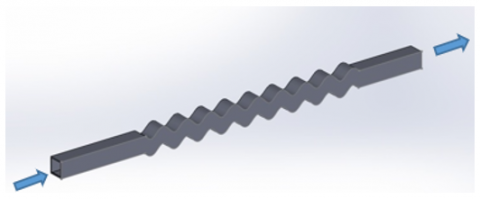
In the present study, the behavior of pulsating water flow through a wavy channel is investigated in detail to evaluate the influence of geometry on thermal performance. The computational domain is divided into three main sections, as illustrated in Figure 1, each serving a specific role in the simulation setup. The first section corresponds to a flat entrance region, designed to provide stable hydrodynamic development of the flow before it enters the wavy portion of the channel. The region serves to remove the entrance effects that can otherwise distort the flow field and, in addition, to establish the pulsating velocity profile appropriately before performing the heat transfer assessment.
Figure 1. Schematic view of the channel
The second part is the wavy test area, the major part of the study. This part of the channel is mathematically represented by a sinusoidal model [19], which introduces periodic oscillations in the wall structure, thereby enhancing fluid mixing and improving effective convective heat transfer. The sinusoidal description provides a systematic, reproducible definition of the wavy surface, facilitating comparisons with earlier studies and ensuring consistency across different simulation cases. The third section, located downstream of the test region, serves as the outlet zone where the flow is allowed to redevelop and exit the channel under fully established conditions, thereby preventing boundary effects from influencing the recorded results within the test section:
$y=A \sin \left(2 \pi \beta \frac{x-x_{\mathrm{i}}}{x_o-x_{\mathrm{i}}}\right)$ (1)
where, A denotes the wave amplitude of the channel and is defined as 0.3 H, where H is the height of the channel, β is the wave number, and xi, xo represent the inlet and outlet positions, respectively. The third section is a flat region that serves as the outlet, measuring 3 H in length.
Table 1 summarizes representative studies on pulsating and wavy-channel flows, highlighting their flow regimes, pulsation parameters, and geometric configurations.
Table 1. Summary of representative studies on pulsating and wavy-channel flows
|
Study |
Channel |
Flow Type |
Re Range |
Pulsation Type |
Key Notes |
|
Ramgadia and Saha [6] |
Wavy channel |
Steady/Unsteady |
100–1000 |
None |
Effect of waviness amplitude |
|
Sui et al. [7] |
Periodic wavy |
Steady |
100–400 |
None |
Enhanced mixing vs. straight channels |
|
Jafari et al. [10] |
Corrugated |
Pulsating |
50–150 |
Sinusoidal |
Effect of frequency and amplitude |
|
Parlak et al. [11] |
Wavy |
Pulsating |
Turbulent |
Sinusoidal |
Reduced Nu at high amplitude |
2.2 Assumptions and governing equations
In this article, the numerical computations were performed with a series of simplifying assumptions. The flow has been modeled as a single-phase, two-dimensional, incompressible flow, with the fluid's thermophysical properties held constant throughout the analysis. One ignored the effects of gravity and radiative heat transfer to focus on the main mechanisms. The modeled flow was considered transient, fully developed, and pulsatile. The governing equations of fluid motion and thermal transport were the continuity equation, the Navier-Stokes equations, and the energy equation.
Continuity equation:
$\frac{\partial \rho}{\partial t}+\frac{\partial(\rho u)}{\partial u}+\frac{\partial(\rho v)}{\partial y}=0$ (2)
Navier-Stokes equation:
In x- direction:
$\rho\left(\frac{\partial u}{\partial t}+u \frac{\partial u}{\partial x}+v \frac{\partial u}{\partial y}\right)=-\frac{\partial p}{\partial x}+\mu\left(\frac{\partial^2 u}{\partial x^2}+\frac{\partial^2 u}{\partial y^2}\right)$ (3)
In y-direction:
$\rho\left(\frac{\partial v}{\partial t}+u \frac{\partial v}{\partial x}+v \frac{\partial v}{\partial y}\right)=-\frac{\partial p}{\partial y}+\mu\left(\frac{\partial^2 v}{\partial x^2}+\frac{\partial^2 v}{\partial y^2}\right)$ (4)
Energy equation:
$\rho c_p\left(\frac{\partial \mathrm{~T}}{\partial t}+u \frac{\partial \mathrm{~T}}{\partial x}+v \frac{\partial \mathrm{~T}}{\partial y}\right)=\kappa\left(\frac{\partial^2 \mathrm{~T}}{\partial x^2}+\frac{\partial^2 \mathrm{~T}}{\partial y^2}\right)$ (5)
2.3 Boundary condition
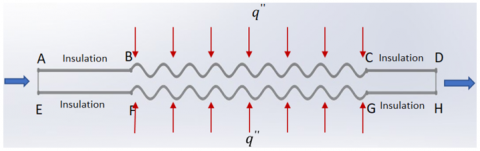
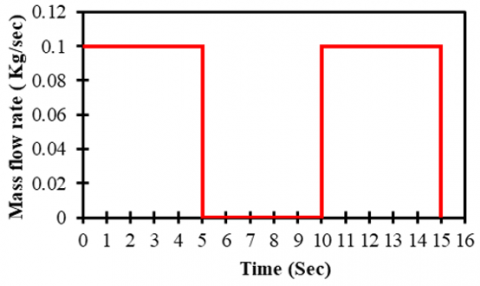
The boundary conditions used to model pulsating water-flow heat transfer in the wavy channel of uniform wall thickness are shown in Figure 2. A continuous heat flux was applied to the wavy wall, and the flat walls were assumed to be insulated. A square waveform was used to analyse the pulsating flow at various average velocities, as shown in Figure 3. The standard no-slip boundary conditions (U = V = 0) were imposed along the walls (A-B, E-F, B-C, F-G, C-D, and G-H [19-21], while (Pₒ=0) was applied at the outlet boundary (D-H) [19].
Figure 2. Boundaries of the domain
Boundary conditions of energy
At the inlet wall (A-E) $\theta=0$
At the insulated wall (A-B, E-F, C-D, G-H) $\frac{\partial T}{\partial y}=0$
At the wave wall (B-C, F-G) $\theta=1$
Figure 3. Pulsatile inlet flow
2.4 Numerical technique
The computational fluid dynamics (CFD) simulations reported in this study were conducted using ANSYS Fluent 2022, a commercially available CFD software that has extensive success in solving fluid flow and heat transfer problems of all types. Particularly valued is the software's robustness, versatility, and ability to compute steady and unsteady flow regimes in complex geometries. The equations of mass, momentum, and energy conservation in the present study were reduced to the finite volume method (FVM). This process was chosen because it can apply both local and global conservation regulations and is precise in regions with irregular geometry and non-uniform meshes, both of which are common in thermal-fluid simulations.
We needed to ensure that the solution, when starting from the computational model, was at a realistic initial state, so the SIMPLE algorithm, well known for its efficiency in solving pressure-velocity coupling problems in incompressible flows, was used to initialise the solution. The solver was run 1000 times in steady-state mode, providing a stabilized velocity and temperature field in the absence of flow pulsations before introducing them. This was an important step to prevent numerical instabilities and ensure that the baseline distributions of velocity and temperature made physical sense and were numerically consistent.
Once this initial steady-state convergence was reached, the model was then switched to transient mode, and the COUPLED algorithm was used to obtain the naturally unsteady flow behavior. Unlike segregated schemes, the COUPLED scheme solves both the momentum and continuity equations; thus, it is better suited to strongly coupled flows with large time variations. The modification rendered the simulation highly responsive to the oscillatory character of the velocity field and the several variations in the thermal field. It is necessary in pulsating flow studies, where the interaction between the oscillating flow and heat transfer may be an important part of the overall thermal performance.
2.5 Mesh generation
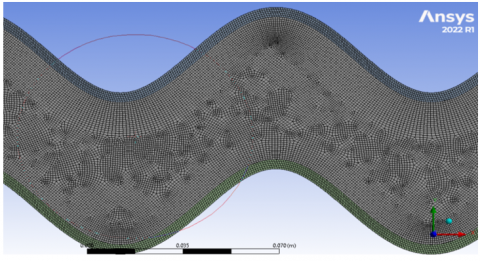
One of the most critical aspects of ensuring the accuracy and reliability of numerical simulations is the appropriate generation of the computational mesh, as it directly influences solution stability, convergence behavior, and the fidelity of the results. In this study, the mesh was generated using ANSYS Meshing 2022, which provides advanced tools for structured and unstructured grid creation, and its quality was thoroughly evaluated using standard numerical metrics commonly recommended in CFD practice. As illustrated in Figure 4, the mesh was refined to include smaller elements near the channel walls, where large velocity and temperature gradients are expected. In comparison, coarser elements were applied in core flow regions with relatively smooth variations. This arrangement ensured a proper balance between computational accuracy and efficiency by focusing resources where they were most needed.
Mesh quality analysis confirmed that the maximum element skewness was limited to 0.75, well below the generally accepted upper threshold of 0.89, thereby reducing the risk of numerical diffusion or instability. Of a total of 166,118 elements, only 45 exhibited skewness values approaching the upper range, representing less than 0.03% of the entire mesh and considered negligible in terms of impact on overall solution accuracy. In addition, the average aspect ratio of the grid elements was 1.3, suggesting that the elements were nearly isotropic and well-shaped. At the same time, orthogonality remained at 0.65, further supporting mesh uniformity and consistency. The combination of these parameters shows that not only was the computational mesh well-shaped, but it was also robust enough to resolve the flow and heat transfer features without causing serious numerical errors, thus guaranteeing the accuracy of the following simulation results.
Figure 4. Mesh distribution
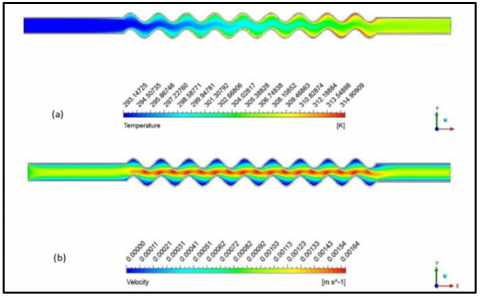
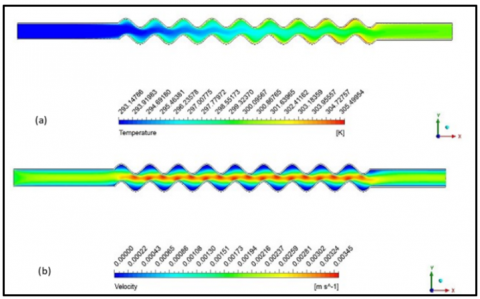
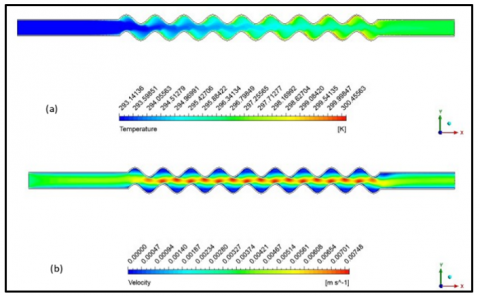
To assess their impact on convective heat transfer performance, three prototypical cases were considered. In particular, the effect of three mass flow rates ($\dot{\mathrm{m}}$ = 0.05, 0.1, and 0.2 kg/s) was studied with a constant heat flux boundary condition of 1200 W/m2 along the heated wavy wall. The latter arrangement has been selected to provide a consistent point of comparison and to emphasize the impact of changes in mass flow on the temperature and velocity fields in the channel.
Case 1:
At $\dot{\mathrm{m}}$ = 0.05 kg/s, as shown in Figure 5, the wavy geometry induces pronounced flow separation at each crest, followed by reattachment downstream, forming periodic recirculation bubbles along the heated wall. These vortical structures enhance mixing within the near-wall region and thicken the thermal boundary layer, contributing to the elevated outlet temperature. The core flow remains stable, while the separated shear layer interacts strongly with the wall undulations, leading to repeated disruption of the temperature gradients.
Case 2:
For $\dot{\mathrm{m}}$ = 0.1 kg/s, as shown in Figure 6, the recirculation zones persist but become shorter and reattach more quickly due to the higher momentum. The intensified shear near the reattachment points produces stronger local mixing, although the reduced residence time limits bulk temperature rise. The thinning of the thermal boundary layer is consistent with the higher inertial forces that suppress large-scale vortical structures.
Case 3:
At the highest examined mass flow rate of $\dot{\mathrm{m}}$ = 0.2 kg/s, presented in Figure 7, the outlet temperature at the end of the wavy section was approximately 289.17 K, suggesting that the heat transfer rate enhancement was limited under these conditions. The velocity field further demonstrated the development of a pronounced high-velocity core along the channel centerline, reaching values of 0.00748 m/s. At the same time, low-velocity zones persisted near the channel walls, although they became narrower compared with the lower flow-rate cases. This indicates that higher flow rates promote stronger core flow development but reduce the relative contribution of near-wall mixing, thereby limiting thermal performance.
Figure 5. (a) Temperature contours and (b) velocity contours of the wavy channel at $\dot{\mathrm{m}}$ = 0.05 kg/s
Figure 6. (a) Temperature contours and (b) velocity contours of the wavy channel at $\dot{\mathrm{m}}$ = 0.1 kg/s
Figure 7. (a) Temperature contours and (b) velocity contours of the wavy channel at $\dot{\mathrm{m}}$ = 0.2 kg/s
The main findings of this numerical investigation can be summarized as follows:
•The lowest mass flow rate (0.05 kg/s) produced the highest outlet temperature due to prolonged residence time and stronger near-wall mixing.
•Increasing the mass flow rate reduced thermal uptake and suppressed recirculation structures responsible for boundary-layer disruption.
•Pulsating flow with a 10-s cycle promoted periodic re-energization of the velocity field, contributing to enhanced mixing relative to steady operation.
The results show that pulsating low-mass-flow operation in wavy channels can be beneficial for compact heat-exchanger applications that require thermal enhancement without significant geometric modification.
[1] Tokgoz, N. (2019). Experimental and numerical investigation of flow structure in a cylindrical corrugated channel. International Journal of Mechanical Sciences, 157-158: 787-801. https://doi.org/10.1016/j.ijmecsci.2019.05.026
[2] Akdag, U., Akcay, S., Demiral, D. (2014). Heat transfer enhancement with laminar pulsating nanofluid flow in a wavy channel. International Communications in Heat and Mass Transfer, 59: 17-23. https://doi.org/10.1016/j.icheatmasstransfer.2014.10.008
[3] Tang, X.Y., Jiang, G., Cao, G. (2015). Parameters study and analysis of turbulent flow and heat transfer enhancement in narrow channel with discrete grooved structures. Chemical Engineering Research and Design, 93: 232-250. https://doi.org/10.1016/j.cherd.2014.07.009
[4] Kurtulmuş, N., Sahin, B. (2019). A review of hydrodynamics and heat transfer through corrugated channels. International Communications in Heat and Mass Transfer, 108: 104307. https://doi.org/10.1016/j.icheatmasstransfer.2019.104307
[5] Çengel, Y.A., Ghajar, A.J. (2015). Heat and Mass Transfer: Fundamentals and Applications (5th ed.). McGraw-Hill Education.
[6] Ramgadia, A.G., Saha, A.K. (2012). Fully developed flow and heat transfer characteristics in a wavy passage: Effect of amplitude of waviness and Reynolds number. International Journal of Heat and Mass Transfer, 55(9-10): 2494-2509. https://doi.org/10.1016/j.ijheatmasstransfer.2012.01.010
[7] Sui, Y., Teo, C.J., Lee, P.S. (2012). Direct numerical simulation of fluid flow and heat transfer in periodic wavy channels with rectangular cross-sections. International Journal of Heat and Mass Transfer, 55(1-3): 73-88. https://doi.org/10.1016/j.ijheatmasstransfer.2011.08.041
[8] Qu, M., Zhang, Y., Zhang, X., Mu, H., Fan, W., Chen, X., Tan, Q. (2024). Numerical analysis of the effect of wave amplitude on thermohydraulic performance in a heat exchanger with sinusoidal wavy channels. International Communications in Heat and Mass Transfer, 155: 107582. https://doi.org/10.1016/j.icheatmasstransfer.2024.107582
[9] Witte, A., Polifke, W. (2017). Dynamics of unsteady heat transfer in pulsating flow across a cylinder. International Journal of Heat and Mass Transfer, 109: 1111-1131. https://doi.org/10.1016/j.ijheatmasstransfer.2017.02.072
[10] Jafari, M., Farhadi, M., Sedighi, K. (2013). Pulsating flow effects on convection heat transfer in a corrugated channel: A LBM approach. International Communications in Heat and Mass Transfer, 45: 146-154. https://doi.org/10.1016/j.icheatmasstransfer.2013.04.006
[11] Parlak, Z., Parlak, N., Islamoğlu, Y., Durmaz, U. (2022). Parametric numerical study of turbulent airflow in a wavy channel under pulsatile conditions. Heat Transfer Engineering, 44(5): 461-477. https://doi.org/10.1080/01457632.2022.2068221
[12] Jafari, M., Farhadi, M., Sedighi, K. (2013). Heat transfer enhancement in a corrugated channel using oscillating flow and nanoparticles: An LBM approach. Numerical Heat Transfer, Part A: Applications, 65(6): 601-626. https://doi.org/10.1080/10407782.2013.836023
[13] Yang, Y.T., Wang, Y.H., Tseng, P.K. (2014). Numerical optimization of heat transfer enhancement in a wavy channel using nanofluids. International Communications in Heat and Mass Transfer, 51: 9-17. https://doi.org/10.1016/j.icheatmasstransfer.2013.12.002
[14] Jafari, M., Farhadi, M., Sedighi, K. (2015). Convection heat transfer of SWCNT-nanofluid in a corrugated channel under pulsating velocity profile. International Communications in Heat and Mass Transfer, 67: 137-146. https://doi.org/10.1016/j.icheatmasstransfer.2015.07.008
[15] Zhou, L., Gao, T., Wang, Y., Wang, J., Gong, J., Li, J. (2024). Large eddy simulation of enhanced heat transfer in grooved channel with pulsating flow corresponding to hydrodynamic frequency. International Journal of Heat and Mass Transfer, 218: 124822. https://doi.org/10.1016/j.ijheatmasstransfer.2023.124822
[16] Shen, Z., Xie, Y., Zhang, D. (2015). Numerical predictions on fluid flow and heat transfer in U-shaped channel with the combination of ribs, dimples and protrusions under rotational effects. International Journal of Heat and Mass Transfer, 80: 494-512. https://doi.org/10.1016/j.ijheatmasstransfer.2014.09.057
[17] Zhang, L., Xiong, W., Zheng, J., Liang, Z., Xie, S. (2021). Numerical analysis of heat transfer enhancement and flow characteristics inside cross-combined ellipsoidal dimple tubes. Case Studies in Thermal Engineering, 25: 100937. https://doi.org/10.1016/j.csite.2021.100937
[18] Gong, B., Yu, S., Li, Y., Lu, P., Zhang, C., Wang, X. (2024). Numerical study and mechanism analysis of heat transfer in a helical tube enhanced by sinusoidal pulsating flow combined with an annular corrugated structure. Journal of Mechanical Science and Technology, 38(10): 5685-5695. https://doi.org/10.1007/s12206-024-0938-7
[19] Salho, A.K., Hamzah, H.K., Hassan, A.M., Ali, F.H., Al-Amir, Q.R. (2024). Numerical investigation of fuel pulsatile flow through wavy channel. Jordan Journal of Mechanical and Industrial Engineering, 18(1): 227-240. https://doi.org/10.59038/jjmie/180118
[20] Ye, Q., Zhang, Y., Wei, J. (2021). A comprehensive review of pulsating flow on heat transfer enhancement. Applied Thermal Engineering, 196: 117275. https://doi.org/10.1016/j.applthermaleng.2021.117275
[21] Nandi, T.K., Chattopadhyay, H. (2013). Numerical investigations of simultaneously developing flow in wavy microchannels under pulsating inlet flow condition. International Communications in Heat and Mass Transfer, 47: 27-31. https://doi.org/10.1016/j.icheatmasstransfer.2013.06.008