Trinh Xuan Viet | Trung Van Dinh | Nguyen Thuy Trang*
© 2025 The authors. This article is published by IIETA and is licensed under the CC BY 4.0 license (http://creativecommons.org/licenses/by/4.0/).
OPEN ACCESS
Research on electricity-saving intentions is important in achieving countries' sustainable development goals. Simultaneously, with the growing development of office buildings for rent, there is a potential for electricity-savings and energy savings in general. This study aims to identify the influence of colleagues, group interaction, and office building management on the intention of office workers to save electricity. The partial least square structured equation modeling (PLS-SEM) analysis with 706 respondents, who are staff in rental office buildings, yielded the following results: the intention to save electricity of employees is positively influenced by colleagues, group interaction in the work environment, building management, and attitudes towards electricity saving. The results also indicate that colleagues' enthusiasm for electricity saving increases the effectiveness of group interaction. The study provides implications to enhance awareness and intention to save electricity in the workplace based on the research findings.
electricity-saving, building management, interaction group, electricity-saving behavior building, PLS-SEM
In the context of increasing demand for electricity and society's development [1]. The demand for energy worldwide has increased every year in recent years. Besides renewable energy sources, fossil electricity still accounts for a high proportion of the structure of electrical energy worldwide [2]. Furthermore, fossil energy will deplete resources such as coal and oil worldwide [3]. Excessive use of this resource will disrupt the sustainable development of countries. The problem of relying too much on resources will cause countries to face big problems when these resources are no longer available [4]. Therefore, reducing the rate of fossil energy extraction for electric power generation is strategically necessary. One of the measures to help reduce fossil energy exploitation is to save energy in general and electricity in particular.
With the development of both domestic and foreign enterprises, rented office spaces in buildings have become popular in big cities [5, 6]. Consequently, the proportion of electricity usage in office buildings is also increasing. This presents an opportunity for implementing energy-saving measures, particularly regarding building electricity consumption [7]. In Vietnam, where the economy is rising, office buildings for rent are widely constructed in major cities. However, a challenge in these rental office buildings is that employees are not directly responsible for paying electricity bills. Therefore, intervening to raise awareness and encourage electricity-saving behavior among employees is crucial [8].
Several studies have indicated electricity-saving behaviors in office buildings [5-7]. Among them, some research suggests that factors influenced by colleagues increase employees' intention and behaviour to save electricity [9, 10]. Other studies propose that engaging in discussions about electricity conservation reminds employees to use electricity responsibly in the office [11, 12]. Given the comprehensive management structure of entire buildings, building management reminders and notifications also enhance the intention and behavior of office employees in electricity savings. The crucial role of attitude toward electricity-saving behavior is extensively mentioned in numerous studies on general behavior, specifically on electricity-saving behavior [13].
In Vietnam, although there have been some studies on electricity-saving behavior, they primarily focus on the behavior of households. Research on electricity-saving behaviour within buildings is still limited. At the same time, the cultural characteristic of responsibility in Vietnam has not been highly valued. Whether this affects electricity-saving behavior in the workplace remains to be explored. Therefore, this study aims to explore the electricity-saving behavior of employees in buildings in Vietnam (The building under consideration in this study is regarded as a commercial building for lease, office, or a combination of housing).
2.1 Electricity-saving behavior in buildings
The behavior of saving electricity in office buildings is an important method to reduce energy costs and minimize negative impacts on the environment. For a modern office building, high energy consumption often comes with the growth of technology and the complexity of electronic devices. An office building is a complex system that includes various devices and technologies, from lighting systems, air conditioning, computers, and personal electronic devices [4, 14]. To optimize energy usage, both managers and employees need to have a clear understanding of energy-saving strategies and behaviors. One important strategy is to use efficient lighting technology and energy-saving electronic devices. LED lighting and electronics certified with ENERGY STAR are popular choices, helping significantly reduce energy consumption and reduce electricity costs. The air conditioning system also plays a crucial role in energy conservation. Using smart devices that can automatically adjust temperature according to actual needs and harness renewable energy sources are effective measures [15-17]. Additionally, training employees on energy-saving behaviors is vital. Staff can be instructed on using electronic devices efficiently, turning off lights when not in use, and implementing other energy-saving measures.
2.2 Impact of colleagues and group interaction on the intention to electricity-saving in the office building
Colleagues can positively influence energy-saving behavior throughout the building [9, 10]. If everyone in a shared work environment is conscious of energy conservation, they can collectively promote this behavior. Sharing messages about environmental awareness and reducing energy consumption can create mutual awareness and support among colleagues. Colleagues can collaborate to implement electricity-saving measures throughout the entire office or work area. This may include turning off lights when unnecessary, shutting down computers when not in use, using energy-efficient devices, and implementing other electricity-saving measures [10]. Colleagues can share information and experiences on reducing energy consumption daily. Such sharing can motivate others to take similar electricity-saving measures. A positive work environment where everyone focuses on energy conservation can positively influence individual behavior. Support from colleagues and a positive perception of electricity saving can create an energetically positive work environment [5, 10, 18]. Suppose the organization has educational activities and awareness-building activities about energy conservation. In that case, colleagues may realize their impact on the environment and be encouraged to participate in electricity-saving activities.
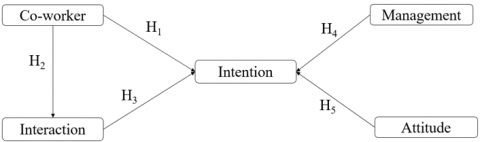
H1: Co-worker has a positive impact on interaction group
H2: Co-worker has a positive impact on electricity-saving intention
H3: Interaction group has a positive impact on electricity-saving intention
2.3 Building management and electricity-saving intention
Building management plays an important role in influencing electricity-saving behavior in buildings. The management can propose and establish policies and regulations regarding energy conservation throughout the building. Social influence theory suggests that individuals' behaviors are influenced by the perceptions, attitudes, and actions of others [4, 14]. This theory explains how management's policies, communication, and role modeling can affect employees' electricity-saving behaviors in building management. When building management sets clear expectations and leads by example—such as promoting energy-efficient practices and offering incentives—employees are more likely to adopt these behaviors due to peer influence and perceived social norms. This can create a collective shift towards energy conservation, demonstrating the power of social influence in promoting sustainable practices in office settings. Several studies have used social influence theory to explain the impact of colleagues or group interaction on the intention to save electricity [9, 10]. However, no specific research has evaluated the role of building management in this context.
This may involve specifying the usage hours for lights, air conditioning, and other electrical devices, as well as requiring the use of energy-efficient equipment [9-11] and [19]. The management can make decisions to invest in energy-saving devices and systems. This could include installing LED lighting systems, efficient air conditioning and cooling systems, and other technologies to reduce energy consumption. The management implements energy management systems to monitor and control energy consumption throughout the building. This helps them identify and minimize energy wastage and implement effective energy-saving measures. The management creates conditions for the resident community to participate in energy-saving activities, such as electricity-saving competitions, rewards for energy-saving actions, and incentive programs for innovative energy-saving ideas [9], [19], [20]. Building management can play a crucial role in creating an electricity-saving living and working environment throughout the building by implementing these measures. Therefore, the research hypothesis is presented as follows:
H4: Building management has a positive impact on electricity-saving intention
2.4 Attitude and electricity-saving intention
Attitudes and intentions related to energy conservation within a building community are crucial in achieving energy efficiency. A positive attitude towards the importance of energy conservation, coupled with an awareness of environmental impacts, is a motivational factor [4, 21, 22]. Clear intentions to save energy reflect personal or communal commitments to reducing consumption. Key behaviors include using energy-efficient devices and technologies such as LED lights and laptops and turning off unnecessary electrical appliances. Individuals and communities can benefit from policies and support, including incentives, discounts, and energy-saving programs governments and building management provide. Education and awareness campaigns, through workshops and training, contribute significantly to fostering a culture of energy conservation.
In summary, a positive attitude, clear intentions, and consistent electricity-saving behaviors, supported by policies and education, are essential components for creating energy-efficient and environmentally friendly living and working environments. The hypothesis is presented:
H5: Attitude has a positive impact on electricity-saving intention
The research model is presented in Figure 1.
Figure 1. Research model
3.1 Research design
Building models research, hypotheses, and questionnaires is based on theories and previous studies. The questionnaire uses items translated from English to Vietnamese, then translated back to English, and compared for differences in meaning between the translation and the original. If there are discrepancies, the items are adjusted until consistency is achieved among them. Items are used on a 5-point Likert: 1- strongly disagree to 5- strongly agree.
3.2 Sample
The survey was conducted to be distributed directly to employees working in buildings from May 2022 to September 2022. The survey results obtained 706 respondents. The results describing the surveyed office employees indicated 219 Females (31%) and 487 Males (69%). The age is mostly under 35 years old. The staff in the building mainly work in offices (469 people, accounting for 66.4%); only 33.6% of employees work in a mixed-use building of offices, houses, and supermarkets (237 people). Finally, the company's size of employees is mainly under 100 people, with 419 people accounting for 59.3%, followed by the group of over 200 people, with 202 people, accounting for 28.6%. The participant characteristics are presented in Table 1.
Table 1. Respondents’ profiles (n = 706)
|
n |
% |
n |
% |
||
|
Gender |
|
|
Type of building |
|
|
|
Female |
219 |
31 |
Complex (Office, household, supper market) |
237 |
33.6 |
|
Male |
487 |
69 |
Only Office |
469 |
66.4 |
|
Age |
Size of Company |
|
|
||
|
<25 |
404 |
57.2 |
<100 |
419 |
59.3 |
|
25-35 |
227 |
32.2 |
>200 |
202 |
28.6 |
|
35-50 |
73 |
10.3 |
100-200 |
85 |
12 |
|
>50 |
2 |
0.3 |
|
|
|
3.3 Data analysis
Confirmatory factor analysis (CFA) was employed to assess the reliability and validity of each construct within the model. To evaluate construct reliability, Cronbach’s alpha and the composite reliability (CR) coefficient were utilized, requiring a threshold exceeding 0.6. The Average Variance Extracted (AVE) was also considered, with a criterion set at a minimum of 0.5 [23]. The convergent validity of each construct was appraised by examining the factor loading of individual items within each construct, requiring a threshold greater than 0.5. Discriminant validity was assessed by comparing the square root of AVEs with the correlations between constructs. If the square root of the constructs exceeded the correlation coefficients, it indicated that the constructs in the model achieved discriminant validity [23]. The proposed hypotheses were then tested using partial least square structured equation modeling (PLS-SEM) with statistical significance set at a 5% level. PLS-SEM has become a widely used method in multivariate analysis [23]. Its key advantages include the flexibility to relax distributional assumptions required by the maximum likelihood method in covariance-based SEM (CB-SEM) and its ability to estimate more complex models with smaller sample sizes. Given these benefits, PLS-SEM is utilized in this study. PLS-SEM has found widespread application in psychological research and social science, particularly in recent years, where it has been utilized by numerous scholars to examine the impact of factors on electricity-saving behavior [24, 25].
4.1 Reliability test
The items are tested for reliability before SEM analysis, with evaluation criteria including Cronbach’s Alpha coefficient of constructs, which must be 0.6 or higher and composite Reliability greater than 0.7 [26]. Additionally, constructs must ensure convergence. Two indicators, factor loading above 0.5 and AVE greater than 50%, demonstrate convergence of constructs.
The analysis results from Smart-PLS software indicate that all constructs achieve reliability with Cronbach's Alpha coefficient greater than 0.6 and Composite Reliability greater than 0.7. Furthermore, constructs demonstrate convergence with factor loading above 0.5 and AVE greater than 50% (details in Table 2).
Table 2. Reliability test
|
Contruct/ Items |
Loading |
|
|
The Co-worker, Cronbach's Alpha=0.828; CR=0.885; AVE=0.659 |
||
|
CO1 |
Colleagues often turn off the lights when leaving an empty room |
0.83 |
|
CO2 |
Colleagues often turn off the air conditioner before leaving the room |
0.79 |
|
CO3 |
Colleagues often turn off their computers when they leave the room. |
0.76 |
|
CO4 |
Colleagues often choose electricity-saving modes for electrical appliances. |
0.84 |
|
Interaction Group, Cronbach's Alpha=0.891; CR=0.933; AVE=0.822 |
||
|
INA1 |
People often remind others about using electricity-saving |
0.88 |
|
INA2 |
People often share experiences and secrets to electricity-saving |
0.91 |
|
INA3 |
People often ask you about using electricity-saving |
0.91 |
|
Building management, Cronbach's Alpha=0.807; CR=0.886; AVE=0.723 |
||
|
MAN1 |
The building management regularly reminds individuals to turn off electrical equipment when not in use. |
0.81 |
|
MAN2 |
The building management board regularly disseminates and guides the use of electricity-saving. |
0.90 |
|
MAN3 |
Building management regularly implements electricity-saving activities and applicable regulations. |
0.83 |
|
Attitude, Cronbach's Alpha=0.786; CR=0.875; AVE=0.701 |
||
|
ATT1 |
Will you use electricity-saving devices in the office? |
0.83 |
|
ATT2 |
Are you ready to change the habit of using electricity-consuming |
0.79 |
|
ATT3 |
You intend to participate in activities related to electricity-saving. |
0.88 |
|
Intention, Cronbach's Alpha=0.872; CR=0.913; AVE=0.725 |
||
|
INT1 |
You will always electricity-saving at work |
0.87 |
|
INT2 |
You will use electricity-saving devices on your work at work |
0.79 |
|
INT3 |
You are willing to buy electricity-saving equipment for work (paying the cost even though it is high) |
0.84 |
|
INT4 |
Overall, you are willing to work towards electricity-saving at work |
0.90 |
4.2 Discriminant validity test
In addition to constructs' reliability and convergence, testing for constructs' discriminant validity is also conducted. This study performs discriminant validity testing [27]. According to this, the square root of AVE should be greater than the corresponding correlation coefficient between constructs. The analysis results indicate that constructs achieve discriminant validity)—the detail in Table 3.
Table 3. The discriminant validity
|
ATT |
CO |
IN |
INT |
MAN |
|
|
ATT |
0.837 |
||||
|
CO |
0.498 |
0.811 |
|||
|
IN |
0.464 |
0.61 |
0.907 |
||
|
INT |
0.616 |
0.581 |
0.731 |
0.851 |
|
|
MAN |
0.448 |
0.542 |
0.567 |
0.572 |
0.848 |
Notes: 1st value = Correlation between variables (2-tailed t-test); Square root of AVE (bold diagonal)
4.3 Hypotheses testing
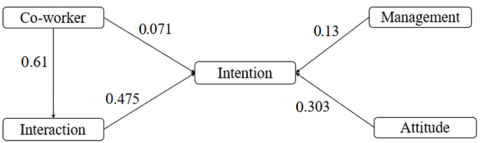
The results of PLS-SEM analysis show that CO has a positive impact on INT at the 10% significance level and a positive impact on IN at the 1% significance level. It can be seen that when there is a discussion with colleagues about saving electricity, employees will tend to increase interactions about electricity-saving and their intention to electricity-saving. Therefore, hypotheses H1, H2 are accepted. IN has a positive impact on INT at the 1% significance level (βIN1=0.071, significant at 10%; βIN2=0.61, significant at 1%). The more interaction within the group, the higher the employee's intention to electricity-saving. Hypothesis H3 is accepted. The building management board also plays an active role with the intention of electricity-saving in the building (βman=0.13, significant at 1%). The hypothesis H4 is accepted. Finally, ATT has the same impact on electricity-saving intention (βATT=0.303, significant at 1%). The control variable for gender is not statistically significant. Details in Table 4.
Table 4. The PLS-SEM result
|
Model 1 |
Model 2 |
||||||
|
IN |
ATT |
INT |
IN |
ATT |
INT |
||
|
H2, H1 |
CO |
0.61a |
0.071c |
0.61a |
|
0.071c |
|
|
0.023 |
0.041 |
0.022 |
|
0.04 |
|||
|
H3 |
IN |
0.474a |
|
|
0.475a |
||
|
0.039 |
|
|
0.042 |
||||
|
H4 |
MAN |
0.129a |
|
|
0.13a |
||
|
0.037 |
|
|
0.037 |
||||
|
H5 |
ATT |
0.303 |
|
|
0.303a |
||
|
|
|
|
|
0.035 |
|
|
0.035 |
|
Control variable |
Gender |
|
|
|
|
|
0.011 |
|
|
|
|
|
|
0.02 |
||
|
|
R2 |
0.372 |
0.649 |
|
0.372 |
|
0.649 |
Notes: CO: Co-worker; IN: group interaction; MAN: Management; ATT: Attitude; INT is electricity-saving Intention; numbers in brackets: standard error; a: significance at 1% respectively; b: significance at 5% respectively; c: significance at 10% respectively (two-tailed t-test)
Figure 2. PLS-SEM result
The PLS-SEM result can present in Figure 2.
4.4 Discussion
Positive impacts from colleagues can significantly influence the intention to save electricity in office buildings. Social influence theory posits that the behaviors and attitudes of others influence individuals. In the context of electricity-saving intention, colleagues can positively impact this behavior by modeling energy-efficient practices, creating social norms, encouraging collective responsibility, motivating others to adopt similar energy-saving habits. Colleagues are crucial in fostering awareness and education regarding the environmental and cost implications of high energy consumption. Establishing communication channels and forums for sharing experiences enhances consensus and motivation. Learning from each other's successes and failures fosters a collaborative environment. Colleagues can discuss the application of information technology, such as smart sensors and automation, to monitor and manage energy consumption effectively [9, 10]. Creating a positive and engaging environment through events like energy-saving competitions stimulates active participation. Collaborative efforts can support the proposal and advocacy of energy-saving policies, like using LED lights and renewable energy sources. Mutual support in implementing specific action plans, such as using energy-efficient devices and optimizing lighting and cooling systems, further reinforces the collective commitment to energy conservation. Overall, the positive influence of colleagues cultivates a sustainable and optimistic workplace environment, driving a shared commitment to energy efficiency in office buildings. This result is the same as the other studies [5, 10].
The positive interaction of a team in a corporate environment can significantly influence employees' intention to save electricity in an office building. Through group support and discussions, employees can share information and experiences on how to reduce energy consumption. Team spirit and support from colleagues can create a positive work environment, encouraging the implementation of electricity-saving measures. The team can also initiate interactive campaigns, such as energy consumption reduction competitions or other group activities, to enhance team solidarity and environmental awareness [5, 10]. Support and encouragement from the team can motivate employees to feel empowered to make positive changes in their individual energy usage behavior, from turning off lights when not in use to optimizing office equipment. Additionally, team interaction fosters a positive and creative work atmosphere, enhancing awareness of electricity conservation within the office building.
The positive impact of building management on employees' intention to save electricity in an office building is crucial. Social influence theory suggests that the behaviors and attitudes of authority figures influence individuals. Building management can positively impact electricity-saving intention by setting energy-efficient policies, promoting sustainable practices, and leading by example. Their actions create a social norm, encouraging employees to adopt similar energy-saving behaviors in the workplace. Management can lead the establishment of policies and measures to encourage energy conservation. Providing clear information and guidance on efficient energy usage can help employees better understand their impact on overall power consumption. Management can also invest in information technology to monitor and manage energy consumption, providing accurate data for assessment and improvement. Encouraging the use of energy-saving devices and implementing efficient energy measures throughout the entire building is an essential part of management policies [9-11, 19]. Additionally, creating a positive work environment by proposing and supporting employee initiatives for energy conservation can significantly promote awareness and a positive attitude among employees.
The positive attitude of employees plays a crucial role in promoting the intention to save electricity in the workplace environment. Employees' awareness and consciousness of their impact on energy consumption can lead to positive changes. Those with a positive attitude often proactively take energy-saving measures such as turning off lights when not in use, optimizing the use of office equipment, and maintaining energy-saving behaviors throughout their daily work routine. A positive attitude is also reflected in sharing opinions, proposing energy-saving solutions, and participating in group activities or competitions that encourage electricity conservation [4, 21, 22]. Employees with a positive attitude can motivate each other, creating a positive work environment where everyone is focused on the common goal of reducing energy consumption. Moreover, this positive attitude can spread, positively impacting the entire organization, fostering environmental awareness, and promoting energy conservation in the office building.
The research has successfully achieved its research objectives. Firstly, the study has systematized the theoretical foundation regarding energy-saving behaviors in office buildings. Accordingly, behaviors such as turning off electrical devices when not in use and using energy-efficient devices in the office are the primary behaviors of office employees. Secondly, the research has constructed a model to investigate the influence of colleagues, interactive groups, and building management on the intention of employees to save electricity in office buildings. Thirdly, the study utilized PLS-SEM and demonstrated the positive impact of colleagues, interactive groups, and building management on the intention of office employees to save electricity.
Although the research has revealed the impact of colleagues, interactive groups, and building management on the intention of office employees to save electricity in buildings, it still has some limitations. Firstly, the study only surveyed employees in leased office buildings. Employees in commercial center areas may have different intentions, but this aspect was not considered in this research. Secondly, the research was conducted at a specific time, while the intention to save electricity may vary over time or in different seasons. Finally, This study acknowledges the limitation of not considering potential moderating or mediating variables, such as employees' economic situation, industry type, or local energy-saving culture. Future research should incorporate these factors to provide a more comprehensive theoretical framework and a deeper understanding of the dynamics influencing workplace electricity-saving behavior.
The study also suggests some implications based on these limitations. Future research should address the limitations identified in this study by expanding the sample to include employees in different types of office spaces, such as commercial centers, to explore potential differences in electricity-saving intentions across various environments. Additionally, longitudinal studies could examine how electricity-saving intentions evolve over time or during different seasons, as these factors may influence behavior. Furthermore, future research should consider moderating or mediating variables, including employees' economic situation, industry type, and local energy-saving culture. By incorporating these variables, researchers could develop a more comprehensive theoretical framework that accounts for the complex interactions shaping electricity-saving behavior in the workplace. Exploring these factors will help build a deeper understanding of how social influence, environmental context, and personal circumstances collectively impact energy-saving practices. This could lead to more tailored and effective interventions for promoting sustainable energy consumption in office buildings.
Theoretical Implication: The theoretical contribution of this study lies in expanding social influence theory by integrating the roles of both colleagues and building management in shaping electricity-saving intentions. It highlights how peer influence and management reminders collectively reinforce energy-saving behavior, adding depth to existing models by considering workplace dynamics and environmental cues. The study examines the roles of social influence theory on the intention to save electricity among office employees in office buildings. The influence of colleagues and interactive groups enhances the intention to save electricity among employees in office buildings. Additionally, the oversight of building management prompts employees to consider electricity conservation when reminded consistently. Consequently, the intention to save electricity among employees is heightened through reminders. Finally, the societal impact contributes to a positive attitude among office employees toward energy-saving behavior.
Practical Implication: The practical contribution of this study provides businesses with actionable insights to implement effective energy-saving policies in office buildings. By leveraging building management's influence, companies can promote energy efficiency through clear signage, guidelines, and incentives. Additionally, fostering a culture of accountability with penalties or rewards can further drive electricity conservation behaviors among employees. Based on the research findings, businesses can formulate policies related to energy-saving initiatives in offices and buildings. Furthermore, penalties and sanctions could enhance self-awareness and foster a trend toward electricity conservation in office buildings. The significant role of building management is crucial in improving the intention to save electricity among office employees. Signage and effective guidelines on energy-efficient practices will increase employee awareness about electricity conservation in the office.
[1] Ngoc, H.T., Tuan, B.A., van Duy, N., Kien, D.T., Dat, N.N. (2021). Impact of foreign direct investment and urbanisation on CO2 emissions in Vietnam. International Journal of Business and Globalisation, 27(3): 313-332. http://doi.org/10.1504/IJBG.2021.113276
[2] Electric Industry Report. (2019). Báo cáo cập nhật Ngành điện. https://www.cts.vn/2019/10/10/vietinbank-securities-bao-cao-cap-nhat-nganh-dien/.
[3] Pothitou, M., Hanna, R.F., Chalvatzis, K.J. (2016). Environmental knowledge, pro-environmental behaviour and energy savings in households: An empirical study. Applied Energy, 184: 1217-1229. http://doi.org/10.1016/J.APENERGY.2016.06.017
[4] Hong, J., She, Y., Wang, S., Dora, M. (2019). Impact of psychological factors on energy-saving behavior: Moderating role of government subsidy policy. Journal of Cleaner Production, 232: 154-162. http://doi.org/10.1016/J.JCLEPRO.2019.05.321
[5] Sun, Y., Yuan, Z., Sun, K., Wang, B. (2023). Electricity-saving potential of residential buildings: Empirical evidence from resident habits. Energy Efficiency, 16(8): 90. http://doi.org/10.1007/S12053-023-10169-7
[6] Chen, Y., Liu, J., Pei, J., Cao, X., Chen, Q., Jiang, Y. (2014). Experimental and simulation study on the performance of daylighting in an industrial building and its energy saving potential. Energy and Buildings, 73: 184-191. http://doi.org/10.1016/J.ENBUILD.2014.01.030
[7] Le Truong, N., Dodoo, A., Gustavsson, L. (2014). Effects of heat and electricity saving measures in district-heated multistory residential buildings. Applied Energy, 118: 57-67. http://doi.org/10.1016/J.APENERGY.2013.12.009
[8] Ru, X., Wang, S., Yan, S. (2018). Exploring the effects of normative factors and perceived behavioral control on individual’s energy-saving intention: An empirical study in eastern China. Resources, Conservation and Recycling, 134: 91-99. http://doi.org/10.1016/J.RESCONREC.2018.03.001
[9] Wang, S., Wang, J., Ru, X., Li, J., Zhao, D. (2019). Understanding employee’s electricity conservation behavior in workplace: Do normative, emotional and habitual factors matter? Journal of Cleaner Production, 215: 1070-1077. http://doi.org/10.1016/J.JCLEPRO.2019.01.173
[10] Chen, C.H.V., Chen, Y.C. (2021). Assessment of enhancing employee engagement in energy-saving behavior at workplace: An empirical study. Sustainability, 13(5): 2457. http://doi.org/10.3390/SU13052457
[11] Wemyss, D., Castri, R., De Luca, V., Cellina, F., Frick, V., Lobsiger-Kägi, E., Blanchi, P.G., Hertach, C., Kuehn, T., Carabias, V. (2016). Keeping up with the Joneses: Examining community-level collaborative and competitive game mechanics to enhance household electricity-saving behaviour. In 4 th European Conference on Behaviour and Energy Efficiency, Coimbra, Portugal.
[12] Zhu, J., Alam, M.M., Ding, Z., Ekambaram, P., Li, J., Wang, J. (2021). The influence of group-level factors on individual energy-saving behaviors in a shared space: The case of shared residences. Journal of Cleaner Production, 311: 127560. http://doi.org/10.1016/J.JCLEPRO.2021.127560
[13] Bong Ko, S., Jin, B. (2017). Predictors of purchase intention toward green apparel products: A cross-cultural investigation in the USA and China. Journal of Fashion Marketing and Management: An International Journal, 21(1): 70-87. http://doi.org/10.1108/JFMM-07-2014-0057
[14] He, X., Zhan, W. (2018). How to activate moral norm to adopt electric vehicles in China? An empirical study based on extended norm activation theory. Journal of Cleaner Production, 172: 3546-3556. http://doi.org/10.1016/J.JCLEPRO.2017.05.088
[15] Handgraaf, M.J., De Jeude, M.A.V.L., Appelt, K.C. (2013). Public praise vs. private pay: Effects of rewards on energy conservation in the workplace. Ecological Economics, 86: 86-92. http://doi.org/10.1016/J.ECOLECON.2012.11.008
[16] Egmond, C., Jonkers, R., Kok, G. (2005). A strategy to encourage housing associations to invest in energy conservation. Energy Policy, 33(18): 2374-2384. http://doi.org/10.1016/J.ENPOL.2004.05.007
[17] Dillman, D.A., Rosa, E.A., Dillman, J.J. (1983). Lifestyle and home energy conservation in the United States: The poor accept lifestyle cutbacks while the wealthy invest in conservation. Journal of Economic Psychology, 3(3-4): 299-315. http://doi.org/10.1016/0167-4870(83)90008-9
[18] Chen, X., Gou, Z. (2022). Bridging the knowledge gap between energy-saving intentions and behaviours of young people in residential buildings. Journal of Building Engineering, 57: 104932. http://doi.org/10.1016/J.JOBE.2022.104932
[19] Chen, J., Zhou, Y., Huang, X., Yu, C., et al. (2023). Ladderphane copolymers for high-temperature capacitive energy storage. Nature, 615(7950): 62-66. https://doi.org/10.1038/s41586-022-05671-4
[20] Zhang, Y., Fu, B., Maani, S., Wen, L. (2024). Employee energy-saving behaviors: Review of theories, influencing factors, and interventions. Renewable and Sustainable Energy Reviews, 203: 114766. http://doi.org/10.1016/J.RSER.2024.114766
[21] Toft, M.B., Schuitema, G., Thøgersen, J. (2014). Responsible technology acceptance: Model development and application to consumer acceptance of Smart Grid technology. Applied Energy, 134: 392-400. http://doi.org/10.1016/J.APENERGY.2014.08.048
[22] Samuelson, C.D., Biek, M. (1991). Attitudes toward energy conservation: A confirmatory factor analysis1. Journal of Applied Social Psychology, 21(7): 549-568. http://doi.org/10.1111/J.1559-1816.1991.TB00536.X
[23] F. Hair Jr, J., Sarstedt, M., Hopkins, L., G. Kuppelwieser, V. (2014). Partial least squares structural equation modeling (PLS-SEM): An emerging tool in business research. European Business Review, 26(2): 106-121. https://doi.org/10.1108/EBR-10-2013-0128
[24] Wang, Y., Lin, B., Li, M. (2021). Is household electricity saving a virtuous circle? A case study of the first-tier cities in China. Applied Energy, 285: 116443. http://doi.org/10.1016/J.APENERGY.2021.116443
[25] Webb, D., Soutar, G.N., Mazzarol, T., Saldaris, P. (2013). Self-determination theory and consumer behavioural change: Evidence from a household energy-saving behaviour study. Journal of Environmental Psychology, 35: 59-66. http://doi.org/10.1016/J.JENVP.2013.04.003
[26] Hair Jr, J.F., Matthews, L.M., Matthews, R.L., Sarstedt, M. (2017). PLS-SEM or CB-SEM: Updated guidelines on which method to use. International Journal of Multivariate Data Analysis, 1(2): 107-123. https://doi.org/10.1504/IJMDA.2017.087624
[27] Fornell, C., Larcker, D.F. (1981). Structural equation models with unobservable variables and measurement error: Algebra and statistics. Journal of Marketing Research, 18(3): 382-388. http://doi.org/10.1177/002224378101800313