Edwin J. L. Lazarus* | Emma Dyelim Wie Lawa | Maritje Aleonor Hilakore
© 2025 The authors. This article is published by IIETA and is licensed under the CC BY 4.0 license (http://creativecommons.org/licenses/by/4.0/).
OPEN ACCESS
This investigation assessed the nutritional properties and in vitro fermentation traits of cooking products made from urea–banana corm flour, exploring their potential as a slow-release urea supplement for ruminant feed. Treatments consisted of 0% (P0), 2% (P2), 4% (P4), and 6% (P6) urea levels (based on dry matter). The product cooked with 6% urea showed the highest crude protein (15.74%) compared to 7.09% in the control (P0). Dry matter digestibility (DMD) and organic matter digestibility (OMD) increased from 42.0% and 36.6% in P0 to 74.6% and 73.2% in P6, respectively. Total volatile fatty acid (VFA) concentration rose from 73.1 to 128.8 mM, and the peak ammonia release was delayed from 1 h (P0) to 3 h (P6) after incubation. Scanning electron microscopy revealed thicker and more compact starch granules at higher urea levels, indicating starch gelatinization and physical entrapment of urea. Urea level did not significantly affect dry matter or organic matter content, but markedly improved crude protein and ether extract contents. It can be concluded that cooking banana corm flour with 6% urea produces a nutrient-enriched, slow-release urea product with superior fermentation characteristics for ruminant diets.
banana corm flour, cooking, in vitro fermentation, slow-release urea, nutrient composition, rumen fermentation
Animals with ruminant digestive systems, like sheep and cattle, are able to digest feedstuffs that other animals have a hard time utilizing. However, to ensure optimal growth and health, their feed must be carefully formulated to meet specific nutritional requirements. One strategy to enhance nutrient utilization in ruminants consuming low-quality basal feeds is to provide supplements that correct nutrient imbalances for rumen microbes. Ruminants benefit greatly from urea and other non-protein nitrogen (NPN) sources as a supplement because of their high nitrogen density, low cost, and efficient usage [1]. Urea serves as an economical substitute for feed protein in ruminant rations [2]. According to Zurak et al. [3], ruminants can efficiently utilize NPN, which rumen microbes convert into microbial crude protein (MCP), ultimately benefiting the host animal.
Because of its potential, urea can reduce feed costs by replacing vegetable protein sources like soybean meal in diets [4, 5]. Urea is a non-protein nitrogen source that ruminants can consume; however, it is inefficiently used and poses dangers due to its high rumen solubility. Hailemariam et al. [6] reported that direct feeding of urea causes rapid ruminal decomposition, which can result in inefficient nitrogen use and hyperammonemia. Additionally, Hynes et al. [7] noted that the high solubility of urea leads to excess nitrogen in the rumen, causing toxicity and energy wastage, as energy is required to eliminate excess ammonia from the blood. This results in negative environmental, health, and economic impacts.
Urea releases ammonia (NH₃) more rapidly than rumen microbes can utilize it for protein synthesis [8]. Therefore, it is crucial to slow its release by synchronizing it with energy sources in the rumen. Improving nitrogen consumption efficiency in the rumen relies on the synchronization of carbohydrate decomposition and nitrogen availability [9].
A more slowly degradable type of urea has long been sought after, promoting better incorporation of ammonia into microbial protein synthesis while reducing urea excretion in urine [2]. According to Gonçalves et al. [10], products designed for controlled urea release are generally referred to as slow-release urea (SRU). These products enhance nitrogen utilization by rumen microorganisms and improve microbial protein synthesis. However, developing SRU products is challenging, as it requires controlling the gradual release of NH₃ without excessively limiting urea degradation in the rumen [11]. Slow-release urea provides a continuous nitrogen supply to rumen microbes, leading to greater microbial protein production for the host animal [12, 13]. According to Niazifar et al. [14], the price of SRU products is a determining factor in whether or not people will buy them instead of more traditional plant protein sources. To better satisfy the nutritional demands of ruminants, it would be beneficial to produce locally created SRU products at a cheaper cost than imported alternatives. This would encourage more farmers to use them.
Banana corm, the basal part of the banana plant, is often considered an underutilized agricultural byproduct [15]. Here, the mother banana plant grows clusters of juvenile plants called "suckers" that will eventually take over the world. The juvenile suckers get the nourishment they need from the stored nutrients in the corm [16].
Banana corm contains significant nutrients, including 91.56% dry matter, 1.72% crude protein (CP), 7.98% crude fiber (CF), 1.15% ether extract (EE), and 88.16% carbohydrates [17]. A product that releases ammonia more slowly, enhancing synchronization between the two substances, might be made by combining banana corm flour with urea by boiling or heating. Cooking enhances the gelatinization of banana corm starch, thereby slowing carbohydrate degradation and increasing urea utilization efficiency. Soeharsono [18] explained that during gelatinization, water molecules penetrate starch granules, allowing soluble protein molecules to become trapped within the gel structure, effectively regulating their release.
Based on the physicochemical properties of starch and the nitrogen characteristics of urea, it is hypothesized that cooking banana corm flour with urea promotes starch gelatinization, which encapsulates urea molecules within the starch matrix. This structural entrapment is expected to regulate the rate of ammonia release in the rumen, thereby synchronizing nitrogen supply with energy availability from carbohydrates. Therefore, this study aimed to verify whether this cooking-induced physicochemical interaction can effectively slow ammonia release and to systematically evaluate its impact on the nutritional composition and in vitro fermentation parameters. This approach represents a locally feasible innovation for developing cost-effective slow-release urea supplements for ruminant nutrition.
The materials used in this study included banana corm flour, urea, and water. The equipment consisted of Bell-brand HDPE heat-resistant plastic, scales, stoves, basins, stirrers, and laboratory analysis tools. Banana corm flour was prepared according to the procedure outlined by Fajrih et al. [19]. The banana corms used were from the Kepok banana species (Musa paradisiaca), sourced from the area around Kupang City, Indonesia. A thorough washing under running water was performed on the fresh Kepok banana corms to remove any dirt. After cleaning the banana corms, we sliced them into pieces around half a centimeter thick and sun-dried them for three days. Once dried, they were ground into flour using a grinder.
The nutritional composition of banana corm flour can be seen in Table 1.
Table 1. Nutrient content of banana corm flour
|
Item |
Banana Corm Flour (%) |
|
Dry Matter (DM) |
82.31 |
|
Organic Matter (OM) |
82.306 |
|
Crude Protein (CP) |
3.224 |
|
Crude Fiber (CF) |
22.41 |
|
Ether Extract (EE) |
0.81 |
|
Nitrogen Free Extract (NFE) |
57.12 |
|
Starch |
49.645 |
|
Amylose |
19.185 |
|
Amylopectin |
30.460 |
2.1 Research methods
2.1.1 Cooking process of urea with banana corm flour
A carbohydrate source called banana corm flour was cooked with different amounts of urea to make the SRU product. A stovetop burner was used to cook the food. Banana corm flour with 0%, 2%, 4%, and 6% urea by dry weight was used in this experiment. Each treatment was repeated four times, resulting in 16 experimental units. The selected urea levels align with the recommended limit for ruminant rations, which is approximately 6%. The cooking process was conducted in a preheated water bath maintained at 95℃ for 60 minutes, following the procedure of Richana and Sunarti [20] with modifications. The treatments were as follows:
Procedure:
2.2 Measured variables
2.2.1 Morphological study of cooked products
The morphology of the cooked samples was analyzed using a scanning electron microscope (SEM), JEOL model JSM 6380 LV.
2.2.2 Ammonia release test of cooked products
The in vitro fermentation method was employed to evaluate the ammonia release rate of the urea–banana corm flour complex. The fermentation medium comprised McDougall’s buffer solution and rumen fluid. Rumen fluid was collected early in the morning from cattle at the Beumopu slaughterhouse in Kupang City. It was immediately transferred to the laboratory in a pre-warmed thermos flask and subsequently filtered through four layers of 100-µm gauze to remove solid particles. McDougall’s buffer solution was prepared with the following composition:
The Conway microdiffusion method was used to measure the NH₃ concentration. Petroleum jelly was applied to a Conway dish's rim and lid for this technique in order to guarantee an airtight seal. To prevent the two liquids from mixing, one milliliter of supernatant and one milliliter of saturated Na2CO3 solution were put on opposing sides of the plate. One milliliter of boric acid solution containing an indicator was placed in the center of the dish. After that, the dish was carefully sealed, and the supernatant and NaCO3 solution were combined. At room temperature, the mixture was allowed to react for a whole day.
Following this time frame, 0.005 N H₂SO₄ was added to the solution in the Conway dish to titrate it until the boric acid solution turned red instead of blue, and the titration results were noted. A pH meter was also used to test the pH of the supernatant from each sample in order to track the incubation conditions and assess the impact of the therapy. Every therapy was administered twice. Ammonia concentration (N-NH₃) was determined using the formula:
$\begin{gathered}\mathrm{N}-\mathrm{NH}_3(\mathrm{mg} / 100 \mathrm{~mL})=\text { Titration volume }(\mathrm{mL}) \times N_{\mathrm{H}_2 \mathrm{SO}_4} \times 17 \times 100\end{gathered}$
where,
Titration volume = volume of sulfuric acid used during titration (in mL)
$N_{\mathrm{H}_2 \mathrm{SO}_4}$ = normality of sulfuric acid
17 = molecular weight of nitrogen (g/mol)
100 = conversion factor to express the result per 100 mL
2.3 Nutritional value of cooked products
The nutritional composition of the cooked products was analyzed using proximate analysis according to AOAC [21] to determine DM, OM, CP, CF, EE, and NFE.
2.4 In vitro fermentation (pH, digestibility of DM, OM, VFA-Total, NH3)
This experiment's working approach is a variation of the two-stage method developed by Tilley and Terry. Centrifugation (3000 rpm, 10 min), broth volume (50 mL) [21]. The methods are as follows:
1. Measure 1.0 g of the dry matter sample and transfer it into 1 mL of McDougall buffer solution, ensuring the pH is set to 8.9, followed by the addition of 10 mL of cattle rumen fluid inoculum.
2. After the fermenter was placed in a 40℃ water bath, CO2 gas was pumped into it, and a vented rubber buffer was placed over it.
3. To kill the microorganisms, 0.2 mL of HgCl2 was added to terminate the fermentation process after a 24-hour incubation period.
4. The precipitate was subsequently re-incubated with 20 mL of 0.2% pepsin solution for 24 hours in an open state following the centrifugation of the fermentation result for 5 minutes at 16,400 rpm. Following the application of a vacuum pump, the residual digestive materials were filtered using Whatman filter paper number 41, and subsequently rinsed with 25 milliliters of hot water.
5. A porcelain cup was filled with the filter and filter paper. To examine the residual dry matter, the remaining water content was evaporated in an oven set to 105℃ for 24 hours. Burning the residue for eight hours at 650℃ in an electric furnace allowed for the analysis of organic materials. The fermentation byproduct served as a blank, as it had no substrate.
The following formulas were utilized to determine dry matter digestibility and organic matter digestibility.
Dry Matter Digestibility (DMD):
$\begin{gathered}\mathrm{DMD}(\%)=\left(\frac{\text { Sample DM }-(\text { Residual DM }-\mathrm{DM} \text { Blank })}{\text { Sample } \text { DM }}\right) \times 100\end{gathered}$
where,
Sample DM = initial dry matter of the sample (g)
Residual DM = dry matter remaining after digestion (g)
DM Blank = blank correction for dry matter
Organic Matter Digestibility (OMD):
$\begin{gathered}\mathrm{OMD}(\%)=\left(\frac{\text { Sample } \mathrm{OM}-(\text { Residual } \mathrm{OM}-\mathrm{OM} \text { Blank })}{\text { Sample } \mathrm{OM}}\right) \times 100\end{gathered}$
where,
Sample OM = initial organic matter of the sample (g)
Residual OM = organic matter remaining after digestion (g)
OM Blank = blank correction for organic matter
2.5 Measurement of NH3 and total VFA concentrations
Total VFA measurement used the steam distillation technique, and NH3 measurement used the Conway microdiffusion technique. Fresh cow rumen fluid was obtained from the slaughterhouse as inoculum. Each sample was put as much as 0.56 g into a sterilized fermenter tube, then the sample was given 40 mL McDougall solution and 10 mL cow rumen fluid, then CO2 gas was added for 10-20 seconds to create anaerobic conditions, and the tube was closed with a rubber cap. After three hours of incubation in a water bath, the tube was submerged in ice water to halt the fermentation process. After centrifuging the mixture for 15 minutes at 3000 rpm, the supernatant was taken out for VFA and NH3 analysis. Total VFA analysis was done by the steam distillation method. Ammonia (NH3) analysis was performed by the Conway microdiffusion method.
The procedure for measuring VFA required the preparation of the distillation apparatus, which included boiling water and channeling the steam to the condenser or cooler. Following this, 5 mL of the sample was combined with 1 mL of 15% H2SO4 in the distillation apparatus. The produced VFAs were collected using 5 mL of 0.5 N NaOH, which was contained in an Erlenmeyer flask. The liquid was collected until it reached 250-300 mL, and then 2-3 drops of an indicator were added. It was titrated with 0.5 N HCl solution until the titrant color changed from pink to colorless. The formula employed for calculating the total VFA concentration is as follows:
$\mathrm{Total}\ \mathrm{VFA} (\mathrm{mM})=\frac{(a-b) \times N_{\mathrm{HCl}} \times 1000}{5 \times \text { Sample weight } (\mathrm{g}) \times \mathrm{DM} \text { fraction }}$
where,
a = volume of HCl used in the blank titration (mL); b = volume of HCl used in the sample titration (mL).
2.6 Statistical analysis
Data were analyzed using SPSS software version 25.0 (IBM Corp., USA) according to a completely randomized design (CRD). Treatment means were compared using Duncan’s multiple range test when significant effects were detected (P < 0.05).
3.1 Scanning electron microscopy (SEM)
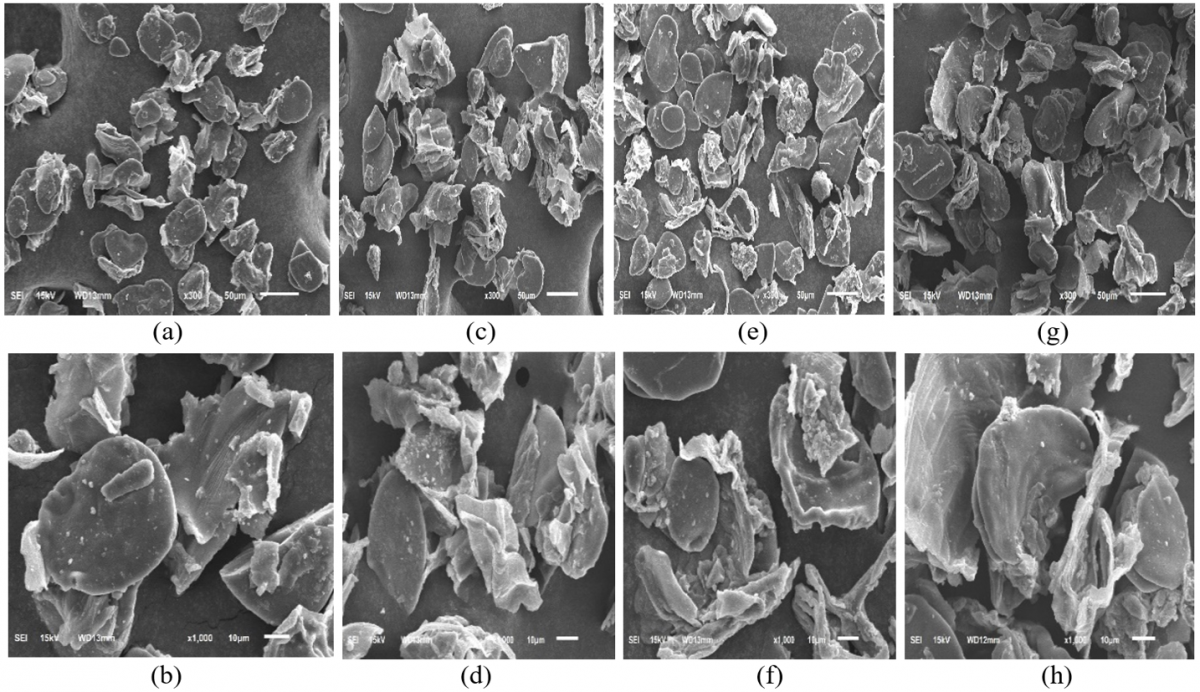
The morphological characteristics of the urea cooking product samples combined with banana corm flour, analyzed through SEM at magnifications of 300 and 1000 times, are presented in Figure 1.
Figure 1. SEM at 300 and 1000 times increments of urea-banana corm flour cooking products. (a, b) No urea (P0), (c, d) 2% urea (P2), (e, f) 4% urea (P4), and (g, h) 6% urea (P6)
SEM results indicated that starch granules became more compact and fused at higher urea levels, suggesting increased hydrogen bonding between hydroxyl groups of amylose/amylopectin and urea molecules. This structural densification likely retarded urea solubilization, explaining the delayed ammonia release observed (3 h for P6 vs. 1 h for P0). The slower release supports a synchronization mechanism between nitrogen and energy availability in the rumen. As a result, microbial activity was enhanced, increasing digestibility (DMD: 42.0 → 74.6%) and total VFA (73.1 → 128.8 mM).
Figures 1(a) and (b) illustrate the cooking process of banana corm flour in the absence of urea (P0). It is evident that during cooking, the starch granules of banana corm flour undergo gelatinization and fragmentation. The microscopic appearance of the products cooked with urea is illustrated in Figures 1(c) and (d) (P2), Figures 1(e) and (f) (P4), and Figures 1(g) and (h) (P6), corresponding to the varying levels of urea utilized. The presence of urea leads to the thickening and compaction of starch granules, with the formation of urea crystals in the product correlating with the urea concentration.
SEM results (Figure 1) showed gelatinization and breakdown in starch granules. According to Magallanes-Cruz et al. [22], starch granules exhibit insolubility in water at ambient temperatures, attributed to their stable and organized semi-crystalline architecture. Upon exposure to thermal treatments, such as cooking, this ordered structure undergoes disorganization, leading to various phenomena, including granule swelling, amylose leaching, and the disarray of amylopectin. Amylose is a starch component that has a straight chain and is soluble in water [23]. Amylose molecules are hydrophilic (easily absorb water) because they contain many hydroxyl groups in their polymer compounds. Therefore, the more amylose components, the higher the water absorption index. This is because amylose is a fraction of amylum that is soluble in hot water, while amylopectin is a fraction of amylum that is difficult to dissolve in hot water. The amylopectin content of banana corm flour is higher, so cooking can damage its crystallization properties. As the gelatinization process occurs, the dimensions of starch granules expand with rising temperatures. At the point of maximum swelling, the size of the starch granule reaches its peak [24].
The structure of starch granules is influenced by amylose and amylopectin, bound by hydrogen bonds. The presence of α-D-(1-4)-glycosidic bonds in amylopectin causes the formation of a zone between the amorphous and crystalline parts. When the hydrogen bonds get stronger, more numerous, and more organized, the chains will form the crystalline part. However, in the amorphous part, hydrogen bonds tend to be weak [25]. As shown in Figure 1, starch carbamate is formed when starch and urea combine when heated. A hydrogen atom is substituted by C=O-NH2 produced from urea molecules in one of the hydroxyl groups (OH) of each α-D-glucose pyranosyl unit in this process. The production of starch carbamate by the reaction of starch and urea is indicative of a mono-substitution reaction. In addition, this carbamation reaction produces ammonia as a waste product [26].
Gamarano et al. [27] reported that the starch gel is more easily formed in the presence of urea. A higher urea content in the plasticizing system results in a reduced number of crystalline phases in the thermoplastic starch produced. More clearly stated by Kozerski et al. [28], during the extrusion process, the addition of urea to gelatinized starch molecules results in a transformation of urea from a crystalline to a non-crystalline structure, which becomes integrated within the gelatinized starch.
The 6% urea treatment showed the most obvious images of slow nitrogen dissolution or slower ammonia release. The SEM images indicate that carbohydrates need to dissolve rapidly and in adequate amounts to align with NH3 and facilitate microbial protein synthesis, as suggested by Kozerski et al. [28]. Cui et al. [26] concluded from their research that starch's external and internal structures were greatly impacted by changes in urea content, leading to a quickening of gelatinization and a gradual shift of the endothermic peak to a lower temperature zone. During cooking, water penetrates starch granules, allowing urea to enter the amorphous regions of gelatinized starch. Upon cooling, the matrix solidifies, physically entrapping urea and reducing its solubility, thereby creating a slow-release structure.
Animals have an easier time digesting this processed food because the starch granules become gelatinized and the urea becomes less crystallized; as a result, the majority of the non-crystalline structures are located inside the gelatinized portion, which makes it taste better than grain mixtures of unprocessed urea [29].
3.2 Ammonia release test of cooked products
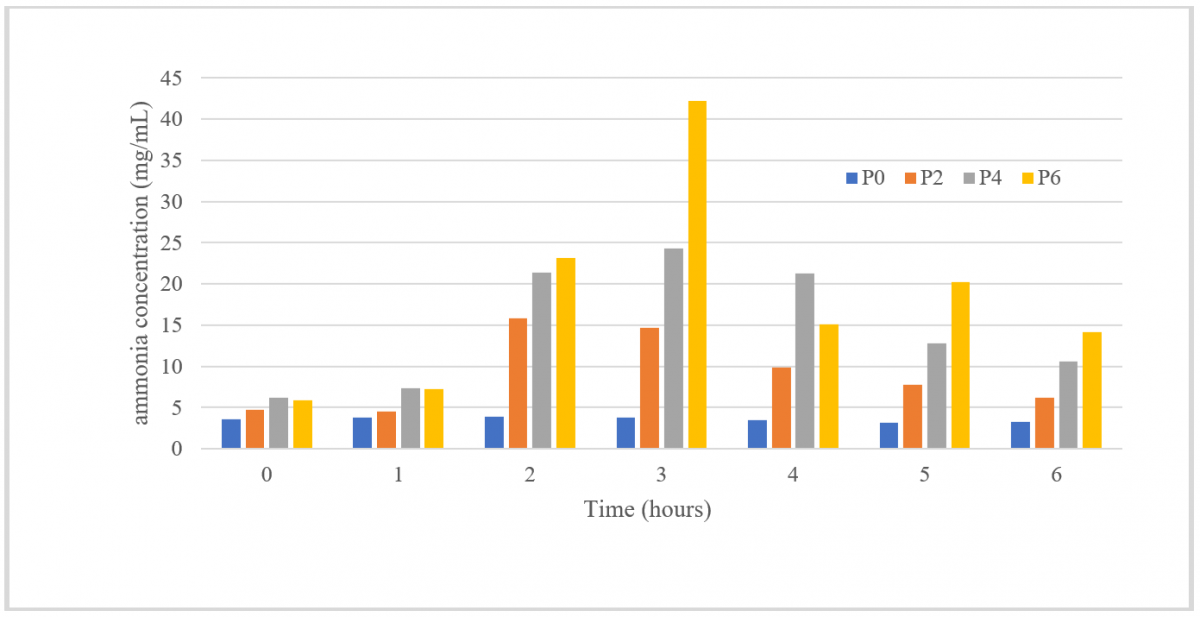
In Figure 2, we can see the outcomes of the ammonia release test, which shows how the urea level treatment affected the rate of ammonia release from cooking goods using banana corm flour.
Figure 2. Ammonia release graph of urea-banana corm starch release product
As the amount of urea utilized in the cooking product increased, so did the concentration of ammonia. The average peak ammonia concentration of the 2% urea treatment (P2) was 2 hours after the incubation time of the cooking product (15.8 mg/mL). In comparison, the 4% urea treatment (P4) was 24.30 mg/mL, and the 6% (P6) was 42.24 mg/mL. Ammonia concentration was reached at 3 hours after the incubation of the cooking product. This illustrates that the ammonia release becomes slow within 3 hours after the product is cooked with 4% and 6% urea levels in the rumen. The cooking treatment of banana corm flour mixture without urea (P0) showed that the peak ammonia concentration was reached 1 hour after incubation.
The emission of ammonia from the urea cooking product with banana corm flour treatments P4 and P6 (Figure 2) was notably slower and exhibited a higher concentration compared to P2 and P0. Likewise, P2 was significantly slower and higher in concentration than P0. During the next incubation time, namely 4 hours, 5 hours, and 6 hours, the ammonia concentration began to decrease. Itavo et al. [30] state that the decomposition rate of carbohydrate sources should directly correlate to the rate of nitrogen release. Ammonia production, which is involved in energy metabolism, determines microbial protein formation in the rumen. Coupled N supplies and energy sources are better utilized because synchronization aids the microbial process in fixing ammonia as glutamate more efficiently, reducing nitrogen and energy losses [31]. Pires et al. [32] state that combining starch with urea for extraction is a standard procedure that speeds up starch fermentation in the rumen and reduces the severity of ammonia release. This helps with microbial protein synthesis and makes urea more acceptable to animals in concentrate form.
Furthermore, studies have shown that starch-based binders, such as Amilum banana corm, can control the rumen's urea release rate. Binding can generate a starch matrix, which can act as a barrier to prevent urea hydrolysis and lead to more controlled release of ammonia (NH₃) [33].
3.3 Nutrient content of urea-banana corm flour cooking products
The results of proximate analysis of banana corm flour cooking products with urea can be seen in Table 2.
Table 2. Nutrient content of urea-cooking products with banana corm flour (%)
|
Item |
Treatments |
SE |
P-Value |
|||
|
P0 |
P2 |
P4 |
P6 |
|||
|
Dry matter |
54.855 ± 8.55 |
55.311 ± 0.342 |
56.903 ± 0.149 |
57.747 ± 0.778 |
0.668 |
|
|
Organic matter |
96.961 ± 0.067 |
97.136 ± 0.525 |
96.332 ± 1.004 |
96.739 ± 0.415 |
0.174 |
|
|
Crude Protein |
7.091 ± 0.041a |
9.033 ± 0.315b |
12.007 ± 0.149c |
15.743 ± 0.500d |
1.885 |
0.01 |
|
Crude Fiber |
12.900 ± 0.061c |
12.547 ± 0.065a |
12.501 ± 0.224a |
12.760 ± 0.040ab |
0.090 |
0.01 |
|
Ether Extract |
3.231 ± 0.081a |
3.246 ± 0.112ab |
3.668 ± 0.135d |
3.299 ± 0.135c |
0.103 |
0.01 |
|
Nitrogen Free Extract |
73.739 ± 0.050a |
72.311 ± 0.662b |
68.657 ± 0.677c |
64.987 ± 0.912d |
1.963 |
0.01 |
Treatment had no influence on cooked products' dry matter and organic matter composition, according to analysis of variance data (P > 0.05). There was an increasing trend in dry matter content with increasing urea levels from 0% - 6%. The increase in the dry matter content of the product during the cooking process is likely due to the material tissue opening wider so that the rate of water evaporation becomes faster and more significant. The cooking process also causes the expansion and development of the starch granule structure, which expands the voids in the material. This makes the material easier to absorb water, but also easier to release during the drying process [34]. When compared to the original material (Table 1), the cooking treatment and the addition of urea to banana corm flour increased the content of OM, CP, EE, and NFE in P0, P2, P4, and P6 treatments. Meanwhile, the value of crude fiber decreased significantly.
Table 2 depicts the gelatinization process of starch will be able to absorb water-containing protein. The increase in urea-containing water imbibed into the granules of banana corm flour is thought to cause an increase in dry matter content. Similar to organic matter, elevating the concentration of urea in the cooking mixture with banana corm flour did not lead to a notable percentage variation. A decrease in moisture content occurs due to heating during the cooking process, which weakens the hydrogen bonds in the granules. Water seeps into the crystalline part, causing the granule to swell and increase in size. Some amylose molecules escape from the granule, making the granule structure more porous or less dense, so that during the drying process, more water can be evaporated.
The crude protein content of the cooking products of these two ingredients increased significantly (P < 0.01). The cooked product's crude protein concentration is directly proportional to its urea level. Compared to the control group, those treated with 2%, 4%, and 6% urea showed statistically significant increases. The cooked product's crude protein composition was unaffected by the application of 2%, 4%, or 6% urea levels. Starch gelatinization has the ability to absorb proteins that contain water. Water molecules enter the starch granules and soluble protein molecules enter the gel structure simultaneously during gelatinization. As a result, the starch granules ensnare the protein molecules. With the increase of N trapped in the granules, the crude protein content of the product increases. The cooking process of the two ingredients shows that the 6% urea level produces the highest CP content (15.743%), so it is expected to be used in supplementary feed for ruminants. The utilization of extruded urea in animal diets, along with the maintenance of an acceptable supply of non-protein nitrogen, can improve protein consumption efficiency in ruminants [35].
A greater gross energy product was obtained by heating banana corm flour with an increased urea level from 0% to 6%. This is due to increased nitrogen availability, which supports microbial protein formation, increased digestibility of fiber and starch, which increases energy availability, and better efficiency in utilization of feed components, resulting in increased total energy that can be metabolized by the animal. All these factors contribute to a higher gross energy value in the final product, which can benefit livestock performance, especially if the product is used as part of a ruminant feed ration.
3.4 In vitro fermentation
Data on the results of in vitro fermentation, including pH, NH3, (DMD), VFA-Total (T-VFA), organic matter digestibility (OMD), and dry matter digestibility from urea cooking products with banana corm flour are listed in Table 3.
Table 3. Average pH, DDM, OMD, T-VFA, and NH3 of urea cooking products with banana corm flour
|
Item |
Treatments |
SE |
P-Value |
|||
|
P0 |
P2 |
P4 |
P6 |
|||
|
pH |
7.13 ± 0.02b |
7.15 ± 0.06b |
7.03 ± 0.02a |
7.08 ± 0.06ab |
0.028 |
0.01 |
|
DDM (%) |
42.043 ± 0.939a |
64.994 ± 1.568b |
73.222 ± 2.307c |
74.582 ± 0.645c |
7.5260.01 |
|
|
OMD (%) |
36.581 ± 0.958a |
62.157 ± 1.971b |
70.634 ± 1.870c |
73.162 ± 0.542c |
8.3560.01 |
|
|
TVFA (mM) |
73.118 ± 6.776c |
85.927 ± 1.048b |
106.519 ± 4.893c |
128.783 ± 4.574d |
12.1920.01 |
|
|
NH3 (mg/mL) |
4.003 ± 0.502a |
5.296 ± 0.675b |
6.777 ± 0.057c |
10.408 ± 0.719d |
1.4720.01 |
|
3.4.1 pH value
The use of banana corm flour in cooking with urea cooking products significantly affected the pH value in vitro, according to the statistical analysis (P < 0.01). Ammonia (NH₃) is produced when microbes in the rumen digest urea, a source of non-protein nitrogen (NPN). Ammonia is alkaline and can increase the pH of rumen fluid or in vitro medium used for digestibility simulation.
The use of urea in cooking products with banana corm flour produced pH values that were no different from the control. These values support increased microbial activity in the rumen. This ammonia plays a role in maintaining the alkaline conditions necessary for microbes to decompose fiber optimally, thereby increasing digestive efficiency. Rumen pH values in this study were 7.03–7.15, which is well within the typical range of 6.0–7.0 [35].
3.4.2 Dry matter digestibility
A higher level of urea was associated with an increase in the dry matter digestibility of urea-banana corm flour cooking products, according to the study's dry matter digestibility value. The cooking product's dry matter digestibility was shown to be significantly affected by the treatment (P < 0.01), according to the statistical analysis. The cookware's dry matter digestibility improves as the urea level rises. A possible explanation is that urea-banana corm flour retains a lot of its dry content, particularly that which comes from soluble carbs, when cooked, leaving a lot of material for microbes to break down. The treatment of 0% and 2% urea levels had significantly lower dry matter digestibility compared to 4% and 6% urea levels. The gelatinization that occurs when plant starch is cooked makes it easier to digest and makes better use of nitrogen rather than protein.
The 4% and 6% urea treatments demonstrated the highest dry matter digestibility in cooking products made from urea-banana corm flour. The higher dry matter digestibility of cooked products at these urea levels compared to the treatment of cooked products without urea (0%) indicates that when cooked banana corm flour is combined with urea, it can enhance the synchronization of energy and ammonia production, leading to greater digestion by rumen microbes.
3.4.3 Organic matter digestibility
There was a highly significant treatment effect (P < 0.01) on the organic matter digestibility value in the cooked urea-banana corm flour product, as measured by the urea level. For cooking products with a 6% urea content (P6), the incubation procedure resulted in the highest average organic matter digestibility of 73.162%. But when compared to the product cooked with 4% urea (P4), this value showed no significant difference. In comparison to the product that was cooked with urea, the one that was cooked without it had the lowest value for the digestibility of organic matter (P0).
This study's findings are in line with those of a prior study [36] that found no statistically significant difference between the cooking products of the gewang starch mixture with and without urea in terms of the digestibility of organic matter.
3.4.4 Total VFA (TVFA)
The fermentation of feed substrates in the rumen by bacteria produces VFA, which provide around 70% of the metabolic energy that can be used for productive processes, including growth and milk production. Energy for ruminant host animals is provided by these VFAs [37]. The urea-banana corm cooking product's total concentration of volatile fatty acids (TVFA) showed a highly significant treatment impact (P < 0.01). The cooking product made with urea and banana corm flour had a dramatic rise in both the urea level and the concentration of TVFA.
When bacteria ferment carbohydrates, a key indicator of rumen fermentation is TVFA synthesis. Ruminants' primary fuel comes from acids like butyric, propionic, and acetic. With the addition of urea, microbes get an additional source of nitrogen, which facilitates the growth of rumen microorganisms and more intensive fermentation activity. This results in an overall increase in VFA, which means energy availability from the feed will also increase. At 6% urea level, the increase in Total VFA was higher than 0%, 2%, and 4%. This indicates that at a 6% urea level, fermentation activity is optimized. The concentration levels of VFA in the rumen, both high and low, are affected by the organic matter present in the cooking product derived from urea-banana corm flour. The TVFA generated reflects the capacity of microorganisms to break down the cooking product.
3.4.5 NH3 concentration
The last byproduct of protein breakdown in the rumen is NH3. Once microbes have absorbed and used it all, the amount of excess NH3 in the rumen fluid starts to rise [38]. The results of the study using urea (2%, 4%, and 6%) in a mixture with banana corm flour cooked for 1 hour showed an increase in ammonia concentration. According to Dewhurst and Newbold [39], most research results cited as a basis state 50mg/L ammonia-N as the minimum level to avoid limiting microbial protein synthesis (MPS). According to Itavo et al. [30], fermentation of the starch present in the extruded urea can influence the rate of use of the starch, optimizing the energy supply for microbial growth.
The high NH3 concentration of the treatment is thought to come from the N trapped in the banana corm flour after the cooking process. This study's findings show that a cooked product made with urea and banana corm starch increases protein synthesis in the rumen microbes in a coordinated fashion. Soybean meal can be partially replaced with SRU in dairy cow diets, according to Guo et al. [40], which increases microbial protein production without affecting rumen fermentation. Consistent with the finding that ruminants given high-protein rations have a greater NH3 concentration than those fed low-protein rations, the NH3 concentration in this investigation rose as the urea level in the cooked product rose [41].
Cooking banana corm flour with 6% urea effectively enhanced crude protein (15.74%), digestibility, and total VFA production while delaying ammonia release, confirming that gelatinization entrapped urea to form a slow-release structure. This finding demonstrates a practical and low-cost method to produce local slow-release urea products, improving nitrogen utilization efficiency and reducing potential ammonia toxicity in ruminants.
[1] Wei, C., Tao, H., Liu, G., Tian, K. (2024). Isobutyramide and slow-release urea as substitutes for soybean meal in the finishing diet of beef cattle. Animals, 14(9): 1321. https://doi.org/10.3390/ani14091321
[2] Jin, D., Zhao, S., Zheng, N., Beckers, Y., Wang, J. (2017). Urea metabolism and regulation by rumen bacterial urease in ruminants – A review. Annals of Animal Science, 18(2): 303-318. https://doi.org/10.1515/aoas-2017-0028
[3] Zurak, D., Kljak, K., Aladrović, J. (2023). Metabolism and utilization of non-protein nitrogen compounds in ruminants: A review. Journal of Central European Agriculture, 24: 1-14. https://doi.org/10.5513/JCEA01/24.1.3645
[4] Lu, Z., Xu, Z., Shen, Z., Tian, Y., Shen, H. (2019). Dietary energy level promotes rumen microbial protein synthesis by improving the energy productivity of the ruminal microbiome. Frontiers Microbiology, 10: 847. https://doi.org/10.3389/fmicb.2019.00847
[5] Salami, S.A., Moran, C.A., Warren, H.E., Taylor-Pickard, J. (2020). A meta-analysis of the effects of slow-release urea supplementation on the performance of beef cattle. Animals, 10(4): 657. https://doi.org/10.3390/ani10040657
[6] Hailemariam, S., Zhao, S.G., He, Y., Wang, J.Q. (2021). Urea transport and hydrolysis in the rumen: A review. Animal Nutrition, 7: 989-996. https://doi.org/10.1016/j.aninu.2021.07.002
[7] Hynes, D.N., Stergiadis, S., Gordon, A., Yan, T. (2016). Effects of crude protein level in concentrate supplements on animal performance and nitrogen utilization of lactating dairy cows fed fresh-cut perennial grass. Journal of Dairy Science, 99: 8111-8120. https://doi.org/10.3168/jds.2016-11110
[8] Benedeti, P.D.B., Paulino, P.V.R., Marcondes, M.I., Valadares-Filho, S.C., Martins, T.S., Lisboa, E.F., Silva, L.H.P., Teixeira, C.R.V., Duarte, M.S. (2014). Soybean meal replaced by slow-release urea in finishing diets for beef cattle. Livestock Science, 165: 51-60. https://doi.org/10.1016/j.livsci.2014.04.027
[9] Sevim, O., Onol, A.G. (2019). Supplemental slow-release urea and non-structural carbohydrates: Effect on digestibility and some rumen parameters of sheep and goats. The Journal of Animal and Plant Sciences, 29(1): 1-7.
[10] Gonçalves, A.P., Do Nascimento, C.F.M., Ferreira, F.A., Da Costa Gomes, R., De Queiros Manella, M., Marino, C.T., De Abreu Demarch, J.J.A., Rodriques, P.H.M. (2015). Slow-release urea in supplement fed to beef steers. Brazilian Archives of Biology and Technology, 58(1): 22-30. https://doi.org/10.1590/S1516-8913201502162
[11] Joysowal, M., Tyagi, A.K., Tyagi, N., Kumar, S., Keshri, A., Sing, D. (2019). Use of slow-release ammonia products in ruminant diet: A review. Journal of Entomology and Zoology Studies, 7(2): 822-888.
[12] Mahmoudi-Abyane, M., Alipour, D., Moghimi, H.R. (2020). Effects of different sources of nitrogen on performance, relative population of rumen microorganisms, ruminal fermentation, and blood parameters in male feedlotting lambs. Animal, 14(7): 1438-1446. https://doi.org/10.1017/s175173111900291x
[13] Ma, S., Faciola, A.P. (2024). Impacts of slow-release urea in ruminant diets: A Review. Fermentation, 10(10): 527. https://doi.org/10.3390/fermentation10100527
[14] Niazifar, M., Besharati, M., Jabbar, M., Ghazanfar, S., Asad, M., Palangi, V., Eseceli, H., Lackner, M. (2024). Slow-release non-protein nitrogen sources in animal nutrition: A review. Heliyon, 10(13): e33752. https://doi.org/10.1016/j.heliyon.2024.e33752
[15] Basumatary, B., Basumatary, S., Das, B., Nath, B., Kalita, P. (2021). Waste Musa paradisiaca plant: An efficient heterogeneous base catalyst for fast production of biodiesel. Journal Clean Production, 305: 127089. https://doi.org/10.1016/j.jclepro.2021.127089
[16] Challam, D.A., Mondal, S., Panda, S., Singh, L.J. (2023). Macronutrient estimation in post-harvest banana corms of different genotypes. Environment and Ecology, 41(3): 1388-1393. https://doi.org/10.60151/envec/ULSX2737
[17] Aswandi, A., Purwanta, P., Sritiani, S., Sudarmi, N., Herawati, M. (2022). Response of broiler chickens to different levels of Kepok banana weevil flour as a partial mixture for basal commercial feed. Livestock and Animal Research, 20(2): 118-129. https://doi.org/10.20961/lar.v20i2.59258
[18] Soeharsono. (2001). Utilization of tempeh industrial waste as local feed through fermentation and gelatinization processes. Master's thesis. IPB University. http://repository.ipb.ac.id/handle/123456789/5065.
[19] Fajrih N., Wiryawan, K.G., Sumiati, Syahpura, S.K., Winarsih, W. (2022). Identification of bioactive compounds of banana corm (Musa paradisiaca) using GC-MS and its inhibitory effect against pathogenic bacteria. Biodiversitas, 23: 195-204.
[20] Richana, N., Sunarti, T.C. (2004). Characterization of the physicochemical properties of tuber flour and starch flour from ganyong tubers, suweg tubers, coconut tubers, and gambili tubers. Jurnal Penelitian Pascapanen Pertanian, 1(1): 29-37. https://repository.pertanian.go.id/handle/123456789/11154.
[21] AOAC. (2000). Official methods of analysis of the Association of Official Analytical Chemists. The Association of Official Analytical Chemists.
[22] Magallanes-Cruz, P.A., Flores-Silva, P.C., Bello-Pérez, L.A. (2017). Starch structure influences its digestibility: A review. Journal of Food Science, 82(9): 2016-2023. https://doi.org/10.1111/1750-3841.13809
[23] Wang, Y., Ou, X., Al-Maqtari, Q.A., He, H.J., Othman, N. (2024). Evaluation of amylose content: Structural and functional properties, analytical techniques, and future prospects. Food Chemistry: X, 24: 101830. https://doi.org/10.1016/j.fochx.2024.101830
[24] Vamadevan, V., Bertoft, E. (2020). Observations on the impact of amylopectin and amylose structure on the swelling of starch granules. Food Hydrocolloids, 103: 105663. https://doi.org/10.1016/j.foodhyd.2020.105663
[25] Subroto, E., Jeanette, G., Meiyanasari, Y., Luwinsky, I., Baraddiaz, S. (2020). Review of the analysis methods of starch, amylose, and amylopectin in food and agricultural products. International Journal of Emerging Trends in Engineering Research, 8(7): 3519-3524. http://dx.doi.org/10.30534/ijeter/2020/103872020
[26] Cui, F., Zi, H., Liu, H., Zhang, S., Yuan, B. (2021). A study of starch-urea-water mixtures with a combination of molecular dynamics simulation and traditional characterization methods. International Journal of Biological Macromolecules, 148: 121-128. https://doi.org/10.1016/j.ijbiomac.2019.12.268
[27] Gamarano, D.D.S., Pereira, I.M., da Silva, M.C., Mottin, A.C., Ayres, E. (2020). Crystal structure transformations in extruded starch plasticized with glycerol and urea. Polymer Bulletin, 77(9): 4971-4992. https://doi.org/10.1007/s00289-019-02999-2
[28] Kozerski, N.D., Ítavo, L.C.V., Camila Ítavo, C.C.B.F., Difante, G.S., De Oliveira, L.C.S., De Aguiar, E.N., Inácio, A.G., Gurgel, A.L.C., Dos Santos, G.T. (2021). Calorimetry, physicochemical characteristics, and nitrogen release from extruded urea. Science Report, 11: 18340. https://doi.org/10.1038/s41598-021-97886-0
[29] Kozerski, N.D., Ítavo, L.C.V., dos Santos, G.T., Ítavo, C.C.B.F., Benchaar, C., Dias, A.M., dos Santos Difante, G., Leal, E.S. (2021b). Extruded urea-corn product can partially replace true protein sources in the diet for lactating Jersey cows. Animal Feed Science and Technology, 282: 115129. https://doi.org/10.1016/j.anifeedsci.2021.115129
[30] Itavo, L.C.V., Ítavo, C.C.B.F., Dias, A.M., Franco, G.L., Pereira, L.C., Leal, E.S., Araújo, H.S., Souza, A.R.D.L. (2016). Combinations of non-protein nitrogen sources in supplements for Nellore steers grazing. Revista Brasileira de Saúde e Produção Animal, 17: 448-460. https://doi.org/10.1590/S1519-99402016000300011
[31] Inácio, A.G., Ítavo, C.C.B.F., Dias, A.M., dos Santos Difante, G., de Queiroz, J.F., de Oliveira, L.C.S., dos Santos, G.T., Ítavo, L.C.V. (2022). A new feed additive composed of urea and soluble carbohydrates coated with wax for controlled release in ruminal fluid. Science Reports, 12: 4487. https://doi.org/10.1038/s41598-022-08372-0
[32] Pires, A.V., de Oliveira Junior, R.C., Fernandes, J., Susin, I., Santos, F.A.P., de Araujo, R.C., Goulart, R.C. (2004). Total replacement of soybean meal by urea or starea in high-grain diets for beef cattle. Pesquisa Agropecuária Brasileira, 39(9): 937-942. https://doi.org/10.1590/S0100-204X2004000900014
[33] de Medeiros, T.T.B., de Azevedo Silva, A.M., da Silva, A.L., Bezerra, L.R., da Silva Agostini, D.L., de Oliveira, D.L.V., Mazzetto, S.E., Kotzebue, L.R.V., Oliveira, J.R., Barbosa Souto, G.S.B., de Barros Carvalho, A., Netto, A.J., Oliveira, R.L. (2018). Carnauba wax as a wall material for urea microencapsulation. Journal of the Science of Food and Agriculture, 99(3): 1078-1087. https://doi.org/10.1002/jsfa.9275
[34] Liu, J., Zhao, Q., Zhou, L., Cao, Z., Shi, C., Cheng, F. (2017). Influence of environmental temperature during the grain filling period on granule size distribution of rice starch and its relation to gelatinization properties. Journal of Cereal Science, 76: 42-55. https://doi.org/10.1016/j.jcs.2017.05.004
[35] Poulsen, M., Jensen, B.B., Engberg, R.M. (2012). The effect of pectin, corn and wheat starch, inulin, and pH on in vitro production of methane, short-chain fatty acids, and the microbial community composition in rumen fluid. Anaerobe, 18(1): 83-90. https://doi.org/10.1016/j.anaerobe.2011.12.009
[36] Lazarus, E.J.L., Lawa, E.D.W. (2022). Effect of cooking time and urea level on dry matter loss, nitrogen fixation, and digestibility of dry matter, organic matter in vitro in the combined products of urea-pith Gewang (Corypha Utan Lamk.) starch. GSC Advanced Research and Reviews, 12(2): 58-68. https://doi.org/10.30574/gscarr.2022.12.2.0194
[37] Gleason, C.B., Beckett, L.M., White, R.R. (2022). Rumen fermentation and epithelial gene expression responses to diet ingredients designed to differ in ruminally degradable protein and fiber supplies. Science Report, 12: 2933. https://doi.org/10.1038/s41598-022-06890-5
[38] McDonald, P., Edwards, R.A., Greenhalgh, J.F.D., Morgan, C., Sinclair, L., Wilkinson, R. (2021). Animal Nutrition, 8th ed. London, UK: Pearson.
[39] Dewhurst, R.J., Newbold, J.R. (2022). Effect of ammonia concentration on rumen microbial protein production in vitro. British Journal of Nutrition, 127(6): 847-849. https://doi.org/10.1017/s000711452100458x
[40] Guo, Y., Xiao, L., Jin, L., Yan, S., Niu, D., Yang, W. (2022). Effect of commercial slow-release urea product on in vitro rumen fermentation and ruminal microbial community using RUSITEC technique. Journal of Animal Science and Biotechnology, 13: 56. https://doi.org/10.1186/s40104-022-00700-8
[41] Mutsvangwa, T., Davies, K., McKinnon, J., Christensen, D. (2016). Effects of dietary crude protein and rumen-degradable protein concentrations on urea recycling, nitrogen balance, omasal nutrient flow, and milk production in dairy cows. Journal of Dairy Science, 99: 6298-6310. https://doi.org/10.3168/jds.2016-10917