Tiara Grace* | Arif Dwi Santoso | Dudi Iskandar | Rodiah Nurbaya Sari | Evie Avianti | Fatim Illaningtyas | Ulfa Ning Thiyas | Fensa Eka Widjaya | Yaumil Putri Erlambang | Renni Diastuti | Suryani Daulay | Ramos Hutapea | Ermin Widjaja | Suprapto | Adi Gumbara Putra
© 2025 The authors. This article is published by IIETA and is licensed under the CC BY 4.0 license (http://creativecommons.org/licenses/by/4.0/).
OPEN ACCESS
Ginger (Zingiber officinale) cultivation in tropical highland areas offers economic potential and sustainability challenges, especially amid climate variability, market asymmetries, and limited technological access. Sukabumi District in West Java, Indonesia, covering 300 hectares and involving over 1,800 smallholder farmers, represents a key case of ginger production facing ecological degradation, institutional fragmentation, and socioeconomic constraints. Despite its growing role in food and industrial sectors, holistic sustainability assessments remain limited. The economic, social, environmental, technological, and institutional aspects of ginger farming sustainability are assessed in this study using a modified version of the rapid appraisal for fisheries (RAPFISH) methodology. Multidimensional scaling (MDS) was used to evaluate 48 qualities, with leverage analysis and Monte Carlo simulations providing support. Stakeholders' focus group, field observations, and expert judgment were used to gather data. The overall sustainability index reached 47.56%, categorized as “less sustainable.” The economic dimension (63.7%) was mainly influenced by the limited market access attribute with 16.34% leverage, the environmental dimension (57.27%) by poor crop rotation (3.34%), and the social dimension (55.81%) by traditional farming practices (5.13%). Meanwhile, the institutional (37.93%) and technological (23.08%) dimensions scored lowest, primarily due to limited credit access (8.41%) and machinery use (10.88%). These findings highlight the urgent need for evidence-based, context-specific interventions aimed at strengthening institutional capacity, promoting sustainable practices, and fostering innovation. The framework established in this study serves as a replicable model for evaluating sustainability in tropical commodity agriculture. In conclusion, this study contributes a replicable framework for assessing sustainability in smallholder commodity-based agriculture and provides critical insights for policymakers, development actors, and researchers. The results emphasize the importance of comprehensive actions that strengthen institutions and promote wider adoption of technology to support the long-term sustainability of smallholder ginger cultivation systems in tropical highland areas.
ginger farming, MDS, sustainability assessment, smallholder agriculture, tropical highlands
In terms of food security, land degradation prevention, and climate change adaptation, agricultural sustainability has emerged as a vital component of the global development framework [1]. To maintain ecological integrity and the long-term economic viability of rural communities, agricultural systems must incorporate sustainability principles [2]. This challenge is especially important in tropical regions, where climate instability and population expansion endanger farm resilience and productivity [3]. Given this background, commodity-based agriculture, such as ginger (Zingiber officinale) cultivation, poses both environmental concerns and economic trade-offs, particularly in Indonesia, a major producer of tropical commodities and spices [4, 5].
The increasing need for spices used in cuisine, medicine, and industry worldwide has made ginger farming more and more important [6]. Growing ginger, a significant export, in tropical areas also illustrates the larger conflict between natural resource sustainability and agricultural expansion [7]. Therefore, a more thorough investigation of the sustainability elements of ginger farming can provide insightful information for creating agricultural models that are ecologically conscious, productive, and adaptable.
Although Sukabumi's agricultural sector has been the focus of numerous development initiatives, there is still a significant lack of quantitative evaluations that examine the multifaceted sustainability of its ginger farming systems. The majority of earlier research has concentrated on either value chain efficiency or manufacturing methods, frequently ignoring the interactions between institutional, technological, economic, and environmental issues. This study is new because it uses the RAPFISH tool to integrate the five main dimensions, economic, social, environmental, technological, and institutional, into a unified analytical framework. RAPFISH was modified here to evaluate ginger cultivation in a tropical highland setting after it was first created for the sustainability assessment of fisheries [8]. This modification expands RAPFISH's methodological use and provides fresh empirical information on the measurement of a particular commodity's sustainability at the district level, an area of study that is still lacking in Indonesia.
This methodological adaptation broadens the application of RAPFISH beyond its original fisheries context. It offers new empirical data on assessing the sustainability of a given commodity at the district level, a field of research that is still absent in Indonesia. The foundation of the research approach is the creation of a structured questionnaire that was obtained by mapping the Sukabumi ginger growing industry's current business procedures. Each of the five characteristics of sustainability, economic, social, environmental, technological, and institutional, is assessed on a Likert scale in this quiz. RAPFISH's multidimensional scaling (MDS) approach was then used to examine the gathered data. The potential of RAPFISH to create perceptual maps that show the proximity of several sustainability indicators in a multidimensional space is what makes it methodologically relevant [9]. In contrast to traditional multivariate methods, MDS does not necessitate strict attribute definitions and allows for individual-level analysis. A variety of agricultural systems, such as algal biomass farming [10], duck production [11], dairy farming [12], rice cultivation [13], cattle production [14], animal feed from sago [15], garlic [16], agriculture compost [17], and integrated farming [18], have been successfully evaluated for sustainability using RAPFISH. Its application in this research supports contextual relevance and methodological validity.
Two related advances are presented in this study. By combining spatial and multidimensional indicators, it first provides a thorough, data-driven mapping of the sustainability of ginger farming in Sukabumi. This mapping serves as a diagnostic tool to identify systemic strengths, vulnerabilities, and spatial disparities, as well as a descriptive baseline [19, 20]. Second, using analytical weighing to ascertain their proportional effect, it methodically defines and classifies the major forces and limitations along five fundamental dimensions: ecological, economic, social, institutional, and technical [21]. This subtle understanding serves as a strong basis for focused, empirically supported, and situation-specific sustainability initiatives [22]. These findings are particularly important for areas like Sukabumi, where implementing sustainable farming techniques is seriously hampered by institutional fragmentation and a variety of farmer behaviors [23].
This study's importance goes beyond its policy relevance. In Sukabumi, this research aids in the strategic planning of sustainable agricultural development by providing a structured evaluation that is adapted to the local situation. In pursuit of a common goal of resilient and inclusive agricultural growth, it unites the interests of various stakeholders, ranging from smallholder farmers and agribusiness operators to local government institutions, legislative bodies.
In this way, the study is a pivotal step toward fostering evidence-based decision-making and collaborative action that ensures agricultural sustainability, equity, and long-term food security in Sukabumi. Accordingly, this study aims to address the following research questions:
1. How can a multidimensional assessment framework be constructed to evaluate the sustainability of smallholder ginger farming in tropical highland systems?
2. What is the quantified sustainability status across economic, environmental, social, technological, and institutional dimensions?
3. Which key attributes most strongly influence the sustainability of ginger farming, and how can these insights guide targeted interventions?
2.1 Study area
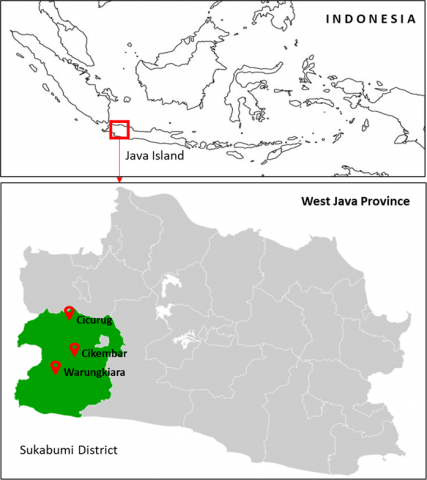
Sukabumi Regency is located in the western part of Java Island, within West Java Province, approximately south of Jakarta. Geographically, it lies between 6°50′-7°15′ South latitude and 106°30′-107°15′ East longitude. The regency is bordered by the Indian Ocean to the south, Cianjur Regency to the east, Bogor Regency to the north, and Lebak Regency of Banten Province to the west.
Figure 1 illustrates the geographical position of Sukabumi Regency within West Java and Indonesia, providing spatial context for identifying the main ginger-producing areas. Table 1 presents data on ginger production in Sukabumi for 2023, including cultivated area, production volume, and market price for the main ginger varieties across selected districts. The data indicate that elephant ginger (Zingiber officinale Roscoe) occupies the largest cultivated area and yields the highest production volume, whereas red ginger (Zingiber officinale var. rubrum) achieves the highest market price [24].
Figure 1. Geographical location of Sukabumi in West Java and Indonesia
Table 1. Ginger production in Sukabumi (2023)
|
District |
Ginger Species |
Cultivate Area (ha) |
Production (kg) |
Market Price (USD) |
|
Cikembar |
Red ginger (Zingiber officinale var. rubrum) |
0.5 |
1,250 |
5.5 |
|
Cicurug |
Elephant ginger (Zingiber officinale Roscoe) |
1 |
3,000 |
1.4 |
|
Warungkiara |
Small white ginger (Zingiber officinale var. amarum) |
0.3 |
800 |
1.22 |
The overall ginger agribusiness process in Sukabumi, illustrated in Figure 2, integrates both hard and soft components. The hard components include technical operations such as seed selection, fertilization, cultivation, irrigation, and pest and disease management. The soft components consist of financial support, extension service, institutional strengthening, and innovation programs. These integrated activities culminate in the harvesting and commercialization of ginger products.
Figure 2. Ginger agribusiness process in Sukabumi
2.2 Data collection and analysis
This study used primary and secondary data. Primary data were collected directly through field observations, encompassing the dimensions of economic, environmental, social, technological, and institutional. Scores for each attribute in the dimensions were determined from three main sources: peer-review scoring, grey literature, and expert judgment. Peer review scoring is based on a review of scientific documentation. Grey literature is based on the results of previous analyses, either unpublished or published. An expert judgment is the determination of scores based on the consensus of experts, typically achieved through a focus group discussion (FGD) following the structured procedures described by Fauzi [25] and Morgan [26].
Based on five dimensions, environmental, social, economic, technological, and institutional, primary data were gathered through field observations and interviews. Table 2 displays the indicators for each dimension. Five different groups of respondents participated in the field observations: ginger farmers, research institutions (BRIN and IPB University), the Sukabumi District Agriculture Office, the Sukabumi District Regional Research and Development Agency, and the Sukabumi Agricultural Extension Center. Each group is represented by two respondents.
Table 2. RAPFISH dimensions and their corresponding attributes
|
Dimension
|
Attributes
|
Data Source / Measurement Method
|
|
Economic
|
Limited market access
Product diversification
Dependency on middlemen
High production costs
Ginger price fluctuation
Limited business capital
Supply chain optimization
|
Primary data obtained through multi-stakeholder FGD; measured using Likert scale (1-5)
|
|
Environment
|
Infertility from poor crop rotation
Overuse of pesticides harms ecosystems
Rain-induced rot from climate change
Degradation from unsustainable land use
Erosion from improper cultivation methods
Rainwater management at waste treatment plants
Bacterial wilt decreases crop productivity
Nematode infestation lowers crop yield
|
Primary data obtained through multi-stakeholder FGD; measured using Likert scale (1-5)
|
|
Social
|
Reliance on old practice
Lack of agri-tech extension
Poor agricultural education
Lack of farm management training
Low female role in agribusiness
Weak local leadership, institutions
Low youth farmer interest
|
Primary data obtained through multi-stakeholder FGD; measured using Likert scale (1-5)
|
|
Technology
|
Evaluation of farm machinery use
Agricultural technology development measurement
Innovation in ginger packaging
Technology use in distribution & marketing
Post-harvest processing for value
Irrigation system technology
|
Primary data obtained through multi-stakeholder FGD; measured using Likert scale (1-5)
|
|
Institution
|
Limited credit access
Lack of cooperatives
Unequal aid distribution
Lack of subsidies
Low private involvement
No export institution
Weak local institutions
Weak policy implementation
|
Primary data obtained through multi-stakeholder FGD; measured using Likert scale (1-5)
|
This primary data was confirmed through a focus group discussion (FGD) method involving experts and practitioners in the smallholder ginger production Sukabumi District. The FGD was attended by two representatives from each group. The secondary data were collected through a literature study of various documents from relevant agencies and previous research results.
2.3 Data processing
An ecosystem-based integrated performance evaluation of ginger agricultural sustainability was examined using a multidimensional scaling technique. Data processing, particularly in situations where financial, human, and institutional resources are scarce, employed the RAPFISH methodology using the Microsoft Excel-based software as a rapid, multidisciplinary assessment tool to evaluate sustainability status across various ecological and human dimensions [27-29].
The final phase is to identify the most significant/dominant characteristics in each dimension that affect sustainability. Additional processes involve stress, ordinal values, ordinal scales (scoring), sustainability traits, and their identification, evaluation, and determination. Based on sustainability criteria from each dimension, multidimensional sustainability indices and status are assessed using the MDS approach. To check for mistakes, Monte Carlo analysis is utilized. The entire ginger agribusiness process in Sukabumi, which incorporates both hard and soft approaches, is shown in Figure 2. While soft tactics include financial support, counseling, institutional change, research and innovation projects, and consistency of attribute ratings versus sustainability, complex processes include seed selection, fertilization, culture, irrigation, and pest and disease management.
The MDS approach tests the inaccuracy and consistency of attribute ratings against sustainability using Monte Carlo analysis. To determine which aspects of each dimension have the most influence on sustainability, the final stage is to conduct a sensitivity analysis, also known as a leverage analysis. A total of 48 traits were discovered (Table 2). Responses to a questionnaire including these traits and attributes were evaluated using a Likert scale. Expert respondents assigned scores of 1 (very poor), 2 (poor), 3 (moderate), 4 (good), 5 (very good) to sustainability performance. The quantitative ranking of features across the environmental, social, economic, technological, and institutional dimensions was changed to align with relevant elements in landslide mitigation and farmer income enhancement.
2.4 Sustainability analysis
Based on percentage intervals of 0-25% (bad, unsustainable), 25.01-50% (less sustainable), 50.01-75% (fairly sustainable), and 75.01-100% (good, very sustainable), sustainability performance is divided into four categories [25, 29]. Table 3 provides details on these classifications.
Table 3. Sustainability index categories and status for each dimension
|
No. |
Index Range (%) |
Classification |
Sustainability Status |
|
1 |
0-25 |
poor |
unsustainable |
|
2 |
25.01-50 |
less |
less |
|
3 |
50.01-75 |
quite |
fairly |
|
4 |
75.01-100 |
good |
very |
The ordination method makes use of the ASCAL algorithm, which is an alternating least squares method based on the square root of Euclidean distance. By reducing the squared differences dij to the squared data (origin = oijk) across three dimensions (i, j, k), also known as S-Stress, this method enhances ordination. The ordination procedure is expressed as follows and is based on the Euclidean distance in n-dimensional space [8].
$d\ =\sqrt{\left( {{\left| {{x}_{1}}-{{x}_{2}} \right|}^{2}}+{{\left| {{y}_{1}}-{{y}_{2}} \right|}^{2}}+{{\left| {{z}_{1}}-{{x}_{2}} \right|}^{2}}+\ldots \right)}$ (1)
The following equation was used to regress the Euclidean distance (dij) between points i and j against the reference point (oij) in order to calculate the positioning of objects or points in MDS:
${{d}_{ij}}=\alpha +\beta \delta {{\beta }_{ij}}+\varepsilon $ (2)
The regression method applied to the equation above utilized the ALSCAL algorithm. This approach optimizes the squared distance (${{d}_{ijk}}$) relative to the squared data (point of origin = ${{o}_{ijk}}$), which, in three dimensions (i, j, k), is expressed through a formula known as S-Stress as follows:
$s\ =\sqrt{\frac{1}{m}\sum\limits_{k=1}^{m}{\left[ \frac{\sum\limits_{i}{\sum\limits_{j\ \ }{{{\left( \ d_{ijk}^{2}-\ \ o_{ijk}^{2} \right)}^{2}}}}}{\sum\limits_{i}{\sum\limits_{j\ \ }{o_{ijk}^{4}}}} \right]}}$ (3)
Euclidean distance assigned a value:
${{d}_{ijk}}\ =\sum\limits_{a=1}^{r}{{{w}_{ka}}}\ {{\left( {{x}_{ia}}-\ {{x}_{ja}} \right)}^{2}}$ (4)
2.5 Leverage factor analysis
Leverage factor analysis was used to identify attributes most sensitive to changes in sustainability performance. The leverage value indicates the extent to which omitting an attribute alters the overall MDS ordination, calculated through the root mean square (RMS) change. Following Pitcher and Preikshot [8], leverage values are categorized as: neutral (< 2%), influential (2-8%), and dominant (> 8%) (Table 4). Attributes exceeding 8% are considered sensitive and thus prioritized for management improvement.
Table 4. Leverage factor parameter values
|
No. |
Factor Value (%) |
Category |
Description |
|
1 |
< 2.0 |
neutral |
not influential |
|
2 |
2.0-8.0 |
influential |
moderate- to- good impact |
|
3 |
> 8.0 |
significant |
dominant |
2.6 Monte Carlo simulation
Monte Carlo simulation was applied to verify the stability and reliability of the MDS results by introducing random variation to the attribute scores. The analysis followed the Rapfish procedure [8, 30] with 25 iterations at a 95% confidence level for each sustainability dimension. The resulting indices were compared with the original MDS ordination to calculate the percentage difference. A deviation below 5% indicates high model stability and low sensitivity to scoring or input errors.
3.1 Sustainability analysis of ginger cultivation in Sukabumi
With an overall index score of 47.56% on a 0-100 scale, the sustainability evaluation falls into the "less sustainable" category according to the MDS analysis results. With R2 (SQR) values between 0.92 and 0.94 and stress values between 0.15 and 0.17, the model exhibits high dependability, suggesting a legitimate and reliable analytical procedure. A variety of variables spread over five major dimensions, economic, environmental, social, institutional, and technological, are evaluated to create the sustainability index.
The economic, environmental, and social dimensions all fell into the "fairly sustainable" category, with the economic dimension scoring the highest at 63.70%, 57.27%, and 55.81%, respectively. The technological dimension received the lowest score of 23.08%, which puts it in the "unsustainable" category, while the institutional dimension had a worse score of 37.93% ("less sustainable"). Table 5 presents the findings of this sustainability assessment, and Figure 3 shows a radar diagram summarizing the findings.
Table 5. Sustainability index and status of ginger cultivation in Sukabumi
|
Dimension |
Index (%) |
Stress Value |
SQR/R2 |
Status |
|
Economy |
63.7 |
0.17 |
0.92 |
Fairly |
|
Environment |
57.27 |
0.15 |
0.94 |
Fairly |
|
Social |
55.81 |
0.15 |
0.94 |
Fairly |
|
Institution |
37.93 |
0.14 |
0.94 |
Less |
|
Technology |
23.08 |
0.14 |
0.94 |
Unsustainable |
|
Average |
47.56 |
0.15 |
0.94 |
Less |
Figure 3. Sustainability performance of ginger farming in Sukabumi
3.2 Economic dimension
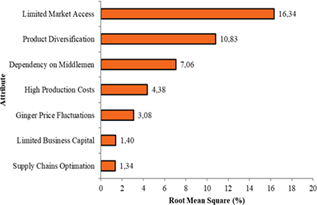
When assessing the sustainability of the ginger agribusiness in Sukabumi, the economic factor is a crucial component. Limited market access (16.34), product diversification (10.83), and reliance on intermediaries (7.06) had the highest leverage scores according to the MDS analysis, suggesting that they had a significant impact on the sustainability index (Figure 4).
Figure 4. Leverage of economic attributes
Quantitative findings were corroborated by qualitative data, wherein respondents highlighted the dominance of informal marketing channels, particularly the reliance on intermediaries, resulting in low bargaining power and restricted access to alternative markets. Asymmetric information and geographic constraints further exacerbate the issue. These findings correspond with the research conducted by Setiawan and Fadillah [31], which identified analogous trends in the ginger value chains of Semarang, illustrating how market centralization and restricted access to digital trading platforms hinder economic progress. This evidence resonates with observations noted in Nepal, where small-scale ginger producers were compelled to relinquish substantial profit margins to traders as a consequence of inefficient market structures [32]. Meanwhile, diversified agribusinesses elsewhere exhibit enhanced economic resilience among farmers when product processing, value-addition, and access to downstream markets are embraced [33].
Low levels of product diversification compound the vulnerability of smallholders, as most farmers in the study area sell only fresh ginger with minimal processing. Limited access to training and downstream partnerships has hindered the adoption of value-added innovations. Similarly, diversification and digital integration significantly enhanced farmers' economic resilience in comparable horticultural systems in Bali [34].
While high production costs (4.38) and ginger price fluctuations (3.08) had moderate leverage values, they nonetheless posed recurrent challenges. Rising input prices and barriers to formal financing, despite the availability of schemes such as People's Business Credit. Institutional and bureaucratic limitations impede access to credit, which is consistent with FAO's observations on financing gaps in Indonesian agribusiness.
Attributes such as limited business capital (1.40) and supply chain inefficiencies (1.34) exhibited lower leverage scores, suggesting either limited variability among respondents or indirect influence through more dominant factors. Nevertheless, interviewees acknowledged logistical barriers and year-round supply inconsistencies as latent impediments to economic optimization.
These findings emphasized that market connectivity, cost efficiency, and product innovation form the triadic foundation of economic sustainability in ginger value chains. The convergence of quantitative leverage analysis and qualitative insights underscores the need for targeted policy interventions, particularly in improving market access, fostering value-added processing, and reducing production-related financial constraints.
Although Figure 4 quantitatively presents the leverage scores for economic attributes, their meaning extends beyond numerical ranking. The dominant factors, limited market access (16.34), product diversification (10.83), and reliance on intermediaries (7.06), correspond closely with the structural issues revealed in field interviews. Farmers reported dependence on informal collectors and unstable pricing, which restricts bargaining power and limits reinvestment capacity. The lack of product diversification also constrains income stability, as most farmers sell unprocessed ginger and miss higher-value opportunities such as drying or powdering. Meanwhile, reliance on intermediaries perpetuates asymmetric market information, further reducing efficiency and profitability. These findings show that leverage values not only represent quantitative influence but also mirror real economic mechanisms shaping sustainability in Sukabumi’s ginger value chain.
3.3 Environmental dimension
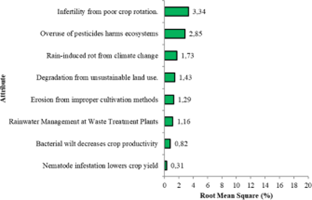
We expanded the discussion of Figure 5 by providing an in-depth interpretation of each major environmental attribute (e.g., poor crop rotation, pesticide overuse, climate-induced rhizome rot, and unsustainable land use). Each attribute is now explained in terms of its leverage value, field observations, and qualitative evidence from farmer interviews and FGDs. For example, the overuse of chemical pesticides was found to degrade soil quality and affect crop productivity, consistent with previous studies showing that excessive pesticide residues can harm soil ecosystems and crop safety [33, 35]. Similarly, the lack of proper crop rotation and soil fertility management contributes to declining soil structure and organic carbon content, aligning with findings by Sudirjo et al. [34] and Ansari et al. [36] on soil health and organic matter dynamics in tropical agricultural systems. Furthermore, continuous monocropping and inadequate soil conservation practices have been linked to higher erosion and nutrient loss in smallholder systems, as also indicated by Bucheli et al. [37].
Figure 5. Leverage of environmental attributes
The revised text explicitly links the root mean square (RMS) results from the MDS-RAPFISH analysis with practical implications and local experiences, demonstrating how leverage results correspond to real on-farm issues such as soil degradation, pest mismanagement, and erosion. In addition, the integration of biopesticide-based pest control and nanotechnology innovations from recent studies suggests potential sustainable alternatives that can reduce chemical dependence and enhance ginger resilience against tropical diseases [38].
We retained Figure 5 and emphasized its interpretive role in the text, ensuring that the results are visually supported rather than described solely through text.
The section was rewritten to improve coherence, academic style, and originality. The revised discussion now combines scientific evidence and contextual relevance by integrating international findings on sustainable pest control, soil management, and biotechnological applications [33, 37].
3.4 Social dimension
Another basic problem is a lack of meaningful and long-term extension support. Insufficient digital penetration restricts farmers' access to contemporary agronomic information and adaptive innovations [39]. This directly affects the sluggish diffusion of technology and the inability to implement collective learning procedures locally. In this scenario, inadequate levels of formal education intensify the situation. Farmers not only struggle to comprehend new technologies, but they also frequently rely more on instinct and habit than on data-driven methods. Inadequate management literacy further constrains farmers' capacity to manage their farms effectively, encompassing production planning, financing, and marketing.
Constraints in this social dimension have demonstrated a systemic effect on other facets of sustainability. From a technological standpoint, inadequate social and educational capability obstructs the adoption of suitable technology, thereby restricting the modernization of agricultural systems. From an economic perspective, inadequate training and agribusiness literacy diminish cost efficiency, reduce the added value of products, and undermine farmers' negotiating power in the market [39]. In terms of ecology, agricultural methods that aren't based on data speed up soil deterioration and lower the carrying capacity of ecosystems [40]. Simultaneously, inadequate engagement in local institutions signifies diminished social capital, which ought to be the catalyst for collective action and local innovation in the execution of sustainable practices [41].
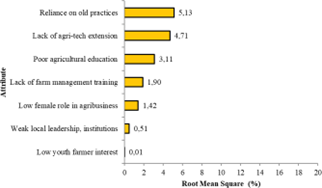
As shown in Figure 6, reliance on old practices and lack of agri-tech extension are identified as the most critical social constraints, followed by poor agricultural education and lack of management training. These weaknesses collectively illustrate how the social dimension exerts leverage across multiple sustainability pillars.
Figure 6. Leverage of social attributes
The enhancement of the social dimension should be prioritized as a strategic imperative. Targeted initiatives include the establishment of community-based field schools, the promotion of horizontal learning among farmers, and the digitization of extension services customized to the local environment. A collaborative ecosystem comprising the government, business sector, and academic institutions is essential to maintain the longevity of programs and innovation. The social dimension functions as both the internal base of the agricultural system and a crucial lever that enhances synergies among the sustainability dimensions: economic, technological, and environmental [42].
3.5 Technology dimension
The technology dimension recorded a sustainability index of 23.08%, indicating an “unsustainable” status within the multidimensional assessment. Leverage analysis (Figure 7) identified two dominant factors influencing institutional performance: evaluation of agricultural tools and machinery use (10.88) and agricultural technology development measurement (9.03). Access, affordability, and digital literacy must be addressed to ensure technology development and benefit smallholder farmers, particularly in developing regions. Supportive economic access, infrastructure, policies, and education are also key to ensuring an inclusive and sustainable transition [43-45].
Many farmers in Sukabumi face economic and financial constraints that hinder the adoption of agricultural machinery. High upfront costs, maintenance expenses, and limited access to credit make mechanization unaffordable for most smallholders. These financial barriers are compounded by irregular income and market uncertainty, which increase farmers’ reluctance to invest in new technologies. Similar patterns were found by the study [46] in East Java, where machinery adoption was delayed due to capital shortages and weak institutional credit access [47, 48]. Also emphasized that the absence of affordable financing and cooperative lending schemes remains a primary obstacle to mechanization in Indonesia’s rural regions.
Figure 7. Leverage of technology attributes
Socio-cultural traditions and low technical knowledge significantly influence farmers’ adoption of agricultural technology in Sukabumi. Many farmers rely on manual tools like hoes and sickles because these methods are familiar, trusted, and align with community farming norms [49]. Traditional beliefs and collective decision-making make farmers cautious toward mechanization, as modern tools are often viewed as risky or unnecessary. Low education levels further limit understanding of new technologies. Most farmers lack training to operate or maintain machinery and have little awareness of its benefits for efficiency and productivity [50, 51]. This limited technical capacity, combined with weak extension support, slows innovation diffusion and reinforces dependence on traditional methods [51].
Limited infrastructure and uneven government support further restrict technology adoption in Sukabumi. Poor road access, limited transportation, and inadequate repair facilities make it difficult for farmers to use or maintain agricultural machinery [52]. Government programs that provide equipment or subsidies often fail to reach remote farmers, creating unequal access to support [52]. Inconsistent policy implementation and weak coordination between agencies also reduce program effectiveness. As a result, farmers in rural areas remain excluded from mechanization initiatives. Improving rural infrastructure and ensuring fair, well-targeted support are essential to encourage wider adoption of modern farming technologies.
Perceived risk and uncertainty strongly affect farmers’ willingness to adopt new technology [53]. Many smallholders fear machinery failure, unpredictable yields, and uncertain profits [54]. Their income depends on stable harvests, so they prefer traditional methods that they know work. New technologies feel risky and unfamiliar. The lack of local demonstrations or field trials increases this fear. Without clear proof of success in their own environment, farmers view modern tools as unsafe investments rather than reliable improvements.
Overall, agricultural technologies should be developed, tested, and refined under diverse agroecological and socio-economic contexts to ensure their effectiveness and inclusivity [43]. Mechanization and technology adoption strategies must extend beyond technical efficiency to incorporate economic viability, cultural relevance, and social acceptability. Addressing the multi-dimensional challenges faced by smallholder farmers, including poverty, limited education, inadequate infrastructure, and risk aversion, is essential for promoting equitable innovation. A holistic, context-specific approach can transform agricultural technology from a purely technical intervention into a catalyst for inclusive, resilient, and sustainable rural development [55].
3.6 Institution dimension
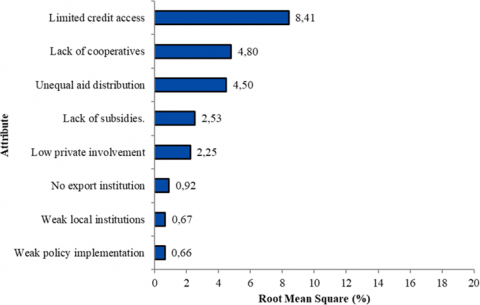
The institutional dimension recorded a sustainability index of 37.93%, indicating a “less sustainable” status within the multidimensional assessment. Leverage analysis (Figure 8) identified two dominant factors influencing institutional performance: limited access to agricultural credit (8.41) and weak cooperatives or farmer organizations (4.80). These institutional deficiencies restrict farmers’ financial capacity, collective action, and integration into value chains, factors that are crucial for sustainable agribusiness development in Sukabumi [50, 51].
Figure 8. Leverage of institution attributes
Access to credit remains a persistent challenge for smallholders. Field interviews revealed that most farmers depend on informal loans or personal savings to finance essential inputs such as fertilizers, irrigation, and seed materials. Bureaucratic procedures and collateral requirements continue to deter farmers from utilizing formal credit schemes like the Kredit Usaha Rakyat (KUR) program despite recent policy efforts under the Regulation of the Minister of Agriculture No. 12/2020 on Agricultural Credit Schemes [56]. Studies indicate that limited access to credit significantly hampers productivity and innovation in small-scale farming systems across Southeast Asia [51, 53, 57]. Strengthening financial inclusion through simplified procedures, group-based guarantees, and digital microfinance platforms is essential to enhance institutional sustainability [45].
The second major constraint is the weak performance of cooperatives and farmer groups. Although the Merah Putih Cooperative in Sukabumi was recently established to facilitate collective marketing and financial management, its governance, coverage, and operational capacity remain limited [58]. Interviews indicate that participation levels are low, and cooperative management lacks structured training in financial planning, digital literacy, and agribusiness negotiation. Similar findings from rural cooperatives in Asia emphasize that effective organizational structures are key to strengthening farmers’ bargaining power, market access, and resilience [51, 53, 59].
From a technical perspective, institutional strengthening should prioritize four integrated actions financial Inclusion: Expand the KUR program through cooperative intermediaries and digital lending systems tailored to smallholders’ risk profiles, cooperative Revitalization: Develop targeted training modules on governance, accounting, and market linkage for cooperative leaders and members, policy Alignment: Harmonize local and national agricultural programs to ensure transparent and consistent subsidy and credit distribution [54]. Stakeholder Collaboration: Foster multi-stakeholder partnerships between cooperatives, government agencies, research institutions, and private agribusinesses to co-develop institutional innovations and investment schemes [45, 60].
Strategically, building institutional resilience requires embedding financial literacy and inclusive governance frameworks into local agricultural systems. These reforms should encourage the replication of successful models like the Merah Putih Cooperative in other villages, supported by adaptive monitoring and digital integration tools. Such measures not only address the immediate leverage constraints but also promote long-term sustainability by empowering local institutions to manage resources, negotiate markets, and sustain innovation within the ginger value chain [41, 42, 25].
3.7 Monte Carlo analysis
The Monte Carlo analysis's findings are shown in Table 6, which contrasts the MDS ordination index with the outputs of the Monte Carlo simulation in every dimension.
Table 6. Results of the Monte Carlo analysis
|
Dimension |
Ordination (%) |
Monte Carlo (%) |
Variation (%) |
|
Economy |
63.70 |
56.52 |
7.18 |
|
Environment |
57.27 |
56.80 |
0.47 |
|
Social |
55.81 |
55.32 |
0.49 |
|
Institution |
37.93 |
37.88 |
0.05 |
|
Technology |
23.08 |
24.28 |
1.20 |
The comparison between the MDS ordination index and the Monte Carlo results across five sustainability dimensions, economy, environment, social, institutional, and technology, shows that four fall within a variation margin of less than 5%, consistent with the stability threshold reported by Iskandar et al. [61], indicating a generally stable and consistent model. However, the economic dimension exhibits a deviation greater than 5%, suggesting relatively lower stability in that dimension. This deviation is primarily attributed to the disproportionately high leverage of two attributes: limited market access and lack of product diversification, which strongly influence the ordination result within the economic dimension.
3.8 Interactions among sustainability dimensions
The five sustainability dimensions examined in this study, namely economic, environmental, social, technological, and institutional, are not independent components but elements of an integrated system. Weaknesses or progress in one dimension invariably influence the others, shaping the overall resilience and sustainability trajectory of smallholder ginger farming in tropical highland areas.
Institutional weaknesses amplify these challenges. The absence of cooperatives, weak policy coordination, and poor governance reduces the dissemination of environmental and technological innovations such as biopesticides, crop rotation management, and soil conservation techniques [42]. These institutional constraints also limit collective marketing and hinder access to credit, further entrenching economic inefficiency and technological stagnation.
Technological backwardness, for instance, constrains productivity and value addition, thereby reducing farmers' income and economic competitiveness [32, 49]. In turn, limited financial resources and market access restrict farmers’ ability to adapt modern technologies or invest in mechanization, demonstrating a circular dependency between the economic and technological dimensions [47, 45].
The social dimension mediates these interactions by influencing knowledge transfer and innovation adoption. Inadequate education limited agricultural extension, and low participation of women and youth diminishes the social capacity needed to absorb technological advances or to engage in institutional programs [41, 43]. This, in turn, constrains the spread of environmentally friendly and economically beneficial practices.
Environmental degradation operates as both a cause and a consequence of weakness in other dimensions. Unsustainable land use, soil erosion, and pesticide overuse reduce productivity and increase production costs, thereby deepening the economic vulnerability of smallholder farmers [40]. Addressing these problems requires institutional coordination and technological interventions, such as climate-smart practices and soil health management, that are supported by economic incentives and social participation [48].
Ultimately, achieving sustainability in smallholder ginger production demands systemic and simultaneous improvements across all five dimensions. Strengthening institutions can facilitate access to finance and training; technological innovation can enhance productivity and environmental stewardship; and improved social capacity can accelerate adoption and resilience. Sustainable transformation, therefore, depends not on isolated improvements but on the coherence and synergy among economic, environmental, social, technological, and institutional actions [41, 42].
3.9 Recommendation
This study reveals that achieving sustainability in ginger farming in Sukabumi District requires technical improvements at the farm level and broader systemic interventions. These recommendations are derived from the multidimensional sustainability assessment and aim to address economic, environmental, social, technological, and institutional weaknesses.
From an economic standpoint, one of the most pressing challenges lies in limited market access and the lack of product diversification. Therefore, it is essential to introduce farmer training programs focused on post-harvest processing and value addition, enabling the production of dried ginger, herbal powders, oils, or sweets. At the same time, digital capacity-building initiatives should be implemented to improve farmers' access to online markets and modern distribution channels. On a strategic level, establishing ginger agribusiness hubs that integrate cultivation, processing, and marketing would support economies of scale. In contrast, contract farming and cooperative-led marketing can enhance farmers' negotiating power and reduce dependence on intermediaries.
In terms of environmental sustainability, technical solutions should prioritize improving soil fertility by implementing legume-based crop rotations and applying organic matter. Integrated pest management (IPM), including botanical biopesticides such as neem and citronella, should be promoted to mitigate the harmful effects of synthetic pesticides. Additionally, farmers must adopt adaptive practices to cope with rhizome rot and soil erosion, such as raised planting beds, organic mulching, and slope conservation. Strategically, environmental conservation principles must be embedded into extension programs, and incentive-based environmental stewardship schemes should be introduced for highland farmers managing vulnerable landscapes.
On the social front, the dominant issues stem from traditional practices, limited agricultural education, and weak access to extension services. Establishing community-centered training modules that emphasize agroecological principles, farm management, and digital literacy is imperative, using methods that suit adult learners. Extension services must be reformed to become more participatory, farmer-led, and responsive to local needs. Involving youth and women in ginger value chains through innovation programs will strengthen the sector's social resilience.
Technological innovation is another critical area. Mechanization support for land preparation and post-harvest processing must be expanded through appropriate-scale technologies and cooperative access schemes. Introducing mobile-based farm management tools, weather monitoring apps, and digital market access platforms can enhance efficiency and precision. Rural innovation platforms that co-create and validate context-specific technologies should be strategically established to support ongoing adaptation and technology scaling.
Lastly, institutional weaknesses were among the most critical barriers identified. Expanding access to agricultural credit is essential and can be facilitated through cooperatives acting as intermediaries with formal financial institutions. Farmer groups should be revitalized to serve as social units and economic and organizational actors. At the policy level, there is a need to synchronize local and national agricultural strategies and replicate successful models such as the Merah Putih Cooperative across more villages. When combined with technical interventions, these institutional reforms form the foundation for a more sustainable and inclusive ginger farming system in tropical highland regions.
This study examined the sustainability of smallholder ginger cultivation under highland agroclimatic conditions in Sukabumi District, Indonesia, where ginger is both economically significant and ecologically vulnerable. Despite its growing role in food, health, and industrial markets, ginger farming in tropical highlands faces multidimensional sustainability challenges, particularly in regions where institutional, social, and technological infrastructures remain fragmented or underdeveloped.
The research introduced a comprehensive and context-specific sustainability assessment model using the methodology adapted for ginger agribusiness to address this. Through the MDS application, the study evaluated 48 sustainability attributes across five dimensions: economic, environmental, social, institutional, and technological. Data triangulation, comprising expert judgment, field observation, and stakeholder focus group discussions, ensured analytical rigor. At the same time, Monte Carlo simulations enhanced model robustness and validated the reliability of the resulting sustainability indices.
The overall sustainability index of ginger farming in Sukabumi was 47.56%, placing it within the "less sustainable" category. Among the dimensions assessed, the economic (63.70%), environmental (57.27%), and social (55.81%) dimensions were categorized as "fairly sustainable." In contrast, the institutional (37.93%) and technological (23.08%) dimensions scored significantly lower, indicating systemic weaknesses that hinder long-term sustainability.
Key leverage attributes were identified through sensitivity analysis. For the economic dimension, limited market access and low product diversification were the most influential constraints. In the environmental dimension, unsustainable crop rotation, pesticide misuse, and climate-induced rhizome rot were highlighted as major ecological threats. Social sustainability was impeded by farmers' dependence on traditional methods, lack of agricultural extension services, and low levels of education. Technological constraints included low adoption of mechanization, minimal digital integration in distribution, and poor post-harvest innovation. Institutionally, weak cooperative structures and limited access to agricultural credit emerged as critical bottlenecks.
These findings point to the urgent need for multidimensional, evidence-based interventions. Policy efforts should focus on strengthening local institutions, expanding market access, and facilitating technology transfer, particularly in post-harvest processing, digital marketing, and sustainable input management. Farmer-centered capacity building, adaptive extension services, and investment in agricultural infrastructure are also essential to elevate the system toward higher sustainability.
In conclusion, this study contributes a replicable framework for assessing sustainability in smallholder commodity-based agriculture and provides critical insights for policymakers, development actors, and researchers. The results emphasize the importance of comprehensive actions that strengthen institutions and promote wider adoption of technology to support the long-term sustainability of the smallholder ginger cultivation system in tropical highland areas. Future studies should integrate longitudinal sampling, remote sensing indicators, and participatory appraisal tools to enhance system-level diagnostics and track sustainability transitions over time. Its methodological adaptation of RAPFISH demonstrates the tool's versatility beyond fisheries, offering a model that can be applied to other tropical highland commodities facing similar structural and ecological pressures.
The authors would like to thank the Head of the Research Center for Industrial Systems and Sustainable Manufacturing. We also thank the Sukabumi local administration and farmer groups for their cooperation and support in making this research possible.
|
% |
Percent |
|
ALSCAL |
Alternating Least Squares Scaling (an algorithm of MDS) |
|
BRIN |
Badan Riset dan Inovasi Nasional |
|
d |
Euclidean distance |
|
dij |
Euclidean distance from point i to point j |
|
dijk |
Squared distance |
|
EPR |
Extended producer responsibility |
|
Eq |
Equation |
|
FAO |
Food and Agriculture Organization |
|
FGD |
Focus group discussions |
|
ha |
Hectare |
|
i, j, k |
Dimensions |
|
MDS |
Multidimensional scaling |
|
oijk |
Point of origin |
|
RAPFISH |
Rapid appraisal for fisheries |
|
R2 |
Coefficient of determination |
|
Stress |
Dissimilarities in MDS |
|
RMS |
Root mean square |
|
S-Stress |
Standardized Stress Value |
|
SQR |
Structured query reporter |
|
IPM |
Integrated Pest Management |
|
KUR |
Kredit Usaha Rakyat (People’s Business Credit) |
|
MCS |
Monte Carlo Simulation |
|
Likert Scale Perception scale |
|
[1] Loboguerrero, A.M., Campbell, B.M., Cooper, P.J.M., Hansen, J.W., Rosenstock, T., Wollenberg, E. (2019). Food and earth systems: Priorities for climate change adaptation and mitigation for agriculture and food systems. Sustainability, 11(5): 1372. https://doi.org/10.3390/su11051372
[2] Kabato, W., Getnet, G.T., Sinore, T., Nemeth, A., Molnár, Z. (2025). Towards climate-smart agriculture: Strategies for sustainable agricultural production, food security, and greenhouse gas reduction. Agronomy, 15(3): 565. https://doi.org/10.3390/agronomy15030565
[3] Tchuenga, G.T.S., Tchindjang, M., Ngome, P.I.T., Degrande, A., Basga, S.D., Saha, F. (2024). Agricultural innovations and adaptations to climate change in the Northern Cameroon region. Sustainability, 16(22): 10096. https://doi.org/10.3390/su162210096
[4] Pandey, D. (2020). Agricultural sustainability and climate change nexus. In Contemporary Environmental Issues and Challenges in the Era of Climate Change, pp. 77-97. https://doi.org/10.1007/978-981-32-9595-7_4
[5] Food and Agriculture Organization (FAO). (2024). FAOSTAT: Major Spice Producing Countries. Food and Agriculture Organization of the United Nations, Rome, Italy. https://www.fao.org/faostat/en/#data/QC.
[6] Joshi, P., Khanal, S. (2021). Production status, export analysis, and prospects of ginger in Nepal. Archives of Agriculture and Environmental Science, 6(1): 12-18. https://doi.org/10.26832/24566632.2021.0602012
[7] Afzaal, M., Saeed, F., Gulzar, R., Samar, N., et al. (2023). Biovalorization and industrial applications of ginger waste: A review. International Journal of Food Properties, 26(1): 311-328. https://doi.org/10.1080/10942912.2023.2254014
[8] Pitcher, T.J., Preikshot, D. (2001). Rapfish: A rapid appraisal technique to evaluate the sustainability status of fisheries. Fisheries Research, 49: 255-270. https://doi.org/10.1016/S0165-7836(00)00205-8
[9] Hout, M.C., Papesh, M.H., Goldinger, S.D. (2013). Multidimensional scaling. WIREs Cognitive Science, 4(1): 93-103. https://doi.org/10.1002/wcs.1203
[10] Santoso, A.D., Hariyanti, J., Pinardi, D., Kusretuwardani, W., Widyastuti, N., Djarot, I.N., Handayani, T., Sitomurni, I., Apriyanto, H. (2023). Sustainability index analysis of microalgae cultivation from biorefinery palm oil mill effluent. Global Journal of Environmental Science and Management, 9(3): 559-576. https://doi.org/10.22035/gjesm.2023.03.13
[11] Bakrie, B., Sirnawati, E., Rohaeni, E.S., Hutahaean, L., Santoso, A.D., Wasito, W., Indrawanto, C. (2023). Sustainability analysis of intensive duck farming system in Sliyeg District, Indonesia: MDS and MICMAC analysis approach. International Journal of Sustainable Development and Planning, 18(10): 3181-3193. https://doi.org/10.18280/ijsdp.181019
[12] Lovarelli, D., Bacenetti, J., Guarino, M. (2020). A review on dairy cattle farming: Is precision livestock farming the compromise for an environmentally, economically, and socially sustainable production? Journal of Cleaner Production, 262: 121409. https://doi.org/10.1016/j.jclepro.2020.121409
[13] Rachman, B., Ariningsih, E., Sudaryanto, T., Ariani, M., Septanti, K.S., Adawiyah, C.R., Ashari, Agustian, A., Saliem, H.P., Tarigan, H., Syahyuti, Yuniarti, E. (2022). Sustainability status, sensitive and key factors for increasing rice production: A case study in West Java, Indonesia. Plos One, 17(12): e0274689. https://doi.org/10.1371/journal.pone.0274689
[14] Rohaeni, E.S., Ilham, N., Saptati, R.A., Rahayu, H.S.P., Priyono, Anggraeny, Y.N., Qomariah, R., Pamungkas, D., Ermuna, S.S., Mahendri, I.G.A.P., Mariyono, Darsani, Y.R., Hutahaean, L., Praptana, R.H., Lesmayati, S., Ahmad, S.N., Bahar, S., Suhartini, S.H., Santoso, A.D., Rakhmani, S.I.W. (2024). Developing a sustainable beef cattle business model for smallholder farms in South Kalimantan’s drylands. International Journal of Sustainable Development and Planning, 19(2): 481-500. https://doi.org/10.18280/ijsdp.190207
[15] Allaily, A., Santoso, A.D., Rofiq, M.N., Sasongko, N.A., et al. (2024). Sustainability assessment of animal feed production from by-products of the sago palm smallholder industry. Global Journal of Environmental Science and Management, 10(3): 1275-1296. https://doi.org/10.22034/gjesm.2024.03.20
[16] Pączka, G., Mazur-Pączka, A., Garczyńska, M., Kostecka, J., Butt, K.R. (2021). Garlic (Allium sativum L.) cultivation using vermicompost-amended soil as an aspect of sustainable plant production. Sustainability, 13(24): 13557. https://doi.org/10.3390/su132413557
[17] Santoso, A.D., Arianti, F.D., Rohaeni, E.S., Haryanto, B., et al. (2023). Sustainability index analysis of organic fertilizer production from paunch manure and rice straw waste. Global Journal of Environmental Science and Management, 9(SI): 193-218. https://doi.org/10.22034/gjesm.2023.09.SI.12
[18] Widjaja, E., Utomo, B.N., Santoso, A.D., Erlambang, Y.P., et al. (2024). Sustainability index analysis for environmentally low-input integrated farming. Global Journal of Environmental Science and Management, 10(2): 537-556. https://doi.org/10.22034/gjesm.2024.02.08
[19] JJwaideh, M.A., Dalin, C. (2025). The multi-dimensional environmental impact of global crop commodities. Nature Sustainability, 8: 396-410. https://doi.org/10.1038/s41893-025-01528-6
[20] Yu, J., Wu, G. (2025). Spatial disparities and dynamics in the high-quality agricultural development in Heilongjiang Province of China. Scientific Reports, 15(1), 4765. https://doi.org/10.1038/s41598-025-89052-7
[21] SSyarifuddin, H., Afdal, M., Yurleni, Y., Hamidah, A., Devitriano, D., Poy, T.T. (2024). Sustainability analysis and decision-making strategy for swamp buffalo (Bubalus bubalis carabauesis) conservation in Jambi Province, Indonesia. Open Agriculture, 9(1): 20220293. https://doi.org/10.1515/opag-2022-0293
[22] Horcea-Milcu, A.I., Dorresteijn, I., Leventon, J., Stojanovic, M., et al. (2024). Transformative research for sustainability: Characteristics, tensions, and moving forward. Global Sustainability, 7: e14. https://doi.org/10.1017/sus.2024.12
[23] Tang, Y., Xia, N., Xiao, Y., Xu, Z., Ma, Y. (2025). Assessment of crop water resource utilization in arid and semi-arid regions based on the water footprint theory. Agronomy, 15(7): 1529. https://doi.org/10.3390/agronomy15071529
[24] BPS-Statistics Indonesia. (2023). Sukabumi Regency in Figures 2023. Badan Pusat Statistik Kabupaten. https://sukabumikab.bps.go.id/en/publication/2023/02/28/700512208bbba871f2e64b07/kabupaten-sukabumi-dalam-angka-2023.html.
[25] Fauzi, A. (2019). Teknik Analisis Keberlanjutan. Gramedia Pustaka Utama.
[26] Morgan, D.L. (1998). The Focus Group Guidebook: Kit 1. Sage Publications.
[27] Pitcher, T.J., Kalikoski, D., Short, K., Varkey, D., Pramod, G. (2009). An evaluation of progress in implementing ecosystem-based management of fisheries in 33 countries. Marine Policy, 33(2): 223-232. https://doi.org/10.1016/j.marpol.2008.06.002
[28] Apresentação, S., Rangel, M., Cristas, A. (2024). Towards sustainability: A framework for evaluating Portuguese small-scale fisheries. Sustainability, 16(8): 3174. https://doi.org/10.3390/su16083174
[29] Kavanagh, P., Pitcher, T.J. (2004). Implementing Microsoft Excel software for Rapfish: A technique for the rapid appraisal of fisheries status. https://doi.org/10.14288/1.0074801
[30] Tesfamichael, D., Pitcher, T.J. (2006). Multidisciplinary evaluation of the Sustainability of Red Sea fisheries using Rapfish. Fisheries Research, 78: 227-235. https://doi.org/10.1016/j.fishres.2006.01.005.
[31] Setiawan, A.B., Fadillah, R.N. (2021). The value chain analysis and strategy for developing ginger farming in Semarang Regency. Jurnal Ekonomi Pembangunan, 22(2): 200-217. https://doi.org/10.23917/jep.v22i2.9452
[32] Dahal, B.R., Rijal, S. (2020). Ginger value chain analysis: A case of smallholder ginger production and marketing in hills of central Nepal. Agricultural Science and Technology, 12(1): 31-36.
[33] Rahmasari, L.F., Abidin, Z. (2025). Product diversification strategy in agribusiness to increase farmers’ profits and economic stability. International Journal of Economics, 4(1): 483-498. https://doi.org/10.55299/ijec.v4i1.1322
[34] Sudirjo, F., Lestari, M.D., Haryono, H., Faisal, H.N., Sajali, C.U. (2024). The effect of sustainable agricultural practices, product diversification, and digital marketing on the economic performance of organic vegetable farmers in Bali. West Science Agro, 2(4): 195-204. https://doi.org/10.58812/wsa.v2i04.1453
[35] Akinwumi, G., Aliku, O., Oshunsanya, S., Aiyelari, E.A. (2022). Organic fertilizer and mulch affect the physical properties of an Alfisol and the ginger (Zingiber officinale) yield. Communications in Soil Science and Plant Analysis, 53(22): 1-13. https://doi.org/10.1080/00103624.2022.2096896
[36] Ansari, T., Sudhakar, S., Prasanna, N.L., Nigam, R., et al. (2025). A review on the potential of ginger essential oil-based nanotechnology for controlling tropical plant diseases. Journal of Advances in Biology & Biotechnology, 28(1): 230-248. https://doi.org/10.9734/jabb/2025/v28i11876
[37] Bucheli, T.D., Barmettler, E., Bartolomé, N., Hilber, I., Hornak, K., Meuli, R., et al. (2023). Pesticides in agricultural soils: Major findings from various monitoring campaigns in Switzerland. Chimia, 77(11): 750-757. https://doi.org/10.2533/chimia.2023.750
[38] Akhter, W., Shah, F.M., Yang, M., Freed, S., et al. (2023). Botanical biopesticides have an influence on tomato quality through pest control and are cost-effective for farmers in developing countries. Plos One, 18(11): e0294775. https://doi.org/10.1371/journal.pone.0294775
[39] Hoang, V.T., Tran, Q.N. (2023). Digital transformation in agricultural extension services: Barriers and opportunities for smallholder farmers in Southeast Asia. Journal of Rural Studies, 98: 101-114. https://doi.org/10.1016/j.jrurstud.2023.06.004
[40] Patel, R., Singh, A., Kumar, P. (2020). Soil degradation and sustainable agricultural practices: A systematic review. Environmental Sustainability, 3(4): 245-259. https://doi.org/10.1007/s42398-020-00119-7
[41] Zhang, L., Wang, J., Li, X. (2023). Social capital and collective action in rural sustainability transitions: Evidence from farmer cooperatives in China. Sustainability Science, 18(2): 789-804. https://doi.org/10.1007/s11625-022-01244-5
[42] Boix-Fayos, C., De Vente, J. (2023). Integrating social and biophysical dimensions for sustainable land management in Mediterranean agroecosystems. Agricultural Systems, 205: 103556. https://doi.org/10.1016/j.agsy.2023.103556
[43] Gamage, A., Gangahagedara, R., Subasinghe, S., Gamage, J., Guruge, C., Senaratne, S., Randika, T., Rathnayake, C. (2024). Advancing sustainability: The impact of emerging technologies in agriculture. Current Plant Biology, 40: 100420. https://doi.org/10.1016/j.cpb.2024.100420
[44] Hwang, B.N., Jitanugoon, S., Puntha, P. (2024). The impact of smart farming technology on agricultural productivity: Evidence from a large-scale database in Thailand. In the 1st International Conference on Creative Design, Business and Society (1st ICCDBS) 2023, KnE Social Sciences, pp. 25-55. https://doi.org/10.18502/kss.v9i32.17425
[45] Sekyi, S., Domanban, P.B., Honya, G.K. (2020). The impact of informal credit on rural agricultural productivity in the savannah ecological zone of Ghana. African Journal of Economics, Finance and Management Studies, 1: 301-315. https://doi.org/10.1108/AJEMS-03-2019-0121
[46] Purwanti, T.S., Nugroho, E., Febrianto, N., Siswijono, S.B. (2023). Unlocking credit access for farmers (Case study of dairy farmers in East Java, Indonesia). BIO Web of Conferences, 81: 00025. https://doi.org/10.1051/bioconf/20238100025
[47] Haryanto, T., Wardana, W.W., Jamil, I.R., Brintanti, A.R.D., Ibrahim, K.H. (2023). Impact of credit access on farm performance: Does source of credit matter? Heliyon, 9(9): e19720. https://doi.org/10.1016/j.heliyon.2023.e19720
[48] Puška, A., Nedeljković, M., Šarkočević, Ž., Golubović, Z., Ristić, V., Stojanović, I. (2022). Evaluation of agricultural machinery using multi-criteria analysis methods. Sustainability, 14(14): 8675. https://doi.org/10.3390/su14148675
[49] Mohammed, A. (2020). Challenges of traditional farming practices in promoting sustainable agriculture in Sub-Saharan Africa. International Journal of Agricultural Sustainability, 18(4): 312-326. https://doi.org/10.1080/14735903.2020.1720475
[50] Becerra-Encinales, J.F., Bernal-Hernandez, P., Beltrán-Giraldo, J.A., Cooman, A.P., Reyes, L.H., Cruz, J.C. (2024). Agricultural extension for adopting technological practices in developing countries: A scoping review of barriers and dimensions. Sustainability, 16(9): 3555. https://doi.org/10.3390/su16093555
[51] Wang, G., Lu, Q., Capareda, S.C. (2020). Social network and extension service in farmers’ agricultural technology adoption efficiency. PLoS ONE, 15(7): e0235927. https://doi.org/10.1371/journal.pone.0235927
[52] Olaniyi, O.A. (2023). Socioeconomic factors influencing climate-smart agriculture adoption among smallholders in Nigeria. Environmental Challenges, 13: 100608. https://doi.org/10.1016/j.envc.2023.100608
[53] Baral, P., Shrestha, R., Aryal, J.P. (2021). The adaptive capacity of smallholder farmers to climate change: Evidence from rural Nepal. Climatic Change, 168: 34. https://doi.org/10.1007/s10584-021-03248-3
[54] Meijer, S.S., Catacutan, D., Ajayi, O.C., Sileshi, G.W., Nieuwenhuis, M. (2014). The role of knowledge, attitudes and perceptions in the uptake of agricultural and agroforestry innovations among smallholder farmers in sub-Saharan Africa. International Journal of Agricultural Sustainability, 13(1): 40-54. https://doi.org/10.1080/14735903.2014.912493
[55] Wang, T., Liu, H., Wang, Z. (2025). Decomposing the impact of agricultural mechanization on agricultural output growth: A case study based on China’s winter wheat. Sustainability, 17(5): 1777. https://doi.org/10.3390/su17051777
[56] BPK regulation. (2020). Regent Regulation (Perbup) of Aceh Besar Regency Number 17 of 2020 concerning the Work Plan of the Regional Government of Aceh Besar Regency in 2021. https://peraturan.bpk.go.id/Home/Details/149961/.
[57] Syamsiyah, N., Sulistyowati, L., Noor, T.I., Setiawan, I. (2023). The sustainability level of an EcoVillage in the upper Citarum watershed of West Java Province, Indonesia. Sustainability, 15(22): 15951. https://doi.org/10.3390/su152215951
[58] Christian, M., Obi, A., Zantsi, S., Mdoda, L., Jiba, P. (2024). The role of cooperatives in improving smallholder participation in agri-food value chains: A case study of one local municipality in Eastern Cape, South Africa. Sustainability, 16(6): 2241. https://doi.org/10.3390/su16062241
[59] Siregar, A.P., O’Donoghue, C., Whay, B. (2024) Agricultural co-operatives in four Asian countries: A review of institutional history. Reviews in Agricultural Science, 12: 24-44. https://doi.org/10.7831/ras.12.0_24
[60] Muhammad, M. (2025). Merah Putih Cooperative is now present in Sasagaran, Sukabumi. Media Pakuan. Retrieved from https://mediapakuan.pikiran-rakyat.com/sukabumi-raya/pr-639504125/koperasi-merah-putih-kini-hadir-di-sasagaran-sukabumi
[61] Iskandar, R., Kurniawan, B.P.Y., Hidayat, T., Malika, U.E., Galushasti, A. (2024). Assessing the sustainability and performance of local soybean production in Indonesia: A multidimensional scaling analysis. International Journal of Sustainable Development and Planning, 19(2): 539-548. https://doi.org/10.18280.ijsdp.190211