Fensa Eka Widjaya* | Muhammad Nasir Rofiq | L. M. Risman Dwi Jumansyah | Arif Dwi Santoso | Ermin Widjaja | Bambang Ngaji Utomo | Lintje Hutahaean | Suryani | Nugroho Adi Sasongko | Anuraga Jayanegara
© 2025 The authors. This article is published by IIETA and is licensed under the CC BY 4.0 license (http://creativecommons.org/licenses/by/4.0/).
OPEN ACCESS
Studies have reported significant variations in global warming potential (GWP) values associated with beef cattle production. This study was aimed to benchmark the GWP values of beef cattle production globally using meta-analysis. A total of 52 research papers, 89 studies, and 1,258 samples were included in this meta-analysis. This meta-analysis includes only peer-reviewed publications with empirical GWP values for the beef cattle industry, expressed in quantities comparable to CO2eq/kgLW (carbon dioxide equivalent/kilogram liveweight). The aggregated GWP value of beef cattle, as derived by combining data from other research, is 15.69 CO2eq/kgLW. This number serves as a benchmark for carbon footprint associated with the beef cattle production. Several subgroup analyses were conducted to identify significant discoveries that contributed to the range of greenhouse gas emission levels in beef cattle research. he utilisation of different feed types revealed that organic feed exhibits a greater GWP value (P<0.01) than inorganic feed. The extensive farming system exhibited a larger (P<0.01) GWP compared to intensive systems, but the intensive system displayed a lower (P<0.01) GWP than semi-intensive systems. Large-scale cow farming, defined as operations with more than 251 head of cattle, had a reduced (P<0.01) GWP compared to medium-scale (50-250 head) and small-scale (<100 head) activities. The last stages of cattle production exhibited reduced (P<0.01) GWP values compared to the cow-calf and cow-calf-finishing stages. The benchmark GWP value from this meta-analysis is a critical reference point for stakeholders to reach emissions reduction targets and improve the sustainability practices. It also allows stakeholders to track progress, compare carbon footprints, and encourage innovations that aim to reduce the environmental impact of beef production.
beef cattle, benchmark, emissions, farming systems, global warming potential, meta-analysis
Beef products have a notably higher carbon footprint relative to other food commodities [1]. The substantial carbon footprint associated with cattle is primarily due to their prolonged rearing period, inefficient feed conversion, and methane emissions. Beef production is a prominent contributor to greenhouse gas emissions, with cattle being a significant source of methane [2] and other emissions associated with the industry. Methane emissions result from secondary metabolite production during digestion in cows [3]. This process occurs in the rumen, where methanogenic archaea facilitate the breakdown of fodder and cellulose into acetate [4]. Methane is released as a byproduct of this process. Methane has a pronounced greenhouse effect, having a stronger impact than other gases such as carbon dioxide and nitrous oxide [5]. The significant carbon footprint associated with the beef cattle industry has prompted various stakeholders to criticize the beef cattle farming sector, urging it to reduce its environmental impact [6]. Specific stakeholders actively work to decrease the quantity of beef cattle ranches [7], while others focus on implementing mitigation measures to minimize the consequential environmental ramifications [8].
There is considerable variation in the reported carbon footprints of beef cattle, as documented in scientific and corporate reports [9]. The diversity observed in beef cattle farming enterprises can be attributed to various management techniques. Several factors, such as farming systems, stage of production, type of feed, and farm scale, contribute to the variability in the carbon footprint of beef cattle farms. Extensive cattle farming typically results in a more significant carbon footprint than intensive farming systems due to the increased mobility and activity of cows in extensive farming practices, as opposed to the more confined conditions of intensive farming [10]. The carbon footprint associated with organic feed is greater than that of inorganic feed due to the increased fertilizer requirements in organic farming [11].
Consequently, forage yield is higher in conventional farms compared to organic farms. The stage of production significantly influences the variability of carbon footprint values in beef cow production because breeding cattle necessitates a more extended maintenance period compared to cattle farming, which primarily focuses on the objective of fattening. The comparative business efficiency of large-scale farms and smaller-scale farms suggests the need for additional research to ascertain the potential impact of farm scale on the carbon footprint of beef cattle farms. The magnitude of the carbon footprint in beef cattle ranching is influenced by various factors, leading to varying results across different studies.
Accurate estimations of GWP in the cattle industry are crucial for addressing climate change and promoting sustainability in agriculture. Precise assessments of the GWP offer a thorough comprehension of the environmental consequences associated with beef production, enabling us to pinpoint areas that require enhancement and efficiently implement solutions to reduce these impacts. Furthermore, GWP assessments are crucial for creating reference points and overseeing advancements in the reduction of the carbon footprint of the beef business. Given the growing worldwide demand for beef, it is becoming increasingly important to reduce its environmental impact to prevent the negative consequences of climate change. Accurate GWP estimates serve as a valuable tool for policymakers, researchers, and the industry to make well-informed decisions, mitigate emissions, and transition to more environmentally sustainable practices in beef production. Amidst the difficulties posed by climate change, accurate evaluations of GWP are crucial for guiding the beef industry toward a more environmentally friendly and sustainable future.
A meta-analysis is necessary to establish normative recommendations, benchmarks, and key variables influencing high and low carbon footprints in beef cattle agriculture. This meta-analytical study will generate adjusted standard values for beef cattle farms, considering their distinct characteristics as variables for the subgroup analysis. The treatment factors encompass farming systems, which encompasses various livestock systems (intensive, extensive, and semi-intensive), different types of organic and inorganic feed, distinct stages of livestock production (breeding, fattening, and breeding-fattening), and varying scales of farming (small, medium, and large). This meta-analytical study can also identify the determinants of high or low carbon footprint values, enabling authorized entities to use it for policy formulation. An extensive research analysis can provide a comprehensive summary of pertinent studies and give a holistic assessment of the carbon footprint associated with beef cattle rearing. This meta-analysis study aims to generate revised standard values for beef cattle ranches on a global scale.
While previous research has extensively documented the significant carbon footprint of beef production, there is considerable variability in the reported data due to differences in farming practices, feed types, and farm scales [12]. Current literature lacks a standardized approach for assessing the carbon footprint of beef cattle farming, resulting in a broad range of reported greenhouse gas emissions across different studies and farming conditions [13]. This inconsistency hinders the development of uniform benchmarks that are crucial for formulating effective mitigation strategies. Furthermore, while some studies have focused on specific factors such as farming systems or feed types, there is a limited comprehensive analysis that integrates all these variables to provide a holistic understanding of the factors influencing greenhouse gas emissions in beef production.
To address these gaps, this study aims to conduct a meta-analysis to establish normative benchmarks and identify the key determinants of high and low carbon footprints in beef cattle farming. Our approach uniquely considers a wide range of variables, including farming systems (intensive, extensive, and semi-intensive), feed types (organic and inorganic), production stages (breeding, fattening, and combined systems), and farm scales (small, medium, and large). This comprehensive analysis will generate adjusted standard values for beef cattle farms, tailored to their specific characteristics, thereby providing more precise recommendations for reducing the environmental impact of beef production.
2.1 Paper selection criteria
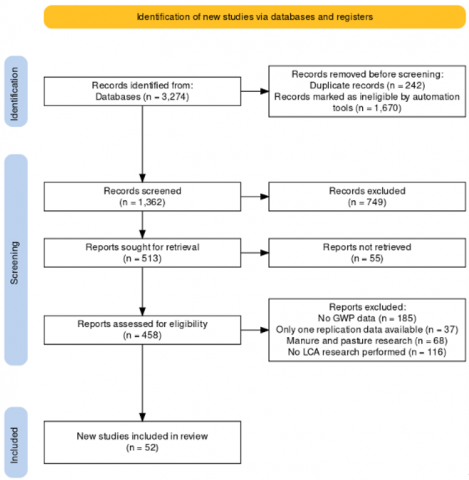
The present study followed the Preferred Reporting Items for Systematic Reviews and Meta-Analyses (PRISMA) assessment framework to guide the systematic review process, promoting transparency and adherence to best practices in meta-analysis [14]. Figure 1 shows the PRISMA processes conducted in this study. The primary focus was on studies that directly investigate the environmental impact of beef cattle farming by applying the Life Cycle Assessment (LCA) method, ensuring methodological consistency and relevance [15].
Figure 1. Paper screening and selection process using PRISMA method [16]
To ensure a thorough review, databases from Scopus, Web of Science, ScienceDirect, and Google Scholar were employed for study selection. This meta-analysis research had strategically chosen to utilize Google Scholar and ScienceDirect databases. Scopus and Web of Science were two platforms that contain a high-quality indexed journal. High-quality journals were needed to present reliable results for meta-analysis research. Two key considerations underpin the decision to employ Google Scholar and ScienceDirect platforms. Firstly, both databases were distinguished by their extensive coverage and open-access materials. Google Scholar was renowned for encompassing a variety of scholarly literature, including journals, conferences, and theses. In contrast, ScienceDirect, as a scholarly publishing platform, provides access to many scientific journals and books across diverse disciplines. A significant portion of the papers available in both Google Scholar and ScienceDirect was accessible through open access, facilitating easy access to valuable information for researchers and the wider public without membership restrictions. By leveraging the broad coverage and open access availability of Google Scholar and ScienceDirect, this research was expected to ensure comprehensive and diverse data collection, fostering inclusivity and accessibility in disseminating scientific findings.
Keywords and search strings were carefully designed to capture studies related to the environmental impact of cattle farming using the LCA method. The keywords used were "Beef Cattle Life Cycle Assessment" which had been accessed from Google Scholar, Scopus, ScienceDirect, and Web of Science from 12 June 2023 to 30 October 2023. The selection process was narrowed down to studies exclusively concerning beef cattle, excluding those related to dairy cattle. LCA methods must be used to conduct the research and contain GWP values. The specified timeframe for study inclusion, from 2015 to 2023, helped to maintain the research currency and considers recent developments. This meta-analysis focused on Beef Cattle LCA exclusively includes papers adopting the cradle-to-gate boundary system. The system boundaries had encompassed post-farm-gate activities, spanning from processing through to consumption. Cradle-to-gate LCA assesses the entire environmental footprint of beef production from the moment raw materials are extracted or sourced (the "cradle") until the product leaves the factory gate. This boundary system accounted for all upstream processes, including feed production, animal husbandry, transportation, and processing, providing a comprehensive view of the environmental effects linked to the entire supply chain. By concentrating on studies employing the cradle-to-gate approach, the meta-analysis ensured a consistent evaluation framework for the environmental impacts of beef cattle production, facilitating meaningful comparisons across the selected papers. The functional unit used in this study was CO2eq/kgLW, with the potential for converting values if discrepancies in functional units were encountered, contingent on data availability in the selected papers. This meticulous selection process ensures that the meta-analysis incorporates studies that align with the research objectives and maintain methodological consistency, thereby enhancing the credibility and reliability of the findings. The total studies included in this meta-analysis were 52 research papers, 89 studies, and 1,258 total sample size. There were several duplicate articles excluded while accessing four different databases and included only one article in this study.
2.2 Data synthesis
The studies included in this research were restricted only to the study performed by a “cradle to gate” perspective. In this meta-analysis, some studies presented their carbon footprint data using functional units other than CO₂eq/kg of live weight (LW). To ensure consistency across studies and allow for meaningful comparison, it was necessary to convert the different functional units into CO₂eq/kgLW. The primary units encountered were CO₂eq/kgLWG, CO₂eq/kgCarcass, and CO₂eq/kgBeef. Below is an outline of the conversion methods applied.
The conversion from live weight gain (LWG) to live weight (LW) was based on the relationship between weight gain (the amount of weight the animal has gained over time) and initial body weight (IBW). The liveweight of cattle was calculated by adding the initial weight (the animal’s starting weight) to the liveweight gain over a specific period. Eq. (1) is the equation to convert CO₂eq/kgLWG to CO₂eq/kgLW:
$\frac{{CO}_2-e q}{{Kg} * L W}=\frac{{CO}_2-e q}{{Kg} * L W G} \times \frac{L W G+I B W}{L W G}$ (1)
For studies reporting carbon footprints based on carcass weight, the carcass dressing percentage (the ratio of carcass weight to live weight) was used to convert the data to live weight. Eq. (2) shows the equation to convert CO₂eq/kgCarcass to CO₂eq/kgLW:
$\frac{{CO}_2-e q}{{Kg} * L W}=\frac{\frac{{CO}_2-e q}{{Kg} {~carcass }}}{0.6}$ (2)
Data related to standard deviation also needs to be collected but not all studies provide standard deviation information. So, it is necessary to synthesize the data through conversion. The standard deviation (σ) can be calculated or estimated from several different parameters, depending on the available data. If the variance is known, the standard deviation can be obtained by taking the square root of the variance which shown in Eq. (3) [17].
$\sigma=\sqrt{ { Variance }}$ (3)
If the standard error (SE) and sample size n are known, the standard deviation can be calculated using the Eq. (4) [18].
$\sigma=S E \times \sqrt{n}$ (4)
Additionally, if only the minimum and maximum values are available, the standard deviation can be estimated through an approximation using the formula in Eq. (5) [19].
$\sigma=\frac{M a x-{Min}}{4}$ (5)
which is a common estimation method for a normal distribution. Each formula provides a practical way to calculate the standard deviation based on the available parameters.
2.3 Data selection
Selected studies were categorized based on various factors to perform a subgroup analysis test. The categories were feed types (organic vs. inorganic), cattle farming systems (extensive vs. intensive vs. semi-intensive), farm scale (small vs. medium vs. large), and production stages (cow-calf vs. finisher vs. cow-calf-finisher). Each category had its distinctive traits to determine for each subgroup. The subgroups selected in this study were chosen for two key reasons: their general applicability and widespread use in prior research, ensuring abundant data availability, and their significant impact on GWP, making them a frequent focus in scientific literature. Subgroup analysis in this context not only provides global benchmark references but also allows for specific benchmark values per category, offering deeper insights into the factors influencing GWP.
The distinction between organic and inorganic feed in beef cattle farming was significant regarding their composition and production practices. Organic feed was characterized by the absence of chemical materials in the composition of the feed given to the cattle and in the fertilizers used for crop production to cultivate the feed [20]. Organic feed production relies on natural and sustainable farming methods, avoiding synthetic pesticides, herbicides, and genetically modified organisms (GMOs). This emphasis on natural and chemical-free feed aligns with the broader philosophy of organic farming, emphasizing environmental sustainability and animal welfare [21]. Conversely, inorganic feed, while not inherently detrimental, may incorporate chemical materials in various aspects of its production practices, such as nitrogen, phosphorus, and potassium, to enhance crop yields using synthetic fertilizer [22]. Additionally, the inorganic feed might rely on conventional agricultural techniques, including applying pesticides and herbicides to manage pests and weeds [23].
Cattle farming systems encompassed extensive, intensive, and semi-intensive models, each characterized by distinct criteria. The extensive system typically involves cattle raised on open pastures with minimal inputs, while the intensive system often implies confinement and high resource utilization [23]. In an extensive system, cattle roam large grazing areas with minimal human intervention, fostering natural behaviors and maintaining a low stocking density. Conversely, intensive systems involve confinement in spaces like feedlots, close human monitoring, and a higher stocking density. Cattle are kept in confined areas or feedlots, where their diet is carefully controlled and optimized for rapid growth [24]. Intensive farming requires higher inputs, including feed, water, and labor [25]. Semi-intensive systems strike a balance, allowing cattle access to grazing areas and confined spaces, involving moderate human intervention, and maintaining a moderate stocking density. These criteria comprehensively overviewed the diverse approaches to managing cattle in different farming systems.
Farming scale was divided into large-scale (>251 head), medium-scale (50-250), and small-scale (<50 head) farming [26]. Large-scale farming, typically involving more than 251 cattle, represents a significant operation in the cattle industry. These farms often benefit from economies of scale, allowing for efficient production and distribution of beef products. Large-scale operations may employ advanced technologies and practices to maximize productivity. Medium-scale farming, with a herd size of 50 to 250 cattle, balances efficiency and manageable scale. These farms can adopt modern practices while maintaining a more intimate connection with their animals. Medium-scale operations often prioritize production and animal well-being, aiming for a sustainable approach. Small-scale farming, typically involving fewer than 50 cattle, emphasizes a personalized and hands-on approach. These farms may focus on niche markets, organic practices, or local distribution. While they may have lower production volumes, they contribute to agricultural diversity and can appeal to consumers seeking locally sourced, ethically raised beef. The summary of the paper utilized in this research is shown in Table 1.
Table 1. Paper utilized in the study
|
Name |
Year |
Feed |
Model |
Stage |
Scale |
|
[27] |
2017 |
Inorganic |
E |
CCF |
Large |
|
[28] |
2021 |
Inorganic Organic |
I, S |
CC, CCF, F |
Small |
|
[29] |
2016 |
Inorganic |
I |
CC |
Large |
|
[30] |
2021 |
Inorganic |
S |
CCF |
Large |
|
[31] |
2018 |
Inorganic |
E, I, S |
CC, F |
Small |
|
[11] |
2017 |
Organic |
S |
CCF |
Large |
|
[32] |
2021 |
Inorganic |
E |
CCF |
Large |
|
[33] |
2016 |
Inorganic |
E |
CCF |
Large |
|
[34] |
2015 |
Organic |
E |
CCF |
Large |
|
[35] |
2021 |
Organic |
S |
CCF |
Large |
|
[36] |
2023 |
Inorganic |
I |
F |
- |
|
[25] |
2021 |
Inorganic |
S |
CCF |
Large |
|
[37] |
2015 |
Inorganic |
E |
CCF |
- |
|
[38] |
2022 |
Inorganic Organic |
E |
CC, CCF, F |
Large |
|
[39] |
2021 |
- |
- |
CCF |
- |
|
[40] |
2016 |
Inorganic |
E |
CCF |
- |
|
[41] |
2017 |
Inorganic |
E |
CCF |
Large |
|
[42] |
2019 |
Inorganic |
I, S |
F |
Large |
|
[43] |
2015 |
Inorganic |
E |
CCF |
Large |
|
[44] |
2019 |
Inorganic |
E, I |
CCF |
Medium |
|
[45] |
2021 |
Inorganic |
E |
F |
Large |
|
[45] |
2021 |
Inorganic |
E |
CCF |
Medium |
|
[46] |
2021 |
Inorganic |
I |
CCF |
Large |
|
[47] |
2018 |
Inorganic |
I |
CCF |
Large |
|
[48] |
2016 |
Inorganic |
E |
CCF |
Medium |
|
[3] |
2019 |
Inorganic |
E |
- |
|
|
[49] |
2020 |
Inorganic |
E, I, S |
CC, CCF, F |
Small, Medium |
|
[50] |
2015 |
Inorganic |
E, I |
F |
Large |
|
[51] |
2023 |
Organic |
I |
F |
Large |
|
[52] |
2016 |
Inorganic |
E |
CC, CCF, F |
Small |
|
[53] |
2023 |
Inorganic |
E |
CCF |
Large |
|
[24] |
2015 |
Inorganic |
I, S |
CCF |
Large |
|
[54] |
2021 |
Inorganic |
I, S |
CCF |
Small |
|
[55] |
2020 |
Inorganic |
I, S |
CCF |
Large |
|
[56] |
2018 |
Inorganic |
E |
CCF |
Medium |
|
[26] |
2021 |
Inorganic |
E |
CC |
Small |
|
[57] |
2019 |
Inorganic |
- |
CCF |
- |
|
[12] |
2015 |
Inorganic |
E |
CCF |
- |
|
[58] |
2020 |
Inorganic |
S |
CCF |
Large |
|
[59] |
2018 |
Inorganic |
I |
F |
Large |
|
[60] |
2018 |
Organic |
I |
CCF |
Large |
|
[61] |
2018 |
Inorganic |
E |
CCF |
- |
|
[62] |
2021 |
Organic |
E |
CCF |
Medium |
|
[63] |
2023 |
Inorganic |
I |
F |
Medium |
|
[64] |
2020 |
Inorganic |
E |
CCF |
Large |
|
[65] |
2021 |
Inorganic |
I |
F |
Large |
|
[66] |
2015 |
Inorganic |
I |
Small |
|
|
[67] |
2015 |
Inorganic |
E |
F |
Large |
|
[68] |
2016 |
Inorganic |
S |
CCF |
Large |
|
[69] |
2015 |
Inorganic |
E |
CCF |
Large |
|
[70] |
2015 |
Inorganic |
I |
F |
Large |
2.4 Data analysis
This study used a single-arm meta-analysis approach to synthesize data from a singular group or intervention, focusing on the standardized mean difference (SMD) as the effect size measure [71]. In this single-arm meta-analysis, the data collected were a population sample, mean, standard deviation, variance, standard error, minimum value, and maximum value to calculate the meta-analysis. The standard deviation value could be converted from the variance, standard error, minimum, and maximum value. The data collected from the selected studies were subject to statistical analysis. The meta-analysis results were visualized using the forest plot graph. The analysis conducted in this study is a random effect analysis with a 95% confidence interval using the method discovered by DerSimonian and Laird [72]. DerSimonian-Laird has a simple procedure for estimating the variation (τ2) of the studies studied compared to other estimation methods. The DerSimonian and Laird procedure also has the advantage of not requiring the assumption of normality for random effects [73]. Subgroup analyses were conducted using the covariates that had been stated. The significance was determined by visualization of the forest plot. Each study in a forest plot was represented by a point estimate (diamond shape) and its CI (horizontal line). If the CI crosses the vertical line, representing no effect, it suggests the result is not statistically significant.
In this meta-analysis, rigorous quality assessment was conducted to remove the outlier [74]. Statistical analysis employed a random-effects model to enhance the robustness of our findings. This model accounted for inherent variability among studies, providing a more conservative and generalizable overall effect estimate. We employed funnel plots to evaluate potential publication bias, a crucial aspect of meta-analysis. These graphical representations allowed for visual inspection of asymmetry, which may indicate selective reporting or other biases. High publication bias was indicated by a high standard error of the study. These analyses involved varying key parameters and exploring their impact on the outcomes, ensuring the consistency and validity of our findings across different scenarios. This comprehensive approach ensured a thorough examination of the literature, enhancing the reliability and credibility of our meta-analytic results. Software such as R 4.2.1 and Openmeta package including metaphor, meta, dmetar was employed for analysis to ensure a rigorous and comprehensive single-arm meta-analysis methodology.
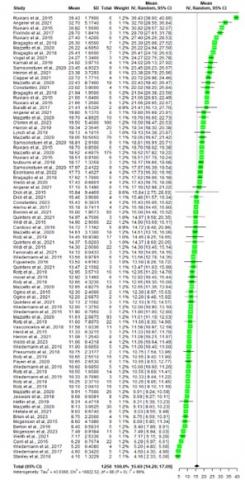
The analysis of GWP values from various studies yielded a range of estimates, reflecting the environmental impact of cattle farming across different contexts and methodologies. Figure 2 displayed the overall study's GWP values along with their 95% confidence intervals for beef cattle, measured using the standard mean difference (SMD). This value was derived from a meta-analysis study that utilized data obtained from 89 investigations. The mean GWP II value is 15.69 CO2eq/kgLW eq, with the minimum value being 14.29 CO2eq/kgLW eq and the maximum value being 17.09 CO2eq/kgLW eq, within a 95% confidence interval. the GWP values exhibit substantial variability, with estimates ranging from 6,430 CO2eq/kgLW eq to 24,030 CO2eq/kgLW eq. Among the studies reviewed, the highest GWP estimate was observed in the study [56], with a GWP of 24,030 CO2eq/kgLW eq (95% C.I. 20.139, 27.921), while the lowest GWP estimate was found in the study [30], with a GWP of 6,430 CO2eqkgLW eq (95% C.I. 5.860, 7.000). This study had 1,258 replications, each with corresponding I2 values. The I2 score suggests that the study exhibits significant heterogeneity [75].
Figure 2. Meta-analysis results on beef cattle GWP
3.1 Beef cattle GWP values worldwide
In this study, we conducted a comprehensive analysis of the GWP associated with various beef production systems, considering data from a range of studies. Our findings in Figure 2. highlighted the substantial variability in GWP estimates across these studies, indicating the complex nature of environmental impacts associated with beef production. The GWP estimate for different production systems ranged from 4.16 to 39.43, with considerable variations in the confidence intervals. Notably, the study [59] reported relatively lower GWP estimates in the range of 2.33 CO2eq/kgLW eq to 6.00 CO2eq/kgLW eq, while the study [12] documented higher GWP estimates of 39.43 CO2eq/kgLW eq. The overall GWP estimate across all studies was calculated to be 15.69 CO2eq/kgLW eq (95% C.I. 14.29, 17.09), indicating significant variation in the environmental impact of beef production.
3.2 Risk bias assessment of GWP values worldwide
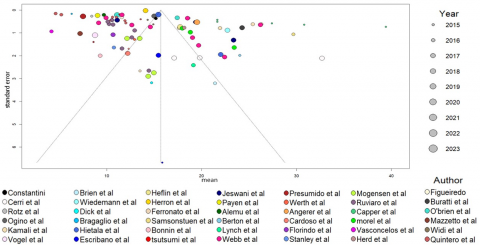
The significant amount of variation suggested that more elements impact the magnitude of the GWP value on beef cattle ranches. The funnel plot in Figure 3 showed that some studies analyzed were located on the outer side of the funnel plot triangle which indicated a bias in meta-analysis. A subgroup analysis was conducted to ascertain the impact of additional factors on the variances in GWP values on beef cattle ranches to subdue the study bias. The variables examined in this meta-analysis study include the kind of feed (organic versus inorganic), the livestock model (intensive, semi-intensive, and extensive), the farm scale (big, medium, and small), and the stage of production (cow-calf and cow-calf finishing).
Figure 3. Funnel plot of beef cattle GWP on all studies
3.3 Subgroup analysis on feed types
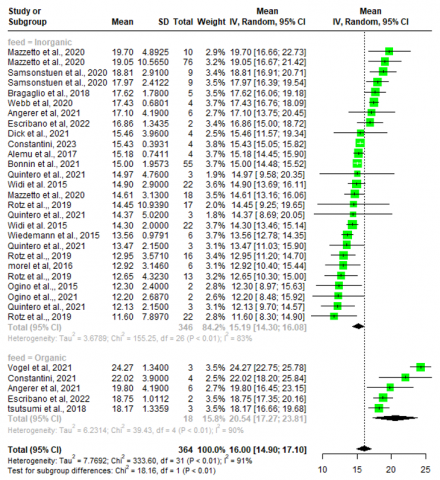
In our comprehensive investigation into the impact of feed type on beef cattle GWP values, we conducted a subgroup meta-analysis focusing on the utilization of organic and inorganic feed. The meta-analysis involved a multitude of studies, each contributing valuable insights into the environmental implications of these different feed sources. Figure 4 shows that inorganic feed utilization has a lower GWP value on beef cattle production compared to organic feed. Two studies on organic feed and 51 on inorganic feed were excluded from the subgroup analysis conducted on this particular type of diet. This study was excluded from the analysis due to its status as an outlier. The inorganic feed exhibited a markedly lower (P<0.01) value of 15.19 CO2eq/kgLW eq compared to the organic feed, which has a value of 20.54 CO2eq/kgLW eq. The funnel plot on feed types indicated that studies [28, 35] exhibit a relatively elevated standard error. The funnel plot revealed that the studies [26, 57] exhibited the most significant bias about inorganic feed.
Figure 4. Subgroup analysis on feed types
3.4 Subgroup analysis on farming systems
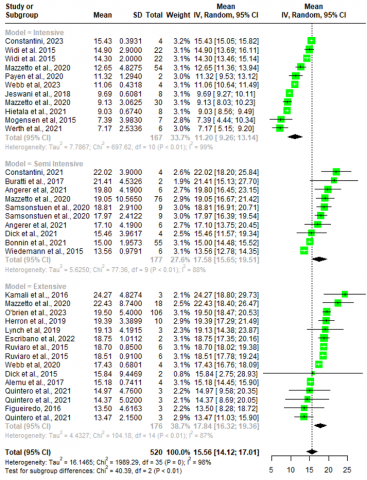
Our research conducted a comprehensive subgroup meta-analysis to assess the GWP values associated with extensive, intensive, and semi-intensive beef cattle production systems in Figure 5. The subgroup analysis revealed that the intense model exhibits a substantially lower value (P<0.01) of 11.2 CO2eq/kgLW, suggesting a more efficient use of resources and reduced emissions. The semi-intensive model followed with a value of 17.58 CO2eq/kgLW, and the extensive model has the highest (P<0.01) value of 17.84 CO2eq/kgLW eq. In this subgroup analysis, numerous studies on extensive (25), semi-intensive (5), and intensive (11) model were excluded. The funnel plot on farming systems subgroup analysis indicates that the most significant bias in the intensive model was observed in the research done in the study [50]. The most pronounced bias in semi-intensive research was identified in the study [12]. The most significant bias in the comprehensive model was observed in the study [25].
Figure 5. Subgroup analysis on farming systems
3.5 Subgroup analysis on the stage of production
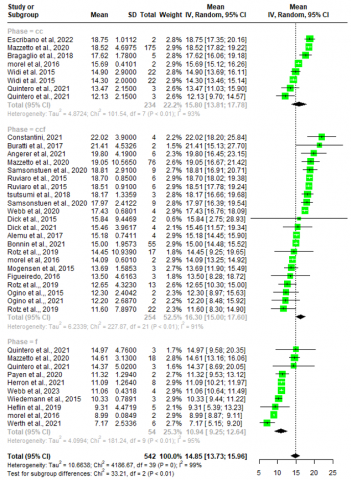
This study conducted an extensive subgroup meta-analysis to investigate the variation in GWP values associated with beef cattle production across different scales, including small-scale, medium-scale, and large-scale operations. According to Figure 6, the cattle production stage had the highest (P<0.01) GWP value on CCF of 16.30 CO2eq/kgLW, followed by CC of 15.80 CO2eq/kgLW. The finisher stage had the lowest (P<0.01) GWP value, which was measured at 10.94 CO2eq/kgLW. In the CC stage, 5 studies were excluded, whereas in the CCF and F stages, 9 research were deleted in each stage. The funnel plot on the stage of production subgroup analysis indicated that the study [26] exhibited the most significant bias in the CC and F stages, while the study [25] revealed the most significant bias in the CCF stage.
Figure 6. Subgroup analysis on stage of production
3.6 Subgroup analysis on farm scale
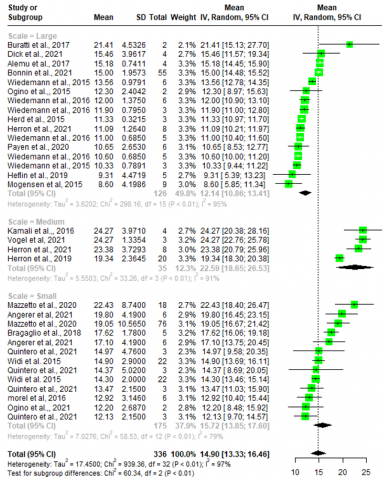
This subgroup analysis was conducted to investigate the variation in GWP values associated with beef cattle production across different scales, including small-scale, medium-scale, and large-scale operations. Figure 7 displayed the findings of the subgroup analysis for large-scale farms, which exhibit the lowest (P<0.01) GWP value of 12.14 CO2eq/kgLW. Small-scale farms followed with a value of 15.72 CO2eq/kgLW, while medium farms have the highest (P<0.01) value of 22.59 CO2eq/kgLW. The large-scale group excluded 20 studies, the medium-scale group excluded 1 study, and the small-scale group excluded 9 studies. The funnel plot on farm scale subgroup analysis revealed a significant bias towards large-scale livestock in the study [11]. A study [48] conducted research that revealed a significant bias towards medium-scale cattle. The presence of a strong inclination for small-scale livestock was documented in study [26].
Figure 7. Subgroup analysis on farm scale
The meta-analysis findings indicate that the mean GWP value is 15.69 CO2eq/kgLW, derived from 89 investigations. This value can serve as a global benchmark for the livestock sector and policymakers to decrease the GWP of beef cattle farming below this threshold. The study's overall value exhibits significant variances, primarily attributable to the intricate nature of the topic matter. Several elements, such as feed type, livestock system model, livestock scale, and livestock production stage, impact the differences in GWP values in the beef cattle business. A subgroup analysis has been conducted to determine the impact of each of these parameters on the GWP value.
The data from this meta-analysis can be considered reliable because the funnel diagram in Figure 3 shows a low bias value. Figure 3 illustrates the well-spread distribution of the study results around the average effect size. The distribution of study results typically balances high effect sizes (to the right of the average effect size) and low effect sizes (to the right of the average effect size). The majority of studies with low effect sizes tend to approach the top of the funnel, indicating that the study is close to the average effect size of the entire study with low uncertainty or bias. While studies with high effect sizes tend to be slightly away from the top of the funnel, there are only a few studies that approach it, indicating that most studies with high effect sizes are different from the average effect size but the resulting bias is not bad. Only a few studies show bias, such as study [25], which showed the highest standard error even though the average of their studies was still within the range of the average of all studies but had quite high uncertainty compared to the others. Or outlier cases, such as in the studies [13, 28], which showed a high average but the resulting bias was not too high.
Inorganic methods have lower GWP values than organic feed sources [76]. Organic beef production is commonly linked to policies that prioritize animal welfare [77], minimize the use of synthetic pesticides and antibiotics, and promote more extensive grazing systems. Despite aligning with sustainability and ethical principles, meta-analyses indicate that this approach results in more significant GWP values. These elevated values can be attributable to poorer feed efficiency and the longer duration organic systems take to achieve market weight. Organic cattle are often raised with a focus on allowing them to graze naturally and limiting their consumption of non-organic concentrated feed [78]. However, this might lead to a longer time for the animals to achieve the desired weight for slaughter because of a low feed conversion [79], resulting in higher methane emissions over their entire existence. Global benchmark for GWP values in the inorganic and organic feed are 15.19 CO2eq/kgLW and 20.54 CO2eq/kgLW.
Intensive livestock systems exhibit a reduced GWP value compared to extensive and semi-intensive livestock systems. Extensive systems frequently necessitate the utilization of vast pastures or grazing fields for livestock [80], enabling them to browse and minimize the reliance on concentrated feed naturally. On the other hand, intensive systems frequently restrict cattle to more crowded spaces and provide strictly controlled feed [81]. Extensive systems may necessitate extra land and can lead to deforestation or alterations in land use in specific regions, thereby amplifying the global warming potential by diminishing carbon reserves. Conversely, intensive systems are purposefully engineered to enhance efficiency by utilizing feedlots and regulated feeding patterns that optimize growth rates and minimize the ecological footprint per unit of meat generated. It is crucial to acknowledge that the environmental impact of these systems, aside from the global warming potential (GWP), differ depending on several circumstances. Hence, it is crucial to employ a strategic methodology when evaluating the ecological consequences of extensive and intensive beef cattle farming. Different cattle production levels significantly impact the beef business's sustainability and carbon footprint. Global benchmark for GWP values in intensive, semi-intensive, and extensive farming are 11.20 CO2eq/kgLW, 17.58 CO2eq/kgLW, and 17.84 CO2eq/kgLW.
The diverse scales of farms significantly impact a cattle business's sustainability and carbon footprint. Large-scale farms have the lowest GWP value, followed by medium-scale and small-scale farms. The large scale cattle farm frequently employs more intensive techniques, such as intensive cattle farming and larger-scale farms, leading to the reduction levels of greenhouse gas emissions. Large cattle farm typically corresponds to enhanced business efficiency, resulting in a more excellent conversion of carbon into products relative to the amount of carbon discharged as emissions. On the other hand, smaller and medium-scaled firms might employ more extensive group grazing systems that may choose a more traditional system and in a non-economic way [82], which, could increase the GWP. Global benchmark for GWP values in CC, CCF, and F were 15.80 CO2eq/kgLW, 16.30 CO2eq/kgLW, and 10.94 CO2eq/kgLW, respectively.
The cow-calf stage encompasses the activities of breeding and calving which has a long period farming in an extensive area before entering the finishing stage [83]. In finishing stage, cows are nourished to attain market weight by intensive feeding and management but has a shorter period compared to cow-calf stage. The duration of cattle maintenance is intricately linked to the cow's developmental stage. The CCF has the most extended maintenance duration, with the CC, and F coming next. The extended period on maintenance suggests a more significant accumulation of methane resulting from enteric fermentation and feces. It is essential to acknowledge that adopting sustainable practices and using technology can effectively mitigate the adverse environmental effects associated with beef production across different levels and stages. Global benchmark for GWP values in large, medium, and small farming are 12.14 CO2eq/kgLW, 22.59 CO2eq/kgLW, and 15.72 CO2eq/kgLW, respectively.
The variations in GWP values among different aspects of beef production, such as feed type, farming system model, farm scale, and livestock production stage. The variations could be affected by various farming styles, mitigations, and other factors. Although cattle farms may be maintained with a system expected to have a low GWP value, some may exhibit a high GWP value. While the results indicate potential variations, the meta-analysis study showed a significant result toward each production aspects. Governmental policies should consider the beef production aspects mentioned to establish customized strategies and comprehensive approaches for reducing beef cattle GWP. Furthermore, additional research could explore into the complexities of this approach to enhance sustainability efforts in the cattle industry. These measures encompass enhancing the efficiency of feed utilization, implementing efficient methods for managing manure, adopting rotational grazing practices, and minimizing.
The worldwide benchmark value of the GWP in beef cattle production is 15.69 kg CO2eq/kgLW. Benchmark values serve as baseline indicators for stakeholders. If stakeholders' GWP values exceed this baseline, efforts should be made to lower the values below the baseline. This study demonstrated that the greenhouse gas emissions from beef cattle vary depending on factors such as feed type, farming system, farm scale, and cattle stage of production. The lowest global warming potential (GWP) value is observed in large-scale intensive cattle production during the finishing stage when inorganic feed is used. It is strongly advised that additional research on acidification potential (AP) and eutrophication potential (EP) be conducted for future research. The AP and EP results were not included in this research due to the small number of trials examined.
|
CO2eq/kgLW |
carbon dioxide equivalent per kg liveweight |
|
CO2eq/kgLWG |
carbon dioxide equivalent per kg liveweight gain |
|
CO2eq/kgBeef |
carbon dioxide equivalent per kg beef |
|
CO2eq/kgCarcass |
carbon dioxide equivalent per kg carcass |
|
kg |
kilogram |
|
Subscripts |
|
|
P |
probability |
|
I2 |
heterogenity |
|
CI |
confidence interval |
[1] Lynch, J., Pierrehumbert, R. (2019). Climate impacts of cultured meat and beef cattle. Frontiers in Sustainable Food Systems, 3: 421491. https://doi.org/10.3389/fsufs.2019.00005
[2] Muntari, M., Poliakiwski, B., Vilches, M., Polanco, O., Smith, D., Walker, R., Pohler, K.G., Lamb, C.C. (2023). PSXI-5 impact of different vaccine formulations in reducing methane production in beef cattle. Journal of Animal Science, 101(Supplement_3): 598-599. https://doi.org/10.1093/jas/skad281.696
[3] Lynch, J. (2019). Availability of disaggregated greenhouse gas emissions from beef cattle production: A systematic review. Environmental Impact Assessment Review, 76: 69-78. https://doi.org/10.1016/j.eiar.2019.02.003
[4] Lu, H., Ng, S.K., Jia, Y., Cai, M., Lee, P.K. (2017). Physiological and molecular characterizations of the interactions in two cellulose-to-methane cocultures. Biotechnology for Biofuels, 10: 1-14. https://doi.org/10.1186/s13068-017-0719-y
[5] Van Amstel, A. (2012). Methane. A review. Journal of Integrative Environmental Sciences, 9(sup1): 5-30. https://doi.org/10.1080/1943815X.2012.694892
[6] Wu, G., Fanzo, J., Miller, D.D., Pingali, P., Post, M., Steiner, J.L., Thalacker‐Mercer, A.E. (2014). Production and supply of high‐quality food protein for human consumption: Sustainability, challenges, and innovations. Annals of the New York Academy of Sciences, 1321(1): 1-19. https://doi.org/10.1111/nyas.12500.
[7] Tilman, D., Clark, M. (2014). Global diets link environmental sustainability and human health. Nature, 515(7528): 518-522. https://doi.org/10.1038/nature13959
[8] Desjardins, R.L., Worth, D.E., Vergé, X.P., Maxime, D., Dyer, J., Cerkowniak, D. (2012). Carbon footprint of beef cattle. Sustainability, 4(12): 3279-3301. https://doi.org/10.3390/su4123279
[9] De Vries, M., de Boer, I.J. (2010). Comparing environmental impacts for livestock products: A review of life cycle assessments. Livestock Science, 128(1-3): 1-11. https://doi.org/10.1016/j.livsci.2009.11.007
[10] Escribano, M., Elghannam, A., Mesias, F.J. (2020). Dairy sheep farms in semi-arid rangelands: A carbon footprint dilemma between intensification and land-based grazing. Land Use Policy, 95: 104600. https://doi.org/10.1016/j.landusepol.2020.104600
[11] Buratti, C., Fantozzi, F., Barbanera, M., Lascaro, E., Chiorri, M., Cecchini, L. (2017). Carbon footprint of conventional and organic beef production systems: An Italian case study. Science of the Total Environment, 576: 129-137. https://doi.org/10.1016/j.scitotenv.2016.10.075
[12] Ruviaro, C.F., de Léis, C.M., Lampert, V.D.N., Barcellos, J.O.J., Dewes, H. (2015). Carbon footprint in different beef production systems on a southern Brazilian farm: A case study. Journal of Cleaner Production, 96: 435-443. https://doi.org/10.1016/j.jclepro.2014.01.037
[13] Pandey, D., Agrawal, M., Pandey, J.S. (2011). Carbon footprint: current methods of estimation. Environmental Monitoring and Assessment, 178: 135-160. https://doi.org/10.1007/s10661-010-1678-y
[14] Boschiero, M., De Laurentiis, V., Caldeira, C., Sala, S. (2023). Comparison of organic and conventional cropping systems: A systematic review of life cycle assessment studies. Environmental Impact Assessment Review, 102: 107187. https://doi.org/10.1016/j.eiar.2023.107187
[15] Lanzoni, L., Whatford, L., Atzori, A.S., Chincarini, M., Giammarco, M., Fusaro, I., Vignola, G. (2023). Review: The challenge to integrate animal welfare indicators into the life cycle assessment. Animal, 17(5): 100794. https://doi.org/10.1016/j.animal.2023.100794
[16] Haddaway, N.R., Page, M.J., Pritchard, C.C., McGuinness, L.A. (2022). PRISMA2020: An R package and Shiny app for producing PRISMA 2020-compliant flow diagrams, with interactivity for optimised digital transparency and Open Synthesis. Campbell Systematic Reviews, 18(2): e1230. https://doi.org/10.1002/cl2.1230
[17] Pfeiffer, P.E. (1990). Variance and Standard Deviation. In: Probability for Applications. Springer Texts in Statistics. Springer, New York, NY. https://doi.org/10.1007/978-1-4615-7676-1_19
[18] Altman, D.G., Blan J.M. (2005). Standard deviations and standard errors. BMJ, 331(7521): 903. https://doi.org/10.1136/bmj.331.7521.903
[19] Schumm, W. R., Higgins, M., Lockett, L., Huang, S., Abdullah, N., Asiri, A., Clark, K., McClish, K. (2017). Does dividing the range by four provide an accurate estimate of a standard deviation in family science research? a teaching editorial. Marriage & Family Review, 53(1): 1-23. https://doi.org/10.1080/01494929.2016.1199196
[20] Huang, Q., Wang, S., Yang, X., Han, X., Liu, Y., Khan, N.A., Tan, Z. (2023). Effects of organic and inorganic selenium on selenium bioavailability, growth performance, antioxidant status and meat quality of a local beef cattle in China. Frontiers in Veterinary Science, 10: 1171751. https://doi.org/10.3389/fvets.2023.1171751
[21] Amirahmadi, E., Moudrý, J., Konvalina, P., Hörtenhuber, S.J., Ghorbani, M., Neugschwandtner, R.W., Jiang, Z., Krexner, T., Kopecký, M. (2022). Environmental life cycle assessment in organic and conventional rice farming systems: Using a cradle to farm gate approach. Sustainability, 14(23): 15870. https://doi.org/10.3390/su142315870
[22] Mondelaers, K., Aertsens, J., van Huylenbroeck, G. (2009). A meta-analysis of the differences in environmental impacts between organic and conventional farming. British Food Journal, 111(10): 1098-1119. https://doi.org/10.1108/00070700910992925
[23] Ogino, A., Sommart, K., Subepang, S., Mitsumori, M., Hayashi, K., Yamashita, T., Tanaka, Y. (2016). Environmental impacts of extensive and intensive beef production systems in Thailand evaluated by life cycle assessment. Journal of Cleaner Production, 112: 22-31. https://doi.org/10.1016/j.jclepro.2015.08.110
[24] Dedeh, D., Sari, K., Busono, W., Nugroho, H. (2016). Cattle production performance in semi-intensive and extensive farming system from Jembrana District, Bali, Indonesia. Research in Zoology, 6(2): 17-20. https://doi.org/10.5923/j.zoology.20160602.01
[25] Dick, M., Abreu Da Silva, M., Dewes, H. (2015). Life cycle assessment of beef cattle production in two typical grassland systems of southern Brazil. Journal of Cleaner Production, 96: 426-434. https://doi.org/10.1016/j.jclepro.2014.01.080
[26] González-Quintero, R., Bolívar-Vergara, D.M., Chirinda, N., Arango, J., Pantevez, H., Barahona-Rosales, R., Sánchez-Pinzón, M.S. (2021). Environmental impact of primary beef production chain in Colombia: Carbon footprint, non-renewable energy and land use using life cycle assessment. Science of The Total Environment, 773: 145573. https://doi.org/10.1016/j.scitotenv.2021.145573
[27] Alemu, A.W., Janzen, H., Little, S., Hao, X., Thompson, D.J., Baron, V., Iwaasa, A., Beauchemin, K.A., Kröbel, R. (2017). Assessment of grazing management on farm greenhouse gas intensity of beef production systems in the Canadian Prairies using life cycle assessment. Agricultural Systems, 158: 1-13. https://doi.org/10.1016/j.agsy.2017.08.003
[28] Angerer, V., Sabia, E., von Borstel, U.K., Gauly, M. (2021). Environmental and biodiversity effects of different beef production systems. Journal of Environmental Management, 289: 112523. https://doi.org/10.1016/j.jenvman.2021.112523
[29] Berton, M., Cesaro, G., Gallo, L., Pirlo, G., Ramanzin, M., Tagliapietra, F., Sturaro, E. (2016). Environmental impact of a cereal-based intensive beef fattening system according to a partial life cycle assessment approach. Livestock Science, 190: 81-88. https://doi.org/10.1016/j.livsci.2016.06.007
[30] Bonnin, D., Tabacco, E., Borreani, G. (2021). Variability of greenhouse gas emissions and economic performances on 10 Piedmontese beef farms in North Italy. Agricultural Systems, 194: 103282. https://doi.org/10.1016/j.agsy.2021.103282
[31] Bragaglio, A., Napolitano, F., Pacelli, C., Pirlo, G., Sabia, E., Serrapica, F., Serrapica, M., Braghieri, A. (2018). Environmental impacts of Italian beef production: A comparison between different systems. Journal of Cleaner Production, 172: 4033-4043. https://doi.org/10.1016/j.jclepro.2017.03.078
[32] Capper, J.L., De Carvalho, T.B., Hancock, A.S., Sá Filho, O.G., Odeyemi, I., Bartram, D.J. (2021). Modeling the effects of steroid implant use on the environmental and economic sustainability of Brazilian beef production. Translational Animal Science, 5(4): txab144. https://doi.org/10.1093/tas/txab144
[33] Cardoso, A.S., Berndt, A., Leytem, A., Alves, B.J., de Carvalho, I.D.N., de Barros Soares, L.H., Urquiaga, S., Boddey, R.M. (2016). Impact of the intensification of beef production in Brazil on greenhouse gas emissions and land use. Agricultural Systems, 143: 86-96. https://doi.org/10.1016/j.agsy.2015.12.007
[34] Cerri, C.C., Moreira, C.S., Alves, P.A., Raucci, G.S., Castigioni, B.D.A., Mello, F.F.C., Cerri, D.G.P., Cerri, C.E.P. (2016). Assessing the carbon footprint of beef cattle in Brazil: A case study with 22 farms in the State of Mato Grosso. Journal of Cleaner Production, 112: 2593-2600. https://doi.org/10.1016/j.jclepro.2015.10.072
[35] Costantini, M., Vázquez-Rowe, I., Manzardo, A., Bacenetti, J. (2021). Environmental impact assessment of beef cattle production in semi-intensive systems in Paraguay. Sustainable Production and Consumption, 27: 269-281. https://doi.org/10.1016/j.spc.2020.11.003
[36] Costantini, M., Zoli, M., Ceruti, M., Crudele, R., Guarino, M., Bacenetti, J. (2023). Environmental effect of improved forage fertilization practices in the beef production chain. Science of The Total Environment, 902: 166166. https://doi.org/10.1016/j.scitotenv.2023.166166
[37] Dick, M., Abreu da Silva, M., Franklin da Silva, R.R., Lauz Ferreira, O.G., de Souza Maia, M., Ferreira de Lima, S., Borges de Paiva Neto, V., Dewes, H. (2021). Environmental impacts of Brazilian beef cattle production in the Amazon, Cerrado, Pampa, and Pantanal biomes. Journal of Cleaner Production, 311: 127750. https://doi.org/10.1016/j.jclepro.2021.127750
[38] Escribano, M., Horrillo, A., Mesías, F.J. (2022). Greenhouse gas emissions and carbon sequestration in organic dehesa livestock farms. Does technical-economic management matters? Journal of Cleaner Production, 372: 133779. https://doi.org/10.1016/j.jclepro.2022.133779
[39] Ferronato, G., Corrado, S., De Laurentiis, V., Sala, S. (2021). The Italian meat production and consumption system assessed combining material flow analysis and life cycle assessment. Journal of Cleaner Production, 321: 128705. https://doi.org/10.1016/j.jclepro.2021.128705
[40] de Figueiredo, E.B., Jayasundara, S., de Oliveira Bordonal, R., Berchielli, T.T., Reis, R.A., Wagner-Riddle, C., La Scala Jr, N. (2017). Greenhouse gas balance and carbon footprint of beef cattle in three contrasting pasture-management systems in Brazil. Journal of Cleaner Production, 142: 420-431. https://doi.org/10.1016/j.jclepro.2016.03.132
[41] Florindo, T.J., de Medeiros Florindo, G.I.B., Talamini, E., da Costa, J.S., Ruviaro, C.F. (2017). Carbon footprint and life cycle costing of beef cattle in the Brazilian midwest. Journal of Cleaner Production, 147: 119-129. https://doi.org/10.1016/j.jclepro.2017.01.021
[42] Heflin, K.R., Parker, D.B., Marek, G.W., Auvermann, B.W., Marek, T.H. (2019). Greenhouse-gas emissions of beef finishing systems in the southern high plains. Agricultural Systems, 176: 102674. https://doi.org/10.1016/j.agsy.2019.102674
[43] Herd, R. M., Oddy, V.H., Bray, S. (2014). Baseline and greenhouse-gas emissions in extensive livestock enterprises, with a case study of feeding lipid to beef cattle. Animal Production Science, 55(2): 159-165. https://doi.org/10.1071/AN14222
[44] Herron, J., Curran, T.P., Moloney, A.P., O’Brien, D. (2019). Whole farm modelling the effect of grass silage harvest date and nitrogen fertiliser rate on nitrous oxide emissions from grass-based suckler to beef farming systems. Agricultural Systems, 175: 66-78. https://doi.org/10.1016/j.agsy.2019.05.013
[45] Herron, J., Curran, T.P., Moloney, A.P., McGee, M., O’Riordan, E.G., O’Brien, D. (2021). Life cycle assessment of pasture-based suckler steer weanling-to-beef production systems: Effect of breed and slaughter age. Animal, 15(7): 100247. https://doi.org/10.1016/j.animal.2021.100247
[46] Hietala, S., Heusala, H., Katajajuuri, J.M., Järvenranta, K., Virkajärvi, P., Huuskonen, A., Nousiainen, J. (2021). Environmental life cycle assessment of Finnish beef - cradle-to-farm gate analysis of dairy and beef breed beef production. Agricultural Systems, 194: 103250. https://doi.org/10.1016/j.agsy.2021.103250
[47] Jeswani, H.K., Espinoza-Orias, N., Croker, T., Azapagic, A. (2018). Life cycle greenhouse gas emissions from integrated organic farming: A systems approach considering rotation cycles. Sustainable Production and Consumption, 13: 60-79. https://doi.org/10.1016/j.spc.2017.12.003
[48] Kamali, F.P., van der Linden, A., Meuwissen, M.P., Malafaia, G.C., Lansink, A.G.O., de Boer, I.J. (2016). Environmental and economic performance of beef farming systems with different feeding strategies in southern Brazil. Agricultural Systems, 146: 70-79. https://doi.org/10.1016/j.agsy.2016.04.003
[49] Mazzetto, A.M., Bishop, G., Styles, D., Arndt, C., Brook, R., Chadwick, D. (2020). Comparing the environmental efficiency of milk and beef production through life cycle assessment of interconnected cattle systems. Journal of Cleaner Production, 277: 124108. https://doi.org/10.1016/j.jclepro.2020.124108
[50] Mogensen, L., Kristensen, T., Nielsen, N.I., Spleth, P., Henriksson, M., Swensson, C., Hessle, A., Vestergaard, M. (2015). Greenhouse gas emissions from beef production systems in Denmark and Sweden. Livestock Science, 174: 126-143. https://doi.org/10.1016/j.livsci.2015.01.021
[51] Mogensen, L., Kristensen, T., Kramer, C., Munk, A., Spleth, P., Vestergaard, M. (2023). Production of organic beef from dairy bull calves in Denmark-Effect of different production strategies on productivity, carbon footprint and biodiversity estimated by modelling. Livestock Science, 276: 105319. https://doi.org/10.1016/j.livsci.2023.105319
[52] Morel, K., Farrié, J.P., Renon, J., Manneville, V., Agabriel, J., Devun, J. (2016). Environmental impacts of cow-calf beef systems with contrasted grassland management and animal production strategies in the Massif Central, France. Agricultural Systems, 144: 133-143. https://doi.org/10.1016/j.agsy.2016.02.006
[53] O’Brien, D., Markiewicz-Keszycka, M., Herron, J. (2023). Environmental impact of grass-based cattle farms: A life cycle assessment of nature-based diversification scenarios. Resources, Environment and Sustainability, 14: 100126. https://doi.org/10.1016/j.resenv.2023.100126
[54] Ogino, A., Van Thu, N., Hosen, Y., Izumi, T., Suzuki, T., Sakai, T., Ando, S., Osada, T., Kawashima, T. (2021). Environmental impacts of a rice-beef-biogas integrated system in the Mekong Delta, Vietnam evaluated by life cycle assessment. Journal of Environmental Management, 294: 112900. https://doi.org/10.1016/j.jenvman.2021.112900
[55] Payen, S., Falconer, S., Carlson, B., Yang, W., Ledgard, S. (2020). Eutrophication and climate change impacts of a case study of New Zealand beef to the European market. Science of the Total Environment, 710: 136120. https://doi.org/10.1016/j.scitotenv.2019.136120
[56] Presumido, P.H., Sousa, F., Gonçalves, A., Dal Bosco, T.C., Feliciano, M. (2018). Environmental impacts of the beef production chain in the Northeast of Portugal using life cycle assessment. Agriculture, 8(10): 165. https://doi.org/10.3390/agriculture8100165
[57] Rotz, C.A., Asem-Hiablie, S., Place, S., Thoma, G. (2019). Environmental footprints of beef cattle production in the United States. Agricultural Systems, 169: 1-13. https://doi.org/10.1016/j.agsy.2018.11.005
[58] Samsonstuen, S., Åby, B.A., Crosson, P., Beauchemin, K.A., Wetlesen, M.S., Bonesmo, H., Aass, L. (2020). Variability in greenhouse gas emission intensity of semi-intensive suckler cow beef production systems. Livestock Science, 239: 104091. https://doi.org/10.1016/j.livsci.2020.104091
[59] Stanley, P.L., Rowntree, J.E., Beede, D.K., DeLonge, M.S., Hamm, M.W. (2018). Impacts of soil carbon sequestration on life cycle greenhouse gas emissions in Midwestern USA beef finishing systems. Agricultural Systems, 162: 249-258. https://doi.org/10.1016/j.agsy.2018.02.003
[60] Tsutsumi, M., Ono, Y., Ogasawara, H., Hojito, M. (2016). Life-cycle impact assessment of organic and non-organic grass-fed beef production in Japan. Journal of Cleaner Production, 172: 2513-2520. https://doi.org/10.1016/j.jclepro.2017.11.159
[61] Vasconcelos, K., Farinha, M., Bernardo, L., Lampert, V. D. N., Gianezini, M., da Costa, J. S., Filho, A.S., Genro, T.C.M., Ruviaro, C. F. (2018). Livestock-derived greenhouse gas emissions in a diversified grazing system in the endangered Pampa biome, Southern Brazil. Land use policy, 75: 442-448. https://doi.org/10.1016/j.landusepol.2018.03.056
[62] Vogel, E., Martinelli, G., Artuzo, F.D. (2021). Environmental and economic performance of paddy field-based crop-livestock systems in Southern Brazil. Agricultural Systems, 190: 103109. https://doi.org/10.1016/j.agsy.2021.103109
[63] Webb, M.J., Block, J.J., Harty, A.A., Salverson, R.R., Daly, R.F., Jaeger, J.R., Underwood, K.R., Blair, A.D. (2020). Cattle and carcass performance, and life cycle assessment of production systems utilizing additive combinations of growth promotant technologies. Translational Animal Science, 4(4): txaa216. https://doi.org/10.1093/tas/txaa216
[64] Webb, L.E., Verwer, C., Bokkers, E.A. (2023). The future of surplus dairy calves-an animal welfare perspective. Frontiers in Animal Science, 4: 1228770. https://doi.org/10.3389/fanim.2023.1228770
[65] Werth, S.J., Rocha, A.S., Oltjen, J.W., Kebreab, E., Mitloehner, F.M. (2021). A life cycle assessment of the environmental impacts of cattle feedlot finishing rations. The International Journal of Life Cycle Assessment, 26(9): 1779-1793. https://doi.org/10.1007/s11367-021-01957-3
[66] Widi, T.S.M., Udo, H.M.J., Oldenbroek, K., Budisatria, I.G.S., Baliarti, E., Viets, T.C., Van der Zijpp, A.J. (2015). Is cross-breeding of cattle beneficial for the environment? The case of mixed farming systems in Central Java, Indonesia. Animal Genetic Resources, 57: 1-13. https://doi.org/10.1017/S2078633615000259
[67] Wiedemann, S.G., Henry, B.K., McGahan, E.J., Grant, T., Murphy, C.M., Niethe, G. (2015). Resource use and greenhouse gas intensity of Australian beef production: 1981-2010. Agricultural Systems, 133: 109-118. https://doi.org/10.1016/j.agsy.2014.11.002
[68] Wiedemann, S., Davis, R., McGahan, E., Murphy, C., Redding, M. (2016). Resource use and greenhouse gas emissions from grain-finishing beef cattle in seven Australian feedlots: A life cycle assessment. Animal Production Science, 57(6): 1149-1162. https://doi.org/10.1071/AN15454
[69] Wiedemann, S., McGahan, E., Murphy, C., Yan, M. (2015). Resource use and environmental impacts from beef production in eastern Australia investigated using life cycle assessment. Animal Production Science, 56(5): 882-894. https://doi.org/10.1016/j.jclepro.2015.01.073
[70] Wiedemann, S., McGahan, E., Murphy, C., Yan, M.J., Henry, B., Thoma, G., Ledgard, S. (2015). Environmental impacts and resource use of Australian beef and lamb exported to the USA determined using life cycle assessment. Journal of Cleaner Production, 94: 67-75. https://doi.org/10.1016/j.jclepro.2015.01.073
[71] Boethig, D., Hecker, H. (2019). Multiply adjusted comparisons: A meta-analysis method to compare single-arm clinical-trial data to literature results regarding a competitor. Statistical Methods in Medical Research, 28(3): 644-669. https://doi.org/10.1177/0962280217733776
[72] DerSimonian, R., Laird, N. (1986). Meta-analysis in clinical trials. Controlled Clinical Trials, 7(3): 177-188. https://doi.org/10.1016/0197-2456(86)90046-2
[73] Hardy, R.J., Thompson, S.G. (1998). Detecting and describing heterogeneity in meta‐analysis. Statistics in Medicine, 17(8): 841-856. https://doi.org/10.1002/(SICI)1097-0258(19980430)17:8<841::AID-SIM781>3.0.CO;2-D
[74] Viechtbauer, W., Cheung, M.W.L. (2010). Outlier and influence diagnostics for meta‐analysis. Research synthesis methods, 1(2): 112-125. https://doi.org/10.1002/jrsm.11
[75] Higgins, J.P., Thompson, S.G., Deeks, J.J., Altman, D.G. (2003). Measuring inconsistency in meta-analyses. BMJ, 327(7414): 557-560. https://doi.org/10.1136/bmj.327.7414.557
[76] De Vries, M.D., Van Middelaar, C.E., De Boer, I.J.M. (2015). Comparing environmental impacts of beef production systems: A review of life cycle assessments. Livestock Science, 178: 279-288. https://doi.org/10.1016/j.livsci.2015.06.020
[77] Åkerfeldt, M.P., Gunnarsson, S., Bernes, G., Blanco-Penedo, I. (2021). Health and welfare in organic livestock production systems—A systematic mapping of current knowledge. Organic Agriculture, 11(1): 105-132. https://doi.org/10.1007/s13165-020-00334-y
[78] Escribano, A.J. (2018). Organic Feed: A Bottleneck for the development of the livestock sector and its transition to sustainability? Sustainability, 10(7): 2393. https://doi.org/10.3390/su10072393
[79] Gaudaré, U., Pellerin, S., Benoit, M., Durand, G., Dumont, B., Barbieri, P., Nesme, T. (2021). Comparing productivity and feed-use efficiency between organic and conventional livestock animals. Environmental Research Letters, 16(2): 024012. https://doi.org/10.1088/1748-9326/abd65e
[80] Morgan-Davies, J., Morgan-Davies, C., Pollock, M.L., Holland, J.P., Waterhouse, A. (2014). Characterisation of extensive beef cattle systems: Disparities between opinions, practice and policy. Land Use Policy, 38: 707-718. https://doi.org/10.1016/j.landusepol.2014.01.016
[81] Wechsler, B. (2011). Floor quality and space allowance in intensive beef production: A review. Animal Welfare, 20(4): 497-503. https://doi.org/10.1017/S0962728600003134
[82] Caballero, R., Riseth, J. Å., Labba, N., Tyran, E., Musial, W., Molik, E., Boltshauser, A., Hofstetter, P., Gueydon, A., Roeder, N., Hoffmann, H., Moreira, M.B., Coelho, I.S., Brito, O., Gil, A. (2007). Comparative typology in six European low‐intensity systems of grassland management. Advances in Agronomy, 96: 351-420. https://doi.org/10.1016/S0065-2113(07)96001-0
[83] Hayek, M.N., Garrett, R.D. (2018). Nationwide shift to grass-fed beef requires larger cattle population. Environmental Research Letters, 13(8): 084005. https://doi.org/10.1088/1748-9326/aad401