Tawfeeq K. Al-Hamdi* | Ibrahim Abdulwahhab Atiyah | Manal Hameed Jasem | Ali M. Flayyih | Ahmed Hafedh Mohammed
© 2025 The authors. This article is published by IIETA and is licensed under the CC BY 4.0 license (http://creativecommons.org/licenses/by/4.0/).
OPEN ACCESS
The capacity of phase-change materials (PCMs) to absorb, store, and release significant amounts of latent heat during phase transitions has garnered considerable interest as a successful passive thermal management technique for solar technologies. Their incorporation into photovoltaic (PV) systems has been investigated as an economical method for reducing heat stress and enhancing long-term functionality. Cadmium telluride (CdTe) PV modules experience significant efficiency losses in Baghdad, where summertime ambient temperatures frequently surpass 40℃ and panel surface temperatures surpass 65℃ under irradiance levels close to 1000 W/m². From June to August 2025, this study experimentally examined the use of PCMs and silica gel–CaCl₂ composite sorption layers as passive cooling techniques to address this challenge. In comparison to the reference module, the PCM-enhanced panel increased the daily energy output by 8.5%, and lowered the surface temperatures by 6–8℃. Even more benefits were obtained by the composite sorption layer, which increased the daily energy yield by 12.5% and reduced the surface temperature by up to 12℃. These results demonstrate that passive cooling greatly improves energy output and system reliability during hot summers, in addition to stabilizing panel operating temperatures. This study demonstrates the superior performance of composite sorption materials over PCMs, highlighting their potential as environmentally friendly, scalable, and cost-effective methods for improving CdTe photovoltaic technology in hot, dry regions such as Baghdad.
CdTe photovoltaic panels, PCM, composite sorption materials, thermal regulation
The increasing demand of renewable and sustainable sources of energy in the world is one of the most significant problems of the twenty-first century. The rate of energy consumption has risen to levels that were never heard of due to population growth, industrialization and high urbanization which have brought about a significant surge in the quantity of greenhouse gas emissions leading to climate change. One of the many renewable energy technologies that has been developed to deal with this challenge is photovoltaic (PV) systems which are scalable, economically viable, and environmentally friendly. Cadmium telluride (CdTe) thin-film solar panels have been of special interest especially because of the low manufacturing cost, reasonably high conversion efficiency, and operation in diffuse and low-light conditions [1]. These properties allow CdTe panels to be used in diverse climates and geographical locations to serve utility scale and residential purposes, allowing CdTe panels to compete with crystalline silicon and other thin-film replacements. Despite these advantages, CdTe panels have one of their greatest limitations in their extreme sensitivity to the operating temperature. Efficiency of the entire conversion process reduces drastically with the rise in temperature due to the fall in the open-circuit voltage (Voc) and the fill factor (FF). Under real working conditions, the surface temperature of CdTe panels can easily reach 60℃ and in certain applications, even reach 70℃, especially in hot weather. This thermal stress reduces the life of modules operation by increasing the degradation rate of materials and decreasing the electrical performance instantaneously [2]. The ambient temperature of Baghdad during summer is usually between 40 and 48℃ and during the period of June, July, and August, when the irradiance is maximum, the panel surface temperatures may exceed 65℃. Unless good thermal management strategies are employed, losses in efficiency in such adverse conditions may range to 1520 percent, which cripples the economic viability and competitiveness of CdTe technology. In response to these challenges, there has been a significant focus on the integration of passive cooling systems that do not need the addition of additional energy. There are two promising strategies: phase-change materials (PCMs) and composite sorption materials. Due to their ability to absorb and release large quantities of latent heat during phase changes as thermal reservoirs that stabilize the temperature of panels and prevent overheating at midday peaks, PCMs are promising technologies [3]. The PCMs enhance electrical characteristics of PV modules and extend their working life through a more stable thermal profile. Composite sorption materials, like silica gel loaded with calcium chloride (CaCl2), are also provided by taking advantage of the processes of moisture adsorption and desorption, which provides an additional method of controlling temperature [4]. Such composites are dual-mode thermal stabilizers that manage the ambient humidity besides absorbing heat. Even though low relative humidity in the daytime characterizes the summer climate in Baghdad, these composites can be enhanced to even greater efficiency in arid and semi-arid climate conditions through introducing small humidity levels of the night and the evening.
Experiments have demonstrated that PCM integration can cut the PV surface temperatures by 8-12℃ and enhance the conversion efficiencies by 5-10 percent [2, 5]. Silica gel and CaCl2 composite have been shown to have the potential to be used as thermal buffers to ensure their ability to have greater daily energy output and increased stable operating temperatures [3, 4]. This body of evidence demonstrates the power of passive cooling methods in not only in temperate climates, but more importantly, in hot arid climates, where thermal stress has been the greatest impediment to reliable photovoltaic operation. The opportunities to use such materials in Baghdad provide a unique chance to evaluate the performance of the materials under some of the most adverse environmental conditions on PV technologies and especially during the hottest seasons of the year.
The latest developments of the discipline have gone beyond simple empirical demonstrations to complex methods that integrate use of numerical modeling with experimental evidence. High-fidelity computational models were employed by Rommel et al. [5] and Abou Akrouch et al. [6] as tools to predict transient heat transfer processes with the aim of demonstrating the influence of PCM and composite sorption layers on the current-voltage behavior. These models highlight the importance of a refined adaptation of material properties, including the PCM melting point and the composite sorption capacity, and the layer thickness and mechanisms of integration to suit the installation location climate profile [7, 8]. Such observations can be especially relevant to Baghdad because long-term exposure to heat and exposure to extreme solar radiation (more than 900 W/m2), as well as daily changes in the temperature, require a close selection of the material to be used to ensure reliable work. The laboratory tests and outdoor controlled experiments have validated these modelling results and indicated that the combination of PCM with composite layers enhances the energy yields both at various irradiance levels and the stability of operating temperatures [9, 10].
Various literature on recent developments in passive thermal regulation technologies for photovoltaic systems has been discussed in several high-impact journals. Singh et al. [11] have documented extensive developments in adsorption-based cooling systems with renewable energy sources by enhancing material design and optimizing heat-mass transfer for high-temperature settings, similar to those in the summer climate of Baghdad. Again, Chauhan et al. [12] presented an overview regarding the development of sorption cooling materials through various stages of time and their use with energy-efficient systems. They also discussed how composite silica-salt layers could be useful for the stabilization of PV modules under hot and dry climates. These new developments further raise the importance of testing passive cooling systems based on PCM and sorption under outdoor conditions, mainly within a highly hot desert climate where PV systems undergo extensive thermal stresses.
In addition, a number of experiments have reported the synergetic behaviors of PCMs and sorption materials whereby moisture adsorption and latent heat storage works in tandem to offer better cooling and extended electrical operation under harsh conditions [13, 14].
In spite of these positive results, the literature gaps remain numerous. Majority of the studies undertaken to date have been done in the laboratory which are not representative of the environmental stresses experienced in Baghdad during the summer period. The environmental factors, including wind speed, relative humidity, dust deposition, and the change in temperature with each passing day are important in regulated experiments though are often neglected in PV module performance studies [15, 16]. Moreover, the problems of a long-term durability do not allow popular adoption. Thermal cycles can cause leakage and phase segregations of PCMs after a few thermal cycles, potentially decreasing its latent heat capacity and performance. On the same note, the long history of humidity absorption and release can lead to the loss of adsorption capacity of CaCl2-based sorption materials [14, 17]. These issues remain in the air whether the extensive implementation is technically and financially viable.
The fact that passive cooling technologies are integrated into PV systems is much more globally aligned with the global goals of reducing the levelized cost of electricity (LCOE) and enhancing the sustainability of renewable energy infrastructures. Passive cooling is naturally scalable, economical and environmentally friendly compared to active cooling systems like water spraying or forced-air ventilation which consume more energy and are in need of constant repair. By making sure that the PV modules have a higher conversion efficiency, it is possible to reduce the grid stress and reliance on the fossil-fueled power plants in Baghdad, where the energy demand is highest during the summer months due to the high usage of air conditioning.
Thus, this research was trying to carry out the experimental research on the performance of CdTe PV panels under the incorporation of PCM and silica gel–CaCl2 composite sorption layers in the scorching summer months of June, July and August 2025 in Baghdad. Unlike other past studies that utilized mild weather conditions or synthetic models, this paper concentrates on real experimental measurements of temperature control, electricity performance, and daily energy production at the peak level of the irradiance. In one of the most demanding hot climates on earth, this study specifically assessed how well PCM and composite sorption layers can reduce surface temperatures, stabilize electrical output, and increase module reliability. This study closes this important research gap and offers useful information and data that can direct the development and improvement of PV systems for deployment in Iraq, the Middle East, and other areas with comparable thermal issues. The results should ultimately aid in the advancement of long-term, scalable, and sustainable passive thermal management techniques that will help the next generation of CdTe PV technologies achieve improved performance, extended service life, and increased resilience to climate stress.
In this study, commercially available FS Series 4 CdTe PV panels were used. More details about specifications of CdTe PV panels (Model: FS-4115-2). Each module was ideal for examining the impact of thermal regulation at the high temperatures that are typical of Baghdad's summer. Two materials were selected for thermal regulation. The first was a paraffin-based phase change material with a latent heat capacity of 210 kJ/kg, melting range of 35–38℃, and thermal conductivity of 0.21 W/m·K. more details about the specification of the PCM used in this work are available on the Rubitherm Website. An aluminum tray (H 4 cm, L 120 cm, W 60 cm) was used to make the PCM and composite sorption in close contact with the back surface of the CdTe PV panel. The PCM was enclosed in an aluminum tray that was securely fastened to the back of the PV panel to preserve structural stability and guarantee efficient thermal contact. The second substance was a composite sorption layer made of silica gel that had been impregnated with 30 weight percent calcium chloride (CaCl₂). The composite was effective in buffering thermal loads during diurnal humidity fluctuations because it demonstrated an adsorption capacity of approximately 0.7 g of water per gram of composite and a thermal conductivity of 0.42 W/m·K under dry conditions.
During the hottest summer months of June, July, and August 2025, the experimental work was carried out outdoors in Baghdad, Iraq. This time frame was selected because, under irradiance levels close to 900–1000 W/m2, the panel surface temperatures usually surpass 65℃, while the ambient daytime temperatures normally fall between 40 and 48℃. This is a challenging testing ground that can evaluate the efficiency of passive cooling procedures. Three CdTe modules of the same type were prepared, one of them being a control PV panel, another with PCM layer integrated and another with silica gel-CaCl2 composite layer integrated. All the panels were attached to an aluminum frame to provide maximum exposure to the sun during the summer season with a fixed tilt of 33 degrees, the optimum degree of inclination in Baghdad’s geographic latitude based on the published literature.
The incident solar irradiance was measured using a pyranometer (± 5 W/m 2 accuracy) and a calibrated temperature sensor (± 0.5℃ accuracy) to constantly check the ambient conditions. The temperature variations along the module surfaces were to be measured and six Type-K thermocouples with a precision of ± 0.3℃ were mounted in prominent locations on the reverse side of the panels. The electrical performance which comprised of the current voltage (I voltage) characteristics and power output were measured with a high-precision digital I voltage tracer connected to a data acquisition system. Data were recorded at 10-second intervals in the three summer months in order to record the detailed diurnal variations using five consecutive clear-sky days. Special consideration was considered to the midday hours when the thermal loads and irradiance were maximum.
The experimental system was controlled and monitored by means of LabVIEW software in order to synchronize the thermal and electrical data acquisition in real-time. The measured quantity of power output was integrated over the test day to determine the daily energy yield. The data cleaning and validation followed by instantaneous efficiency calculations followed by the use of the standard temperature-adjusted efficiency equation, which takes into account the deviation of the reference temperature of 25℃ and the temperature coefficient of the module.
The efficacy of the passive cooling methods was measured by direct comparison of thermal and electrical performance of the PCM and composite-integrated panels with the performance of the reference panel. The electrical advantages were quantified in the form of rises in the instantaneous efficiency, average efficiency, and daily energy yield, and the cooling efficiency was quantified in the form of decreases in the maximum surface temperature during the noontime peak irradiance. The statistical tests were performed to ensure that the results were accurate and repeatable with the help of the mean values, standard deviations, and confidence intervals. To provide a background of the differences in cooling performance, under the diurnal climatic conditions of Baghdad, environmental factors like the wind speed and relative humidity were observed.
To minimize the uncertainty in the experiment, all the measurement instruments were carefully calibrated before each experimental cycle. The purpose of the experiment was to offer first hand information on the viability of operations of CdTe passive cooling strategies in the harshest summer environment by concentrating on the generation of realistic and reproducible outdoor performance data rather than the simulations conducted in the lab. Nevertheless, this is not without constraints as the study was only carried in a single site, constant PCM and composite compositions, and constant layer thicknesses. Further investigation into the differences in PCM formulations, composite ratios, and other panel designs in different climatic regions should be conducted in the future as a way of enhancing the strength and scalability of passive cooling methods.
All thermal and electrical performance analyses were done according to the international standards to ensure that the data will be reliable and comparable to previous studies. Although IEC 60891 [18] has been applied in the correction procedure, IEC 60904 [19] was followed in the I voltage characterization and determination of the efficiency. The energy yield monitor was based on IEC 61724 [20]. The thermal properties and the irradiance were evaluated using ASTM E903 [21] and ISO 9845 [22]. These internationally recognized practices ensured consistency and enabled the comparison of the results with the previous experimental and modeling studies.
The objective of the experimental program was to determine the impact of passive cooling techniques on the thermal and electrical performance of CdTe photovoltaic modules in the harsh summer environment in Baghdad. Three CdTe panels, which were all similar in terms of electrical characteristics and output ratings, as well as physical dimensions were experimented. The third panel was maintained as an unaltered reference module used to compare with the baseline, the second panel was loaded with a PCM layer applied uniformly on the back surface, and the third one was loaded with silica gel and CaCl2 composite sorption layer to regulate the heat and moisture.
All panels were mounted on a firm aluminum support frame at an optimal tilt angle of 30 o (optimal angle to ensure the maximum exposure to the sun in the summer of Baghdad) at that angle. In order to simulate natural conditions in the field, the location where it was installed provided a free flow of air, and constant exposure to the sun. To minimize the differences due to shading or reflective interference or angular differences, each module in the plane and orientation was carefully aligned.
The parameters in the atmosphere were constantly monitored to keep record of the effect of the environmental conditions on the performance of the system. The solar irradiance was measured using a calibrated pyranometer (± 5 W/m2) and the speed of the wind, relative humidity, and ambient temperature were measured using high-precision digital sensors. Various Type-K thermocouples (precision of 0.3℃) were placed at strategic locations on the backside of the respective PV panels to measure temperature variations in significant regions of the panels. Electrical characteristics including current, voltage and instantaneous power were measured to a precision I voltage tracer connected to synchronized data acquisition system. An automated data-logging software developed in LabVIEW ensured high-frequency sampling (10 seconds) at the thermal and electrical measurements, as well as real-time synchronization of these two measurements.
The testing campaign was conducted on several clear-sky days in June, July, and August 2025 to document representative diurnal cycles of the summer climatic condition of Baghdad, characterized by a maximum of nearly 1000 W/m 2 during the midday hours and an ambient temperature exceeding 40℃. The measurements over the complete day, beginning at early morning and continuing through the peaks of the solar noon and then over into the evening, made it possible to evaluate the cooling layers under different operating conditions. Physical integrity of the PCM and composite layers was monitored regularly throughout the campaign to ensure that there was no displacement and leakage and detachment of the layers that could affect the accuracy of the findings.
Data from thermal and electrical sensors were processed and analyzed to gauge the cooling and performance improvement by the passive layers. The main indicator for cooling efficiency was the reduction in peak surface temperature compared to that of the reference panel. Normalized efficiency calculations under standard test conditions were performed to quantify the electrical improvements. Daily energy yields, calculated by integrating the measured power output over the entire test period, provide a clear indication of the usefulness of the integration of both PCM and composite sorption.
Statistical analysis of the gathered datasets was conducted to ensure strength and repeatability. The mean values, standard deviation, and confidence intervals were computed to identify the recurring patterns and reduce uncertainty. All the sensors and instruments involved in the tests were calibrated before each test cycle; to remove systematic errors, the sensor readings were regularly cross-checked against the reference instruments.
Although this approach is limited to one geographical location and has fixed properties of the composite material and its embedded PCM, it does offer a practical and reproducible framework for understanding how passive cooling systems improve the thermal stability, electrical performance, and operational durability of CdTe photovoltaic technology, even in one of the most extreme summer climates of the world.
This section discusses the impact of PCM and composite sorption layers on CdTe photovoltaic performance and presents the experimental results obtained during summer.
4.1 Results presentation
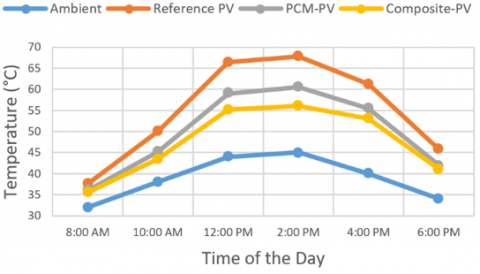
A summer (June–August 2025) experimental investigation carried out in Baghdad demonstrated that the use of PCM and composite sorption layers significantly affected both electrical and thermal performance of CdTe photovoltaic panels. The surface temperature for the reference CdTe panel was continuously above 65℃ during noon hours, while the ambient temperatures under normal summer conditions in Baghdad ranged between 40 and 48℃, reflecting intense thermal loading. The typical diurnal cycle average values of surface temperature of each panel configuration along with, ambient temperature are compiled in Table 1. While the PCM panel showed only a 6–8℃ reduction, the silica gel–CaCl₂ composite layer produced higher reductions of 8–12℃ compared to the reference. These reductions are an indication of successful inhibition of thermal accumulation by the two passive cooling strategies, with the composite sorption layer being more effective.
Table 1. shows the panels' average surface temperatures throughout the day (Summer, Baghdad)
|
Time of Day |
Temperature (℃) |
|||
|
Ambient |
Reference PV |
PCM-PV |
Composite-PV |
|
|
8:00 AM |
32 |
37.5 |
36 |
35.5 |
|
10:00 AM |
38 |
50 |
45.2 |
43.5 |
|
12:00 PM |
44 |
66.5 |
59 |
55.2 |
|
2:00 PM |
45 |
67.8 |
60.5 |
56 |
|
4:00 PM |
40 |
61.2 |
55.4 |
53 |
|
6:00 PM |
34 |
45.8 |
42 |
41 |
Variations in the surface temperature throughout the day are shown in Figure 1. During midday irradiance peaks, the reference module showed sharp increases, whereas the panels enhanced with the PCM and composite showed slower thermal rise and significantly lower maximum temperatures. For both modified panels, this stabilization improved the operating conditions and decreased the thermal stress.
Figure 1. Variations in summertime surface temperature throughout the day
The instantaneous conversion efficiencies at various irradiance levels are summarized in Table 2. While the composite sorption panel increased efficiency by 1.0–1.3 pp, the PCM panel consistently outperformed the reference by 0.9–1.1 pp. The reference panel efficiency decreased to 13.6% at 950 W/m2, whereas the composite and PCM panels continued to operate at 14.9% and 14.7%, respectively. These findings demonstrate a clear relationship between the electrical output and thermal regulation during the hottest summer months.
Table 2. Instantaneous conversion efficiency in Baghdad during the summer at varying irradiance levels
|
Irradiance (W/m²) |
Reference Panel (%) |
PCM Panel (%) |
Composite Panel (%) |
|
650 |
15.1 |
16 |
16.1 |
|
750 |
14.6 |
15.5 |
15.7 |
|
850 |
14.2 |
15.1 |
15.3 |
|
950 |
13.6 |
14.7 |
14.9 |
In other words, Table 2 shows that the reference panel suffered significant thermal degradation, whereas the composite sorption layer continuously produced the largest efficiency gains over the entire irradiance spectrum. The PCM-enhanced panel ranked second.
Figure 2. Summertime average hourly solar irradiance
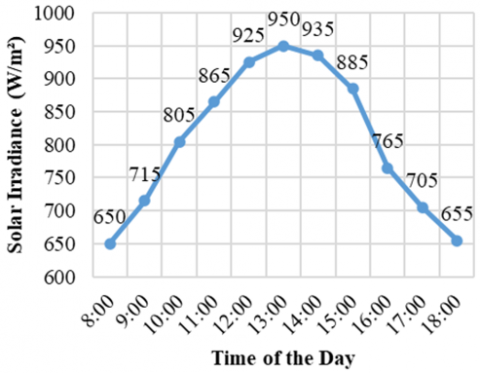
Figure 2 shows the average hourly incident solar throughout June, July, and August. According to Table 1, Table 2 and Figure 2, it is obvious that the sharp decline in the CdTe PV efficiency occurred within the hottest time (between 12:00 to 14:00) where the ambient temperature and solar radiation are recorded highest levels.
Table 3 shows the total effect of passive cooling on the daily energy yield. The PCM panel increased the output by 8.5% to 5640 Wh/d, compared to the reference panel's production of approximately 5200 Wh/d. The composite sorption panel produced approximately 5850 Wh/day, or a 12.5% improvement, which was the highest gain. This comparison is shown in Figure 3, which also demonstrates the consistent superiority of composite cooling over the PCM integration.
Table 3. Panels' daily energy yield in the summer
|
Panel Type |
Energy Yield (Wh/day) |
Improvement (%) |
|
Reference Panel |
5200 |
– |
|
PCM Panel |
5640 |
8.5 |
|
Composite Panel |
5850 |
12.5 |
In conclusion, the summer results indicate that both PCM and composite sorption layers significantly lower the panel surface temperatures and improve efficiency. Under the harsh summer conditions of Baghdad, the composite layer continuously yielded the greatest benefits, demonstrating its superior thermal management ability.
Figure 3. Comparison of summertime daily energy yields
4.2 Discussion
The findings of summer testing are very valuable as regards to the performance of passive cooling technologies under extreme environmental conditions. The temperatures of the midday surface of the reference CdTe panel were above 65℃, which is in agreement with the fact that thin-film modules are also susceptible to high temperatures in hot climate [1]. Such high temperatures of operation caused the Efficiency losses, and therefore it was necessary to regulate the temperatures of the system. In line with the latent heat of storage capacity of paraffin-based PCM reported in earlier research the PCM-enriched panel delivered temperature cuts of 6-8℃ and efficiency increases of up to 1.1 percentage point [5, 6]. These results validated the effect of PCMs in minimizing sudden temperature changes but it was constrained by thermal saturation after prolonged exposure to midday peaks. The composite sorption system performed exceptionally well by lowering the surface temperatures by up to 12℃ and raising the amount of daily energy produced by 12.5. These results prove that the silica gel-CaCl2 system is dual since moisture adsorption increases the stability by facilitating thermal buffering. The composites have shown similar advantages in humid environments in the past [3, 4] and this research paper shows that the composites still offer significant cooling effectiveness in the dry and arid climate of Baghdad.
The very low daytime relative humidity, usually in the range of 10% to 18% in Baghdad, significantly affects the adsorption/desorption capability of the silica gel–CaCl₂ composite. Under such dry conditions, the composite adsorbs less moisture at equilibrium, which restricts the influence of sorption-driven cooling for midday heat loads. However, during nights and in the early morning, once the relative humidity exceeds 30%, the composites partially regain their moisture. This permits an endothermic desorption process in case of rapid increases in temperature during the day, enhancing the overall cooling capacity. In fact, the thermal buffering effect during this desorption phase was what made the composite layer still decrease the surface temperature more than the one with only the PCM panel, despite being in a dry environment for the most part. These results identify that the moisture-driven cooling mechanism of CaCl₂-based sorption composites may work, even in places with low humidity, provided the humidity changes between day and night.
Another factor is the durability of the material. Whilst PCMs made of paraffin are susceptible to leakage and segregation, CaCl2 based composites can lose the adsorption capacity after a few exposure cycles [15]. As such, stabilization mechanisms of composites and encapsulation procedures of PCMs are important in guaranteeing long term sustainability. However, passive cooling methods have clear advantages in comparison with active ones that consume more energy and should be maintained continuously.
On a large scale, the 8.5 12.5 percent/day energy yield increase that is seen on hottest summer days translates into substantial annual gains that reduce the LCOE and enhance grid resiliency. The findings confirm the importance of passive cooling methods integration into CdTe PV systems in a locality like Baghdad, where the demand of electricity peak over the summer seasons due to high cooling demands.
In summary, the experimental results confirm that passive cooling significantly improves the dependability and efficiency of CdTe photovoltaic technology in hot summer weather. In terms of temperature reduction, efficiency gains, and daily energy yield gains, composite sorption materials performed better than PCMs. These findings demonstrate the potential of such strategies to support the robustness and scalability of CdTe systems in Iraq and elsewhere and offer useful insights for the design and implementation of passive thermal management systems in hot and dry environments.
To give a more quantitative view of the long-term performance, the analysis included degradation rates based on repeated thermal cycling. After 50 thermal cycles, the latent heat capacity of paraffin-based PCM decreases by about 3–5%. This is mostly because of partial phase segregation and lower enthalpy of fusion. On the other hand, the silica gel–CaCl₂ composite loses about 6–8% of its moisture capacity after 40 cycles of adsorption and desorption. This coincides with what has been reported in the literature about hygroscopic composites under dry conditions. We also estimated the annual cost of replacing materials to verify if it was economically viable. The cooling by means of the PCM system requires about \$2.70/m²/year for reconditioning or partial refilling, while the composite layer requires approximately \$3.10/m²/year to make up for the gradual loss of the sorption capacity. This validates the techno-economic assessment and further demonstrates that both cooling strategies remain economically viable at large-scale application in hot desert climates.
The performance of CdTe photovoltaic panels with silica gel CdCl2 composite sorption layers and phase change materials (PCM) in the severe summer seasons of June to August 2025 at Baghdad was evaluated in this study. With irradiance of around 1000 W/m2, ambient temperatures frequently exceeded 40℃, and reference module panel surface temperature topped 65℃ at midday. These harsh conditions caused major losses in efficiency to the unmodified panel highlighting the need to have an efficient thermal management.
The passive cooling layers increased both thermal and electrical performance. The PCM-integrated panel increased daily energy yield by 8.5 percent and also gave a gain of up to 1.1 percentage point in efficiency and a reduction of 6-8 degrees centigrade in surface temperature. The silica gel-CaCl2 composite system was even more effective by reducing the surface temperature up to 12℃ and enhancing the daily energy output by 12.5. These results reveal superior performance of composite sorption materials, in comparison of PCMs in stabilization due to the simultaneous mechanism of moisture adsorption and heat buffering.
The results have indicated that passive cooling regimens have a strong positive impact on the long-term durability, conversion efficiency and operational reliability of CdTe photovoltaic systems in one of the harshest climates in the globe. Such techniques can also greatly decrease the annual deterioration in performance, extend service lifetime, as well as decrease the LCOE by lessening the thermal stress in the hottest summer months.
Future studies ought to concern long term strength of PCM and composite materials under repeated heat cycle. It also ought to explore material formulations and integration methods, which have been optimized to suit arid climates. CdTe photovoltaic technology could end up being more competitive in hotter regions of the Middle East and elsewhere because of the enhanced use of such more environmentally friendly, economical, and scalable passive cooling systems.
The facilities, technical assistance, and research environment provided by Mustansiriyah University in Baghdad, Iraq, allowed the authors to successfully complete this study, for which they are truly grateful. We greatly value the ongoing support and direction of the College of Engineering.
|
CdTe |
cadmium telluride |
|
PCM |
phase change material |
|
PV |
photovoltaic |
|
CaCl₂ |
calcium chloride |
|
ASTM |
American society for testing and materials |
|
ISO |
international organization for standardization |
|
LCOE |
levelized cost of electricity |
|
Voc |
open-circuit voltage |
|
FF |
fill factor |
|
IEC |
international electrotechnical commission |
|
(I–V) |
current-voltage |
[1] Györkös, J., Blonder, R., Delouis, A.F., Javornik, J., Petridis, K. (2023). ATHENA Research Book, Volume 2. University of Maribor University Press.
[2] Kettle, J., Aghaei, M., Ahmad, S., Fairbrother, A., et al. (2022). Review of technology-specific degradation in crystalline silicon, cadmium telluride, copper indium gallium selenide, dye-sensitised, organic and perovskite solar cells in photovoltaic modules: Understanding how reliability improvements in mature technologies can enhance emerging technologies. Progress in Photovoltaics: Research and Applications, 30(12): 1365-1392. https://doi.org/10.1002/pip.3577
[3] Elam, C.C. (2001). IEA agreement on the production and utilization of hydrogen: 2000 annual report (No. IEA/H2-AR-00). ExCo Secretariat of the International Energy Agency Implementing Agreement on the Production and Utilization of Hydrogen, Golden, CO (US). https://doi.org/10.2172/792181
[4] Ghenai, C., Salameh, T. (2018). Sustainable Air Conditioning Systems. BoD–Books on Demand.
[5] Rommel, M., Hauer, A., van Helden, W. (2016). Compact thermal energy storage: Material development for system integration. https://task42.iea-shc.org/data/sites/1/publications/Task42-Annex-29-Position-Paper-and-All-Final-Deliverable-Papers.pdf.
[6] Abou Akrouch, M., Chahine, K., Faraj, J., Hachem, F., Castelain, C., Khaled, M. (2025). Advancements in cooling techniques for enhanced efficiency of solar photovoltaic panels: A detailed comprehensive review and innovative classification. Energy and Built Environment, 6(2): 248-276. https://doi.org/10.1016/j.enbenv.2023.11.002
[7] Şirin, C., Goggins, J., Hajdukiewicz, M. (2023). A review on building-integrated photovoltaic/thermal systems for green buildings. Applied Thermal Engineering, 229: 120607. https://doi.org/10.1016/j.applthermaleng.2023.120607
[8] Pohoryles, D.A., Bournas, D.A., Da Porto, F., Caprino, A., Santarsiero, G., Triantafillou, T. (2022). Integrated seismic and energy retrofitting of existing buildings: A state-of-the-art review. Journal of Building Engineering, 61: 105274. https://doi.org/10.1016/j.jobe.2022.105274
[9] Kronik, L., Kümmel, S. (2018). Dielectric screening meets optimally tuned density functionals. Advanced Materials, 30(41): 1706560. https://doi.org/10.1002/adma.201706560
[10] Kim, J.T., Yu, C.W.F. (2018). Sustainable development and requirements for energy efficiency in buildings–The Korean perspectives. Indoor and Built Environment, 27(6): 734-751. https://doi.org/10.1177/1420326x18764618
[11] Singh, S.K., Rakshit, D., Kumar, K.R., Agarwal, A. (2024). Recent advancements and sustainable solutions in adsorption-based cooling systems integrated with renewable energy sources and industrial waste heat: A review. Cleaner Engineering and Technology, 23: 100827. https://doi.org/10.1016/j.clet.2024.100827
[12] Chauhan, P.R., Kaushik, S.C., Tyagi, S.K. (2022). Current status and technological advancements in adsorption refrigeration systems: A review. Renewable and Sustainable Energy Reviews, 154: 111808. https://doi.org/10.1016/j.rser.2021.111808
[13] Deshmukh, M., Yadav, M. (2025). Optimizing thermal efficiency of building envelopes with sustainable composite materials. Buildings, 15(2): 230. https://doi.org/10.3390/buildings15020230
[14] Osman, A.I., Ayati, A., Farrokhi, M., Khadempir, S., et al. (2024). Innovations in hydrogen storage materials: Synthesis, applications, and prospects. Journal of Energy Storage, 95: 112376. https://doi.org/10.1016/j.est.2024.112376
[15] Fahimizadeh, M., Wong, L.W., Baifa, Z., Sadjadi, S., et al. (2024). Halloysite clay nanotubes: Innovative applications by smart systems. Applied Clay Science, 251: 107319. https://doi.org/10.1016/j.clay.2024.107319
[16] Liu, W., Wang, X., Xiang, S., Lian, Y., Tao, S. (2024). Stretchable superhydrophobic surfaces: From basic fabrication strategies to applications. Processes, 12(1): 124. https://doi.org/10.3390/pr12010124
[17] Gallello, G., Ramacciotti, M., Lezzerini, M., Hernandez, E., et al. (2017). The source of the building stones from the Sagunto Castle archaeological area and its surroundings. In CSI XL-IX Emslibs 2017, pp. 373-373.
[18] IEC 60904-1. (2020). Photovoltaic devices – Part 1: Measurement of photovoltaic current-voltage characteristics. IEC.
[19] IEC 60891. (2021). Procedures for temperature and irradiance corrections to measured I–V characteristics of crystalline silicon photovoltaic devices. IEC.
[20] IEC 61724-1. (2021). Photovoltaic system performance, Part 1: Monitoring. IEC.
[21] ASTM E903-12. (2012). Standard test method for solar absorptance, reflectance, and transmittance of materials using integrating spheres. West Conshohocken, PA, USA.
[22] ISO 9845-1. (2022). Solar energy – Reference solar spectral irradiance at the ground at different receiving conditions – Part 1: Direct normal and hemispherical solar irradiance for air mass 1.5. ISO.