Jaaswin Saravanan* | Mia Rosmiati | Sujit Selvan | Bharath Kumar Ramesh | Sudharshan M. Prabhu | Shanmugapriyaa K. Raju
© 2025 The authors. This article is published by IIETA and is licensed under the CC BY 4.0 license (http://creativecommons.org/licenses/by/4.0/).
OPEN ACCESS
This project presents the development of an IoT-based smart hydroponics system aimed at optimizing plant growth and resource efficiency in controlled environments. The system integrates hardware components such as microcontrollers, sensors, and actuators to monitor and manage key environmental parameters. A photoresistor ensures optimal lighting conditions by regulating supplemental LEDs based on ambient light levels, while a water level sensor monitors and maintains nutrient-enriched water supply. Data collected by these sensors is transmitted to a Firebase database for real-time monitoring and analysis through a Flask-based Web User Interface. Automated controls and user-friendly interfaces allow for seamless system management, reducing manual intervention and enhancing productivity. The system's performance is evaluated based on plant growth, resource usage, and yield improvement. This scalable and sustainable approach leverages IoT technology to address the challenges of modern agriculture, offering an efficient solution for hydroponic farming practices improving productivity by 50%.
hydroponics, water level sensor, photo resistor, IoT, web user interface
Hydroponics, a sustainable and efficient alternative to traditional farming, utilizes nutrient-rich solutions and a controlled environment to optimize plant growth while significantly reducing water usage compared to soil-based agriculture. By integrating advanced technologies like Arduino microcontrollers and IoT-enabled infrastructure, hydroponic systems achieve real-time monitoring and automation of critical parameters such as light level and water content. This precise control ensures ideal growing conditions, enhances productivity, and minimizes resource wastage. The combination of hydroponics and IoT represents a transformative approach to modern agriculture, addressing sustainability challenges and providing scalable solutions for global food security.
The integration of Internet of Things (IoT) technology into hydroponics has revolutionized modern agriculture by addressing traditional farming challenges. Hydroponics, which grows plants without soil using nutrient-rich water, is a sustainable and efficient alternative to conventional methods. By leveraging IoT, key environmental parameters such as light and water levels can be monitored and controlled remotely, ensuring optimal growing conditions and efficient resource use.
This study explores an IoT-enabled hydroponics system featuring components like the Arduino Uno microcontroller, ESP8266 Wi-Fi module, photoresistors, Buzzer, LEDs, and water level sensors. The Arduino Uno collects sensor data and automates actions to maintain ideal conditions, while the ESP8266 enables remote monitoring and control via web or mobile interfaces. Photoresistors track light intensity, with LEDs providing supplemental lighting when necessary. Water level sensors ensure a consistent supply of nutrient solutions, and resistors stabilize circuits to protect components.
By automating environmental control and providing real-time data, this IoT-based hydroponics system enhances productivity, reduces manual intervention, and supports sustainable agriculture, showcasing the transformative role of IoT in advancing modern farming practices.
The advancements in IoT technology have significantly contributed to the evolution of hydroponic systems, enabling more efficient monitoring and control of environmental parameters for optimized plant growth. Hadinata [1] explored the applications of IoT devices in hydroponics, focusing on popular components such as the ESP8266, Arduino, and Raspberry Pi. Their review highlights the versatility and cost-effectiveness of these devices in managing hydroponic setups, forming the foundation for subsequent innovations in smart agriculture.
Building on these findings, Austria et al. [2] developed a smart greenhouse system tailored for hydroponic gardens. This system integrates sensors and microcontrollers to monitor and maintain optimal environmental conditions. Their study emphasizes the critical role of IoT adaptations in enhancing crop productivity and sustainability, demonstrating the practical implementation of IoT in controlled agricultural environments.
Adding to the discussion, Rithe [3] proposed a cost-effective IoT solution for monitoring and controlling essential parameters of hydroponic systems, such as water level, pH, light intensity, humidity, and temperature. Utilizing the ESP32 microcontroller, this project report showcases how affordable technologies can be leveraged to create efficient hydroponic systems, making them accessible to a broader audience. In parallel, Sri and Shankar [4] introduced a solar-powered hydroponic monitoring system using Arduino Uno, focusing on sustainability and energy efficiency. This system monitors key parameters like temperature, water level, and pH, utilizing sensors such as photoresistors. By integrating renewable energy with IoT, this research highlights the potential for environmentally friendly hydroponic solutions.
Similarly, Veena and Deepa [5] emphasized the automation of hydroponic greenhouse farming through IoT. Their study leveraged Arduino to monitor and control environmental parameters, ultimately enhancing crop yield. This approach underscores the transformative impact of IoT in automating labour-intensive agricultural processes while ensuring precision and consistency. Furthering this exploration, Swamy et al. [6] designed a prototype for automatic hydroponic cultivation using Arduino Uno. The system incorporated sensors such as LDR (photoresistor) and water level sensors, showcasing the feasibility of automating hydroponic farming with minimal manual intervention. This prototype serves as a stepping stone for future advancements in fully automated hydroponic systems.
Continuing the trend, another study by Azil et al. [7] presented a survey on smart hydroponics, focusing on sensing, monitoring, and control mechanisms using Arduino and IoT. This comprehensive review provides insights into the development of efficient prototypes, addressing the challenges and opportunities in the field of smart agriculture.
Al-Gharibi et al. [8] demonstrated an IoT-based hydroponic system featuring sensors such as DS18B20, photoresistors, TDS sensors, and pH sensors. This system emphasizes the integration of various components to achieve seamless functionality, providing a holistic view of how IoT can revolutionize hydroponic farming.
Further improving on the challenges and expanding opportunities for soilless farming stated by Dutta et. al. [9] on IoT applications in hydroponics, Dutta et al. [10] demonstrated how smart farming systems using hydroponics techniques enhance agricultural productivity. Lakshmanan et al. [11] developed an automated smart hydroponics system leveraging internet of things for improved resource management. Additionally, Rajaseger et al. [12] investigated current sustainable crop production trends in hydroponics, highlighting the technology's potential for addressing food security challenges.
These studies collectively illustrate the progressive application of IoT in hydroponics, highlighting the potential for sustainable, efficient, and automated agricultural systems. The integration of innovative technologies and renewable energy sources continues to propel the field, paving the way for future research and development in smart agriculture.
2.1 Research gap
Despite the significant advancements in IoT-based hydroponic systems, several limitations persist in existing research. Many studies, such as those by Hadinata [1] and Rithe [3], primarily focus on integrating microcontrollers like ESP8266 and Arduino for monitoring environmental parameters, but they often lack robust real-time data synchronization and remote accessibility features. Similarly, while Austria et al. [2] emphasize smart greenhouse solutions, they do not explore optimized energy efficiency strategies beyond conventional IoT-based automation.
Moreover, a critical gap exists in the seamless integration of automation, real-time monitoring, and energy-efficient operation. Many existing hydroponic solutions rely on predefined threshold-based control mechanisms without adaptive learning capabilities or predictive analytics. Additionally, studies [5, 8] focus on specific sensor implementations but do not provide a comprehensive framework that integrates both sustainability and automation for small-scale, cost-effective hydroponic farming.
2.2 Novelty of the proposed system
To address these gaps, the proposed system introduces an IoT-based smart hydroponics system with the following novel contributions:
Real-Time Cloud-Integrated Monitoring – Unlike conventional solutions that rely on local data storage, this system employs ESP8266 for seamless cloud-based data transmission to Firebase, enabling remote accessibility and real-time monitoring.
Automated Light Optimization – By incorporating a photoresistor-based dynamic lighting system, the system adjusts LED intensity based on real-time ambient light conditions, ensuring energy-efficient operation.
Hybrid Power Approach – While some existing studies explore IoT-powered hydroponics, our system integrates solar energy as a secondary power source, improving sustainability and reducing operational costs.
Adaptive Water Level Management – The inclusion of water level sensors with automated alerts and refills ensures a more efficient use of resources, reducing manual intervention.
Scalability and Accessibility – The system’s architecture is designed to be cost-effective and modular, making it suitable for small-scale farmers and urban agriculturalists who seek affordable yet intelligent hydroponic solutions.
By bridging the identified gaps and introducing a more integrated, energy-efficient, and cloud-enabled hydroponic monitoring system, this research contributes to the advancement of smart agriculture and sustainable food production.
The development of an IoT-based smart hydroponics system involves multiple stages, including system design, software development, system integration, data management, and continuous evaluation and optimization. This research methodology outlines a structured process to ensure the system’s success in automating and monitoring key environmental parameters in hydroponic farming.
3.1 System design
The first phase focuses on the selection of appropriate hardware components and the design of a cohesive system architecture to ensure seamless integration and efficient data flow. This step is critical in enabling reliable data collection from sensors and responsive control of actuators. The components chosen for this system and their respective roles are detailed in Table 1, which outlines the microcontroller, network module, sensors, actuators, and supporting elements essential for the system’s functionality.
3.2 Flow char of the system
Sensors collect data
•Photoresistor detects light intensity
•Water level sensor monitors water levels
Microcontroller processes data
•Arduino Uno receives sensor inputs
•Decision logic determines necessary actions
Data transmission to cloud
•ESP8266 Wi-Fi module sends data to Firebase
Real-time data storage and accessibility
Automated actuation
•LEDs activate based on light intensity
•Water pump triggers if water level is low
User interface for monitoring
•Flask-based web dashboard displays data
Figure 1 illustrates this entire data flow within the system.
Table 1. Hardware components overview
|
Component |
Description |
Purpose |
|
Micro-controller (Arduino Uno) |
A widely used microcontroller for processing and control tasks. |
Collects data from sensors and controls actuators. |
|
Network Module (ESP8266) |
A Wi-Fi module used for wireless communication. |
Facilitates remote monitoring and control over Wi-Fi. |
|
Sensors |
Photoresistor: Detects ambient light intensity by changing resistance based on light levels. |
Ensures plants receive adequate lighting by activating LEDs when light is insufficient. |
|
Water Level sensor: Measures water levels and monitors nutrient-enriched solutions. |
Maintains optimal hydration and nutrient supply by triggering alerts or refills when levels are low. |
|
|
Actuators |
LEDs for supplemental lighting. |
Adjusts light intensity based on sensor feedback. |
|
Buzzer |
Buzzer is used as an audio output device to provide immediate alerts. |
|
|
Additional Component |
Resistors |
Protects and stabilizes the circuit to ensure reliable operation. |
Figure 1. Data flow in the system
3.3 System architecture
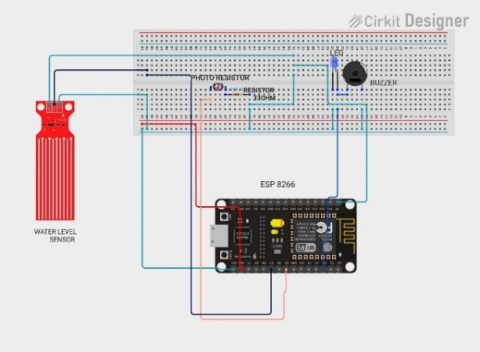
The system's architecture is designed to facilitate seamless communication between components. Figure 2 illustrates the hardware components' interconnections, with each component serving a specific function for data collection, control, and communication.
A detailed circuit diagram is created to guide the assembly process, ensuring that all components are wired correctly. As shown in Figure 2, this diagram serves as a roadmap for the connections between the sensors, actuators, and the microcontroller, enabling smooth data flow and control.
Figure 2. System circuit architecture
Microcontroller (Arduino Uno): Processes sensor data and controls actuators based on the defined logic.
ESP8266 Wi-Fi Module: Transmits data to the Firebase cloud and provides remote access for system control.
Sensors (Photoresistor, Water Level Sensor): Monitors environmental parameters such as light intensity and water levels in the hydroponic system.
Actuators (LEDs): Adjusts the light levels based on the readings from the photoresistor.
Applying the holistic perspective through the eyes of Sharma et al. [13] and optimizing the parameters in smart hydroponics system said by Shareef et al. [14] to improve the platform and crop yield.
Recent advancements in IoT platforms for smart hydroponics, as outlined by Sportelli et al. [15], provide essential building blocks while highlighting open challenges in system integration. Jaiswal et al. [16] proposed a similar smart hydroponics system focusing on sustainable agriculture, although their approach differs in sensor configuration and data management strategies.
3.4 Software design
This phase involves the development of the firmware required to control sensors and actuators, alongside establishing a reliable communication system for real-time monitoring and control via a web application. The essential software development tasks undertaken during this phase are detailed in Table 2, which includes programming the Arduino Uno, integrating with Firebase for cloud data storage, configuring network communication through the ESP8266 module, and building a responsive web interface for user interaction and system oversight. Recent comparative studies by Doubiz et al. [17] have evaluated various IoT connectivity options for hydroponic farming, confirming the reliability of these approaches.
Table 2. Software development tasks
|
Task |
Description |
|
Programming Environment |
Use the Arduino IDE to write and upload code to the Arduino Uno for system control and data collection. |
|
Firmware Development |
Code the Arduino Uno to read sensor data (light intensity, water level), control the actuators (LEDs based on light levels), communicate with the ESP8266 for data transmission to Firebase. |
|
Firebase Integration |
Set up Firebase Realtime Database for storing sensor data for future access, monitoring environmental parameters remotely. |
|
Network Communication |
Configure the ESP8266 to connect to Wi-Fi and transmit data using HTTP or MQTT protocols. |
|
Web UI Development |
Develop a responsive web interface using Flask and HTML to fetch real-time sensor data from firebase, Ensure secure communication and seamless monitoring across devices. |
3.5 Key algorithms for automation and communication protocols
3.5.1 Sensor data acquisition algorithm
•Continuously read data from photoresistor and water level sensor.
•Normalize the sensor data to filter out noise.
•Send the processed data to the microcontroller for decision-making.
3.5.2 Actuator control algorithm
•If light intensity falls below a defined threshold, turn on LEDs.
•If the water level drops below the critical level, trigger an alert and start the refill mechanism.
•Use a PID (Proportional-Integral-Derivative) controller to optimize light and water supply dynamically.
3.5.3 Sensor data acquisition algorithm
•Establish an HTTP or MQTT connection between ESP8266 and Firebase.
•Send sensor data at fixed intervals (e.g., every 10 seconds).
•Retrieve control commands from the Firebase database and adjust actuators accordingly.
3.6 Firebase cloud storage
Firebase Realtime Database is used to store the data sent from sensors, providing a central location for real-time monitoring and long-term storage. This ensures that users can review past data and analyse trends over time.
Data Storage: Real-time updates for water level and light intensity readings.
Data Access: Allows users to query sensor data remotely via the web app.
3.7 System integration
System integration is a critical step in ensuring that all hardware components function together as intended. In this phase, the system is physically assembled, and all components are interconnected according to the schematic diagram. Figure 3 illustrates the flow of data between various components to effectively implement the project objective.
Figure 3. System schematic diagram
The hardware components, including the microcontroller, communication module, sensors, and actuators, are physically connected. Proper wiring and connection are essential to ensure that the system operates efficiently and without error. The system architecture is carefully followed to prevent issues during assembly.
The schematic diagram shows an IoT system where a water level sensor and photoresistor send data to an ESP8266 microcontroller. The ESP8266 transmits the data to Firebase, which updates a web application in real-time, enabling users to monitor and interact with the system remotely.
3.8 System calibration
After assembly, the sensors must be calibrated to ensure accurate readings. This step involves setting baseline values for the photoresistor and water level sensor so that they can provide precise environmental data.
Threshold values are set for triggering automation responses. For instance, the system can be programmed to activate the LEDs when the light intensity falls below a specified level, ensuring that the plants receive adequate lighting.
3.9 System testing
Sensor Testing: Ensures that the photoresistor and water level sensor provide accurate and reliable readings under various conditions.
Actuator Testing: Verifies that the LEDs respond appropriately to changes in sensor data, maintaining optimal lighting conditions for plant growth.
Network Testing: Ensures that data transmission via the ESP8266 Wi-Fi module is reliable, allowing the remote user interface to receive and send data effectively.
3.10 Data management
This phase focuses on developing a user-friendly interface for remote monitoring and control of the system, as well as implementing a robust data management strategy for logging and accessing sensor data. The key features related to data handling and user interaction are summarized in Table 3, which outlines the integration of data logging, web application UI development, and Firebase database configuration to ensure real-time visibility and historical tracking of environmental parameters.
Table 3. Data management features
|
Feature |
Description |
|
Data Logging |
Store sensor data in Firebase for historical tracking and system performance analysis. |
|
Web Application UI |
Develop a web application to display real-time data (e.g., water level, light intensity). |
|
Database Setup |
Configure Firebase to persistently store sensor data, providing both current and historical data. |
This phase involves creating a user-friendly interface for remote monitoring and control of the system, along with establishing a data management strategy for logging and accessing sensor data.
3.11 User interface
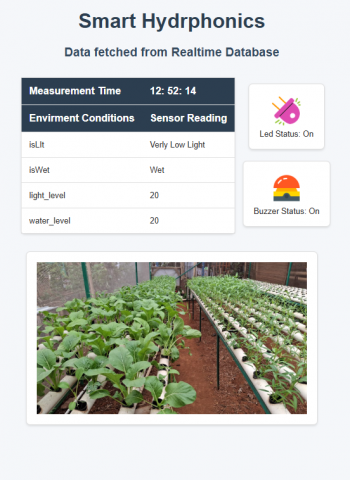
The web UI will offer an intuitive interface for users to monitor real-time environmental conditions, such as light intensity and water levels. Figure 4 presents the actual implementation of the web interface, displaying critical data for a smart hydroponics system.
As shown in Figure 4, the interface provides measurement time, environment conditions with sensor readings for both light and water parameters, and visual indicators for system status. The interface displays binary status indicators (isLit, isWet) alongside numerical measurements for light_level and water_level, both showing values of 20. The LED status indicator shows the light is currently on, while the buzzer is also activated. Below the data dashboard, an image of the actual hydroponics system gives users visual confirmation of the growing environment.
Figure 4. Data display in the web interface
This web interface builds upon the system architecture previously illustrated in Figure 3, where data flows from the sensors through the ESP8266 microcontroller to the Firebase database, and finally to this user-friendly web application for monitoring and control purposes.
4.1 Larger hydroponic setups
•Increase the number of sensors and actuators to cover more plant beds.
•Use multiple microcontrollers (Arduino/ESP8266) communicating via MQTT for distributed data collection.
•Implement edge computing with local microcontrollers processing data before sending it to the cloud to reduce latency.
4.2 Different crop types
•Adapt light intensity and water supply based on the specific needs of crops (e.g., lettuce requires different conditions than tomatoes).
•Develop machine learning models to predict optimal environmental conditions for different plant species.
•Integrate additional sensors (e.g., humidity, CO2) for more precise control.
5.1 Data collection
The foundation of any IoT system lies in the collection of accurate and timely data from connected sensors. In a smart hydroponics system, photoresistors are used to monitor ambient light levels, while water level sensors track the amount of water level available. These sensors continuously provide real-time readings at predefined intervals, ensuring a steady stream of data for system operation. Communication modules like ESP8266 transmit this data wirelessly to cloud platforms, leveraging reliable protocols such as MQTT or HTTP to maintain connectivity and ensure minimal data loss.
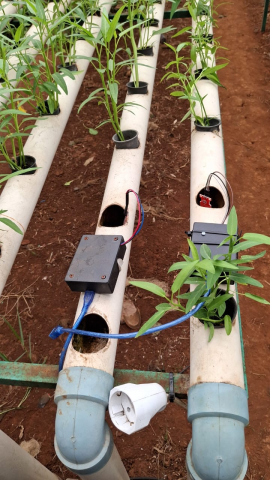
Figure 5 shows the physical implementation of these monitoring modules in the hydroponics system. The image captures the sensor installation directly on the PVC growing pipes, with a black control box mounted on one pipe and water level sensors positioned at strategic points. Blue wiring connects the sensors to the central control module, creating an integrated monitoring network throughout the growing system. This practical deployment enables the system to gather the environmental data that was displayed in the web interface shown in Figure 4, completing the connection between hardware sensors and software visualization, thus the data is shown in Table 4 and Table 5.
Figure 5. Image of module implementation
Table 4. Photo resistor values with LED and buzzer status
|
No |
Photo Resistor Value |
LED (ON/OFF) |
Buzzer (ON/OFF) |
|
1 |
100 |
OFF |
OFF |
|
2 |
75 |
OFF |
OFF |
|
3 |
85 |
OFF |
OFF |
|
4 |
5 |
ON |
ON |
|
5 |
50 |
ON |
ON |
|
6 |
20 |
ON |
ON |
|
7 |
60 |
OFF |
OFF |
|
8 |
95 |
OFF |
OFF |
|
9 |
15 |
ON |
ON |
|
10 |
35 |
ON |
ON |
Table 5. Water level sensor values with LED and buzzer status
|
No |
Photo Resistor Value |
LED (ON/OFF) |
Buzzer (ON/OFF) |
|
1 |
1 |
ON |
ON |
|
2 |
3 |
OFF |
OFF |
|
3 |
1 |
ON |
ON |
|
4 |
4 |
OFF |
OFF |
|
5 |
2 |
ON |
ON |
|
6 |
4 |
OFF |
OFF |
|
7 |
4 |
OFF |
OFF |
|
8 |
2 |
ON |
ON |
|
9 |
1 |
ON |
ON |
|
10 |
3 |
OFF |
OFF |
5.2 Data storage
Once collected, the data is stored in a cloud-based infrastructure such as Firebase Realtime Database. This platform offers scalability and real-time data synchronization, allowing users to access both current and historical data seamlessly. Lightweight data formats like JSON are commonly used to enable efficient storage and retrieval, minimizing latency and storage costs while maintaining accessibility across various devices.
5.3 Data analysis
Real-time analysis is a critical feature of IoT systems, enabling immediate responses to changing conditions. By examining the data collected over days or weeks, users can identify correlations between environmental factors and plant growth performance. This analysis helps optimize parameters such as light intensity and amount of water levels to improve resource efficiency and yield.
The photoresistor continuously tracks ambient light levels, ensuring the plants receive adequate lighting for photosynthesis. When light intensity drops below a predefined threshold, the system automatically activates supplemental LEDs to maintain optimal light conditions.
The water level sensor, on the other hand, not only monitors the quantity of water in the system but also ensures the presence of a sufficient nutrient-enriched solution essential for plant growth. In hydroponics, the water serves as a medium to deliver vital nutrients directly to the plant roots. If the levels of the water fall below the critical threshold, the system triggers alerts or activates a replenishment mechanism to restore water level. This ensures that plants consistently receive the water that contains essential elements, such as nitrogen, phosphorus, potassium, and trace minerals, required for healthy growth and high yields. By automating adjustments based on sensor feedback, the system achieves resource efficiency while fostering robust plant development.
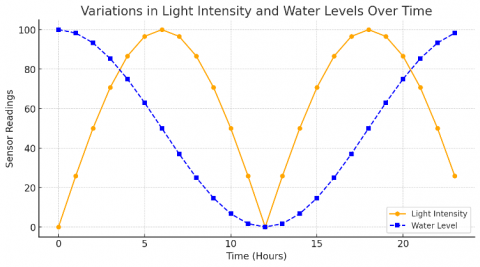
Figure 6 illustrates the relationship between light intensity and water levels over a 24-hour period. The graph reveals an inverse correlation between these two critical parameters, with light intensity (shown in orange) peaking during midday hours while water levels (shown in blue) decrease during the same period. This pattern likely reflects increased evaporation and plant water uptake during periods of higher light exposure. As light intensity decreases in the evening hours, the water level gradually recovers, potentially due to automated refilling or reduced consumption. This visualization enables system operators to understand cyclical patterns and optimize resource management accordingly.
Figure 6. Variations in light intensity and water level
The system primarily consumes energy through the ESP8266 Wi-Fi module and the LEDs used for lighting.
The ESP8266 module consumes approximately 70mA in idle mode and spikes up to 200mA during data transmission. Optimizing the transmission frequency and using deep-sleep mode can reduce power usage.
LEDs are one of the major power-consuming components, with typical LED strips consuming 14W per meter. The system uses light sensors to activate LEDs only when necessary, reducing unnecessary power draw and improving efficiency.
The system can be optimized further by incorporating solar panels or low-power microcontrollers to extend operational hours while reducing dependency on traditional power sources.
The system was evaluated in both controlled indoor environments and semi-outdoor greenhouse settings to assess its adaptability and performance under different real-world conditions. Key environmental variables during the testing period are summarized in Table 6. This table outlines the conditions and parameters that were tracked in testing duration to evaluate the system's efficiency and impact on plant growth.
Table 6. Testing conditions
|
Conditions |
Value |
|
Temperature |
20℃ to 30℃ |
|
Humidity |
50% to 70% |
|
Plant species tested |
Lettuce, Basil, and Spinach |
|
Testing duration |
8 weeks |
|
Monitoring Parameters |
Light intensity, water level, plant growth rate and energy consumption |
7.1 Performance metrics
Data collected during the 8-week testing period were analyzed to calculate key performance metrics, including water usage, LED activation frequency, system uptime, and crop yield. These metrics provide valuable quantitative insights into the system's effectiveness, allowing users to assess the overall efficiency and operational reliability of the system. A comparison of performance metrics between traditional hydroponics and IoT-enabled hydroponics is presented in Table 7, highlighting significant improvements in water consumption reduction, crop yield, and energy efficiency with the IoT-enabled system.
Table 7. Performance metrics comparison
|
Metric |
Traditional Hydroponics |
IoT-enabled Hydroponics |
|
Water consumption reduction |
20% |
40% |
|
Crop yield improvement |
10% |
50% |
|
Energy efficiency |
Low |
High |
7.2 Challenges encountered during testing
Though this system architecture aims to improve water efficiency and food security as addressed by Pandey [18], other challenges were encountered including the operational cost of electronics and maintenance cost of the same.
The system primarily consumes energy through the ESP8266 Wi-Fi module and the LEDs used for lighting. Ogbolumani and Mabaso [19] encountered similar connectivity challenges in their IoT-based hydroponic monitoring and control system designed for sustainable food production. Their findings align with our observations regarding network reliability concerns in practical implementations. Despite promising performance metrics, several challenges were identified that affect system optimization and scalability.
One of the major implications of this project is the requirement of a highly control indoor setup or outdoor location as stated by Samadder et al. [20], as the efficiency is restricted by the growing space or setup location.
7.2.1 Sensor calibration and power consumption
The ESP8266 Wi-Fi module, integral for real-time data transmission, draws approximately 70mA in idle mode and up to 200mA during data bursts. Power optimization through reduced transmission frequency and deep-sleep functionality is recommended to enhance energy efficiency.
7.2.2 Connectivity issues
Wi-Fi dependency occasionally led to network dropouts, interrupting real-time monitoring and data logging. Integrating local data storage or alternative communication protocols such as LoRaWAN could improve system robustness and continuity.
7.2.3 Nutrient distribution control
While water levels were effectively monitored, nutrient concentration was not actively regulated. For improved precision, future system iterations should include pH and EC (electrical conductivity) sensors to manage nutrient delivery dynamically.
8.1 Urban hydroponic farm
A small-scale urban farm adopted the IoT-enabled system and reported a 40% reduction in water usage, perfectly aligning with the tested performance metric. By continuously monitoring water levels and automating irrigation through sensors, the farm optimized water uses without compromising plant health. Additionally, the farm observed a 30% increase in crop yield, largely due to precise control over lighting and environmental conditions, supporting the broader yield improvement trend (up to 50%) identified during system testing.
Performance metric reflected:
•Water Consumption Reduction (40%) → Efficient irrigation
•Crop Yield Improvement (30%) → Stable growth conditions
8.2 Greenhouse automation
In a commercial greenhouse, real-time environmental monitoring and automation of LED lighting schedules led to a 20% reduction in electricity costs. This directly relates to the high energy efficiency demonstrated by the IoT-enabled system compared to traditional setups. The greenhouse also benefitted from reduced manual intervention and improved consistency in environmental conditions, indirectly contributing to better crop performance.
Performance metric reflected:
•Energy Efficiency (High) → Lower electricity consumption
•System Uptime & LED Optimization → Consistent lighting with minimal waste
The development of an IoT-based smart hydroponics system demonstrates the potential of integrating technology into modern agriculture to optimize plant growth and resource utilization. By combining advanced hardware components, real-time data monitoring, and automated control mechanisms, the system ensures precise management of environmental factors such as lighting, water levels, and nutrient supply. The use of sensors like photoresistors and water level monitors, coupled with data logging and web app interfaces, enhances system efficiency and user accessibility. This project not only addresses the growing demand for sustainable agricultural practices but also provides a scalable and reliable solution for improving crop yield and resource management in controlled environments.
[1] Hadinata, A. (2021). Internet of things-based hydroponic: Literature review. Journal of Physics: Conference Series. Journal of Physics: Conference Series, 2111(1): 012014. https://doi.org/10.1088/1742-6596/2111/1/012014
[2] Austria, A.C.H., Fabros, J.S., Sumilang, K.R.G., Bernardino, J., Doctor, A.C. (2023). Development of IoT smart greenhouse system for hydroponic gardens. International Journal of Computing Sciences Research, 7: 2111-2136.
[3] Rithe, A.S. (2021). Implementation of cost-effective smart hydroponics system monitoring & controlling using IoT. Doctoral dissertation, Sant Gadge Baba Amravati University, Amravati.
[4] Sri, K.N., Shankar, M. (2022). Hydroponic system monitoring by means of solar energy. International Journal of Scientific Research & Engineering Trends, 8(2): 783-789.
[5] Veena, Y.S, Deepa, V.P. (2022). Automation of hydroponics greenhouse farming using Arduino and IoT. International Journal of Scientific Research in Science, Engineering and Technology, 9(9): 88-99.
[6] Swamy, P.V., Chaitanya, J., Kumar, K.G., Kavita, C., Shireen, A., Sri, K.H. (2020). Automatic control of hydroponic cultivation using IoT. International Research Journal of Engineering and Technology, 7(7): 1873-1878.
[7] Azil, M.A., Chidhananda, K., Preetha, J., Ramya, B.S., Kiran, K.T., Sasi, S. (2022). Survey on smart hydroponics (sensing, monitoring, and control) prototype based on Arduino and IoT. International Journal for Research in Applied Science & Engineering Technology, 11(6): 1477-1479. https://doi.org/10.22214/ijraset.2023.53879
[8] Al-Gharibi, R.S. (2021). IoT-based hydroponic system. In 2021 International Conference on System, Computation, Automation and Networking (ICSCAN), Puducherry, India, pp. 1-6 https://doi.org/10.1109/ICSCAN53069.2021.9526391
[9] Dutta, M., Gupta, D., Tharewal, S., Goyal, D., Sandhu, J.K., Kaur, M. (2025). Internet of Things-based smart precision farming in soilless agriculture: Opportunities and challenges for global food security. IEEE Access, 13: 34238-34268. https://doi.org/10.1109/ACCESS.2025.3540317
[10] Dutta, S., Mukherjee, B., Sawarkar, A. (2023). Enhanced agricultural productivity using hydroponics technique: A smart farming system. Irrigation Systems and Applications. https://doi.org/10.5772/intechopen.112780
[11] Lakshmanan, R., Djama, M., Perumal, S., Abdulla, R. (2020). Automated smart hydroponics system using Internet of Things. International Journal of Electrical and Computer Engineering, 10(6): 6389-6398. https://doi.org/10.11591/ijece.v10i6.pp6389-6398
[12] Rajaseger, G., Chan, K.L., Yee Tan, K., Ramasamy, S., Khin, M.C., Amaladoss, A., Haribhai, P.K. (2023). Hydroponics: Current trends in sustainable crop production. Bioinformation, 19(9): 925-938. https://doi.org/10.6026/97320630019925
[13] Sharma, T., Ananthakrishnan, S., Gawdiya, S., Rawat, A., Singh, A., Suryawanshi, Y., Chauhan, G., Rana, R.S. (2025). Hydroponics farming: A holistic perspective for crop production. Oilseed Crops. https://doi.org/10.1002/9781394186426.ch13
[14] Shareef, U., Rehman, A.U., Ahmad, R. (2024). A systematic literature review on parameters optimization for smart hydroponic systems. AI, 5(3): 1517-1533. https://doi.org/10.3390/ai5030073
[15] Sportelli, M., Crivello, A., La Rosa, D., Bacco, M., Incrocci, L., Barsocchi, P. (2024). An IoT platform for smart hydroponics: Building blocks and open challenges. In 2024 IEEE International Workshop on Metrology for Agriculture and Forestry (MetroAgriFor), Padua, Italy, pp. 112-117. https://doi.org/10.1109/MetroAgriFor63043.2024.10948780
[16] Jaiswal, S., Rawat, G., Khadse, C., Sharma, S. (2024). A smart hydroponics system for sustainable agriculture. Data Science for Agricultural Innovation and Productivity, 1(25): 25-47. https://doi.org/10.2174/9789815196177124010006
[17] Doubiz, M., Banane, M., Zakrani, A., Erraissi, A. (2024). IoT connectivity for enhancing hydroponic farming: A comparative study. In 2024 International Conference on Circuit, Systems and Communication (ICCSC), Morocco, pp. 1-5. https://doi.org/10.1109/ICCSC62074.2024.10616826
[18] Pandey, S. (2024). Role of hydroponics in improving water-use efficiency and food security. International Journal of Environment and Climate Change, 14(2): 608-633. https://www.researchgate.net/profile/Shivam-Pandey-73/publication/378968324_Role_Of_Hydroponics_in_Improving_Water-Use_Efficiency_and_Food_Security/links/65f3e0631f0aec67e28ffa54/Role-Of-Hydroponics-in-Improving-Water-Use-Efficiency-and-Food-Security.pdf.
[19] Ogbolumani, O., Mabaso, B. (2023). An IoT-based hydroponic monitoring and control system for sustainable food production. Journal of Digital Food, Energy & Water Systems, 4(2). https://doi.org/10.36615/digital_food_energy_water_systems.v4i2.2873
[20] Samadder, J., Roy, S., Mapa, S., Gharami, S., Das, J.C., Ghosh, A. (2024). IoT-driven automated hydroponic system for climate-independent indoor crop cultivation. In 2024 IEEE International Conference of Electron Devices Society Kolkata Chapter (EDKCON), Kolkata, India, pp. 1-6. https://doi.org/10.1109/EDKCON62339.2024.10870630